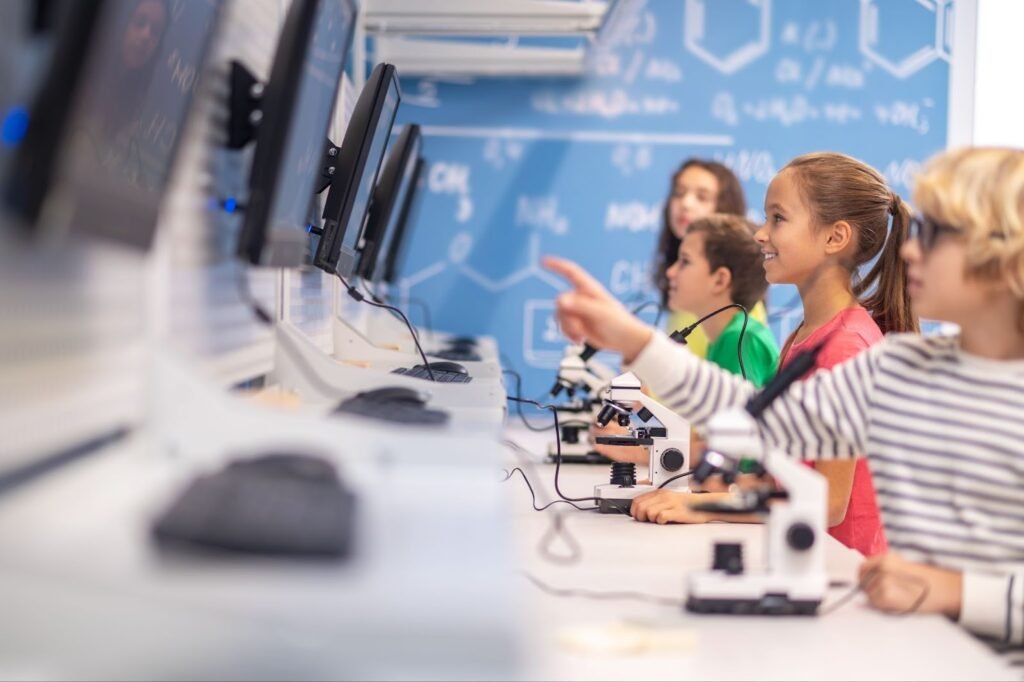
Educational technology offers a multitude of benefits that enhance the classroom experience. It greatly boosts student engagement through interactive lessons and gamified learning, catering to diverse learning styles. Personalized learning experiences allow for individual pacing and tailored resources, promoting academic success. Collaboration is enhanced through digital platforms, fostering teamwork and communicative skills. Additionally, students gain access to diverse resources, real-time feedback, and improved classroom management. Technology also supports diverse learners and encourages critical thinking. Ultimately, it prepares students for future career challenges by bridging theoretical knowledge with practical application. Further insights await those seeking a deeper understanding.
KEY TAKEAWAYS
- Educational technology enhances student engagement through interactive learning experiences, promoting motivation and academic success.
- Personalized learning experiences allow for individualized pacing and tailored resources that meet diverse student needs.
- Collaborative tools facilitate teamwork and communication, enhancing students’ collaboration skills and peer feedback opportunities.
- Real-time feedback mechanisms enable continuous improvement and adaptive learning, fostering accountability and student confidence.
- Access to diverse resources and real-world applications prepares students for future careers by bridging theoretical knowledge with practical experience.
ENHANCED STUDENT ENGAGEMENT
Enhanced student engagement is an essential factor in fostering a productive learning environment, as it directly influences motivation, retention, and academic success. By integrating educational technology, educators can implement innovative methods such as gamified learning, which transforms traditional lessons into interactive experiences. This approach encourages active participation, allowing students to immerse themselves in the subject matter while fostering a sense of competition and achievement. By integrating innovative digital tools and adaptive assessments, the engineering teacher can create more engaging, project-based learning experiences that connect classroom concepts to real-world technical applications.
Multimedia presentations and interactive simulations enhance the learning experience, catering to diverse learning styles and enabling students to visualize complex concepts. The incorporation of virtual reality can further elevate engagement, offering immersive experiences that transport learners to new environments, enriching their understanding.
Adaptive assessments allow educators to tailor evaluations to individual student needs, ensuring that each learner is appropriately challenged and supported. Mobile learning extends the reach of education, enabling students to engage with content anytime and anywhere, while blended instruction combines online and face-to-face interactions, promoting flexibility and collaboration.
Online discussions facilitate peer teaching, creating opportunities for students to learn from one another and develop critical thinking skills. The flipped classroom model empowers learners to take ownership of their education by engaging with content outside of class, thereby maximizing in-class time for collaborative activities.
These strategies not only enhance student engagement but also foster a community of learners who are motivated and equipped to succeed. By embracing educational technology, educators can create dynamic and inclusive learning environments that serve the needs of all students, ultimately leading to greater academic outcomes.
Personalized Learning Experiences
Personalized learning experiences are increasingly recognized as a pivotal element in modern education, frequently leading to improved student outcomes. By leveraging educational technology, educators can create adaptive assessments that cater to the unique needs of each student, allowing for individualized pacing and promoting learner autonomy. This tailored approach guarantees that every learner receives the support necessary to thrive academically.
The integration of data-driven insights is fundamental to the development of personalized pathways. Educators can utilize learning analytics to identify strengths and weaknesses, enabling them to implement differentiated instruction that aligns with each student’s learning style.
Furthermore, the incorporation of tailored resources—such as interactive digital content and adaptive learning platforms—further enhances the dynamic curriculum, making it more relevant and engaging.
Feedback from students is invaluable in refining these personalized experiences. By actively soliciting student feedback, educators can adjust instructional strategies and resources to better meet the evolving needs of their classrooms. This responsiveness nurtures a culture of continuous improvement, empowering students to take ownership of their learning journeys.
Ultimately, personalized learning experiences not only foster academic success but also cultivate essential skills such as critical thinking and self-directed learning. As educators embrace the possibilities afforded by educational technology, they are better equipped to create supportive environments where every student can flourish, paving the way for a more equitable and effective educational landscape.
Improved Collaboration Skills
The integration of educational technology in the classroom has greatly transformed the way students develop collaboration skills, which are vital for success in both academic and professional environments.
With the advent of digital platforms, students can engage in group projects that foster teamwork strategies, enabling them to work together more efficiently and effectively. These platforms provide a space for online discussions, allowing students to share ideas, express differing viewpoints, and collectively negotiate solutions to complex problems.
Communication tools such as instant messaging and video conferencing facilitate real-time interactions, enhancing the immediacy and fluidity of peer feedback. This not only cultivates social skills but also encourages a culture of open dialogue and mutual respect.
By incorporating task management features, these collaborative platforms help students organize their efforts, set deadlines, and monitor progress, thereby promoting accountability and shared responsibility.
Moreover, technology-driven joint problem-solving exercises challenge students to think critically and creatively as they navigate diverse perspectives within their groups. By collaborating in a virtual environment, learners gain valuable insights into conflict resolution and the importance of compromise, which are essential for their future endeavors.
The skills developed through these innovative educational practices not only prepare students for academic excellence but also equip them with the collaboration skills necessary to thrive in a globalized workforce.
As educators embrace these technologies, they foster a generation of learners who are not only knowledgeable but also capable of building harmonious and productive relationships in their personal and professional lives.
Access to Diverse Resources
Access to diverse resources has become increasingly attainable through the integration of educational technology in the classroom. This evolution enables educators and students to transcend geographical and cultural boundaries, fostering a richer learning experience. Virtual libraries provide a vast repository of knowledge, allowing learners to access a plethora of texts, journals, and multimedia resources that were previously confined to physical spaces.
Furthermore, the incorporation of global perspectives through online courses and educational apps empowers students to engage with content from various cultural contexts. This exposure not only enhances critical thinking but also nurtures empathy and understanding among learners.
Interactive simulations and gamified learning platforms present complex concepts in engaging formats, and structured instructional materials from the engineering teacher shop can further support hands-on activities and design challenges in the classroom. Digital storytelling serves as another innovative tool in this landscape, enabling students to express their understanding creatively while integrating various multimedia elements.
This approach facilitates resource accessibility, ensuring that learners can curate content that aligns with their individual interests and learning styles. Moreover, educators can harness the power of content curation to filter and present the most relevant resources, guiding students toward meaningful interactions with knowledge.
Real-Time Feedback Mechanisms
In today’s educational landscape, effective real-time feedback mechanisms have emerged as essential tools for enhancing student learning and engagement. These mechanisms, which include instant assessments and formative evaluations, facilitate immediate responses to student performance, creating dynamic feedback loops that foster continuous improvement.
By utilizing data analytics and learning analytics, educators can closely monitor student progress, enabling informed instructional adjustments that cater to individual learning needs. The integration of performance tracking tools allows for adaptive learning experiences tailored to the diverse capabilities and paces of students.
As learners engage with content, they can provide student reflections through digital platforms, offering their insights and promoting a deeper understanding of their learning processes. The ability to capture these reflections in real-time empowers both educators and students, fostering a collaborative environment where feedback is constructive and growth-oriented.
Moreover, real-time feedback mechanisms support innovative teaching strategies that prioritize student-centric learning. Educators can swiftly identify areas where students struggle and make necessary instructional adjustments to address these challenges, thereby enhancing overall educational outcomes.
This proactive approach not only boosts student confidence but also encourages a culture of accountability and engagement. Ultimately, the implementation of real-time feedback mechanisms in the classroom cultivates an environment of continuous improvement and effective learning.
Increased Digital Literacy
Amid the rapid evolution of educational technology, increased digital literacy has become a fundamental competency for both students and educators. As the digital landscape continues to expand, the ability to navigate, evaluate, and create information using technology is essential. This skill not only empowers learners but also supports educators in implementing effective technology integration strategies to facilitate meaningful learning experiences.
The emphasis on digital literacy encompasses various dimensions, including:
- Understanding online safety and privacy
- Developing critical thinking skills for evaluating information sources
- Engaging in responsible digital citizenship education
- Utilizing collaborative tools for enhanced communication
- Adapting to new technologies and platforms effectively
Educators play a pivotal role in fostering digital literacy through thorough instruction and innovative practices. By integrating technology thoughtfully into curricula, teachers can cultivate an environment where students actively engage with digital tools and resources.
This approach not only enhances students’ technological proficiency but also instills essential soft skills such as problem-solving and adaptability. Modern platforms adjust to students’ needs, creating more personalized, effective instruction.
Furthermore, digital literacy extends beyond mere technical skills; it encompasses ethical considerations and social responsibilities. In an age where misinformation is rampant, promoting digital citizenship education becomes vital.
It enables students to navigate online interactions with integrity and respect, preparing them to contribute positively to society.
Better Classroom Management
While effective classroom management has always been a cornerstone of successful teaching, the integration of educational technology has introduced innovative strategies that can greatly amplify this essential practice. By leveraging technology, educators can improve classroom organization, streamline resource management, and foster positive classroom dynamics. By thoughtfully integrating educational technology into daily instruction, educators can streamline classroom management, personalize feedback, and enhance collaboration among students.
One notable advantage of technology integration is the ability to implement behavior tracking systems. These systems allow teachers to monitor student behavior in real-time, providing immediate feedback and facilitating discussions around expectations and accountability. This data-driven approach not only encourages student autonomy but also empowers teachers to identify patterns and adjust their communication strategies accordingly.
Furthermore, technology offers various engagement techniques that can help establish routines in the classroom. Tools like digital calendars and task management applications enable students to take ownership of their learning, promoting responsibility and independence. This shift towards student-centered learning encourages a more collaborative classroom environment, where peer-to-peer interactions are enhanced.
Additionally, effective feedback systems facilitated by technology can considerably improve communication between educators and students. By utilizing platforms that allow for instant feedback, teachers can address issues as they arise, fostering a proactive rather than reactive management style.
Ultimately, the thoughtful application of educational technology not only enriches classroom management but also cultivates an atmosphere of respect and support. This, in turn, enhances the overall learning experience and guarantees that students are engaged and empowered to reach their full potential.
Support for Diverse Learners
Support for diverse learners is increasingly facilitated by educational technology, which offers personalized learning experiences tailored to individual needs. The vast array of educational technology that is available today offers students a wide range of options from which they can choose the best ones for their learning needs.
By ensuring accessibility for all students, technology can bridge gaps in understanding and engagement, fostering an inclusive environment.
Interactive tools not only enhance participation but also cater to various learning styles, promoting a more effective educational experience for everyone.

PERSONALIZED LEARNING EXPERIENCES
In the age of digital transformation, personalized learning experiences have emerged as a pivotal strategy for supporting diverse learners in the classroom. By leveraging educational technology, educators can facilitate individualized pacing and adaptive assessments that cater to the unique needs of each student. This approach fosters student autonomy, empowering learners to take charge of their educational journeys.
Key components of personalized learning include:
- Differentiated Instruction: Tailoring teaching methods to accommodate varied learning styles.
- Learning Analytics: Utilizing data to inform instructional strategies and support targeted interventions.
- Goal Setting: Encouraging students to set and monitor personal academic objectives.
- Competency-Based Learning: Allowing students to progress upon mastering concepts, rather than adhering to a fixed schedule.
- Formative Evaluations: Providing ongoing assessments to gauge student understanding and adjust learning pathways accordingly.
Through curriculum alignment that emphasizes these elements, educators can design learning environments that are not only inclusive but also conducive to the diverse capabilities of all students.
This innovative approach not only enhances academic engagement but also promotes a sense of belonging and success among learners, ultimately contributing to their holistic development.
Accessibility for All Students
Accessibility in education is essential for guaranteeing that all students, regardless of their backgrounds or abilities, have equitable opportunities to succeed. By employing universal design principles and assistive technology, educators can reduce barriers and promote inclusive practices that foster learning equity. Technology integration supports differentiated instruction and flexible learning environments, accommodating diverse learning needs.
The following table illustrates key aspects of accessibility in education:
| Aspect | Description | Benefits |
| Universal Design | Design of products and environments for all users | Promotes inclusive learning |
| Assistive Technology | Tools that aid learning for students with disabilities | Enhances engagement and participation |
| Socio Emotional Support | Strategies to support students’ emotional well-being | Fosters a positive learning environment |
| Barrier Reduction | Minimizing obstacles to learning | Increases access to educational resources |
| Flexible Learning | Adaptive teaching methods tailored to individual needs | Encourages self-paced learning |
Incorporating these elements guarantees that all students experience equitable access to education. As we aim for learning equity, it is our collective responsibility to create environments where diverse learners can thrive.
Engagement Through Interactive Tools
Engagement through interactive tools represents a transformative approach to learning that caters to the diverse needs of students. By leveraging technology, educators can implement various strategies that not only enhance participation but also support different learning styles.
Utilizing tools such as gamification strategies and interactive simulations, teachers can create immersive experiences that resonate with students, making learning both enjoyable and effective.
Key interactive tools include:
- Virtual field trips that expand geographical and cultural horizons.
- Student-led presentations that empower learners to take ownership of their education.
- Multimedia storytelling that fosters creativity and critical thinking.
- Responsive assessments and adaptive learning technologies that provide personalized feedback.
- Engaging quizzes and classroom voting that facilitate peer-to-peer feedback and active participation.
These innovative methods promote a collaborative learning environment where diverse learners can thrive.
Encouragement of Critical Thinking
Educational technology markedly enhances critical thinking by fostering problem-solving skills through interactive tools and resources. By teaching students skills like PowerPoint, you can help set your students up for success. Introducing instructional technology in the classroom at a young age can help prepare students for future digital demands.
In addition, it promotes collaborative learning opportunities that allow students to engage with diverse perspectives, enriching their analytical capabilities.
Enhanced Problem-Solving Skills
Numerous studies indicate that integrating technology into classroom settings greatly enhances students’ problem-solving skills by fostering critical thinking.
The implementation of educational technology not only provides access to a wealth of information but also encourages students to develop effective problem-solving strategies. This integration allows learners to engage with complex scenarios, analyze data, and construct logical solutions.
Key benefits of enhanced problem-solving skills through technology integration include:
- Access to Diverse Resources: Students can explore various perspectives and methodologies.
- Interactive Learning Tools: Simulations and games encourage experimentation and creative solutions.
- Real-World Applications: Technology enables students to tackle real-life problems, enhancing relevance and engagement.
- Immediate Feedback: Digital platforms can provide instant assessments, facilitating quick adjustments in strategies.
- Encouragement of Self-Directed Learning: Students learn to independently navigate challenges, increasing their confidence.
Collaborative Learning Opportunities
How can collaborative learning opportunities transform the classroom experience? By integrating technology, educators can facilitate peer-to-peer learning that encourages critical thinking and enhances student engagement.
Collaborative learning, supported by educational technology, allows students to work together on projects, share diverse perspectives, and collectively solve problems. This not only fosters a sense of community but also nurtures essential skills such as communication and teamwork.
The integration of technology in collaborative settings can take various forms, including online discussion forums, collaborative documents, and interactive presentations. Such tools enable students to contribute in real-time, making their learning experience more dynamic and inclusive.
In turn, this empowers learners to critically evaluate each other’s ideas, leading to deeper understanding and retention of knowledge.
Moreover, collaborative learning environments stimulate curiosity and innovation. As learners engage with their peers, they are encouraged to ask questions and explore concepts in greater depth.
This active participation cultivates critical thinking skills, essential for maneuvering through the complexities of today’s world. Ultimately, by embracing collaborative learning through technology integration, educators can create transformative classroom experiences that prepare students for future challenges and foster a lifelong love of learning.
Real-World Application Scenarios
Through the integration of real-world application scenarios in the classroom, educators can greatly enhance critical thinking skills among students.
By employing innovative educational technologies, such as virtual simulations and gamified learning, teachers can create immersive experiences that prompt students to analyze, evaluate, and synthesize information effectively. These approaches not only engage learners but also prepare them for challenges they may face in their professional lives.
Consider the following strategies to promote critical thinking through real-world applications:
- Virtual Simulations: Allow students to navigate complex scenarios and make decisions in a controlled environment.
- Mobile Applications: Facilitate learning on-the-go, enabling students to access resources and collaborate anytime, anywhere.
- Data Analytics: Encourage students to interpret data, drawing meaningful conclusions that inform their decisions.
- Blended Learning: Combine traditional and digital methods, fostering diverse problem-solving approaches.
- Interactive Platforms: Promote collaboration through cloud collaboration tools, enhancing teamwork and communication skills.
Preparation for Future Careers
The integration of educational technology in the classroom is a pivotal factor in preparing students for future careers. By leveraging innovative tools and resources, educators can effectively bridge the gap between theoretical knowledge and practical application. This alignment is essential in equipping students with the skills that are highly sought after in today’s dynamic job market.
Educational technology enables institutions to forge meaningful industry partnerships, creating pathways for students to engage with real-world scenarios. These partnerships not only enhance learning experiences but also facilitate mentorship opportunities, where industry professionals can share insights and expectations directly with students. Such interactions are invaluable in ensuring that students understand the competencies required in various fields.
Furthermore, technology facilitates skills alignment, enabling educators to tailor curricula to meet the evolving demands of the workforce. By integrating project-based learning and collaborative platforms, students develop critical thinking, problem-solving, and teamwork skills—attributes that employers prioritize.
Additionally, the use of simulation software and other digital tools prepares students for specific roles, making them more competitive candidates upon graduation.

RELATED STUDIES ABOUT BENEFITS OF EDUCATIONAL TECHNOLOGY
To conclude, the integration of educational technology in the classroom serves as a catalyst for transformative learning experiences. By fostering enhanced engagement, personalized pathways, and collaborative endeavors, technology becomes the compass guiding learners through the vast ocean of knowledge. The ability to access diverse resources and receive real-time feedback further enriches this journey, while supporting diverse learners and encouraging critical thinking prepares students for the challenges of the future. Consequently, educational technology emerges as an essential ally in cultivating a generation poised for success.
Successful Intelligence: A Model for Testing Intelligence Beyond IQ Tests
- Objective and Background
For over a century, standardized tests (like IQ tests, the SAT, and ACT) have remained largely unchanged, primarily measuring analytical and memory-based skills—what is often called “general ability” or “g”. While useful, these tests provide an incomplete picture of a person’s potential for success in school and in life. This paper presents the augmented theory of successful intelligence (WICS) , a broader framework for understanding and assessing human abilities. WICS is an acronym for Wisdom, Intelligence, and Creativity, Synthesized.
The theory posits that success requires a balance of four key skills:
- Creative Skills: Generating novel and valuable ideas.
- Analytical Skills: Evaluating whether those ideas are good ones.
- Practical Skills: Implementing ideas and convincing others of their value.
- Wisdom-Based Skills: Ensuring that one’s knowledge and skills are used to achieve a common good, balancing intrapersonal, interpersonal, and extrapersonal interests over the long term.
The paper summarizes three major projects—Rainbow, Kaleidoscope, and Panorama—that applied this theory to university admissions to test whether a broader assessment could improve predictions of student success and increase diversity.
- Methodology and Key Findings
Each project built upon the last, moving from a controlled experiment to a real-world application.
- The Rainbow Project (Multi-site Study):
- Method: 1,013 students from 15 U.S. institutions completed supplemental assessments measuring analytical, creative, and practical skills using a mix of multiple-choice and open-ended formats (e.g., writing stories, solving everyday problems, watching video scenarios).
- Key Finding 1 (Increased Predictive Power): The Rainbow assessments doubled the prediction of first-year college GPA compared to using the SAT alone. High school GPA was also a strong predictor.
- Key Finding 2 (Reduced Group Differences): The assessments significantly reduced score differences between ethnic groups (African American, Latino, and White students) compared to traditional tests. The format of the test (e.g., open-ended vs. multiple-choice) proved critical for measuring different skills.
- The Kaleidoscope Project (Tufts University Implementation):
- Method: This was a real-world implementation where over 15,000 applicants annually to Tufts University were given optional, essay-based questions designed to assess creative, practical, and wisdom-based thinking as part of their application.
- Key Finding 1 (Improved Prediction): Students who received top ratings (“A”) for their creative, practical, or wisdom-based essays had double the acceptance rate of those who did not. The assessments correlated with extracurricular leadership, not just SAT scores, confirming they measured distinct skills.
- Key Finding 2 (Enhanced Diversity & Quality): Contrary to fears, the academic quality of the applicant pool and admitted students increased. Furthermore, applications and admissions from underrepresented minority groups (African American and Latino students) also increased significantly (e.g., African American admissions rose by 30% in the first year).
- The Panorama Project (Oklahoma State University):
- Method: Similar principles were applied to admissions at a large, diverse state university.
- Key Finding: The project was deemed a success by the admissions office for admitting a diverse and qualified group of students who would not have been admitted under traditional metrics alone.
- Conclusions and Implications
The paper concludes that the traditional, century-old model of testing is “quaint, antique, [and] passé.” It is not that these tests are “bad,” but that they are fundamentally incomplete. The WICS model offers a scientifically and quantitatively sound way to assess a fuller range of human capabilities.
- Implications for Admissions:
- Fairer and More Accurate Selection: Colleges can improve their ability to identify talented students from all backgrounds by looking beyond narrow test scores. This approach shows that it is possible to increase both academic quality and diversity simultaneously.
- Better Applicant Experience: Students appreciate the opportunity to show “who they are” beyond a test score.
- Implications for Society:
- The widespread reliance on a narrow set of skills stifles potential and limits opportunities for countless individuals whose strengths lie in creativity, practicality, or wisdom.
- The forces maintaining the status quo (cost, perceived precision, entrenchment) are powerful but must be challenged to create a more equitable and effective system for identifying and nurturing talent.
- Generalizability: The principles have been successfully applied in other contexts, including business school admissions, Advanced Placement (AP) exams, secondary school admissions, and elementary school gifted identification, suggesting the framework is robust and adaptable.
| REFERENCE: Robert J. Sternberg, Successful intelligence: A model for testing intelligence beyond IQ tests, European Journal of Education and Psychology, Volume 8, Issue 2, 2015, Pages 76-84, ISSN 1888-8992, https://doi.org/10.1016/j.ejeps.2015.09.004. (https://www.sciencedirect.com/science/article/pii/S1888899215000070) |
Prerequisites for Teachers’ Technology Use in Formative Assessment Practices: A Systematic Review
- Objective and Background
This study addresses a central paradox in modern education: while researchers highlight the interactive potential of digital tools to enhance learning and the proven benefits of formative assessment, teachers often struggle to implement these practices effectively. Instead of using technology to innovate and support student-active learning, teachers frequently adapt digital tools to fit their existing, traditional practices.
This systematic review aimed to investigate how teachers use technology to support formative assessment in primary and secondary education. It sought to identify the challenges teachers face and to synthesize the prerequisites necessary for successful implementation.
- Methodology
The review followed rigorous systematic review guidelines (PRISMA) to ensure transparency and replicability.
- Search Strategy: Systematic searches were conducted in six electronic databases (ERIC, Education Database, ASSIA, IBSS, PsychInfo, Scopus) covering the period from 2012 to 2021. A hand search in 14 relevant journals was also conducted to capture the most recent publications.
- Inclusion Criteria: Studies were included if they addressed teachers’ technology use in formative assessment practices, were conducted in primary or secondary education, were published in peer-reviewed journals after 2012, and were written in English.
- Screening and Selection: The initial search yielded 2,321 hits. After title, abstract, and full-text screening, 75 articles were assessed for quality and relevance. This process resulted in a final sample of 22 included articles.
- Analysis and Synthesis: Data were extracted and coded using NVivo software, focusing on three categories: definitions of formative assessment, digital tools used, and descriptions of teachers’ technology use. A configurative synthesis was then performed to identify patterns and themes across the heterogeneous studies. This process involved translating the studies into each other to build a coherent picture.
- Key Findings
The analysis revealed significant challenges and gaps in the research, leading to the identification of three core prerequisites for success.
- Challenge 1: Vague and Inconsistent Definitions of Formative Assessment. The review found that most studies lacked a clear definition of formative assessment, with terms like “formative assessment,” “assessment for learning,” and “feedback” used interchangeably. This conceptual confusion makes it difficult to compare findings and hinders cumulative knowledge-building. Only eight of the 22 studies provided a clear definition and operationalized formative assessment as a process.
- Challenge 2: Misalignment Between Technology and Pedagogy. There was a persistent gap between the intended interactive use of technology and its actual implementation. Studies showed that teachers often adapt technology to their existing, teacher-centered practices rather than using it to innovate or support student-active, formative processes. The digital tools themselves were frequently more focused on features and data generation than on supporting pedagogical goals.
- Challenge 3: Teachers’ Need for Data Literacy. Many digital tools generate vast amounts of student data. However, teachers often lack the necessary data literacy skills to interpret this information and translate it into effective instructional actions. They struggled to make sense of the data provided by the tools and to connect it to their classroom practice.
- Identified Prerequisites for Success: The synthesis of the findings, particularly from eight “core” studies that clearly defined concepts and documented teacher use, resulted in a three-part framework of prerequisites (Fig. 3):
- Clear Conceptualization: A well-defined and operationalized understanding of formative assessment is essential for both research and practice.
- Pedagogical Alignment: Digital tools must be designed and used in a way that is aligned with sound pedagogical practice. Involving teachers and students as co-designers in tool development is crucial for achieving this alignment.
- Teacher Data Literacy: Teachers need professional learning and support to develop the skills to interpret assessment data and use it formatively to improve student learning.
- Conclusions and Implications
The review concludes that the successful integration of technology into formative assessment is not primarily a technical challenge, but a pedagogical and conceptual one.
- Theoretical Contribution: The study underscores the need for greater conceptual clarity in assessment research to move the field forward. It advocates for a return to the foundational understanding that all assessment begins with a summative judgment, and formative assessment is the subsequent process of using that information for learning (Taras, 2005, 2009).
- Practical Implications for Educators and Policymakers:
- Professional Development: Teacher training must go beyond technical skills and focus on developing data literacy and a deep understanding of formative assessment as a pedagogical process.
- Tool Design: Developers of educational technology should prioritize co-design with teachers and students to ensure tools are usable and meaningfully integrated into classroom workflows.
- Systemic Support: Schools and districts must provide the time, support, and professional learning opportunities that enable teachers to move from adapting technology to their old practices to innovating new, student-active, and formative ones.
| REFERENCE: Kristin Børte, Sølvi Lillejord, Jessica Chan, Barbara Wasson, Samuel Greiff, Prerequisites for teachers’ technology use in formative assessment practices: A systematic review, Educational Research Review, Volume 41, 2023, 100568, ISSN 1747-938X, https://doi.org/10.1016/j.edurev.2023.100568. (https://www.sciencedirect.com/science/article/pii/S1747938X23000611) |
Exploring Integration Aspects of School Leadership in the Context of Digitalization and Artificial Intelligence
- Objective and Background
The COVID-19 pandemic dramatically accelerated the use of digital tools in education, forcing school leaders to navigate an emergency transition to technology-mediated operations. As the world moves beyond the pandemic, new cutting-edge technologies like Artificial Intelligence (AI), particularly generative AI tools such as ChatGPT, are emerging. However, there is a significant gap in research on how school leaders integrate these technologies—both digital tools and AI—into their leadership practices.
This study addresses this gap by focusing on the experiences of school leaders in Cyprus. It has two primary objectives:
- To explore the benefits and challenges of integrating digital tools into school leadership practices.
- To examine, to some extent, the benefits and challenges of adopting AI tools (like ChatGPT) in school leadership.
- Methodology
The study employed a qualitative research approach to gain in-depth insights into school leaders’ perspectives.
- Participants: The sample consisted of 43 school leaders (principals) from both primary (n=24) and secondary (n=19) schools across all five districts of Cyprus. Participants volunteered after an email invitation was sent to all school organizations in the country.
- Data Collection: Data was collected through semi-structured interviews conducted between January and April 2024. The interviews explored leaders’ experiences with digital tools and their perceptions of AI.
- Data Analysis: The interview transcripts were analyzed using a three-step content analysis approach (open coding, category creation, and overall description) to identify key themes related to the benefits and challenges of technology integration.
- Key Findings
The findings reveal a clear picture of the current state of technology integration in school leadership, highlighting progress, persistent challenges, and cautious optimism for the future.
- Benefits of Digital Tools: School leaders reported that digital tools have significantly improved communication and administrative efficiency. Commonly used tools included Viber for instant staff communication, school websites for external communication, and platforms like Google Drive, Dropbox, and MS Teams for document sharing and collaboration.
- Challenges of Digital Tools:
- Poor Infrastructure: Leaders cited inadequate equipment, outdated computers, slow internet, and the costs associated with software licensing as major barriers.
- Lack of Targeted Training: A critical finding was that school leaders received no specific training on using digital tools for leadership and administration. While teachers received training, leaders were left to learn on their own, hindering their effectiveness.
- Perceptions of AI (e.g., ChatGPT):
- Optimism and Perceived Benefits: School leaders were largely optimistic about AI’s potential. They saw it as a valuable tool to automate administrative tasks, speed up work, and provide more time for strategic leadership. Some also saw its potential for supporting student learning.
- Significant Barriers to AI Adoption:
- Limited Knowledge: Most leaders admitted they had no idea how to effectively use AI tools in their leadership practice.
- Need for Comprehensive Training: Leaders emphasized that they need more than just a guide; they require systematic, ongoing professional development from qualified experts, not just generic training.
- Time Constraints: The heavy administrative workload within Cyprus’s centralized system leaves leaders with no time to learn and implement new technologies.
- Uncertainty and Need for Support: Leaders expressed a need for continuous support and a clear framework to use AI ethically and effectively, addressing concerns about data privacy and the unknown long-term impacts.
- Conclusions and Implications
The study concludes that while school leaders in Cyprus recognize the value of digitalization and AI, their ability to integrate these technologies is severely hampered by systemic issues. There is a clear disconnect between the rapid evolution of technology and the support provided to those expected to lead with it.
- Implications for School Leaders: Leaders must prioritize building their own digital and AI literacy and advocate for the necessary infrastructure and training.
- Implications for Educational Policy and Stakeholders:
- Invest in Infrastructure: Ministries must allocate funding for reliable hardware, software, and high-speed internet in all schools.
- Develop Targeted Training: Policymakers must create and fund structured, ongoing professional development programs specifically designed for school leaders’ needs, covering both digital leadership and the ethical use of AI.
- Reduce Administrative Burden: To free up time for leaders to engage with technology, the excessive administrative workload within centralized systems needs to be addressed.
- Create a Framework for AI: A clear national framework is needed to guide the safe, ethical, and effective use of AI tools in school leadership and administration, addressing data privacy and security.
- Future Research: The study calls for more research on the long-term impact of digitalization and AI on school leadership effectiveness and student outcomes, as well as comparative studies across different educational contexts.
| REFERENCE: Antonios Kafa, Exploring integration aspects of school leadership in the context of digitalization and artificial intelligence, International Journal of Educational Management, Volume 39, Issue 8, 2025, Pages 98-115, ISSN 0951-354X, https://doi.org/10.1108/IJEM-11-2024-0703. (https://www.sciencedirect.com/science/article/pii/S0951354X25000018) |
