
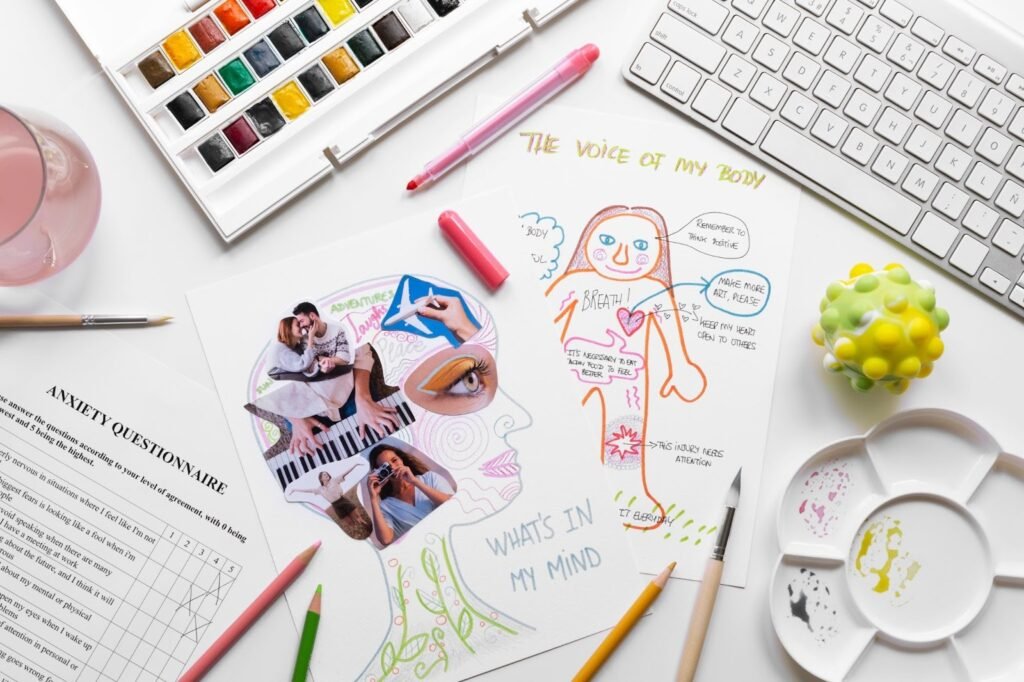
As someone who spent years grinding through an engineering degree, I’ve had my fair share of staring blankly at walls of black-and-white text until the words started to blur together. I used to think that “studying” just meant reading the chapter enough times that the information would eventually stick through sheer willpower. But for those of us who lean toward visual learning, that approach is a fast track to burnout and mediocre grades.
I remember sitting in a fluid mechanics lecture, watching the professor scrawl endless equations, and realizing that I wasn’t actually “seeing” the logic behind the math. It wasn’t until I started treating my notebook like a canvas rather than a transcript that things finally clicked. Visual learning isn’t just a preference; it’s a mechanical necessity for how some of our brains process spatial relationships and complex systems.
When you can see the “map” of a concept, the details become much easier to hang on that framework. In this guide, I want to share the exact strategies that saved my academic career, moving away from passive reading and toward active, visual engagement. Whether you’re navigating the heavy coursework of a technical degree or just trying to manage a demanding workload, these systems are designed to do the heavy lifting for you so you can stop stressing and start performing.
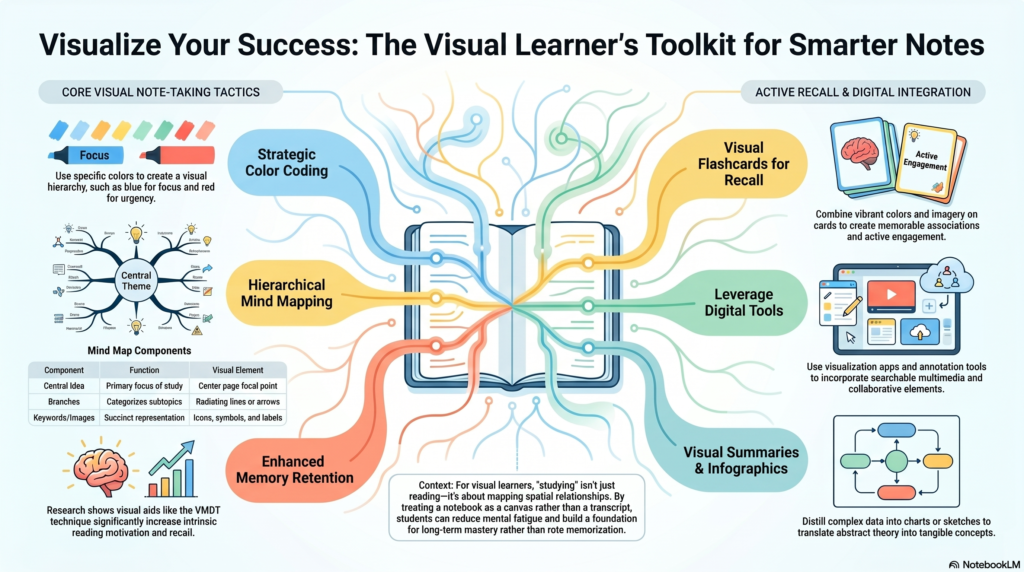
Visual learners can enhance their study effectiveness by adapting their note-taking strategies. Utilize color coding to create a visual hierarchy and improve organization. Incorporate diagrams, charts, and infographics to clarify complex ideas, making information more digestible. Mind mapping helps structure thoughts visually, promoting better retention of concepts. Flashcards with images and vibrant colors can create memorable associations. Additionally, digital tools streamline the process, allowing for interactive and multimedia learning experiences. By implementing these strategies, visual learners can transform their notes into powerful study aids. Explore further techniques to maximize your learning potential effectively.
KEY TAKEAWAYS
- Use color coding to enhance organization and create a visual hierarchy in your notes for better information absorption.
- Incorporate diagrams, charts, and infographics to visually represent complex ideas and improve comprehension.
- Create mind maps to visually organize thoughts, connecting central themes with subtopics for enhanced retention.
- Utilize flashcards with vibrant colors and images to create memorable associations and promote active engagement during study sessions.
- Leverage digital tools for note-taking to incorporate visuals, multimedia, and collaboration with peers for a richer learning experience.
UNDERSTAND YOUR LEARNING STYLE
Understanding your learning style is crucial for maximizing your educational experience, particularly for visual learners who thrive on imagery and spatial understanding. Visual learners often excel in environments where information is presented through graphs, diagrams, and illustrations. This preference stems from their strong visual perception, allowing them to process information more effectively when it is represented in a visual format.
For visual learners, cognitive processing is enhanced through the use of visual aids that can transform abstract concepts into concrete representations. This approach not only aids in comprehension but also in retention, as the brain tends to remember images more readily than text. By incorporating visual elements into study routines, such as mind maps or infographics, learners can create a more engaging and effective educational experience.
Moreover, recognizing one’s learning style can empower individuals to tailor their study techniques accordingly, using specialized resources from the engineering teacher shop to support visual and hands-on learning preferences. Visual learners should actively seek resources that align with their strengths, such as videos, illustrations, and color-coded materials. This self-awareness fosters a more proactive approach to education, enabling them to navigate challenges with confidence.
In serving others, understanding the diverse learning styles within a community can also enhance teaching methodologies. By recognizing that some individuals may not share the same visual learning preferences, educators can adopt a more inclusive strategy that accommodates various cognitive processing styles.
Ultimately, embracing one’s learning style is a crucial step towards achieving academic success and fostering a supportive learning environment for everyone.
Use Color Coding
Color coding serves as a powerful tool for visual learners, enhancing their ability to organize and absorb information effectively. By utilizing different colors, learners can create a visual hierarchy that simplifies the note organization process. This approach not only makes studying more engaging but also aids memory retention by associating specific colors with particular themes or subjects.
Understanding color psychology can greatly enhance the effectiveness of color coding. For example, blue can evoke feelings of calmness and focus, making it an excellent choice for notes related to complex subjects. Conversely, warm colors like red or orange may stimulate energy and urgency, ideal for highlighting essential deadlines or vital concepts. By selecting colors that resonate with personal preferences and learning goals, individuals can tailor their notes to suit their unique studying needs.
Implementing a consistent color scheme across subjects can also foster a sense of coherence in note organization, making these strategies especially effective as practical study tips for college students managing multiple courses. Assigning specific colors to categories—such as yellow for definitions, green for examples, and purple for key concepts—allows learners to quickly locate and review information. This method not only streamlines the study process but also encourages proactive engagement with the material.
Incorporate Diagrams and Charts
Diagrams and charts serve as visual representations that can greatly enhance comprehension for visual learners. By incorporating these tools into study sessions, one can markedly improve visual organization of information, making complex subjects more accessible. Diagram creation allows learners to illustrate concepts, enabling a clearer understanding of relationships and processes.
There are various chart types, such as bar graphs, pie charts, and line graphs, each serving a distinct purpose in data visualization. Choosing the appropriate graphic representation is essential; for instance, pie charts effectively display proportions while bar graphs facilitate comparison across categories. Utilizing these visual aids can cater to diverse learning styles, making information retention easier and more effective.
In addition to charts, concept illustrations can help clarify intricate ideas, while adhering to design principles guarantees that the visuals are not only informative but also aesthetically pleasing. This artistic representation engages learners, fostering a deeper connection with the subject matter.
Furthermore, visual learners often excel in spatial reasoning, allowing them to interpret diagrams and charts intuitively. Incorporating diagrams and charts into study materials not only enhances comprehension but also empowers learners to visualize their thought processes.
Create Mind Maps
One effective strategy for visual learners is the creation of mind maps, which serve as dynamic tools for organizing thoughts and ideas. By visually representing information, mind maps enhance conceptual clarity, allowing learners to see connections between concepts and retain information more effectively. This form of visual organization not only aids in comprehension but also encourages creativity as it provides a flexible way to explore topics.
To create an effective mind map, start with a central theme, then branch out into subtopics, using keywords and images to represent ideas. This hierarchical structure makes it easier to digest complex information and facilitates active engagement with the material.
Here is a simple table to illustrate the components of an effective mind map:
| Central Idea | Subtopic 1 | Subtopic 2 |
| Main Topic | Key Idea 1 | Key Idea 2 |
| Visual Element | Related Concept 1 | Related Concept 2 |
| Additional Notes | Insights or Questions | Potential Applications |
Utilize Flashcards
The real secret to making your notes work for you is creating a visual hierarchy that your brain can navigate at a glance. Personally, I’m a huge advocate for color-coding because it acts as an instant filing system for your eyes. Back in college, I’d use different colored pens to separate definitions from formulas and examples; it saved me so much time during exam prep because I didn’t have to hunt through pages of text to find a specific key concept.
My hand used to get incredibly sore from writing everything down, but that physical and visual connection to the material was the only thing that kept my short attention span locked in during long study sessions. I also found that mind mapping and diagrams were total game-changers for “seeing” the big picture. If a concept felt too abstract, I’d force myself to draw it out, even if my drawing looked like a mess. That process of translating a paragraph into a visual summary is one of the most effective forms of active recall you can do.
It’s about satisfying that creative outlet while you’re stuck in the books, which honestly helps keep stress levels down when the pressure is on. By the time I reached my junior year, I was using digital tools to incorporate multimedia into my workflow, allowing me to search my visual notes instantly and collaborate with peers who were struggling with the same dense material.
Utilizing flashcards can greatly enhance the study experience for visual learners by incorporating color-coding techniques that aid in categorization and retention. Before class begins, ask the teacher if there is a handout you can review during the lecture. Handouts will help you keep track of the information being presented in the lecture.
By integrating visual imagery on each card, students can create more memorable associations with the information being studied.
Additionally, interactive learning activities using flashcards promote active engagement, making the learning process not only effective but also enjoyable.
Color-Coding Techniques
Using color-coding techniques can greatly enhance the effectiveness of flashcards for visual learners. By strategically applying colors based on the principles of color psychology, you can create a more engaging and memorable study experience. For instance, using red for important terms, blue for definitions, and yellow for examples can help categorize information effectively, making it easier to retrieve during study sessions.
Moreover, color-coding not only aids memory retention but also promotes better note organization. When you create flashcards, consider using varying colors to represent different subjects or topics. This visual distinction allows learners to navigate their study materials more efficiently. For example, having green flashcards for biology and purple for history can facilitate quicker access to relevant information, reducing cognitive load.
Additionally, incorporating colors that evoke certain emotions or responses can enhance learning. For instance, warm colors can stimulate excitement and motivation, while cool colors can promote calmness and concentration.
Visual Imagery Use
Building upon the foundation established by color-coding techniques, the incorporation of visual imagery can greatly enhance the effectiveness of flashcards for visual learners. By utilizing imagery techniques, learners can create flashcards that not only present information but also tell a story. This approach, known as visual storytelling, transforms abstract concepts into memorable visual cues.
To implement this strategy effectively, consider using images that resonate personally or symbolically with the content. For instance, pairing a scientific term with a relevant photo or illustration can create a stronger mental association. Additionally, incorporating diagrams or mind maps on flashcards can facilitate deeper understanding and retention of complex subjects.
Moreover, consider using vibrant colors and dynamic layouts to make flashcards more visually appealing. This not only captures attention but also aids in memory recall. Drawing out what you’ve learned can be a great way to synthesize large amounts of information and establish connections between ideas.
When studying, review these flashcards regularly, focusing on the visual elements that evoke a sense of narrative, which can greatly enhance comprehension and retention.
INTERACTIVE LEARNING ACTIVITIES
Engagement is a crucial element in the learning process, particularly for visual learners who thrive on interaction and creativity. Interactive learning activities, such as utilizing flashcards, can greatly enhance retention and understanding. These tools not only facilitate memorization but also encourage active participation, making learning more enjoyable.
Here are four effective strategies to incorporate flashcards within your study routine:
- Create Visual Flashcards: Combine images with text to capitalize on visual stimulation. Use colors and symbols that resonate with your learning style.
- Incorporate Interactive Quizzes: After reviewing your flashcards, challenge yourself with quizzes that test your knowledge. This reinforces learning and aids in identifying areas needing improvement.
- Utilize Visual Simulations: Pair flashcards with visual simulations to provide context. This can transform abstract concepts into concrete representations, enhancing comprehension.
- Collaborate with Peers: Share your flashcards with classmates or friends. Engaging in group study sessions can lead to dynamic discussions and diverse perspectives, enriching the learning experience.
Draw Visual Summaries
Creating visual summaries is an effective strategy for visual learners to synthesize information. For example, if you are studying a medical textbook, you could use different highlighters to separate sentences based on the part of the human body it refers to or the type of disease.
Techniques such as mind mapping can help organize thoughts hierarchically, while infographics enhance clarity by presenting data in engaging formats.
Additionally, employing color-coding strategies can further aid retention and comprehension by visually distinguishing between different concepts.
Mind Mapping Techniques
Many students find that mind mapping techniques serve as an effective strategy for organizing their thoughts and enhancing their understanding of complex subjects.
By utilizing conceptual frameworks through spatial organization, mind maps allow learners to visualize relationships between concepts, making information easier to digest and recall.
Here are four essential steps to create effective mind maps:
- Start with a Central Idea: Place your primary topic at the center of the page to establish a clear focal point that directs your thoughts.
- Branch Out: Create branches for each subtopic that stems from the central idea. This hierarchical structure helps to categorize related information and establishes connections.
- Use Keywords and Images: Incorporate keywords, symbols, and images to represent ideas succinctly. This visual representation aids memory retention and enhances engagement.
- Review and Revise: Regularly revisit your mind map to refine and expand your thoughts as your understanding deepens. This iterative process fosters a stronger grasp of the subject matter.
Infographics for Clarity
Visual aids enhance learning experiences, and infographics stand out as powerful tools for summarizing information effectively. By combining engaging visuals with concise text, infographic design fosters a deeper understanding of complex topics. These visual summaries allow learners to distill essential information, making it easier to recall and apply knowledge in practical settings.
To create effective infographics, focus on data visualization techniques that highlight key points. Utilize graphs, charts, and icons to transform raw data into easily digestible formats. This not only captivates your audience but also guarantees that critical data is presented in a way that promotes retention and comprehension.
When designing your infographic, prioritize clarity and simplicity. Avoid clutter, and instead use white space strategically to guide the viewer’s eye through the information. Start with a clear objective, making sure each element serves a purpose in conveying the message.
Incorporating infographics into your study materials can notably enhance your learning experience. By leveraging data visualization, you can create compelling summaries that not only inform but also inspire others to engage with the material more effectively.
This approach empowers you to serve your peers, fostering a collaborative learning environment.
Color-Coding Strategies
Color-coding strategies can greatly enhance the organization and retention of information for visual learners. By utilizing color psychology, you can create a visual hierarchy in your notes that aids in better comprehension and recall.
Here are four effective ways to implement color-coding in your note organization:
- Categorize Information: Assign specific colors to different subjects or topics. For instance, use blue for definitions, green for examples, red for important concepts, and yellow for questions.
- Highlight Key Points: Use vibrant colors to emphasize critical information. This will draw your attention to essential details during review sessions.
- Develop a Legend: Create a color legend at the beginning of your notes. This will serve as a quick reference guide, ensuring you remember what each color represents.
- Incorporate Visuals: Integrate colored diagrams or charts that visually summarize information. This not only breaks up text-heavy notes but also enhances memory retention through visual association.
Explore Digital Tools
Frequently, digital tools can enhance the learning experience for those who prefer visual methods of information retention. Utilizing digital note-taking platforms allows visual learners to organize their thoughts effectively, incorporating images and graphics that resonate with their learning style.
Visualization apps can aid in transforming complex ideas into digestible visuals, making study sessions more engaging. Graphic design tools enable learners to create visually appealing content that can enhance memory recall.
Online resources abound, providing access to multimedia presentations that incorporate videos and infographics, ensuring a richer understanding of subjects. Engaging with virtual study groups can foster collaboration, where learners share insights and create visually-driven materials together.
Interactive quizzes serve as excellent reinforcement tools, allowing visual learners to discover the best way to study for a test through engaging, image-driven practice and immediate feedback. Video tutorials further support this demographic by presenting information in a dynamic format that combines visuals and narrative, catering to various learning preferences.
Moreover, annotation tools facilitate the process of adding personal notes and highlights to digital resources, enabling learners to create customized study aids. For those who enjoy a hands-on approach, digital sketching applications can transform abstract concepts into tangible diagrams, enhancing comprehension.

RELATED STUDIES ABOUT STUDY TIPS FOR VISUAL LEARNERS
In conclusion, employing tailored strategies for visual learners can enhance the study experience greatly. Techniques such as color coding, diagrams, and mind maps serve as effective tools, akin to a lighthouse guiding ships through foggy waters. By integrating these methods, learners can transform complex information into manageable visual formats, fostering better retention and understanding. Ultimately, adapting study practices to align with visual learning preferences not only promotes academic success but also encourages a deeper engagement with the material.
The Effect of Application of Picture into Picture Audio-Visual Aids on Vocabulary Learning of Young Iranian EFL Learners
- Objective and Background
Vocabulary is the fundamental building block of communication, yet many young language learners struggle to acquire and retain new words, often due to rote memorization techniques and a lack of engaging instructional methods. This study, conducted in Iran, aimed to investigate whether the use of “Picture into Picture” audio-visual aids could significantly improve vocabulary learning for young beginner learners of English as a Foreign Language (EFL).
The central research question was: Do Picture into Picture audiovisual aids have any effect on the vocabulary learning of young Iranian EFL learners?
- Methodology
The study employed a quasi-experimental design with a pre-test and post-test to compare the effectiveness of traditional instruction versus instruction enhanced with audio-visual aids.
- Participants: Sixty female Iranian EFL learners, aged 7-12, were selected from a larger pool of 86 students based on their scores on a Cambridge Young Learners’ Test (Starters) to ensure homogeneity. They were randomly divided into two groups of 30: an experimental group and a control group.
- Instruments:
- Cambridge Young Learners’ Test (Starters): Used to confirm the homogeneity of the two groups at the outset
- Vocabulary Pre-test: A test of 200 words from the course book (New Parade, Book 2) was administered to both groups to identify and exclude already-known words, establishing a baseline of unknown target vocabulary
- Vocabulary Post-test: The same vocabulary test was administered at the end of the study to measure learning gains
- Procedure: The study was conducted over 30 sessions, each lasting 90 minutes.
- The control group was taught vocabulary using conventional methods, such as filling in blanks, matching exercises, and listen-and-circle activities from the textbook.
- The experimental group was taught the same vocabulary using a variety of Picture into Picture audio-visual techniques. These activities, designed to be engaging and multi-sensory, included:
- Silent viewing: Guessing words from video without sound.
- Freezing frames: Identifying vocabulary from a paused image.
- Pictureless listening: Drawing what they heard.
- Partial viewing: Guessing words from a partially covered screen.
- Role reversal and communication games.
- Analysis: A t-test was used to compare the mean scores of the two groups on the pre-test and post-test to determine if the difference in learning outcomes was statistically significant.
- Key Findings
The results provided clear evidence for the effectiveness of the audio-visual approach.
- Pre-test Homogeneity: The t-test analysis of the pre-test scores confirmed that there was no significant difference between the two groups before the intervention, meaning they had a similar baseline of vocabulary knowledge.
- Post-test Gains: The experimental group, which learned vocabulary through Picture into Picture audio-visual aids, significantly outperformed the control group on the post-test. The calculated t-value (-12.175) was substantially higher than the critical t-value (1.96), indicating a statistically significant difference.
- Hypothesis Confirmed: The null hypothesis—that audio-visual aids have no effect—was rejected. The study concluded that Picture into Picture audio-visual aids have a significant positive effect on vocabulary learning for young Iranian EFL learners.
- Conclusions and Implications
The study concludes that incorporating dynamic, multi-sensory audio-visual materials into vocabulary instruction is highly beneficial for young learners.
- Enhanced Engagement and Comprehension: The use of video, images, and sound appears to capture students’ attention, make learning more enjoyable, and provide rich contextual clues that aid in understanding and remembering new words.
- Practical Implications for Teachers: Educators of young language learners should move beyond traditional translation-based methods and actively integrate audio-visual aids into their lessons. Techniques like silent viewing, freezing frames, and pictureless listening can transform vocabulary learning from a passive, rote activity into an active, engaging, and memorable experience.
- Relevance: The findings support the broader educational principle that matching teaching methods to the technologically rich, visual world students live in can significantly improve learning outcomes, particularly for young children.
| REFERENCE: Ghasem Barani, Omid Mazandarani, Seyyed Hassan Seyyed Rezaie, The effect of application of picture into picture audio- visual aids on vocabulary learning of young Iranian ELF learners, Procedia – Social and Behavioral Sciences, Volume 2, Issue 2, 2010, Pages 5362-5369, ISSN 1877-0428, https://doi.org/10.1016/j.sbspro.2010.03.874. (https://www.sciencedirect.com/science/article/pii/S1877042810009146) |
The Visual Memory Development Technique: A Remedial and Pre-Reading Activity to Enhance EFL Learners’ Motivation
- Objective and Background
Preparatory Year (PY) students in Saudi universities often face a dual challenge: low English proficiency and a lack of motivation to learn, particularly in reading. This creates a vicious cycle where poor skills lead to demotivation, and low motivation hinders skill development. Previous research has identified this problem but offered few practical, classroom-ready solutions.
This study aimed to test a practical intervention: the Visual Memory Development Technique (VMDT) . The VMDT is a brief, 10-minute pre-reading activity designed to develop students’ visual memory by having them quickly observe and then recall visual elements from a page (e.g., pictures, layout, key words). The study investigated whether this technique could enhance the intrinsic and extrinsic reading motivation of low-proficiency EFL students.
- Methodology
The study employed a mixed-methods, quasi-experimental design with a control group to assess the impact of the VMDT over a six-week period.
- Participants: 64 low-proficiency male students from the Preparatory Year program at Najran University, Saudi Arabia, were divided into an experimental group (n=30) and a control group (n=34). Both groups were confirmed to have equivalent initial levels of intrinsic and extrinsic reading motivation via a pre-test.
- Instruments:
- Motivation for Reading in English Questionnaire (MREQ): A validated, Arabic-translated questionnaire measuring intrinsic (16 items) and extrinsic (31 items) motivation on a 4-point scale. It was administered to both groups before and after the intervention.
- Exit Slips: A qualitative tool given to the experimental group after each lesson, asking what they found interesting and why.
- Intervention: For six weeks (12 lessons), the experimental group began each remedial reading class with a 10-minute VMDT activity. The teacher would show a page from their textbook (containing pictures, titles, or text layouts) for a brief period, then hide it and ask students to recall visual details (e.g., “How many pictures were there?”, “What was on the left?”). The difficulty increased over time. The control group followed the same remedial reading curriculum without the VMDT.
- Analysis: Quantitative data from the MREQ was analyzed using independent t-tests in SPSS. Qualitative data from exit slips was thematically analyzed.
- Key Findings
The study found that the VMDT had a significant and positive impact on student motivation.
- Significant Increase in Intrinsic Motivation: The experimental group showed a statistically significant increase in intrinsic motivation compared to the control group. Students reported greater interest, enjoyment, and a lost sense of time while reading. The effect was strong (F = 10.21, p < .05).
- Moderate Increase in Extrinsic Motivation: The experimental group also showed a significant increase in extrinsic motivation, particularly in areas related to competition, recognition from peers, and achieving good test scores. The effect was positive but less pronounced than for intrinsic motivation.
- Qualitative Support from Students: Exit slips confirmed the quantitative findings. Over 71% of student responses explicitly mentioned the VMDT as the most interesting part of the lesson. Students reported that the technique “made me want to read,” sparked their curiosity, and gave them confidence to participate.
- Skill Development: Over the six weeks, students demonstrated noticeable improvement in their visual recall ability, taking less time to “capture” a mental image and recalling more complex details, which in turn fueled their confidence and engagement.
- Conclusions and Implications
The study concludes that the Visual Memory Development Technique is a simple yet powerful tool for enhancing reading motivation among low-proficiency EFL learners.
- Mechanism of Action: The VMDT appears to work by lowering the affective filter. By providing a non-threatening, game-like visual challenge, it builds student confidence and curiosity. This positive emotional state then transfers to the subsequent reading task, making students more willing to engage with a text they might otherwise find intimidating.
- Practical Implications for Educators:
- Easy to Implement: The VMDT is a low-preparation, 10-minute activity that can be easily integrated into any reading lesson.
- Addresses the Root Cause: It directly tackles the lack of motivation by making the initial encounter with a text an achievable and enjoyable puzzle, rather than a frustrating struggle.
- Versatile Application: The technique can be adapted for different text types (pictures, text layouts, tables) and may also be useful for teaching other skills like listening, speaking, and writing.
- Future Research: The authors call for further research on the VMDT’s effectiveness with other language skills, in different educational contexts, and with larger samples.
| REFERENCE: Sultan Saleh Ahmed Almekhlafy, Abdullah Ayidh J. Alqahtani, The visual memory development technique: A remedial and pre-reading activity to enhance EFL learners’ motivation, Heliyon, Volume 6, Issue 3, 2020, e03627, ISSN 2405-8440, https://doi.org/10.1016/j.heliyon.2020.e03627. (https://www.sciencedirect.com/science/article/pii/S2405844020304722) |
Engaging Young Language Learners in Participatory Research: A Visual Arts-Based Approach
- Objective and Background
Conducting research with children presents unique challenges, as traditional adult-led methods like structured interviews can fail to capture children’s authentic voices and embodied experiences. This methodological paper argues for a visual arts-based approach as a more ethical, engaging, and empowering way to conduct participatory research with young language learners.
The authors draw on two qualitative studies with 9- to 11-year-old Chinese learners of English to explore how visual methods—specifically drawing and graphing (motigraphs) —can facilitate children’s thinking, verbalization, and nonverbal expression during interviews. The study addresses two key research questions:
- What role do visual artefacts play in participatory interviews involving children?
- How do children perceive and interact with these visual tools?
- Methodology
The paper analyzes micro-processes from two separate but complementary longitudinal studies.
- Study A (The Motivation Project): Conducted over six months with 18 upper primary children in a bilingual school. The primary tool was a motigraph, a blank graph on which children plotted the daily and yearly ups and downs of their motivation to learn English. This was supplemented with metaphor drawings and collages. Data included 258 visual artefacts and 27 hours of video recordings.
- Study B (The eBook Project): Conducted over four months with 13 children from a private language institution and a public school. Children used the “Palfish” app and were invited to critique it by designing their own “dream apps,” reward games, and stories through drawing and discussion.
- Analysis: The researchers analyzed data at two levels: the site of the image itself (the composition of the drawings) and the site of production (the video-recorded process of children creating and talking about their art). They used the ancient Greek concept of “Kairos” —a critical, opportune moment—to identify episodes of heightened, spontaneous self-expression that interrupted the steady timeline of the research.
- Key Findings
The analysis revealed three key themes about the role and perception of visual tools in participatory research.
- Co-constructing Expertise as Insiders: Visual artefacts acted as powerful mediating and scaffolding tools. When a child struggled to verbalize a critique of a peer’s story (saying only “it’s supposed to be…”), being invited to draw his idea allowed him to express his sophisticated “insider” knowledge of childhood and storytelling. The drawing bridged the gap between the adult researcher’s understanding and the child’s authentic voice.
- Subverting Prescribed Power Status: Children actively used the visual tools to challenge the adult researcher’s authority—a subversion rarely permitted in their everyday classrooms.
- In Study A, children deliberately rated their motivation far above the prescribed maximum score (e.g., “10 plus” or “a googol”) and collectively turned the individual graphing activity into a playful competition.
- They explicitly stated they enjoyed the research sessions because they offered a space for self-expression, unlike their “boring” and controlled “reality” of school.
- Appropriating Tools to Address Social Goals: The visual activities became a vehicle for children’s peer culture. In group settings, children transformed individual tasks into social arenas for competition and status negotiation. For example, a child designed a 3D game not just to be fun, but to outdo a peer’s design, revealing the deeply relational nature of their motivations and creativity.
- Conclusions and Implications
The study concludes that a visual arts-based approach is a creative, engaging, and ethical methodology that allows researchers to glimpse the otherwise hidden, multi-faceted lifeworlds of young language learners.
- Strengths of the Approach:
- Empowers Children: It provides a legitimate mode of expression that does not rely solely on advanced verbal skills, helping to balance the inherent power dynamic between adult and child.
- Reveals Authentic Data: It can elicit spontaneous, “Kairotic” moments of genuine insight that scripted interviews cannot.
- Accesses Peer Culture: It allows researchers to observe how children’s individual experiences are shaped by and expressed within their social peer world.
- Limitations and Cautions: The authors note that visual methods are not a panacea. Some children may not enjoy drawing, leading to silence. The open-ended nature can also generate large amounts of “irrelevant” or “defiant” data, which requires careful, reflexive analysis to interpret properly.
- Implications for Researchers: The findings encourage applied linguistics researchers to “hold tools loosely,” remain curious, and pay “exquisite attention” to the complex, agentive ways children engage with visual methods. Analyzing both the product (the drawing) and the process (the interaction) is crucial for doing justice to children’s voices.
| REFERENCE: Junjie Li, Weizhao Gong, Engaging young language learners in participatory research: Visual arts-based approach, Research Methods in Applied Linguistics, Volume 4, Issue 1, 2025, 100187, ISSN 2772-7661, https://doi.org/10.1016/j.rmal.2025.100187. (https://www.sciencedirect.com/science/article/pii/S2772766125000084) |
CONCLUSION
Looking back, the shift toward visual strategies wasn’t just about getting better grades; it was about reclaiming my time and reducing the mental fatigue that comes with traditional studying. It can feel like a lot of extra work at first, I definitely had days where I felt like I was “wasting” time by re-learning a topic through YouTube or spending an hour perfecting a study guide, but the payoff is massive. When you comprehend information beyond just “good enough,” you’re building a foundation that stays with you long after the final exam is over.
These visual tools, from color-coded flashcards to complex mind maps, act like a lighthouse guiding you through the fog of a difficult semester. They take the intimidating, invisible world of theory and turn it into something tangible and manageable. If you’re a student currently feeling overwhelmed by expensive classes and a high-stakes future, my best advice is to embrace your visual strengths.
Don’t be afraid to make your notes look “different” or to spend that extra time drawing out a concept. It’s an investment in yourself that will beneficially impact your professional life forever. Trust the system, keep your creative energy flowing into your work, and you’ll find that you aren’t just surviving your coursework, you’re actually mastering it.