
In my years transitioning from a traditional engineering professor to an educational psychologist, I have often observed a frustrating disconnect between how we think students learn and how their brains actually process information under pressure. We often treat the classroom as a simple delivery system, I speak, you listen, you learn, but the reality is far more complex. Educational psychology isn’t just an academic specialty; it is the essential toolkit for making learning “stick” in a world where students are constantly bombarded by cognitive overload.
When I sit at a local café, sketching out Arduino-based tools or journaling research ideas, I am constantly thinking about the “Law of Readiness” and the “Law of Association”. How can we connect what a student already knows to a difficult new concept in fluid mechanics or structural analysis? By starting from the known and moving toward the unknown, or moving from concrete examples to abstract theories, we honor the natural architecture of the human mind.
My perspective is rooted in the belief that every learner is a unique psychological puzzle. We must move beyond monotony and embrace teaching modalities that respect individual differences in cognitive ability and emotional development. It is not enough to simply be an expert in our technical fields; we must become experts in the students themselves.
Applying educational psychology in the classroom effectively enhances learning outcomes and engagement. Key strategies include understanding learning theories, such as behaviorism and constructivism, to tailor instructional methods. Fostering a growth mindset encourages resilience and values effort, while active learning techniques boost participation through collaboration and hands-on experiences. Designing inclusive classrooms with differentiated instruction guarantees all students thrive. Additionally, enhancing motivation through supportive environments and effective feedback promotes self-efficacy. Building positive teacher-student relationships fosters trust and respect, further enriching the educational experience. Exploring these strategies reveals deeper insights into their practical application and impact on student success.
KEY TAKEAWAYS
- Implement differentiated instruction to cater to diverse learning preferences and abilities, enhancing student engagement and success.
- Foster a growth mindset by emphasizing effort and resilience, encouraging students to view challenges as learning opportunities.
- Utilize active learning techniques, such as group activities and hands-on experiences, to increase participation and knowledge retention.
- Provide timely and constructive feedback to support student growth while promoting reflection and self-improvement.
- Build positive teacher-student relationships through trust, empathy, and regular communication to create a supportive learning environment.
UNDERSTANDING LEARNING THEORIES
Understanding learning theories is essential for educators aiming to enhance their teaching effectiveness and foster student engagement. A thorough grasp of these theories enables educators to tailor their instructional strategies to meet diverse learning needs. Cognitive development, a cornerstone of educational psychology, emphasizes the mental processes involved in learning. Understanding this development can inform personalized instruction that aligns with students’ cognitive stages.
Behaviorism principles highlight the importance of environmental influences on behavior, suggesting that reinforcement can effectively shape student learning. In contrast, constructivist approaches advocate for experiential learning, wherein students actively construct knowledge through interaction with their environment, fostering deeper understanding and retention.
Social learning theory posits that observation and imitation play critical roles in the learning process, illuminating the importance of collaborative learning experiences among peers. Additionally, integrating metacognition skills allows students to reflect on their own learning processes, enhancing self-regulated learning and promoting intrinsic motivation.
Educators should also recognize the theory of multiple intelligences, which acknowledges that students possess varied strengths and preferences. By employing diverse teaching strategies that cater to these intelligences, educators can create a more inclusive classroom environment.
Ultimately, understanding and applying these learning theories not only enhances educational practices but also empowers students to take charge of their learning journeys. By fostering an environment that supports intrinsic motivation and personalized instruction, educators can cultivate engaged, self-directed learners prepared to thrive in an ever-changing world.
Fostering a Growth Mindset
Fostering a growth mindset in the classroom is essential for promoting resilience and long-term academic success. Educational psychologists apply theories of human development to understand individual learning and inform the instructional process.
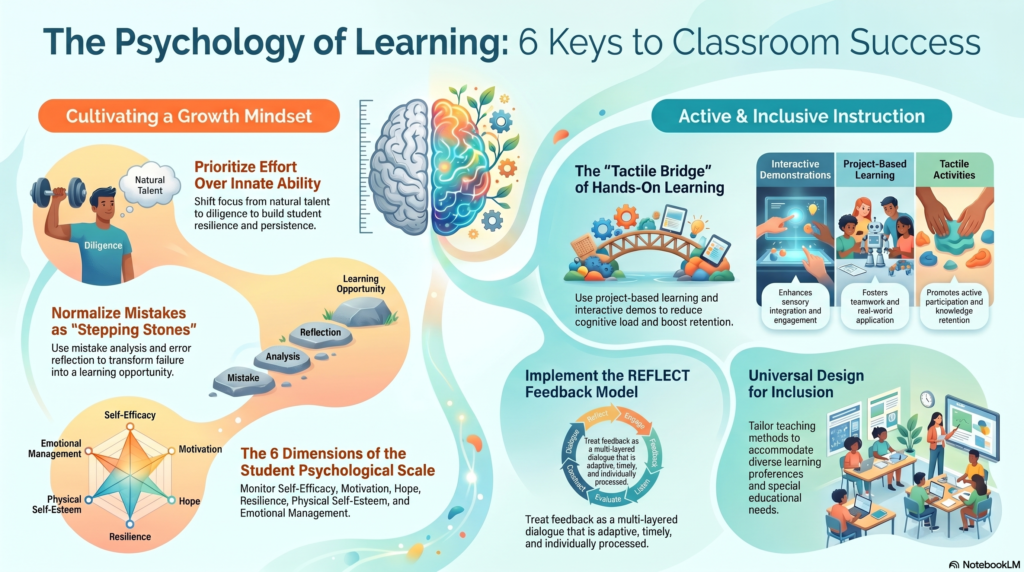
By prioritizing effort over inherent ability, educators can help students recognize that perseverance is a key component of achievement.
Additionally, emphasizing the value of learning from mistakes encourages a constructive approach to challenges, ultimately enhancing students’ self-efficacy and motivation.
Encouraging Effort Over Ability
In the domain of education, prioritizing effort over innate ability is essential for cultivating a growth mindset among students. This approach addresses common ability misconceptions that can hinder motivation and learning. Educators can implement motivation strategies that emphasize effort recognition, thereby encouraging students to value hard work and persistence over merely natural talent.
To foster a culture of resilience, teachers should incorporate resilience training into their curricula, equipping students with the skills to overcome challenges. Praise differentiation plays a significant role in this process; by specifically acknowledging students’ efforts rather than their inherent abilities, educators can reinforce the notion that success is attainable through diligence.
Additionally, employing self-regulation techniques empowers students to set personal goals and monitor their progress, shifting the focus from performance to the process of learning. Achievement rewards should be aligned with effort-based accomplishments, further motivating students to engage deeply in their educational endeavors.
Emphasizing Learning From Mistakes
Embracing mistakes as valuable learning opportunities is a cornerstone of cultivating a growth mindset in the classroom. By implementing mistake analysis, educators can guide students in identifying the root causes of their errors, fostering a culture where failure normalization becomes essential. This approach encourages resilience training, allowing students to develop adaptive strategies that enhance their learning cycle.
Error reflection is a crucial component of this process, as it prompts students to engage in self-assessment techniques that deepen their understanding of subject matter. When teachers provide corrective feedback, they empower students to view setbacks not as endpoints but as stepping stones toward mastery. Such feedback should be constructive, focusing on specific areas for improvement while reinforcing the idea that effort and perseverance are key.
Moreover, integrating these strategies into the curriculum helps students internalize the value of mistakes, transforming anxiety associated with errors into opportunities for growth. By fostering a classroom environment that prioritizes learning from mistakes, educators equip students with the tools necessary for lifelong learning and adaptability, essential skills in today’s rapidly changing world.
Consequently, emphasizing learning from mistakes is not merely beneficial; it is imperative for developing resilient and capable learners.
Utilizing Active Learning Techniques
In the heart of the instructional process, I believe the most transformative work happens in the small, often overlooked interactions between teacher and student. From my viewpoint, fostering a growth mindset is not just a nice-to-have classroom “vibe”, it is a critical cognitive strategy. When we prioritize effort over innate ability, we are essentially training the brain to see challenges as solvable problems rather than fixed barriers. This is particularly vital in STEM, where math anxiety can paralyze a brilliant mind.
By normalizing failure and analyzing mistakes, we transform errors into the “stepping stones toward mastery” that the research describes. Furthermore, as someone who spent years in engineering labs, I see hands-on, active learning as the “tactile bridge” to deep retention. Whether it is through project-based learning or collaborative design challenges, we are engaging multiple sensory systems.
This isn’t just about fun; it’s about reducing extraneous cognitive load so students can focus on the core concepts. Effective feedback plays a massive role here, too. I’ve always advocated for timely, constructive feedback loops that act more like a dialogue than a grade. When students feel heard and supported, their intrinsic motivation flourishes, and as the research suggests, a well-motivated student can truly achieve more than anyone, even themselves, might expect.
Active learning techniques, such as engaging group activities and hands-on learning experiences, are essential for enhancing student participation and retention of knowledge.
These methods encourage collaboration and critical thinking, fostering a deeper understanding of the material. Educational psychology determines the point that if a student is well motivated, he/ she can do more than expected.
Engaging Group Activities
Engaging students in group activities is a crucial strategy for fostering active learning in the classroom. Implementing team building exercises not only cultivates interpersonal skills but also enhances students’ ability to collaborate effectively.
Cooperative learning structures promote an environment where learners can share diverse perspectives, leading to deeper understanding and retention of material.
To maximize the benefits of group activities, educators should design tasks that require interdependence among students. In STEM-focused classrooms, the engineering teacher can structure collaborative design challenges that mirror real-world problem-solving scenarios, encouraging accountability and ensuring that each member contributes meaningfully to the team’s success.
Additionally, establishing clear objectives and roles within groups can facilitate focused discussions and efficient problem-solving.
Incorporating reflective practices, such as group debriefings, allows students to evaluate their collaborative experiences and identify areas for improvement.
Educators should also remain vigilant in monitoring group dynamics, providing support when conflicts arise, and guaranteeing equitable participation.
Ultimately, engaging group activities serve as a crucial component in applying educational psychology principles, fostering an inclusive learning environment that prepares students for real-world challenges.

HANDS-ON LEARNING EXPERIENCES
Hands-on learning experiences serve as a powerful extension of group activities by immersing students in practical applications of theoretical concepts. These approaches leverage experiential learning, allowing students to engage in tactile activities that enhance understanding and retention. By incorporating project-based learning, educators facilitate collaborative exploration, where learners work together to solve real-world problems. This approach is especially effective in engineering lessons, where students apply theoretical concepts through design, testing, and iterative improvement.
To illustrate the effectiveness of hands-on learning, consider the following table:
| Hands-On Learning Techniques | Benefits |
| Interactive Demonstrations | Enhance sensory integration and engagement |
| Tactile Activities | Promote active participation and retention |
| Project-Based Learning | Foster teamwork and real-world application |
| Collaborative Exploration | Encourage peer learning and diverse perspectives |
Designing Inclusive Classrooms
In inclusive classrooms, educators endeavor to create environments where all students, regardless of their diverse backgrounds and abilities, can thrive and participate meaningfully in the learning process. Achieving this goal requires a commitment to employing strategies such as differentiated instruction and universal design.
Differentiated instruction involves tailoring teaching methods, materials, and assessments to accommodate varying learning preferences and capabilities. Educators can implement this approach by offering choices in assignments, utilizing varied instructional materials, and adapting assessments to reflect individual student strengths. This guarantees that all learners, including those with special educational needs, have equitable access to the curriculum.
Universal design, on the other hand, focuses on creating learning environments that are accessible and effective for everyone from the outset. By considering the diverse characteristics of learners during the planning phase, educators can design lessons that are flexible and inclusive. This might involve incorporating multiple means of representation, expression, and engagement to cater to different learning styles.
Furthermore, fostering a culture of respect and collaboration within the classroom is essential. Encouraging peer-to-peer interactions and cooperative learning activities enables students to appreciate diverse perspectives and abilities, reinforcing a sense of belonging. Educators can use concepts from education psychology to understand and address the ways rapidly changing technologies both help and harm their students’ learning.
Ultimately, designing inclusive classrooms is not merely about compliance with educational mandates; it is a proactive approach that recognizes the value of diversity in enhancing the learning experience. By integrating differentiated instruction and universal design principles, educators can cultivate an environment that celebrates individual differences while promoting collective success.
Enhancing Student Motivation
Motivation serves as an essential driver of student achievement and engagement in the classroom, influencing not only academic performance but also the overall learning experience.
To enhance student motivation, educators must carefully consider both intrinsic and extrinsic factors. Intrinsic motivation, which stems from a student’s internal drive to learn, can be fostered through autonomy support and interest cultivation. Providing opportunities for students to set personal and academic goals can improve their self-efficacy, as they take ownership of their learning journey.
Extrinsic rewards, such as recognition for achievements, can also play a significant role in motivating students, particularly in environments where performance is emphasized. However, it is important to balance these rewards with intrinsic motivators to guarantee that students remain engaged and do not become overly dependent on external validation.
Social influences, including peer interactions and collaborative learning experiences, greatly impact motivation. Creating a supportive learning community where students can share their successes and challenges can foster a sense of belonging and encourage persistence.
Additionally, environmental factors such as classroom design and accessibility can either enhance or hinder motivation; hence, a well-organized and stimulating environment is fundamental.
Implementing Effective Feedback
Effective feedback is a critical component of the learning process, greatly influencing student performance and development. To implement effective feedback, educators must prioritize timely feedback that fosters growth and encourages students to engage in reflective practices. Constructive criticism should be framed positively, focusing on how students can improve while also acknowledging their strengths. Personalized responses are essential, as they cater to individual learning needs and promote goal setting.
Utilizing digital tools can enhance the feedback process, allowing for quick and efficient communication. Educators may also draw from structured resources, such as materials available through the engineering teacher shop, to support formative assessments and create meaningful feedback loops that guide student improvement. For instance, integrating peer feedback mechanisms can empower students to assess each other’s work, thereby reinforcing collaborative learning. Formative assessments should be strategically employed to create feedback loops that inform both teaching strategies and student learning.
The following table summarizes key components of effective feedback:
| Component | Description | Benefits |
| Timely Feedback | Immediate responses to student work | Enhances motivation and engagement |
| Constructive Criticism | Specific suggestions for improvement | Encourages growth and resilience |
| Peer Feedback | Collaborative evaluation among students | Builds critical thinking and community |
| Digital Tools | Platforms for providing feedback quickly and effectively | Facilitates ongoing communication |
Incorporating these strategies into performance reviews can lead to a more thorough understanding of student progress. Ultimately, by focusing on these elements, educators can create an environment where feedback serves as a powerful tool for learning and development.
Building Positive Teacher-Student Relationships
Cultivating trust and respect forms the foundation of positive teacher-student relationships, which are crucial for fostering an effective learning environment. Trust building is critical, as it encourages students to engage openly in the learning process.
Educators can enhance their communication skills through training in empathy, which enables them to better understand students’ perspectives and foster emotional support.
Effective relationship dynamics hinge on mutual respect. Teachers who demonstrate appreciation for diverse backgrounds and experiences cultivate cultural awareness, thereby validating the identities of their students. This approach not only builds rapport but also empowers students, promoting student agency in the decision-making processes regarding their education.
Additionally, conflict resolution strategies play a crucial role in maintaining positive interactions. Educators should be equipped to address misunderstandings promptly and constructively, ensuring that students feel heard and valued. This proactive approach prevents escalation and reinforces trust.
Furthermore, incorporating regular check-ins and feedback sessions can greatly enhance rapport development. These interactions provide students with a platform to express their feelings and thoughts, reinforcing emotional support and mutual respect.
RELATED STUDIES ABOUT EDUCATIONAL PSYCHOLOGY
The integration of educational psychology in the classroom serves as a cornerstone for effective teaching and learning. By applying diverse learning theories, fostering a growth mindset, and utilizing active learning techniques, educators can cultivate an environment conducive to student success. Additionally, designing inclusive classrooms and enhancing motivation through effective feedback solidifies the foundation for positive teacher-student relationships. Ultimately, these strategies illuminate the path toward a more engaged and empowered learning community, transforming challenges into stepping stones for academic achievement.
Exploring Cognitive Behavioral Aspects in Educational Psychology: A Rigorous Analysis of Reliability and Validity Measures
- Objective and Background
Understanding students’ psychological states—such as their motivation, resilience, and self-belief—is crucial for effective teaching and learning. However, educators and researchers need reliable and valid tools to measure these complex psychological constructs. This study aimed to develop and rigorously test a new Educational Psychology Scale (EPS) designed to comprehensively assess the psychological well-being and cognitive-behavioral aspects of undergraduate students.
The primary goal was to create a scale with strong psychometric properties (reliability and validity) that could be used to evaluate student psychology and inform educational practice.
- Methodology
The study employed a multi-phase, mixed-methods approach to develop and validate the scale.
- Phase 1: Item Development (Qualitative):
- Literature Review: Extensive review of existing psychological and educational scales.
- Semi-Structured Interviews: Conducted with 3 psychology researchers, 12 teaching faculty, and 10 undergraduate students to gather real-world insights into student experiences related to learning, motivation, and emotion. This generated 55 initial statements.
- Phase 2: Scale Refinement (Quantitative – Pilot):
- An initial 64-item questionnaire was administered to 412 students.
- Item Analysis: Items with low discrimination were removed.
- Exploratory Factor Analysis (EFA): Used to identify the underlying structure of the scale, reducing the items to a core set and revealing key dimensions.
- Phase 3: Scale Validation (Quantitative – Main Study):
- The revised 27-item scale was administered to a new sample of 450 students, yielding 320 valid responses.
- Confirmatory Factor Analysis (CFA): Used to test whether the factor structure identified in the EFA fit the new data.
- Reliability Testing: Internal consistency (Cronbach’s alpha) and test-retest stability (with 50 students after 2 weeks) were calculated.
- Validity Testing: Content validity (correlations between dimensions and total score) and construct validity (via CFA) were assessed.
- Key Findings
The analysis resulted in a robust 27-item scale with a clear six-factor structure.
- The Six Dimensions of the Scale: The final Educational Psychology Scale measures six key aspects of student psychology:
- Self-Efficacy: Belief in one’s ability to succeed.
- Learning Motivation: Drive and interest in learning.
- Hope Trait: Goal-directed thinking and pathways to achieve goals.
- Psychological Resilience: Ability to bounce back from adversity.
- Physical Self-Esteem: Feelings about one’s body and physical self.
- Emotional Management: Ability to understand and regulate emotions.
- Strong Psychometric Properties:
- Reliability: The scale demonstrated excellent reliability. The overall scale had a high internal consistency (Cronbach’s α = 0.83) and outstanding test-retest stability (r = 0.90), meaning it produces consistent results over time.
- Validity:
- Construct Validity: Confirmatory factor analysis confirmed that the six-factor structure was a good fit for the data (GFI = 0.90), proving the scale measures what it intends to measure.
- Content Validity: The six dimensions showed moderate correlations with each other and stronger correlations with the total score (0.55 to 0.78), indicating they are related but distinct components of a single overarching construct.
- Conclusions and Implications
The study concludes that the newly developed Educational Psychology Scale is a scientifically sound, reliable, and valid instrument for assessing undergraduate students’ psychological characteristics.
- A Practical Tool for Educators: The scale provides a comprehensive profile of a student across six critical domains. This information can help educators:
- Identify students who may be struggling with motivation, resilience, or emotional regulation.
- Tailor their teaching strategies and support to meet the specific psychological needs of their students.
- Evaluate the effectiveness of interventions or teaching reforms on student well-being.
- A Tool for Researchers and Administrators: The scale offers a validated instrument for conducting research on student psychology. For administrators, aggregated data from the scale can provide insights into the overall psychological climate of the student body, informing decisions on mental health resources and curriculum design.
- Foundation for Future Work: The authors suggest that while this scale is robust, future research should validate it in other educational contexts and consider adding new dimensions or using technology for more efficient administration.
| REFERENCE: Xuesong Chen, Jianchang Jin, Wei Ke, Yuqin Mao, Feilin Hao, Dongmei Xu, Exploring cognitive behavioral aspects in educational psychology: A rigorous analysis of reliability and validity measures, SLAS Technology, Volume 29, Issue 4, 2024, 100144, ISSN 2472-6303, https://doi.org/10.1016/j.slast.2024.100144. (https://www.sciencedirect.com/science/article/pii/S2472630324000268) |
Advancing Feedback Research in Educational Psychology: Insights into Feedback Processes and Determinants of Effectiveness
- Objective and Background
Feedback is one of the most powerful tools in education, influencing learning through cognitive, motivational, and emotional pathways. However, research shows that feedback is not universally effective; its impact depends on a complex interplay of factors. This theoretical analysis introduces a special issue of Contemporary Educational Psychology dedicated to advancing the science of feedback. Its primary objective is to synthesize cutting-edge research and propose a new, comprehensive model—the REFLECT Model of Feedback—that captures the dynamic, multi-layered processes that determine when and why feedback works.
The paper argues that understanding feedback effectiveness requires moving beyond a simple “transmission” model to one that considers feedback as an adaptive, individually processed, interaction-dependent, and developmentally relevant phenomenon.
- The REFLECT Model of Feedback
The authors propose the REFLECT Model (Reciprocal Engagement with Feedback: Learning, Emotion, Cognition, and Trajectories) as a framework to organize and guide future research. The model conceptualizes feedback as a process shaped by four key principles and operating across three contextual layers.
- Four Core Principles of Feedback:
- Adaptive and Multi-Layered: Feedback is embedded within and shaped by three interacting contexts:
- Immediate Feedback Context: The characteristics of the feedback message itself (e.g., timing, tone, specificity, source).
- Achievement Context: The broader learning environment, task characteristics, and instructional goals.
- Surrounding Context: Cultural norms, institutional policies, and classroom climate.
- Individually Processed: Learners actively process feedback through four key stages: attention, decoding, interpretation, and acceptance/implementation. Individual differences (e.g., self-concept, anxiety, motivation, prior knowledge) influence each stage.
- Interaction-Dependent: Feedback is a dialogue, not a monologue. It involves a dynamic interplay between the feedback provider and receiver. The provider’s own cognitive and motivational states, as well as the relationship between the two parties, shape the feedback’s creation and reception. The role of AI as a provider is noted as a distinct context where this social dynamic is absent.
- Developmentally Relevant: Feedback interactions have cumulative, long-term effects. They contribute to the co-development of both provider and receiver and shape learners’ enduring dispositions like self-efficacy, resilience, and feedback literacy over time.
- Overview of Studies in the Special Issue
The paper summarizes the diverse contributions to the special issue, which collectively test and expand upon the REFLECT model’s propositions. Key themes and findings include:
- Individual Differences in Processing: Studies show that learners with high math anxiety or low self-concept are more likely to disengage from feedback (Merrick & Fyfe, 2025). Higher-performing students are more likely to seek out and use feedback opportunities (Maier & Klotz, 2025).
- Long-Term Development: Longitudinal data reveals reciprocal relationships where prior feedback experiences shape students’ future self-concept and motivation, which in turn influence how they engage with subsequent feedback (Hübner et al., 2025).
- Feedback Source and Design: Research confirms a general preference for teacher feedback over peer feedback, highlighting the role of perceived authority and credibility (Lopera-Oquendo et al., 2025). Multimedia and emotional design elements in digital feedback can enhance positive emotional engagement (Kuklick & Lindner, 2025). The quality of peer feedback comments is linked to their perceived helpfulness and subsequent implementation (Zhang et al., 2025).
- Neuroeducational Insights: Integrating neuroscience, research suggests that negative feedback can be effective when it is framed to enhance competence, evoke curiosity, or support self-correction, rather than being purely critical (Kim & Shin, 2025).
- Fostering Learner Agency: Simple, structured interventions, such as checklists for teachers, can shift feedback practices from a purely corrective focus to one that promotes student motivation and agency (Grønnli et al., 2025).
- Conclusions and Future Directions
The paper concludes that the field of feedback research is undergoing a “renaissance,” moving towards more nuanced, process-oriented, and interdisciplinary approaches.
- Theoretical Contribution: The REFLECT model provides a comprehensive, integrative framework that synthesizes prior work and offers a roadmap for future research by explicitly mapping the multi-layered nature of feedback and the psychological mechanisms involved.
- Methodological Implications: To capture the complexity of feedback processing, the authors advocate for methodological innovations, including real-time multi-modal tracking (e.g., eye-tracking, log data analysis), learning analytics, and natural language processing. These methods allow researchers to study feedback engagement at a micro-level and personalize feedback at scale.
- Practical Implications: The findings underscore the need for feedback to be tailored to individual learners’ characteristics and contexts. Effective feedback design must consider not only the message’s content but also its emotional tone, source credibility, and the broader learning culture. Low-cost interventions that support teachers in adopting student-centered feedback practices show significant promise.
- Call for Interdisciplinary Collaboration: The paper strongly encourages closer collaboration between educational psychology and fields like learning analytics and computer science to leverage new data sources, refine theoretical models, and develop more effective, personalized feedback systems.
| REFERENCE: Martin Daumiller, Jennifer Meyer, Advancing feedback research in educational psychology: Insights into feedback processes and determinants of effectiveness, Contemporary Educational Psychology, 2025, 102390, ISSN 0361-476X, https://doi.org/10.1016/j.cedpsych.2025.102390. (https://www.sciencedirect.com/science/article/pii/S0361476X25000554) |
Socio-Educational Ecologies for Learning, Social Change, and Future Thinking: Expanding Educational Psychology’s Boundaries
- Objective and Background
This paper is a position paper that introduces a special issue on “Socio-educational ecologies for learning, social change, and future thinking.” It argues that the field of educational psychology must fundamentally expand its boundaries to remain relevant in an era of profound societal and ecological crises (climate change, inequality, threats to democracy). The authors contend that the discipline’s historical focus on individual learners within the bounded context of traditional schooling is no longer sufficient to address the complex challenges facing humanity.
The central thesis is that educational psychology needs to shift its focus from studying “how individuals learn in schools” to investigating and designing socio-educational ecologies—collaborative arrangements that connect schools with communities, families, and other social actors to work toward more just and sustainable futures.
- The Argument: Expanding Boundaries
The paper critiques the traditional paradigm of educational psychology, which has been defined by its focus on schooling and individual learning outcomes (e.g., test scores). This approach, the authors argue, leads to several limitations:
- It disconnects learning from the real-life contexts and concerns of students and communities.
- It treats learners as objects of intervention rather than as subjects with agency to transform their world.
- It fails to address systemic issues of power, inequity, and social justice.
To revitalize the field, the authors propose a fundamental expansion across three dimensions:
- The “What” (Objects of Study): Moving from individual learning outcomes to studying learning as it occurs within and across multiple contexts, driven by interests, pursuits, and collective endeavors.
- The “How” (Methodologies): Moving from detached observation and “what works” experiments to engaged, participatory, and interventionist approaches like design-based research, formative interventions, and research-practice partnerships.
- The “Who” and “What-For” (Purpose): Moving from a focus on academic achievement to a focus on fostering collective agency and contributing to the flourishing of communities and the planet.
- Key Concepts and Theoretical Expansions
The paper introduces and synthesizes several key concepts that form the foundation of a renewed, ecologically-oriented educational psychology.
- Socio-Educational Ecologies: These are intentional partnerships and networks that link schools with families, community organizations, and other institutions. They are designed to create learning opportunities that are meaningful, connected to real-world issues, and aimed at collective well-being (e.g., “open schooling,” “widespread education”).
- Expanded Units of Analysis: To study these ecologies, the field needs new units of analysis beyond the individual learner. The authors propose four alternatives:
- Pursuits: The interest-driven trajectories of individuals or groups across different settings over time.
- Ongoing Shared Endeavors: Collective activities (e.g., a community carnival, a family project) where learning happens through contribution and participation.
- Social Movements: Collective actions focused on justice, where learning is tied to prefiguring alternative futures.
- Learning Ecosystems: The entire network of people, places, and resources within a community that supports learning.
- Community Funds of Knowledge and Identity: This concept recognizes that all communities possess valuable knowledge, skills, and cultural practices that should be brought into the educational process, not left at the schoolhouse door.
- Methodological Implications
Studying socio-educational ecologies requires a shift in how research is conducted. The authors advocate for methodologies that are collaborative, interventionist, and future-oriented, such as:
- Research-Practice Partnerships (RPPs): Long-term, mutualistic collaborations between researchers and practitioners to solve problems of practice and generate new knowledge.
- Formative Interventions: Research that introduces a problem or contradiction into a setting and follows how participants collectively work to transform their activity, fostering their own agency.
- Utopian Methodologies: Approaches that explicitly engage participants in envisioning and enacting more just and equitable educational futures.
- Conclusion and Implications
The paper concludes that for educational psychology to be relevant, responsive, and responsible in times of crisis, it must embrace a broader vision of its purpose. This involves:
- Decentering the School: Seeing schools as one important node within a larger network of learning opportunities, not as the sole site of education.
- Valuing Collective Agency: Focusing on how people learn to act together to transform their circumstances, not just on individual achievement.
- Embracing Complexity: Adopting theoretical frameworks and methodologies that can capture the dynamic, multi-layered, and value-laden nature of learning in real-world contexts.
The authors hope that this expanded ecological perspective can equip researchers and practitioners to better understand and support the role of education in building more just and sustainable futures for all.
| REFERENCE: Alfredo Jornet, William R. Penuel, Moisès Esteban-Guitart, Sanne Akkermann, Socio-educational ecologies for learning, social change, and future thinking: Expanding educational psychology’s boundaries, Acta Psychologica, Volume 258, 2025, 105156, ISSN 0001-6918, https://doi.org/10.1016/j.actpsy.2025.105156. (https://www.sciencedirect.com/science/article/pii/S000169182500469X) |
CONCLUSION
As I reflect on the evolving landscape of educational psychology, I am struck by how much our “units of analysis” must expand. We are no longer just looking at an individual student in a vacuum; we are looking at “socio-educational ecologies”. My perspective is that schools should be viewed as one node in a vast network that includes families, communities, and digital spaces. Especially as an engineering educator, I feel a responsibility to ensure our teaching strategies help students navigate the “profound societal and ecological crises” of our time, such as climate change and rapid technological shifts.
We need to decenter the school as the sole site of education and start valuing the collective agency of our students. It’s about building a community where everyone feels they belong and can contribute their “funds of knowledge”. My work at The Engineering Teacher is dedicated to making this rigorous research approachable and practical for the everyday educator.
Ultimately, applying these psychological principles is about more than just boosting test scores or improving retention, it’s about empowering a new generation of learners to be resilient, motivated, and capable of solving the world’s most complex problems. By bridging the gap between psychology and pedagogy, we aren’t just teaching engineering; we are engineering a better way to learn.