
In my twelve years of navigating the landscape of adult development, I’ve often observed that we tend to discuss “economic growth” and “workforce development” as if they are cold, mechanical gears in a vast machine. We look at the data, the employment rates, the productivity indices, and the market demands, and sometimes lose sight of the individual at the heart of the curriculum. From my perspective as an educator rooted in human development, workforce development is less about “filling slots” and more about the profound transformation of the adult learner.
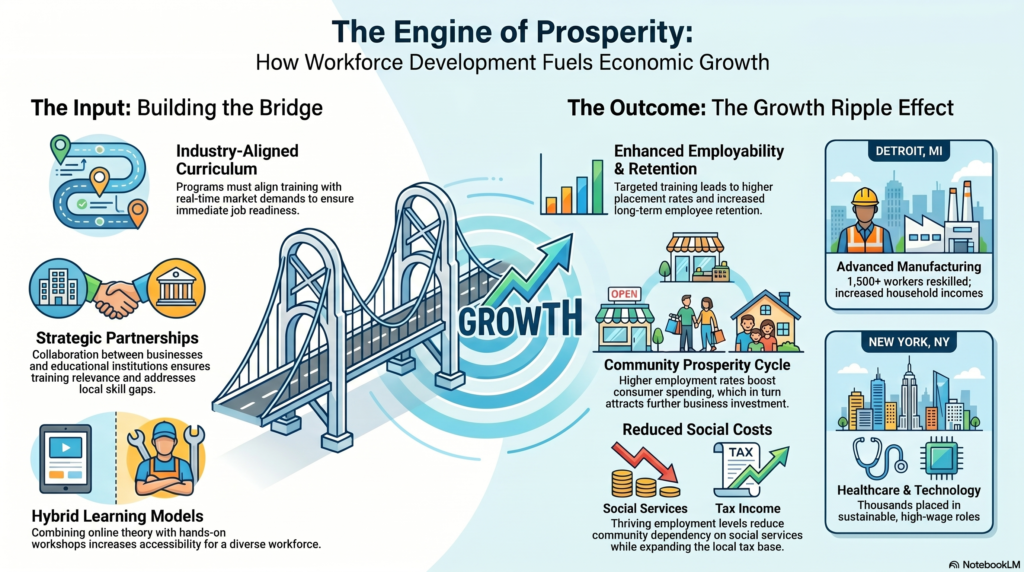
When we arm individuals with skills aligned to market demands, we aren’t just boosting a metric; we are restoring agency to people who may feel sidelined by rapid technological shifts. I’ve seen firsthand how a well-designed program acts as a bridge between a job seeker’s untapped potential and an employer’s urgent needs. But for this bridge to hold weight, it must be built on a foundation of learner-centered strategies that foster genuine independence.
It isn’t enough to simply provide a training manual; we must create pathways that respect the adult student’s lived experience and self-direction. As we explore how these initiatives drive our local economies, I encourage you to look beyond the surface-level statistics and see the vibrant culture of lifelong learning that makes sustainable prosperity possible.
Workforce development programs are essential for economic growth as they arm individuals with skills aligned to market demands. By bridging gaps between job seekers and employer needs, these initiatives enhance employability and reduce unemployment rates. Collaborative partnerships among businesses, educational institutions, and community organizations further guarantee training relevance and broaden accessibility. Investment in skill development not only fosters innovation and productivity but also attracts investments into local economies. Consequently, as communities experience higher employment rates and increased consumer spending, the overall economic health improves. For a deeper understanding of their transformative impact, consider exploring further insights into successful program implementations.
KEY TAKEAWAYS
- Workforce development programs enhance employee skills, increasing employability and driving economic growth through higher employment rates.
- By aligning training with industry needs, these programs foster a skilled workforce that meets market demands.
- Partnerships between businesses and educational institutions ensure relevant training, addressing local skill gaps effectively.
- Continuous evaluation of programs promotes improvement and sustainability, contributing to long-term economic resilience.
- Investment in workforce development attracts businesses, stimulates job creation, and boosts local economies through increased consumer spending.
IMPORTANCE OF WORKFORCE DEVELOPMENT
Although economic growth is often driven by technological advancements and market trends, the significance of workforce development cannot be overstated. A robust workforce development strategy is essential for enhancing employee retention, guaranteeing that organizations cultivate a skilled workforce equipped for evolving industry demands.
This focus on skill advancement not only prepares individuals for immediate job readiness but also creates clear career pathways that align with organizational goals. By prioritizing lifelong learning, organizations can cultivate a culture that values continuous improvement, thereby enhancing overall productivity and innovation.
Training accessibility is a fundamental aspect of effective workforce development. It guarantees that all employees, regardless of background, have opportunities for professional development, fostering workforce diversity and inclusivity.
By prioritizing lifelong learning, organizations can cultivate a culture that values continuous improvement, thereby enhancing overall productivity and innovation.
Moreover, aligning workforce development initiatives with industry needs is critical for promoting economic mobility. When training programs are tailored to equip employees with sought-after skills, they not only advance individual careers but also contribute to the broader economic ecosystem.
This alignment creates a dynamic labor market responsive to technological changes and market fluctuations.
Key Components of Effective Programs
To effectively drive economic growth through workforce development, programs must incorporate several key components that guarantee their success and sustainability. Many modern training frameworks are also informed by adult learning theories, which emphasize experience-based learning, self-direction, and practical application in workplace environments.
First and foremost, robust curriculum design is essential, ensuring that training aligns with industry demands and equips participants with relevant skills. This alignment is further reinforced by stakeholder involvement, allowing businesses and educational institutions to collaborate in developing curricula that meet current and future workforce needs.
Funding strategies play a crucial role in sustaining these programs. Securing diversified funding sources, including government grants and private partnerships, can enhance program longevity and expand accessibility considerations for underserved populations.
Equally important are evaluation metrics, which measure program effectiveness and provide insights for continuous improvement based on participant feedback.
Technology integration is another critical component, as it facilitates innovative learning methods and equips participants with the digital skills necessary in today’s job market.
Additionally, establishing mentorship programs fosters a supportive environment where individuals can receive guidance, enhancing their professional development and networking opportunities.
Certification pathways should also be a focus, as they provide recognized credentials that validate participants’ skills and enhance their employability. By ensuring these pathways are clearly defined and accessible, programs can attract a broader range of participants.
Impact on Employment Rates
The effectiveness of workforce development programs is often measured by their direct impact on employment rates within communities. These programs serve as essential tools to bridge the gap between the job market’s demands and the skills possessed by job seekers. By focusing on skill alignment, workforce development initiatives not only enhance individual employability but also contribute to broader economic growth by filling critical labor shortages.
When workforce development programs effectively align training offerings with local industry needs, they create a more prepared and adaptable workforce. This strategic approach guarantees that individuals gain relevant skills that are directly applicable in today’s evolving job market. As a result, communities experience a decrease in unemployment rates, fostering economic stability and growth.
Moreover, the ripple effects of improved employment rates extend beyond individual success stories. By reducing dependency on social services and increasing consumer spending, thriving employment levels contribute to overall community prosperity. This, in turn, attracts further investments and encourages businesses to expand, perpetuating a cycle of economic growth.
Ultimately, the impact of workforce development programs on employment rates speaks volumes about their significance in shaping a vibrant and sustainable economy. By investing in these initiatives, we not only empower individuals but also strengthen communities, guaranteeing that we meet the challenges of the future with a skilled and capable workforce.
The alignment of skills with the job market is not just a tactical necessity; it is a strategic imperative for economic resilience and growth.
Role of Partnerships in Development
Partnerships play a pivotal role in enhancing workforce development programs by facilitating collaborative skills training that aligns with industry needs. Workforce development, broadly defined, is an interrelated set of solutions designed to meet employment needs. Workforce development promotes employment using a reciprocal approach of addressing the needs of both job seekers and employers. From a job seeker’s perspective (or the supply side), workforce development prepares potential employees with needed skills and provides support services that allow individuals to optimize their opportunities for employment. From an employer’s point-of-view (or the demand side), workforce development serves as an appropriate and a practical channel to communicate and meet employers’ demands for skills. Central to workforce development is helping individuals obtain jobs and thrive in the workplace, while meeting the hiring demands of employers. This two-pronged approach of tackling supply and demand sides of employment sets workforce development apart from existing programs, such as basic education and technical and vocational skills training.
By engaging community stakeholders, these partnerships foster initiatives that not only build local capacity but also guarantee that training is relevant and effective.
Ultimately, a strategic alliance among businesses, educational institutions, and community organizations is essential for driving sustainable economic growth.
Collaborative Skills Training
Effective collaborative skills training is increasingly recognized as an essential component in workforce development, particularly when driven by strategic partnerships between educational institutions, industry leaders, and community organizations. Such alliances enhance team dynamics by fostering an environment where diverse expertise converges, creating a robust framework for effective training methodologies.
By implementing competency frameworks that address specific job requirements, organizations can conduct thorough skill evaluations to identify gaps and tailor training programs accordingly. This targeted approach not only aligns workforce capabilities with industry needs but also promotes industry collaboration, ensuring that training remains relevant and impactful.
Experiential learning opportunities, facilitated through these partnerships, allow participants to engage in real-world scenarios that bolster their skills and enhance problem-solving abilities. Workforce development refers to a range of strategies, initiatives, and educational activities that aim to enhance the skills and competencies of people engaged in or available for work. It’s about equipping individuals with the necessary tools, knowledge, and training to meet current and future job demands. This not only ensures that employees remain relevant in their roles, but also helps businesses thrive in a competitive market.
Additionally, continuous program evaluation is essential for evaluating the effectiveness of training initiatives, enabling stakeholders to adapt strategies and improve outcomes over time.
Ultimately, collaborative skills training serves as a catalyst for workforce alignment, equipping individuals with the necessary competencies to thrive in a rapidly evolving job market. This commitment to shared growth not only benefits participants but also strengthens the broader economy, fostering sustainable economic development for all.
Community Engagement Initiatives
Driving economic growth through community engagement initiatives requires a strategic focus on building and sustaining partnerships that leverage local resources and expertise.
Effective community outreach and stakeholder involvement are crucial components in this process, fostering a collaborative environment that addresses local needs while promoting economic vitality.
Successful community engagement initiatives hinge on several key elements:
- Shared Vision: Establishing a common goal among partners encourages collective action and commitment.
- Resource Mobilization: Pooling resources from various stakeholders amplifies impact and fosters innovation.
- Capacity Building: Equipping community members with skills and knowledge enhances their ability to contribute to economic development.
- Feedback Mechanisms: Continuous dialogue with stakeholders guarantees that programs are responsive to community needs and challenges.
- Sustainability Focus: Initiatives should prioritize long-term outcomes, guaranteeing that partnerships endure beyond initial funding cycles.

ADDRESSING SKILLS GAPS
The efficacy of any adult education initiative relies heavily on what I call “contextual rigor”. In my research on learner engagement, I’ve found that adults thrive when they can immediately relate theoretical content to the practical challenges of their professional lives. This is why the collaborative partnerships mentioned in our discussion—those between businesses, educational institutions, and community organizations—are so vital. They ensure that the curriculum isn’t designed in an ivory tower but is instead a living document responsive to real-world industry demands.
When I think about the “skills gap,” I don’t just see a deficit; I see an opportunity for innovation in how we teach. For instance, integrating technology through hybrid models or immersive bootcamps allows us to reach a broader, more diverse range of participants who might otherwise be excluded by traditional schedules or high costs. I am particularly passionate about the use of mentorship and project-based learning, as these methods provide the “scaffolding” necessary for an adult to transition from a student to a confident professional.
Whether it’s a manufacturing worker in Detroit reskilling for a new era or a technician learning to optimize energy efficiency, the goal is the same: to create a skilled and capable workforce that is as resilient as it is productive. By tailoring our training to the specific needs of the community, we don’t just fill jobs, we build the long-term economic resilience of the entire ecosystem.
Addressing skills gaps is critical for aligning workforce capabilities with the demands of an evolving economy. By incorporating practical training materials and structured learning resources—similar to those available through the engineering teacher shop—these initiatives can better equip participants with hands-on competencies needed in today’s job market.
Identifying specific skill shortages allows organizations to implement tailored training initiatives that effectively bridge these gaps.
Identifying Skill Shortages
In today’s rapidly evolving labor market, pinpointing skill shortages is essential for fostering economic growth and ensuring workforce competitiveness. Effective identification of these gaps begins with robust skill assessment processes, which provide a clear understanding of the existing workforce capabilities compared to industry demands.
A strategic approach to identifying skill shortages can be broken down into several key components:
- Labor Market Analysis: Regularly evaluate trends and forecasts to gauge the evolving needs of industries.
- Stakeholder Engagement: Collaborate with employers, educators, and community organizations to gather insights on skills that are currently lacking.
- Data-Driven Decision Making: Utilize statistical tools and analytics to identify discrepancies between available skills and required competencies.
- Continuous Feedback Mechanisms: Establish systems that allow for ongoing input from workers and employers about emerging skill requirements.
- Targeted Skill Assessments: Conduct assessments that not only measure current skills but also predict future skill requirements based on technological advancements.
Tailored Training Initiatives
Effective workforce development hinges on the implementation of tailored training initiatives designed to close identified skills gaps. By focusing on personalized learning, these initiatives empower individuals to gain the specific competencies required by today’s dynamic job market. When training is customized to meet the distinct needs of both the workforce and employers, participants are more likely to engage meaningfully and achieve sustainable outcomes.
Strategic industry partnerships play a critical role in this process. By collaborating with local businesses and organizations, workforce development programs can guarantee that training aligns with real-world demands. These partnerships not only inform curriculum development but also facilitate internships and on-the-job training opportunities, enhancing participants’ employability.
Moreover, tailored training initiatives foster a culture of lifelong learning, equipping individuals with the agility to adapt to evolving industry standards. As communities invest in personalized learning pathways, they cultivate a skilled workforce that contributes to economic resilience and growth.
Economic Benefits for Communities
While many factors contribute to a community’s economic importance, the implementation of workforce development programs stands out as a crucial strategy for fostering sustainable growth.
These programs not only enhance the skill diversity of the local workforce but also create pathways for economic resilience and stability. By aligning training initiatives with industry demands, communities can effectively respond to the ever-evolving labor market.
The economic benefits of workforce development programs can be summarized as follows:
- Job Creation: Targeted training initiatives result in higher employment rates, directly contributing to job creation in various sectors.
- Community Investment: Investing in workforce development bolsters local economies, attracting businesses and fostering long-term community growth.
- Training Accessibility: Programs that prioritize inclusivity guarantee that all members of the community have access to essential training, promoting equity and opportunity.
- Industry Alignment: By focusing on skill sets that are in demand, workforce development programs help bridge the gap between education and industry needs, enhancing overall productivity.
- Workforce Innovation: Encouraging innovation within the workforce leads to the development of new ideas and approaches, guaranteeing that local economies remain competitive.
In essence, workforce development programs serve as a foundation for economic stability, enabling communities to thrive amidst challenges.
Case Studies of Success
The success of workforce development programs can be best illustrated through real-world examples that highlight their transformative impact on local economies. One compelling success story is the program initiated in Detroit, Michigan, where a partnership between community colleges and local industries facilitated the reskilling of over 1,500 workers in advanced manufacturing.
Program evaluations indicated a significant increase in employment rates among participants, leading to a boost in household incomes and a revitalization of the local economy. Workforce development is a comprehensive approach business professionals take to enhance the capabilities of their workforce over time. The goal of workforce development initiatives is to build relevant expertise now and create a pipeline where employees continually grow and develop within their roles to meet future demands.
Similarly, the “WorkAdvance” initiative in New York City showcases the effectiveness of targeted training programs. By focusing on sectors with high demand, such as healthcare and technology, WorkAdvance has successfully placed thousands of individuals into sustainable jobs.
Evaluations of this program revealed that participants not only achieved higher wages but also reported improved job satisfaction, contributing to long-term economic stability for families.
These case studies demonstrate that workforce development programs are not merely beneficial; they are vital for economic growth and social mobility. They empower individuals, reduce unemployment, and enhance community resilience.
The strategic alignment of training with market needs guarantees that resources are utilized efficiently, creating a win-win scenario for both employers and job seekers. As stakeholders in workforce development, it is important to draw lessons from these success stories and advocate for continued investment in such programs, as they offer a pathway to brighter futures for individuals and communities alike.

RELATED STUDIES ABOUT WORKFORCE DEVELOPMENT
To sum up, workforce development programs serve as the cornerstone of sustainable economic growth, nurturing a skilled labor force akin to fertile soil that cultivates prosperity. By bridging skills gaps and fostering strategic partnerships, these initiatives ignite employment opportunities and invigorate communities. The cascading effects of enhanced workforce capabilities ripple through local economies, ultimately transforming the landscape of opportunity. Sustained investment in such programs not only fuels economic engines but also strengthens societal resilience, paving the way for a brighter future.
Workforce Development In Low-Carbon Energy Transitions: The Case Of Horizontal Governance In Schleswig-Holstein (Germany)
- Purpose and Research Questions
This study addresses a critical gap in sustainability transitions research: the intersection of workforce dynamics and low-carbon energy policy. While transitions are often framed as technical or technological challenges, they are fundamentally social processes with profound implications for labor markets, skills, and employment. The paper investigates how “policy mixes”—the combination of strategies and instruments—are governed horizontally across different policy domains (e.g., energy, labor, education) to address workforce development for the energy transition. The central research question is: How do policy mixes unfold in the horizontal governance of socio-technical transitions and workforce dynamics?
- Theoretical Framework and Methodology
The study operationalizes an extended policy mix framework, analyzing four core characteristics—consistency (of policy elements), coherence (of policy processes), comprehensiveness, and credibility—across three horizontal governance dimensions: internal (within a policy domain), cross-sectoral (between domains like energy and labor), and public-private (between state and non-state actors). It also incorporates feedback loop analysis to understand how these characteristics interact and evolve.
The research employs a qualitative single-case study of Schleswig-Holstein (SH), Germany, a self-declared energy transition frontrunner facing severe labor shortages in key climate occupations (e.g., wind energy, heating technology). The methodology combines a content analysis of 25 policy documents (2018-2024) with 22 semi-structured interviews with regional stakeholders from government, industry, labor unions, and training providers.
- Key Findings: A Fragmented Governance Landscape
The analysis reveals significant challenges in governing workforce development for the energy transition in SH:
- Inconsistency: Energy transition goals are poorly integrated into labor and education strategies. While the state has a skilled labor initiative (FLSH), its instruments are intentionally “sector-neutral,” failing to prioritize the specific needs of the energy sector. Policy instruments across domains operate in parallel rather than in unison, leading to training gaps (e.g., in grid installation).
- Incoherence: Formal coordination platforms exist, but policymaking remains siloed. Inter-ministerial coordination is weak, with each ministry sticking to its own goals. Stakeholder input, particularly from employers, is often symbolic and lacks clear impact, leading to initiatives that are disconnected from practical needs.
- Limited Comprehensiveness: The policy mix is narrow, focusing primarily on skills training while neglecting other critical areas like the integration of immigration with energy-sector training. Short-term project funding and bureaucratic hurdles hinder long-term, strategic capacity building.
- Weak Credibility: Stakeholders express low trust in the policy mix due to shifting political agendas, short planning horizons, and a lack of strategic follow-through. This uncertainty discourages long-term investment in training by both providers and employers.
In response to these top-down governance gaps, a “patchwork” of stakeholder-led initiatives (from chambers, universities, and local networks) has emerged to fill the void. However, these efforts remain disconnected from formal policy structures, limiting collective learning and risking duplicated efforts.
- Conclusion and Implications
The study concludes that workforce development is not merely a downstream consequence of technological change but a systemic enabler of low-carbon transitions. The case of Schleswig-Holstein demonstrates that weak horizontal governance—characterized by misaligned strategies, siloed processes, and low credibility—can become a major barrier to transition, even in a region with high political ambition.
Theoretical Contributions:
The paper advances policy mix research by:
- Disaggregating horizontal governance into three distinct dimensions (internal, cross-sectoral, public-private), providing a more precise tool for diagnosing policy failures.
- Applying the policy mix framework to a non-technological, systemic policy area (workforce development), revealing the complexities of governing cross-cutting issues.
- Demonstrating how feedback loops between policy characteristics can create negative dynamics, where inconsistency erodes coherence and credibility, which in turn reinforces fragmentation.
Policy Implications:
- Need for Integration: Policymakers must move beyond sector-neutral approaches and actively integrate energy transition workforce needs into labor and education strategies.
- Leveraging Bottom-Up Initiatives: Instead of allowing stakeholder-led projects to operate in parallel, governments should create coordination mechanisms (e.g., joint planning platforms, transparent reporting) to connect them to shared strategic goals, enhancing learning and resource efficiency.
- Building Credibility: Long-term, reliable policy signals and funding are essential to build trust and encourage the sustained investment in training needed to meet ambitious climate targets. Workforce policy must become an anticipatory, adaptive force rather than a reactive one.
| REFERENCE: Tim Weishaupt, Workforce development in low-carbon energy transitions: The case of horizontal governance in Schleswig-Holstein (Germany), Environmental Innovation and Societal Transitions, Volume 57, 2025, 101040, ISSN 2210-4224, https://doi.org/10.1016/j.eist.2025.101040. (https://www.sciencedirect.com/science/article/pii/S2210422425000796) |
Hybrid Education And Training Approaches Enabling Workforce Development In Additive Manufacturing
- Purpose and Problem Statement
Additive Manufacturing (AM), or 3D printing, is a rapidly growing and transformative technology for sectors like aerospace, automotive, and healthcare. Despite significant market expansion and technological advances, its widespread industrial adoption is severely hindered by a critical shortage of a skilled workforce. Traditional online courses often lack hands-on experience, while hands-on training is frequently cost-prohibitive. This study addresses this gap by developing and validating a hybrid educational framework that integrates theoretical knowledge with experiential, hands-on learning to accelerate AM workforce development.
- Methodology
The research was conducted in three phases:
- Industry Survey (Needs Assessment): To identify the primary barriers to AM adoption, the team conducted a mixed-method study (online questionnaires and one-on-one interviews) with 20 participants from major companies (e.g., Ford, Tesla, GM, BASF) across the automotive, semiconductor, and AM technology sectors.
- Framework Design: Based on survey insights, a hybrid learning model was developed, combining online modules with in-person lab work.
- Implementation and Validation: The framework was implemented in graduate-level courses at the University of Michigan’s AM Lab. Students worked with four key AM technologies: polymer-based Fused Filament Fabrication (FFF), Stereolithography (SLA), Selective Laser Sintering (SLS), and Metal FFF.
- Key Findings
- Workforce Gap is the Primary Barrier: The survey confirmed that while capital investment is a concern, workforce-related gaps are the most significant barriers to AM adoption. These include a lack of formal training, slow integration, and uncertainty in AM’s value. Critically, 37% of respondents cited insufficient knowledge of CAD (Computer-Aided Design) and DfAM (Design for Additive Manufacturing) as a major challenge.
- Demand for Hybrid Solutions: Over 85% of participants emphasized the critical need for workforce training, with 40% specifically favoring hybrid training approaches that blend practical workshops with online learning.
- Effectiveness of the Hybrid Model: The University of Michigan’s program successfully demonstrated the hybrid framework. Students participated in project-based learning, such as:
- M5 Bolt Manufacturing: Students fabricated the same bolt using all four technologies/materials, comparing outcomes like strength, surface finish, and geometric accuracy to understand process-specific nuances (e.g., delamination in FFF, graininess in SLS, sharp edges in SLA).
- Bridge Design Competition: Teams designed and printed bridges, applying DfAM principles and topology optimization to improve strength-to-weight ratios, fostering critical thinking and collaboration.
- Medical Case Study (3D Reconstruction): Students applied their skills to a real-world scenario by converting CT scan data of a cervical spine into 3D-printed anatomical models using SLA. This exercise demonstrated the application of AM in healthcare for pre-operative planning.
- Accessibility through Hybrid Delivery: The use of recorded video tutorials (on platforms like Panopto) and live-streamed machine demonstrations allowed remote students to engage with the workflow before physical lab sessions, improving inclusivity for working professionals and off-campus students.
- Conclusion and Implications
The study concludes that a structured hybrid educational framework is highly effective for addressing the AM workforce skills gap. By combining rigorous online theoretical foundations with hands-on, project-based learning, students gain not only technical proficiency but also the critical thinking and decision-making skills necessary for industrial AM adoption.
Key Contributions:
- Validated Framework: Provides a replicable model for AM education that balances technical rigor with accessibility and inclusivity.
- Curriculum Design: Offers concrete examples of project-based learning activities (bolt testing, bridge competition, medical case study) that effectively teach DfAM, material selection, and process optimization.
- Industry Alignment: The framework is directly informed by and responsive to the specific needs and barriers identified by industry stakeholders.
Future Directions:
The authors identify a need for global AM standards to improve scalability and recommend the development of mathematical models to guide decision-making in technology and material selection, further strengthening the link between academia and industry.
| REFERENCE: Abhishek Singh, Pinyi Wu, Bhavana Komaraju, Chinedum E. Okwudire, Mihaela Banu, Hybrid education and training approaches enabling workforce development in additive manufacturing, Manufacturing Letters, Volume 46, 2025, Pages 65-71, ISSN 2213-8463, https://doi.org/10.1016/j.mfglet.2025.10.007. (https://www.sciencedirect.com/science/article/pii/S2213846325002792) |
Key Insights From Us Department Of Energy Better Plants Workforce Development Bootcamps (2022-2025)
- Purpose and Program Overview
This study evaluates the effectiveness of the US Department of Energy (DOE) Better Plants Program’s “Bootcamps,” an immersive workforce development initiative designed to address critical skill gaps in manufacturing. Launched in August 2022, the bootcamps aim to enhance the technical capabilities of the manufacturing workforce to improve energy efficiency, optimize operations, and reduce emissions.
The program offers two primary bootcamp tracks:
- Energy Efficiency Focus: A 4.5-day course covering energy management for major industrial systems (compressed air, process heating, cooling, and motor-driven systems) using hands-on demonstration models and DOE-developed tools like MEASUR.
- Emission Reduction Focus: A curriculum covering emissions accounting, electrification strategies, renewable energy adoption, and the use of software tools for baselining and benchmarking.
- Methodology and Data
The research analyzes data collected from 529 participants across nine bootcamp sessions (six on energy efficiency, three on emission reduction) held between August 2022 and February 2025. Data sources included registration information, participant polls, and post-bootcamp surveys (with a 48% response rate). The analysis examined participant demographics, job roles, industry sectors, motivations for attending, and perceived benefits.
- Key Findings
- High Industry Demand: The bootcamps attracted strong participation from energy-intensive and high-employment sectors, with the Chemical (325) and Transportation Equipment (336) manufacturing industries having the highest representation. The proportion of attendees from non-partner organizations grew steadily (from 9% to 50%), indicating expanding trust and demand for the training model.
- Primary Motivations: The overwhelming drivers for attendance were to “Acquire New Skills” and “Update Skills,” confirming that skill development is the core value proposition.
- Most Valued Content:
- In the Energy Efficiency Bootcamps, the top-rated sessions were Compressed Air, Energy Basics/Utility Bills, and Process Heating.
- In the Emission Reduction Bootcamps, the most valuable sessions were Energy Efficiency, Industrial Electrification, and Renewable Energy Contracting.
- Participant Demographics (Job Roles):
- Over 50% of participants had job titles including “EHS” (Environmental, Health, and Safety) or “Energy,” highlighting their central role in leading sustainability initiatives.
- Manager/Leader roles constituted the largest group (42-50% of attendees), followed by Engineer/Analysts.
- Technicians were significantly underrepresented. This reveals a potential gap in reaching the shop-floor workforce who are critical for implementing and sustaining energy-saving measures.
- Key Benefits: Post-bootcamp surveys highlighted that beyond the technical curriculum, participants highly valued:
- Hands-on training with diagnostic equipment and software.
- Networking and peer learning—structured opportunities to exchange ideas and best practices with professionals from other companies and sectors.
- Inspiration and confidence gained from seeing peers pursue ambitious goals.
- Access to high-quality resources, including presentation materials and DOE tools.
- Conclusion and Implications
The study concludes that the Better Plants Bootcamps are an effective model for enhancing manufacturing workforce capabilities in energy efficiency and emissions reduction. The program successfully combines technical rigor with hands-on application and structured peer-to-peer learning.
Key Recommendations for Future Programs:
- Targeted Outreach to Technicians: To ensure comprehensive workforce development, programs should intentionally recruit technicians, equipment operators, and maintenance staff. This could involve tailored content, flexible scheduling, or team-based participation models.
- Curriculum Focus: Future iterations should continue to emphasize high-impact topics like compressed air, process heating, and industrial electrification, as identified by participant feedback.
- Leverage Peer Learning: The high value placed on networking suggests that programs should continue to invest in structured activities that facilitate cross-industry knowledge exchange and collaboration.
By addressing both technical skill gaps and fostering a community of practice, the bootcamps are contributing to a more competent, confident, and connected manufacturing workforce, ready to tackle the dual challenges of energy efficiency and industrial decarbonization.
| REFERENCE: Wei Guo, Kalie Miera, James Nguyen, Alexandra Botts, Paulomi Nandy, Thomas Wenning, Jennifer Travis, Key insights from US Department of Energy Better Plants workforce development bootcamps (2022–2025), Manufacturing Letters, Volume 47, 2026, Pages 20-24, ISSN 2213-8463, https://doi.org/10.1016/j.mfglet.2025.12.001. (https://www.sciencedirect.com/science/article/pii/S2213846325003074) |
CONCLUSION
As I reflect on the transformative impact of these programs, from the “WorkAdvance” initiative in New York to the energy transition efforts in Germany, one truth remains clear: education is the cornerstone of community prosperity. My experience as a marathon runner has taught me that the hardest miles are often the ones where you must rely solely on your preparation and your internal drive; the same is true for adults navigating career transitions. Workforce development provides the “training ground” that allows individuals to meet the challenges of the future with a sense of mastery and purpose.
We must move away from reactive, siloed policymaking and toward an anticipatory, integrated approach that values the human element of the economy. This means sustained investment, not just in technology, but in the people who operate it. When we prioritize inclusivity and accessibility in our training, we ensure that the “fertile soil” of our labor force can cultivate prosperity for everyone, not just a select few.
I firmly believe that by fostering a culture that prizes continuous improvement and collaborative growth, we are doing more than just supporting economic growth, we are paving the way for a brighter, more equitable future for every individual who has the courage to keep learning.