
As someone who has spent over 12 years at the intersection of technology and education, I have watched “online learning” transition from a niche experimental alternative into the very backbone of modern professional and academic development. When I was completing my PhD at Stanford, the conversation was often about whether digital environments could ever truly replicate the “magic” of a physical classroom. Today, the data and our lived experiences have shifted that narrative entirely. We aren’t just replicating traditional models; we are transcending them.
Online education offers a level of democratization that I find personally inspiring. It breaks down the physical and geographical walls that once restricted high-level expertise to those who could afford to relocate or commute. Whether you are a full-time student or a working professional balancing a complex career, the digital space provides a “home” for your ambitions that doesn’t require you to sacrifice your existing responsibilities.
This flexibility isn’t just a convenience; it’s a fundamental shift in how we value and access knowledge. In this article, we explore the tangible advantages, from cost-effectiveness to global networking, that make this modality a transformative force in the lives of learners worldwide.
Online learning provides substantial advantages for students and working professionals alike. Its flexibility allows individuals to tailor study schedules to their commitments, fostering improved time management and personal discipline. Cost-effectiveness further enhances accessibility while reducing expenses typically associated with traditional education. Additionally, diverse learning resources and advanced multimedia tools create engaging educational experiences that cater to various learning styles. Networking opportunities abound within online platforms, facilitating meaningful connections across industries. Overall, personalized learning paths promote continuous growth and engagement, making online education a powerful choice for lifelong learning and professional advancement. Explore these benefits further to understand their potential impact.
KEY TAKEAWAYS
- Online learning offers unparalleled flexibility, allowing students and professionals to tailor their study schedules around personal commitments and responsibilities.
- Cost-effectiveness is a significant advantage, as online education reduces tuition and extra expenses related to traditional learning environments.
- Access to diverse global resources enhances educational experiences and fosters empathy through exposure to various perspectives and cultures.
- Engaging multimedia tools and interactive platforms create a dynamic learning environment, promoting retention and active participation in the educational process.
- Networking opportunities abound in online learning, facilitating professional connections and collaboration through virtual communities, webinars, and mentorship programs.
FLEXIBILITY IN SCHEDULING
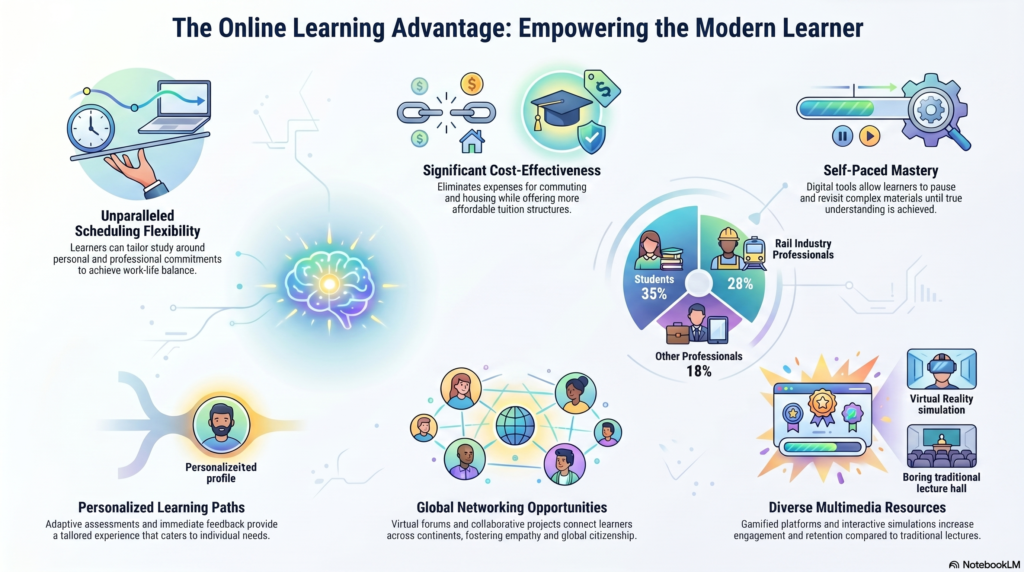
One of the most significant advantages of online learning is the unparalleled flexibility it offers in scheduling. This flexibility is particularly beneficial for students and working professionals who often juggle multiple responsibilities. The ability to engage in self-paced learning allows individuals to tailor their educational experiences to fit their unique schedules, thereby fostering a more personalized approach to acquiring knowledge.
With online courses, learners can access materials and complete assignments at times that are convenient for them. This adaptability is essential for those aiming to achieve a sustainable work-life balance. Participants can effectively allocate time for family, work commitments, and personal well-being while pursuing their educational goals. As a result, online learning not only enhances the educational experience but also contributes to overall life satisfaction.
Moreover, the flexibility in scheduling encourages a more profound engagement with the material. Learners can revisit complex concepts and take the time necessary to master them, rather than feeling rushed by traditional classroom constraints. This self-paced approach ultimately cultivates a deeper understanding, which is particularly valuable for individuals seeking to serve others in their professions.
Cost-Effectiveness
The cost-effectiveness of online learning presents a compelling advantage for students and professionals alike. As the demand for affordable education continues to rise, online learning emerges as a viable option that not only reduces tuition costs but also mitigates ancillary expenses typically associated with traditional classroom settings.
First and foremost, students can bypass the costs of commuting, housing, and other logistical arrangements, which can greatly burden their finances. By learning from home, individuals can allocate their financial resources more efficiently, channeling funds towards essential needs or furthering their education. This not only promotes financial savings but also allows for a more sustainable approach to personal and professional development.
Moreover, many online programs offer a diverse range of pricing structures, including payment plans and scholarships, enhancing accessibility to quality education. This democratization of learning fosters an environment where individuals from various economic backgrounds can pursue their goals without the intimidating weight of excessive debt.
In addition, the availability of free or low-cost online resources further contributes to the cost-effective nature of this learning modality. With a plethora of open educational resources, students can supplement their coursework without incurring additional costs.
Ultimately, the financial advantages of online learning empower learners to invest in their futures, cultivate new skills, and achieve their aspirations without succumbing to the financial strains that often accompany traditional education pathways.
Consequently, the cost-effectiveness of online learning stands as a transformative force in the landscape of education and professional training.
Access to Diverse Resources
In my research on online pedagogy, I often focus on the “silent” advantages of digital tools—the ones that go beyond just watching a video. One of the most profound benefits is the ability to create a “personalized learning path”. In a traditional lecture hall, the professor speaks at one pace, and if you miss a complex concept, the moment is gone. Online, the power is in the learner’s hands. You can pause, revisit recorded lectures, and engage with interactive simulations until you’ve achieved true mastery.
This self-paced approach fosters a deeper psychological connection to the material, which I believe is the key to long-term retention. Furthermore, I want to challenge the myth that online learning is a solitary endeavor. My experience designing AI-driven tools and asynchronous programs has shown me that the networking opportunities in virtual spaces are often more diverse than those found on a single campus.
Through global forums and collaborative projects, I’ve seen students from different continents solve engineering problems together, bringing a rich tapestry of cultural perspectives to the table. This exposure doesn’t just build technical skills; it nurtures empathy and global citizenship. When we leverage multimedia tools and virtual communities effectively, we aren’t just “teaching”, we are building a robust, interconnected professional presence for every participant.
Access to diverse resources is a hallmark of online learning, enabling students to engage with global learning materials that reflect a wide array of perspectives and knowledge bases. Another advantage of online education is that it allows students to attend classes from any location of their choice. It also allows schools to reach out to a more extensive network of students, instead of being restricted by geographical boundaries. Additionally, online lectures can be recorded, archived, and shared for future reference. This allows students to access the learning material at a time of their comfort.
Additionally, multimedia learning tools enhance the educational experience by catering to various learning styles and preferences.
The flexibility in resource availability further empowers learners to study at their own pace, making education more accessible and tailored to individual needs.
Global Learning Materials
Consistently, online learning platforms provide students with unparalleled access to a wealth of global learning materials, markedly enhancing their educational experience. This access not only fosters individual learning but also promotes global collaboration and cultural exchange, essential components in today’s interconnected world.
Students can draw from an extensive array of resources, including academic journals, e-books, and case studies originating from diverse geographical and cultural backgrounds. This exposure enables learners to appreciate various perspectives and methodologies, enriching their understanding of subjects while developing critical thinking skills.
The ability to engage with materials from different countries encourages a broader worldview and nurtures empathy, qualities crucial for serving others in an increasingly complex global landscape. Among the many benefits of an online learning, you’ll find virtual classrooms are great for people who are advancing their education while working. In a traditional classroom, lectures will be scheduled at a specific time of day and your schedule will be formed around the availability of classes. If you’re currently employed and courses aren’t available after your working hours, it can be difficult to juggle a course load in addition to your work duties.
Moreover, the integration of global learning materials supports collaborative projects that link students from various parts of the world. Such initiatives enhance communication skills and cultural awareness, preparing individuals for future roles in diverse environments.
Ultimately, the accessibility of these resources not only empowers students and working professionals but also contributes to a more informed and compassionate society, ready to tackle the challenges of global citizenship.
Multimedia Learning Tools
Multimedia learning tools have revolutionized access to diverse educational resources, greatly enriching the online learning experience. These tools leverage technology to create interactive simulations and video tutorials that cater to various learning styles, similar to how the engineering teacher demonstrates complex technical concepts through guided instruction. For instance, gamified learning platforms introduce elements of competition and rewards, motivating learners to achieve their goals while enjoying the process.
Moreover, virtual classrooms facilitate real-time interactions among students and instructors, fostering collaborative projects that enhance teamwork skills and knowledge sharing. The integration of mobile accessibility guarantees that learners can access audio resources, visual aids, and other materials anytime, anywhere, thereby breaking the constraints of traditional learning environments.
Adaptive assessments further personalize the educational journey, allowing learners to progress at their own pace and focus on areas that require improvement.
These immersive experiences not only deepen comprehension but also cultivate critical thinking and problem-solving skills essential for both students and working professionals. By harnessing these multimedia tools, online education becomes a dynamic platform, empowering individuals to pursue their learning objectives while effectively serving their communities and advancing their careers.

FLEXIBLE RESOURCE AVAILABILITY
A wealth of resources is available to learners in the domain of online education, greatly enhancing the learning process. This flexibility in resource availability empowers students and working professionals alike to engage in self-paced study, tailoring their educational journey to personal needs and schedules.
The diversity of resources fosters a rich learning environment, including structured teaching materials and activity resources similar to those found in the engineering teacher shop.
Key advantages of flexible resource availability include:
- Access to Multimedia Content: Videos, podcasts, and interactive simulations enhance engagement and comprehension.
- Global Learning Communities: Online forums and social media groups connect learners with peers and experts worldwide, facilitating knowledge exchange.
- Variety of Learning Materials: E-books, articles, and research papers provide diverse viewpoints and insights, enriching the learning experience.
- On-Demand Support: Online tutoring and mentorship programs offer assistance whenever needed, ensuring learners receive guidance in real-time.
- Customizable Learning Paths: Learners can select courses and materials that align with their career goals and interests, promoting a more effective learning journey.
Incorporating these varied resources not only supports academic success but also prepares individuals to serve effectively in their respective fields.
Enhanced Learning Experience
Many learners find that online education offers a distinctly enhanced learning experience compared to traditional classroom settings. This evolution in educational delivery is particularly useful for technical subjects, where virtual labs and simulations allow students to practice concepts commonly taught in engineering lessons.
Unlike conventional lectures, online learning environments foster a participatory atmosphere where students can interact with multimedia resources, engage in discussions, and take part in virtual simulations that bring theoretical concepts to life.
Furthermore, online education promotes peer collaboration in ways that transcend geographical limitations. Students can connect with diverse individuals from around the globe, sharing insights and perspectives that enrich their understanding of the subject matter.
This collaborative approach not only cultivates a sense of community but also encourages learners to embrace different viewpoints, enhancing critical thinking skills essential for problem-solving in today’s interconnected world.
The flexibility of online platforms allows for personalized learning experiences, enabling students to progress at their own pace and revisit materials as needed.
This adaptability is particularly beneficial for those balancing professional commitments with their educational pursuits. By tailoring learning experiences to individual needs, online education empowers learners to take ownership of their educational journeys.
Improved Time Management
One significant advantage of online learning is the improvement it offers in time management skills for students. The flexibility inherent in online education allows individuals to tailor their study schedules according to personal commitments, which is particularly beneficial for those balancing work and study.
This adaptability necessitates the development of robust self-discipline strategies and productivity techniques, fostering essential skills that extend beyond the academic domain. With online learning, the classroom comes to you. No matter what type of credential you’re interested in achieving—degree, professional certificate, qualification—you can access some of the most renowned educational institutions or industry leaders online. What’s more, you’re not limited by borders. You can find programs across the country or even across the globe, without having to factor in relocation costs to study elsewhere. Many colleges and universities also require students to pay parking fees to access the campus, which can be costly. But you won’t have to worry about that additional cost or the cost of commuting with an online program.
Students engaged in online learning often find themselves needing to prioritize tasks effectively and allocate time wisely. They learn to set realistic goals, establish deadlines, and break larger projects into manageable parts. This approach not only enhances their academic performance but also instills a sense of accountability and responsibility.
Key time management strategies that online learners can employ include:
- Creating a structured daily schedule to allocate specific time slots for studying and assignments.
- Utilizing digital tools and apps to track progress and set reminders for important deadlines.
- Establishing a dedicated study environment that minimizes distractions and maximizes focus.
- Setting short-term and long-term goals to maintain motivation and measure progress.
- Practicing self-reflection to assess the effectiveness of time management strategies and make necessary adjustments.
Networking Opportunities
Online learning not only enhances time management skills but also opens up a wealth of networking opportunities that can be significant for professional growth. The digital landscape fosters virtual connections that transcend geographical barriers, allowing students and working professionals to build meaningful professional relationships.
Engaging in online communities is essential for those seeking to expand their networks and gain industry insights. Participating in collaborative projects, whether through coursework or group assignments, can lead to valuable peer networking opportunities. Such interactions often result in partnerships that extend beyond the classroom, encouraging the sharing of ideas and experiences.
Additionally, attending industry webinars not only enriches knowledge but also facilitates connections with experts and peers alike. Mentorship programs within online learning platforms further amplify networking potential. These initiatives enable students and professionals to connect with seasoned mentors who can provide guidance, insights, and introductions to influential circles.
Social media engagement plays a significant role in this context, as platforms like LinkedIn allow individuals to showcase their work, engage in discussions, and connect with industry leaders. Moreover, alumni networks from online institutions serve as invaluable resources for ongoing support and collaboration.
These networks often host skill exchanges, fostering a culture of continuous learning and professional development. By leveraging these diverse networking opportunities, individuals can cultivate a robust professional presence, ultimately enhancing their careers and their ability to serve others effectively.
Personalized Learning Paths
Transforming the educational experience, personalized learning paths cater to the unique needs and preferences of each learner. In an era where a one-size-fits-all approach proves inadequate, personalized learning facilitates a deeper connection between the learner and the material, allowing for more effective engagement.
This tailored approach is particularly beneficial in online learning environments, where flexibility and adaptability are paramount.
Personalized learning paths leverage technology to provide customized experiences through various mechanisms, including:
- Adaptive assessments: These tools adjust the difficulty of questions based on the learner’s responses, ensuring that they are challenged appropriately while avoiding frustration.
- Individualized feedback: Immediate and specific feedback helps learners understand their strengths and areas for improvement, promoting continuous growth.
- Goal setting: Learners can establish personal objectives, allowing them to take ownership of their educational journey.
- Learning modalities: Options such as video, text, and interactive simulations cater to diverse learning styles, enhancing comprehension and retention.
- Progress tracking: Continuous monitoring of progress enables learners to visualize their achievements and stay motivated.
Incorporating these elements fosters an environment where students and working professionals can thrive.
Personalized learning paths not only enhance academic performance but also cultivate essential skills such as self-directed learning and critical thinking.

RELATED STUDIES ABOUT ADVANTAGES OF ONLINE LEARNING
In the vast landscape of education, online learning emerges as a beacon of flexibility and opportunity. It transcends geographical boundaries, allowing students and professionals to navigate their academic journeys with ease. This digital domain offers a treasure trove of resources and personalized pathways, fostering an enriched learning experience. As individuals cultivate time management skills and forge valuable connections, the horizon of knowledge expands, illuminating pathways to success and personal growth in an ever-evolving world.
High Speed Rail Learning System (HSRLS) – Taking Advantage of Online Technologies in Railway Education
- Purpose and Problem Statement
The United States is in the early stages of developing a High Speed Rail (HSR) network. However, the domestic workforce lacks the necessary experience and institutional knowledge for the planning, design, construction, and operation of such systems. Traditional in-person education and training are often prohibitively expensive and impractical for a geographically dispersed workforce. This paper describes the development and preliminary assessment of the High Speed Rail Learning System (HSRLS) , a proof-of-concept online education portal designed to address these critical workforce development gaps.
- Project Objectives and Design
Funded by the Federal Railroad Administration (FRA) and developed by Michigan Tech and MTI, the HSRLS aimed to:
- Establish an online clearinghouse for rail-related information and content.
- Connect teachers, trainers, and students across pre- and post-graduate levels.
- Collect demographic and usage data on individuals and groups interested in HSR.
The project began with a needs assessment, including a review of online education in other transportation fields (e.g., NHI, CITE) and a study of the more mature HSR education and training systems in Europe. The findings informed the design of the HSRLS, which was built using open-source tools (Joomla CMS, Moodle LMS) and launched in July 2013. Initial content focused on introductory HSR topics and was delivered in various formats, from basic recorded presentations to highly interactive JavaScript-based modules, to test user preferences.
- Key Findings: Usage and Demographics
From July 2013 to October 2014, the HSRLS demonstrated clear demand for accessible HSR education:
- Site Traffic: The site attracted over 6,300 visits from more than 4,100 unique visitors. The majority of users accessed the site via desktop computers, with mobile and tablet users spending significantly less time on site, suggesting a need for mobile optimization.
- Course Registrations: A total of 571 users registered for courses, with the introductory “HSR 101” being the most popular (339 enrollees).
- Diverse Audience: Registrants represented a wide range of backgrounds, including students (35%), rail industry professionals (28%), and other professionals (18%) . Ages were also diverse, with the largest group being 21-30 (34%), but over 20% were aged 51 or older. Organizational affiliations included Caltrans, Amtrak, and various state DOTs, confirming broad stakeholder interest.
- Key Findings: User Satisfaction and Content Format
A user satisfaction survey for the HSR 101 modules revealed:
- High Satisfaction: Respondents reported high levels of satisfaction with the course’s organization, clarity, and content, regardless of the delivery format.
- No Preference for Interactivity: Critically, there was no significant difference in user satisfaction between the highly interactive (JavaScript) modules and the more basic (PowerPoint-based) modules. However, the interactive modules required over 50% more development time.
- Technical Issues: A notable percentage of users (18-33%) reported encountering some technical “bugs,” which was attributed to the experimental nature of the proof-of-concept project.
- Conclusions and Recommendations
The HSRLS proof-of-concept successfully demonstrated that an online portal can effectively serve as a platform for HSR workforce development by reaching a geographically dispersed and professionally diverse audience. The project confirmed a strong latent demand for accessible rail education.
Key Recommendations for Future Development:
- Prioritize Content Volume over High Interactivity: Given that users showed no preference for complex interactivity, future efforts should focus on efficiently producing and releasing a high volume of content, likely in a recorded presentation format.
- Expand Content Scope: The site’s content should be broadened beyond HSR to cover a wider range of rail topics, moving closer to its goal of becoming a comprehensive clearinghouse.
- Evaluate Learning Outcomes: Future research should move beyond satisfaction surveys to measure actual learning effectiveness and compare outcomes across different delivery modes (online, face-to-face, and hybrid).
- Optimize for Mobile: With a significant portion of users accessing via mobile devices, the platform should be optimized for a better mobile learning experience.
By adopting these strategies, the HSRLS model can provide valuable, scalable, and cost-effective education to support the growing HSR industry and the broader rail sector in the US.
| REFERENCE: Pasi T. Lautala, Peter J. Haas, John L. Velat, High Speed Rail Learning System (HSRLS) – Taking Advantage of Online Technologies in Railway Education, International Journal of Transportation Science and Technology, Volume 4, Issue 2, 2015, Pages 179-196, ISSN 2046-0430, https://doi.org/10.1260/2046-0430.4.2.179. (https://www.sciencedirect.com/science/article/pii/S2046043016300685) |
A Transformer-Based Deep Learning Approach for Detecting Online Hate Speech in Spanish
- Purpose and Problem Statement
The exponential growth of social media has led to a parallel increase in online hate speech. While automatic detection is crucial for moderating content and protecting vulnerable groups, it remains a significant technical challenge. The line between free expression and hate speech is often blurry, and the problem is particularly acute for languages other than English, such as Spanish, which suffer from a lack of resources and dedicated research. This study addresses this gap by developing a high-performance, efficient model for detecting hate speech in Spanish-language online content.
- Methodology
The researchers proposed a novel approach named SHS-ALBETO (Spanish Hate Speech with ALBETO) . This is a transformer-based deep learning model, which leverages a pre-trained language model specifically designed for Spanish.
- Model Architecture: SHS-ALBETO is built on ALBETO, a lite and efficient version of the BERT model that is exclusively trained on Spanish corpora. It uses a weight-tied strategy to reduce the total number of parameters, making it faster and more efficient than full-sized models.
- Dataset: The model was trained and evaluated using the HatEval dataset, a standard benchmark from the SemEval-2019 Task 5. It contains 6,600 labeled tweets in Spanish, classified as either “hate speech” or “non-hate speech” against the targets of immigrants and women.
- Evaluation: The model’s performance was measured using standard NLP metrics: Accuracy, Precision, Recall, and Macro F1-Score (F1M). It was compared against other transformer models (multilingual BERT, BETO, DistilBETO) and against 32 state-of-the-art proposals from the last five years.
- Key Findings
- Superior Performance: SHS-ALBETO outperformed all competing models and all previous state-of-the-art proposals. It achieved the highest scores in Accuracy (0.785), Precision (0.779), and F1M (0.781), and the second-highest Recall (0.785).
- Efficiency: Compared to other Spanish-specific models, SHS-ALBETO was significantly faster. It was 8.33 times faster than BETO and 5.08 times faster than DistilBETO, while still achieving better results.
- Improvement over State-of-the-Art: On average, SHS-ALBETO improved upon previous proposals by 9.93% in Accuracy, 11.87% in Precision, 12.45% in Recall, and 10.24% in F1M scores.
- Analysis of Challenges
An in-depth error analysis revealed the primary reasons why hate speech detection remains difficult, even for the best models:
- Contextual Nuance: The biggest challenge is understanding complex linguistic features like sarcasm, irony, and rhetorical language, which can completely change the meaning of a text.
- Dialectical Variations: Spanish is spoken in many countries, and variations in dialect and phrasing can confuse models.
- Noise in Data: Social media text is often riddled with typographical and grammatical errors.
- Labeling Ambiguity: The analysis found instances where even expert human annotators disagreed on whether content constituted hate speech, highlighting the subjective nature of the task.
- Conclusion and Future Work
This study demonstrates that SHS-ALBETO provides a new state-of-the-art solution for detecting online hate speech in Spanish. Its combination of high accuracy and computational efficiency makes it a powerful and practical tool for content moderation.
Future research directions include:
- Validating the approach on new and emerging datasets, such as the one from the Hatemedia Project.
- Expanding the analysis to other platforms like online forums.
- Incorporating newer, more powerful models like GPT-based architectures.
- Exploring the use of generative adversarial networks to improve model robustness against noisy data.
| REFERENCE: Jesus M. Sanchez-Gomez, Fernando Batista, Miguel A. Vega-Rodríguez, Carlos J. Pérez, A transformer-based deep learning approach for detecting online hate speech in Spanish, Applied Soft Computing, Volume 187, 2026, 114259, ISSN 1568-4946, https://doi.org/10.1016/j.asoc.2025.114259. (https://www.sciencedirect.com/science/article/pii/S1568494625015728) |
Conventional Versus Fully Online Flipped Learning Environments: A Comparison Of Flexibility, Interaction, Flow Experience, And Student Learning Outcomes
- Purpose and Research Questions
Flipped learning has become a popular and effective pedagogical model. The COVID-19 pandemic forced a rapid shift from conventional flipped classrooms (in-person interactive sessions) to fully online flipped formats (synchronous online sessions). However, research comparing the effectiveness of these two formats has yielded mixed results, with many studies finding no significant differences in learning outcomes. This study investigates this issue by exploring potential boundary conditions, specifically flow experience—a state of deep absorption and focus in an activity. The research questions were:
- Do conventional and fully online flipped learning environments differ in perceived flexibility, interaction, flow experience, and student learning outcomes?
- Does flow experience serve as a boundary condition for the effects of these two formats on learning outcomes?
- Theoretical Framework and Hypotheses
The study builds on flipped learning research, which identifies course flexibility (control over time, place, and pace of learning) and course interaction (among students and with the instructor) as its core characteristics. It integrates Flow Theory, which posits that flow—characterized by control, focused concentration, and a loss of self-consciousness—enhances learning and is fostered by clear goals, immediate feedback, and a balance between skill and challenge.
The authors hypothesized that:
- H1: Fully online flipped learning offers greater flexibility than conventional flipped learning.
- H2: Conventional flipped learning offers greater interaction than fully online flipped learning.
- H3: Conventional flipped learning is associated with higher levels of flow experience.
- H4: Conventional flipped learning is associated with better student learning outcomes.
- H5: Flow experience mediates the relationship between flexibility/interaction and learning outcomes in conventional flipped learning, but not in fully online flipped learning.
- Methodology
The study employed a multiple case study design, comparing two iterations of the same graduate-level management course at a German university:
- Case 1 (Conventional): 67 students in a pre-pandemic semester, with weekly in-person interactive sessions.
- Case 2 (Fully Online): 69 students in the first post-pandemic lockdown semester, with weekly synchronous online sessions via Zoom (including breakout rooms).
Data was collected via questionnaires at the beginning (to ensure group comparability on factors like prior knowledge and motivation) and end of each course. Validated scales were used to measure course flexibility, interaction, flow experience, and self-reported learning outcomes. Quantitative analysis included ANOVA and mediation analysis using structural equation modeling, supplemented by qualitative analysis of open-ended student comments.
- Key Findings
The results strongly supported all hypotheses:
- Flexibility (H1): Students in the fully online format reported significantly higher levels of course flexibility.
- Interaction (H2): Students in the conventional, in-person format reported significantly higher levels of course interaction.
- Flow Experience (H3): Students in the conventional format experienced significantly higher levels of flow. Qualitative comments revealed that online students struggled with a “community feeling” and lower concentration.
- Learning Outcomes (H4): Students in the conventional format reported significantly better learning outcomes. The effect size was medium (Cohen’s d = 0.55).
- Mediating Role of Flow (H5): Mediation analysis confirmed that in the conventional format, flow experience fully mediated the relationship between flexibility/interaction and learning outcomes. In the fully online format, this mediating effect was not significant. Flexibility and interaction did not translate into learning outcomes via flow.
- Conclusion and Implications
This study provides critical insights into why conventional and fully online flipped learning environments produce different results. It demonstrates that while online formats offer greater flexibility, this advantage is offset by a significant reduction in interaction, which in turn diminishes students’ ability to enter a flow state, ultimately harming learning outcomes.
Theoretical Contributions:
- The research refines flipped learning theory by showing that its core characteristics (flexibility and interaction) have opposing advantages in different formats.
- It identifies flow experience as a critical boundary condition that explains the differential effects of the two formats. In online settings, the link between the learning environment and flow is broken.
Practical Implications for Educators:
To improve fully online flipped learning, instructors must take proactive steps to foster interaction and flow, counteracting the limitations of the medium. Recommended strategies include:
- Promoting Flow: Remind students to structure their study time and actively participate.
- Enhancing Interaction: Actively use discussion forums, chat functions, and consider emerging technologies like augmented reality (AR) to create a greater sense of presence.
- Sustaining Motivation: Exhibit immediacy, clarity, and caring behaviors to keep students engaged.
- Gamification: Integrate game-like elements, which have been shown to improve flow.
By understanding these dynamics, educators can better design both conventional and online flipped learning environments to maximize student engagement and success.
| REFERENCE: Sabrina Wittmann, Torsten Wulf, Fabian Alexander Müller, Conventional versus fully online flipped learning environments: A comparison of flexibility, interaction, flow experience, and student learning outcomes, The International Journal of Management Education, Volume 24, Issue 1, 2026, 101304, ISSN 1472-8117, https://doi.org/10.1016/j.ijme.2025.101304. (https://www.sciencedirect.com/science/article/pii/S1472811725001740) |
CONCLUSION
As we look toward the future, it’s clear that the skills cultivated through online learning, self-discipline, time management, and digital literacy, are the exact competencies required in the modern workforce. I’ve always believed that education should be a lifelong journey, not a four-year destination. The cost-effectiveness and accessibility of digital platforms ensure that financial or situational barriers no longer have to be the end of someone’s educational story. By reducing the “intimidating weight” of debt and logistical burdens like commuting, we allow learners to focus on what truly matters: their growth and their ability to serve their communities effectively.
However, as an educator, I also know that the technology is only as good as the intention behind it. While online formats offer unparalleled flexibility, we must continue to proactively foster the “flow” and interaction that lead to the best learning outcomes.
Whether you are a student just starting out or a seasoned professional looking to pivot, the digital landscape is a “treasure trove” of opportunity. I encourage you to take ownership of your educational journey, dive into the diverse resources available, and embrace the transformative power of learning in the digital age. The horizon of knowledge is expanding, and it has never been more accessible.