

As an educator who has spent years designing virtual courses across multiple continents, I know firsthand that selecting a Learning Management System (LMS) isn’t just a technical checkbox, it’s about choosing the digital heart of your classroom. I’ve often seen institutions get dazzled by flashy features while losing sight of the actual humans who will use them. When we talk about making technology a “seamless part of the learning journey,” we are talking about finding a platform that disappears into the background so that the content and the connection can shine.
In my experience, the most successful online environments aren’t necessarily the ones with the most expensive “bells and whistles,” but the ones that feel intuitive and supportive from the very first login. It’s like picking a trail for a long hike; you want something well-marked and accessible that allows you to enjoy the view, rather than spending the whole time struggling with the path itself.
This systematic approach we are about to discuss is designed to ground your decision in what truly matters: your students’ needs and your educational mission. We aren’t just buying software; we are building a space where meaningful learning can happen without technical friction getting in the way.
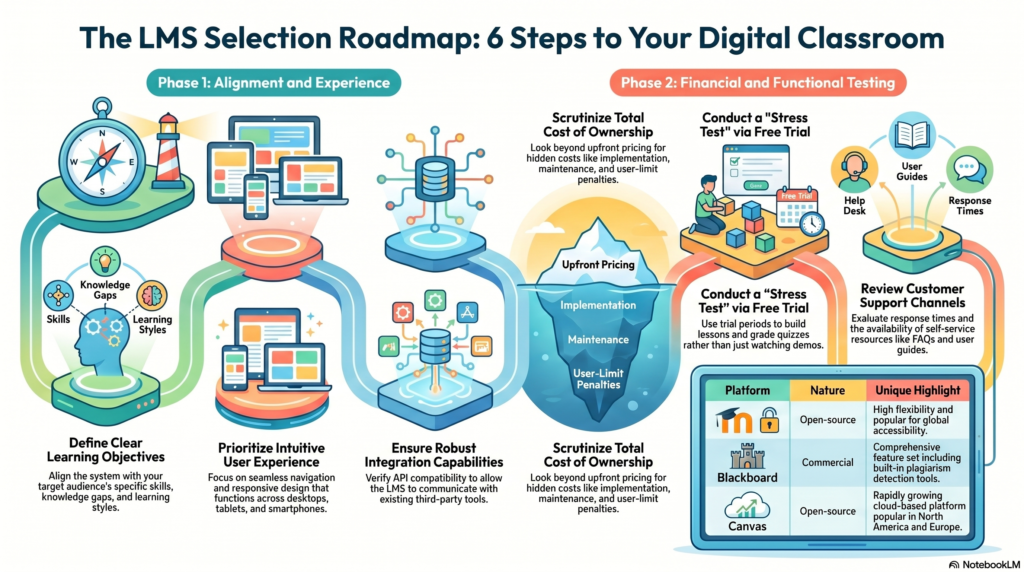
To choose the right Learning Management System (LMS), start by clearly defining your learning objectives based on the needs of your target audience. Assess the user experience, focusing on intuitive navigation and responsive design. Evaluate key features like integration capabilities and accessibility to enhance user engagement. Analyze pricing structures carefully, noting potential hidden costs, licensing options, and support services. Don’t forget to test the LMS through free trials to gauge its functionality and fit. This systematic approach will lead to a more informed decision on the most suitable LMS for your organization’s objectives and user requirements. Further insights await.
KEY TAKEAWAYS
- Define clear learning objectives to align the LMS with the needs and characteristics of the target audience.
- Assess user experience through feedback and usability testing for seamless navigation and engagement.
- Evaluate key features like integration capabilities and accessibility to enhance learning outcomes.
- Analyze pricing structures and hidden costs to ensure budget alignment and avoid unexpected expenses.
- Test with a free trial to assess the LMS’s functionality and user interface before committing.
DEFINE YOUR LEARNING OBJECTIVES
In the domain of selecting an effective Learning Management System (LMS), defining your learning objectives serves as the foundational step. Clear objectives guide the selection process, guaranteeing that the chosen LMS aligns with the needs of your target audience and supports the desired educational outcomes. Establishing specific learning goals allows organizations to create a structured roadmap that enhances the learning experience and leads to measurable outcomes.
To begin, identify the characteristics of your target audience. Understanding their skills, knowledge gaps, and preferred learning styles will inform the design of your curriculum and the features required from the LMS. Objectives should be tailored to meet the unique needs of this audience, promoting engagement and retention. A learning management system is a software or a cloud-based SaaS solution used to plan, implement, and manage an organisation’s learning processes. Used to meet the specific needs of your organisation’s eLearning, LMSs are a critical element in implementing your learning strategy, whether the focus is on increasing learner engagement, boosting employee retention, or developing the skills you need to thrive.
Next, articulate measurable outcomes that reflect the desired competencies learners should achieve upon course completion. These outcomes not only provide benchmarks for success but also facilitate the evaluation of the LMS’s effectiveness. Measurable outcomes could include improved performance metrics, skill acquisition, or increased learner satisfaction.
Assess User Experience
A seamless user experience is vital for the success of any Learning Management System (LMS), as it directly impacts learner engagement and retention. To effectively assess user experience, it is essential to incorporate user feedback and conduct usability testing throughout the selection process. This guarantees that the LMS aligns with the needs and preferences of its users, ultimately fostering a more productive learning environment.
When evaluating user experience, consider the following key aspects:
- Intuitive Navigation: Users should be able to easily find courses, resources, and support without confusion. A well-structured layout enhances accessibility and encourages exploration.
- Responsive Design: The LMS must function seamlessly across various devices, including desktops, tablets, and smartphones. A responsive design caters to learners’ diverse needs and preferences.
- Engaging Interface: An aesthetically pleasing and interactive interface can greatly boost user satisfaction. Visual elements should enhance the learning experience rather than distract from it.
- Feedback Mechanisms: Implementing features that allow users to provide feedback on their experience can highlight areas for improvement. Continuous evaluation through user feedback guarantees the LMS evolves with changing educational demands.
An engaging interface may also include structured activity materials and ready-to-use resources, similar to those available from the engineering teacher shop, which can support instructors in creating more interactive lessons.
Evaluate Key Features
When evaluating a Learning Management System (LMS), key features such as user interface design and integration capabilities are critical to take into account. Learning management systems (LMS) are e-learning tools that simplify every step of the training process. It often offers features such as content creation, learner registration, assessment tools, and reporting to create, manage, and analyze courses and learning programs.
A well-designed interface enhances learner engagement and accessibility, while robust integration options guarantee seamless connectivity with existing tools and platforms.
Prioritizing these elements can greatly affect the overall effectiveness and user satisfaction of the LMS.
User Interface Design
Effective user interface design is essential for the success of any learning management system (LMS). A well-designed interface enhances user engagement and promotes effective learning, making it vital to evaluate key features that support an intuitive and user-friendly experience.
Consider the following elements when reviewing LMS user interfaces:
- Visual Hierarchy: The arrangement of content should guide users naturally through the information, emphasizing key areas like navigation, course materials, and progress tracking.
- Intuitive Navigation: Users should easily find what they need without confusion. Clear menus, search functionality, and logical categorization contribute to a seamless experience.
- Responsive Design: The LMS should function well across various devices, ensuring that learners can access materials from desktops, tablets, or smartphones.
- Accessibility Features: Include options such as screen reader compatibility, adjustable text sizes, and color contrast settings to accommodate all users.
Integration Capabilities
User interface design sets the foundation for a positive user experience, but the effectiveness of a learning management system (LMS) is additionally enhanced by its integration capabilities. An LMS is one of the most effective ways to create, manage, and implement training content. Basically, it’s a Gartner’s definition of an LMS software platform designed to streamline your learning process and track employee training. But you can also use such cloud-based software-as-a-service (SaaS) tools as a method to educate customers or provide compliance training.
An LMS with robust integration features allows organizations to streamline processes, improve data accuracy, and enhance overall learning outcomes.
One vital aspect to evaluate is API compatibility. A well-designed API enables seamless communication between the LMS and other educational tools, facilitating the transfer of data and resources. This capability is essential for organizations that rely on a variety of third-party tools, such as assessment software, content libraries, and communication platforms.
When considering integration capabilities, assess how easily the LMS can connect with existing systems. A system that supports a wide range of third-party tools can enhance the learning environment, providing users with a cohesive experience.
Additionally, effective integration reduces redundancies and fosters collaboration among stakeholders, ultimately serving the needs of learners more effectively.
Consider Integration Capabilities
How well does a Learning Management System (LMS) integrate with existing tools and platforms? This question is crucial for ensuring a smooth user experience and maximizing the effectiveness of your educational initiatives. A well-integrated LMS can enhance collaboration and streamline processes, which ultimately contributes to improving the effectiveness of online learning for both educators and students.
A well-integrated LMS can enhance collaboration and streamline processes, making it easier to serve learners and educators alike. Here are four essential factors to evaluate regarding integration capabilities:
- API Compatibility: Assess whether the LMS supports robust APIs that allow seamless connections with other systems. This is fundamental for ensuring interoperability and enhancing functionality.
- Data Migration: Evaluate the ease of transferring existing data into the new LMS. A system that facilitates straightforward data migration can save considerable time and reduce the potential for errors.
- Third-Party Integrations: Investigate the LMS’s ability to connect with third-party applications such as CRM systems or content repositories. This can greatly enrich the learning experience by providing diverse resources and tools.
- User Experience: Reflect on how integration affects the end-user experience. An LMS that integrates well reduces friction for learners and educators, leading to higher engagement and satisfaction.

ANALYZE PRICING STRUCTURES
When we dive into the technical evaluation of an LMS, I always urge my fellow educators to look beyond the admin dashboard and see the system through the eyes of a student. In my work, I’ve found that a “seamless user experience” is often the difference between a student finishing a course or dropping out due to frustration. For instance, think about responsive design. I’ve designed courses for students who might be accessing their lessons on a smartphone while commuting in a busy city or on a tablet in a remote village.
If that interface doesn’t adapt, the learning journey hits a dead end. Similarly, integration capabilities are the invisible threads that hold a digital ecosystem together. As someone who loves seeing students collaborate, I look for systems that play well with third-party tools like communication platforms or interactive content libraries. It shouldn’t feel like a struggle to get different apps to talk to each other; it should feel like a unified experience.
And let’s be honest about the costs, nothing stalls a great educational project faster than “hidden fees” that eat up a budget meant for actual instruction. I always recommend using free trials as a “stress test”. Don’t just look at the demo; try to build a lesson, try to grade a quiz, and see if the platform supports the kind of effectiveness of online learning you are aiming for.
When selecting a Learning Management System (LMS), it is essential to analyze the various licensing options available to guarantee alignment with your organization’s needs.
Additionally, being aware of potential hidden costs can help prevent budget overruns and secure a more accurate total cost of ownership.
A thorough understanding of pricing structures will enable users to make informed decisions that support their educational objectives.
Licensing Options Comparison
Navigating through the complexities of licensing options is crucial for organizations seeking the right Learning Management System (LMS). Understanding the available structures can notably impact both operational efficiency and budget management.
Here are key licensing considerations to evaluate:
- Subscription Models: Assess whether monthly or annual subscriptions align better with your financial planning.
- Enterprise Licensing: Consider enterprise licenses that may provide thorough access for larger teams, often at a discounted rate.
- User Limits: Evaluate user limits imposed by different licensing options to verify they align with your organization’s growth projection.
- Compliance Standards: Confirm that the LMS meets compliance standards relevant to your industry, safeguarding your organization’s integrity.
Additional factors include scalability options for future expansion, content ownership rights to affirm your materials remain accessible, and understanding renewal terms to avoid unexpected costs.
Hidden Costs Awareness
Understanding hidden costs is essential for organizations evaluating Learning Management Systems (LMS), as these expenses can greatly impact the overall budget. While most LMS providers present upfront pricing, additional hidden fees can accumulate, leading to unexpected expenses that may strain financial resources.
It is vital to scrutinize the pricing structure thoroughly, paying attention to aspects such as implementation costs, ongoing maintenance fees, and charges for additional features. Often, organizations overlook costs associated with user support, training, and upgrades, which can markedly alter the total cost of ownership.
Moreover, some LMS providers may impose penalties for exceeding user limits or require costly integrations with existing systems, further obscuring the true expense of the platform.
Review Customer Support Options
A thorough evaluation of customer support options is crucial for selecting a Learning Management System (LMS) that aligns with an organization’s needs.
In a learning environment, effective customer service can greatly enhance user experience and guarantee that both instructors and learners can fully utilize the platform.
Here are four critical aspects to take into account when reviewing customer support options:
- Customer Service Channels: Identify the various channels available for support—whether through email, live chat, phone calls, or community forums. A robust LMS should offer multiple avenues for assistance to accommodate different user preferences.
- Support Response Times: Examine the responsiveness of the support team. Quick response times are imperative, especially during critical periods when users may encounter technical issues. An LMS with dedicated support teams and clear service level agreements (SLAs) can often provide timely solutions.
- Availability of Resources: Assess the availability of online resources such as FAQs, user guides, and tutorials. Extensive self-service resources empower users to troubleshoot minor issues independently.
- User Feedback and Ratings: Review testimonials and ratings from current users regarding their experiences with customer support. This qualitative data can provide insight into the consistency and quality of support offered.
Test With a Free Trial
Evaluating an LMS through a free trial is an invaluable step in the selection process, allowing organizations to gauge the platform’s functionality and suitability for their specific needs. Many vendors offer trial periods that enable potential users to explore the system’s features without committing financially. This hands-on experience is critical for making informed platform comparisons, as it provides insight into user interface, navigation, and the overall learning experience. During this evaluation stage, organizations may also explore how the platform supports remote instruction and better understand what is distance learning in practical application through the LMS features.
During the trial, organizations should focus on key functionalities relevant to their objectives, such as course creation, assessment tools, and reporting capabilities. Engaging with the platform in a real-world context allows teams to determine how well it can meet the needs of learners and instructors alike.
However, it is essential to be aware of trial limitations; some platforms restrict access to features or user accounts, which could hinder a thorough evaluation.
To maximize the benefits of a free trial, organizations should develop a structured approach, including setting specific goals and criteria for assessment. Gathering feedback from all stakeholders involved—such as educators, administrators, and learners—will provide a holistic view of the platform’s effectiveness.
Ultimately, utilizing a free trial can greatly enhance the decision-making process, ensuring the chosen LMS aligns with the organization’s mission to serve and educate effectively.

RELATED STUDIES ABOUT LIST OF LEARNING MANAGEMENT SYSTEMS
In summary, the selection of an appropriate learning management system necessitates a thorough evaluation of learning objectives, user experience, essential features, integration capabilities, pricing structures, and customer support. The process resembles traversing a medieval marketplace, where informed choices determine the value of investments. By systematically analyzing these aspects, organizations can guarantee the acquisition of a system that not only meets current educational needs but also adapts to future learning demands, fostering a robust learning environment.
Utilization of Learning Management Systems in Higher Education System – A Case Review for Saudi Arabia
- Purpose and Background
Learning Management Systems (LMS) have become integral to higher education institutions worldwide, enhancing teaching and learning through digital tools for content delivery, communication, assessment, and administration. This paper reviews the features of major commercially available LMS platforms and presents a case study on their adoption and utilization across public universities in Saudi Arabia. The study aims to understand the current landscape of LMS usage, compare system features, and identify trends and gaps, particularly regarding the integration of practical laboratory experiences.
- Key Features of LMS
The paper identifies several core benefits and features of modern LMS platforms:
- Location Independence: LMS enables educational continuity for students across multiple campuses, time zones, or those facing geographical or health barriers.
- Accessibility: Most systems support access via personal computers and mobile devices (smartphones, tablets) through web browsers or dedicated apps, accommodating the Bring Your Own Device (BYOD) trend.
- Engaging Environments: Features like gamification can make learning more attractive, particularly for younger students.
- Integration Capability: LMS platforms can be integrated with external tools and content, such as virtual or remote laboratories, to supplement missing features.
- Comparison of Major LMS Platforms
The study compares four widely used LMS platforms:
- Moodle: An open-source, free platform launched in 2002, popular globally for its flexibility.
- Blackboard: A commercial (fee-based) platform established in 1997, known for its comprehensive feature set, including tools like Safe Assignment for plagiarism detection.
- Canvas: An open-source platform introduced in 2011, which has seen rapid growth, particularly in North America and Europe.
- D2L (Desire2Learn): A cloud-based, open-source platform founded in 1999, noted for its accessibility partnerships (e.g., with the National Federation of the Blind).
A feature comparison table indicates that while all four systems offer core functionalities (discussions, file sharing, quizzes, etc.), Blackboard uniquely includes a built-in “Safe Assignment” tool for plagiarism detection.
- LMS Adoption in Saudi Arabia
The case study of Saudi Arabia’s 28 public universities reveals a distinct adoption pattern:
- Blackboard is the dominant system, used by 25 universities (89%).
- Moodle is used by 2 universities (7%).
- D2L is used by 1 university (4%).
- Canvas has no reported adoption in Saudi public universities at the time of the study.
This dominance of Blackboard is attributed to the pioneering adoption by King Abdulaziz University in 2006, a subsequent “follow-the-leader” effect among other institutions, a preference for commercially supported systems, and effective marketing by Blackboard Inc.
- Discussion and Identified Gap
The study highlights that while LMS platforms are excellent for managing course content and communication, they currently lack integrated tools for conducting hands-on laboratory experiments, which are essential for science and engineering education. The integration of virtual or remote laboratories into LMS platforms is an emerging need, with some examples found in research (e.g., using Moodle with simulation software), but it is not a standard feature.
- Conclusion and Recommendations
LMS platforms are widely and successfully used in Saudi higher education, with Blackboard holding a near-total market share. While these systems provide robust administrative and communication features, a critical gap exists in their ability to support practical, laboratory-based learning at a distance.
Key Recommendation:
Future development and research should focus on creating and integrating virtual and remote laboratory features within mainstream LMS platforms. This would enable students in engineering and science disciplines to conduct essential experiments through distance learning, thereby expanding the utility and reach of online education. Further research is also recommended to assess the capacity of Saudi Arabia’s telecommunication infrastructure to support the bandwidth demands of such implementations.
| REFERENCE: Abdulaziz Aldiab, Harun Chowdhury, Alex Kootsookos, Firoz Alam, Hamed Allhibi, Utilization of Learning Management Systems (LMSs) in higher education system: A case review for Saudi Arabia, Energy Procedia, Volume 160, 2019, Pages 731-737, ISSN 1876-6102, https://doi.org/10.1016/j.egypro.2019.02.186. (https://www.sciencedirect.com/science/article/pii/S1876610219312767) |
Maximizing Learning Management Systems in Online College English Education: Views from France and Saudi Arabia
- Purpose and Background
The COVID-19 pandemic forced a global, mandatory shift to online education, making it critical to understand how faculty across different cultural contexts perceive and adapt to this change. This study investigates the perceptions of university faculty in France and Saudi Arabia regarding the adoption of e-learning, particularly Learning Management Systems (LMS), for teaching English during the pandemic. Using the Technology Acceptance Model (TAM) as a theoretical framework, the research aimed to identify cross-cultural differences in faculty behaviors, intentions, readiness for e-learning, and the specific benefits and challenges they encountered.
- Methodology
A mixed-methods approach was employed, collecting both quantitative and qualitative data from 126 TESOL faculty members (96 from King Khalid University in Saudi Arabia and 30 from the Université de Lorraine in France). The primary instrument was the Online Learning Intentions, Behaviours, and Attitudes Survey (OLIBAS), adapted from prior research and validated through confirmatory factor analysis (Cronbach’s alpha = 0.94). The survey measured six key constructs: behavioural intentions and readiness, perceived usefulness, perceived ease of use, perceived content quality, online teaching self-efficacy, and e-course attributes. Quantitative data were analyzed using t-tests, correlation, and multiple regression. Qualitative data from open-ended questions were analyzed thematically using QSR NVivo.
- Key Findings
- Overall Readiness, but a Cultural Difference in Perceived Usefulness: Both Saudi and French faculty reported strong behavioural intentions and readiness to use LMS for teaching. However, a statistically significant difference emerged in perceived usefulness: French faculty perceived online English education as significantly more useful than their Saudi counterparts (p < 0.001). No significant differences were found between the groups on other factors like ease of use, content quality, or self-efficacy.
- Key Predictors of Readiness: Multiple regression analysis revealed that perceived ease of use (β = 0.432) and perceived usefulness (β = 0.47) were the two strongest predictors of faculty’s readiness to adopt e-learning systems. Other significant predictors included self-efficacy, content quality, and course attributes, together explaining 91% of the variance in readiness.
- Benefits and Challenges: Qualitative analysis revealed that faculty in both countries saw e-learning as:
- Essential for emergencies and a valuable complement to traditional teaching.
- A tool that enhances collaboration through shared resources and online discussions.
- Capable of increasing student engagement and enjoyment through well-designed courseware.
- However, they also noted significant challenges, including the lack of reliable technology and bandwidth for students, the tiring and arduous nature of e-teaching, and the inability of online learning to fully replace hands-on activities or ensure students are genuinely engaged.
- The Hybrid Ideal: A strong consensus emerged that blended learning—combining face-to-face instruction with online tools—is more effective than relying on a single medium, as it fosters a richer, more interactive environment.
- Conclusion and Implications
This study confirms that faculty in both France and Saudi Arabia are broadly ready for e-learning, but their perceptions of its usefulness differ, potentially influencing the depth and quality of its adoption. The findings underscore the critical role of the core TAM constructs—ease of use and usefulness—in driving faculty acceptance of technology.
Recommendations:
- For Saudi Arabia: Higher education institutions should invest in targeted training and ongoing support to help faculty fully understand and leverage the utility of LMS, thereby enhancing their perception of its value and maximizing its effectiveness in English education.
- For All Institutions: Professional development should focus on demonstrating the practical usefulness of LMS features and simplifying their use. Addressing external barriers like technology access and internet connectivity is also essential.
- Future Research: Further studies should explore the long-term impact of LMS on student learning outcomes, motivation, and critical thinking, as well as identify effective teaching methods and strategies to overcome implementation barriers in diverse educational settings.
The study provides valuable cross-cultural insights for educators, curriculum developers, and policymakers seeking to optimize the use of e-learning in higher education, both during emergencies and as a sustainable component of modern pedagogy.
| REFERENCE: Abdulaziz I. Fageeh, Maximizing learning management systems in online college English education: Views from France and Saudi Arabia, Social Sciences & Humanities Open, Volume 9, 2024, 100868, ISSN 2590-2911, https://doi.org/10.1016/j.ssaho.2024.100868. (https://www.sciencedirect.com/science/article/pii/S2590291124000652) |
Digital Transformation for Sustainable Healthcare Education – Evaluating the Impact of Moodle Learning Management System on ICD-11 Training
- Purpose and Background
The Malaysian Ministry of Health (MOH) adopted the International Classification of Diseases, 11th Revision (ICD-11) in 2019, necessitating a massive training effort for clinical coders nationwide. During the COVID-19 pandemic, face-to-face training was impossible, prompting the MOH to deploy a Moodle-based Learning Management System (LMS) as the primary platform for ICD-11 education. This study evaluates the effectiveness of this digital training initiative by assessing user satisfaction, attitudes towards the platform, and its perceived impact on clinical coding competencies. It also explores how sociodemographic and professional factors correlate with these outcomes to inform the design of more equitable and effective future training programs.
- Methodology
A cross-sectional survey was conducted from February to July 2025 among 214 MOH healthcare professionals registered on the ICD-11 Moodle LMS platform. Participants included Medical/Dental Officers, Medical Record Officers (MROs), Assistant Medical Record Officers (AMROs), and support staff from hospitals and health departments across Malaysia. The self-administered questionnaire measured:
- Satisfaction: Content clarity, system usability, overall experience.
- Attitude: Perceptions of flexibility, preference for online vs. face-to-face training.
- Impact: Self-reported improvement in knowledge, coding skills, accuracy, and confidence.
Data were analyzed using descriptive statistics, t-tests, ANOVA, and multiple linear regression.
- Key Findings
- High Satisfaction and Positive Attitudes: The majority of users were satisfied with the Moodle LMS (57.5% satisfied, 23.4% strongly satisfied). A significant 71.9% agreed that the platform offered more flexibility than traditional training. However, a strong preference for face-to-face training persisted (75.2% agreed/strongly agreed they preferred it), indicating a desire for blended learning.
- Positive Impact on Skills, with a Caveat: Most participants agreed that the LMS improved their basic medical knowledge (82.2%), clinical coding skills (80.8%), and coding accuracy (81.8%). However, the perceived impact on confidence to code independently was notably lower (76.6%), suggesting a gap between theoretical knowledge and practical, self-reliant application.
- Professional Differences in Attitude: Significant differences in attitudes were found based on occupation. The Assistant Medical/Dental Officer or Nurse group had significantly more positive attitudes towards the LMS than Medical/Dental Officers and MROs. This is likely because support staff perform coding as a core daily task, while officers face new coding responsibilities on top of existing clinical duties.
- Key Predictors of Success:
- Level of education was a significant predictor of both satisfaction and perceived impact. Higher educational attainment correlated with more positive outcomes, suggesting greater adaptability to new learning technologies.
- Occupation and ethnicity were significant predictors of attitude towards the platform.
- Conclusion and Implications
The ICD-11 Moodle LMS proved to be a viable and effective tool for large-scale knowledge transfer during a critical transition period, especially under the constraints of a pandemic. It successfully delivered foundational knowledge and was well-received for its flexibility. However, the findings reveal that digital training alone has limitations, particularly in building the practical confidence needed for independent clinical coding.
Key Recommendations:
- Adopt a Blended Learning Approach: The MOH should develop a hybrid training model that combines the scalability and flexibility of the Moodle LMS with the interactive depth and hands-on practice of face-to-face instruction to fully master ICD-11.
- Tailor Interventions to Learner Profiles: Training programs must be customized to account for differences in occupational roles, educational backgrounds, and cultural/ethnic contexts. For example, officers with added coding responsibilities may need additional support and advocacy to understand the importance of this task.
- Address the Confidence Gap: Future iterations of the training should include elements specifically designed to build practical confidence, such as more interactive case studies, virtual simulations, or follow-up mentoring.
- Improve the Predictive Model: Future research should incorporate additional variables like prior e-learning experience, individual learning styles, and the quality of technical support to better understand the drivers of online learning success.
By embracing a tailored, blended strategy, the MOH can build a more competent, confident, and sustainable healthcare workforce ready to leverage digital tools for continuous professional development.
| REFERENCE: Ahmad Soufi Ahmad Fuad, Erwyn Chin Wei Ooi, Azman Ahmad, Nuraidah Mohd Marzuki, Digital transformation for sustainable healthcare education: Evaluating the impact of Moodle learning management system on ICD-11 training, Informatics and Health, Volume 3, Issue 1, 2026, Pages 10-18, ISSN 2949-9534, https://doi.org/10.1016/j.infoh.2025.12.003. (https://www.sciencedirect.com/science/article/pii/S2949953425000475) |
CONCLUSION
Ultimately, making an informed decision about your LMS is about ensuring that your investment pays off in the form of student success and teacher satisfaction. I often think of this process like painting a large-scale mural; you need the right canvas and the right quality of brushes before you can ever hope to create something beautiful. If the foundation is shaky, the art suffers. The studies we’ve looked at, from higher education in Saudi Arabia to healthcare training in Malaysia, remind us that technology is a tool for equity and continuity, especially during times of global change.
But they also highlight a vital truth I’ve seen in my own career: even the best LMS cannot fully replace the human element of teaching. This is why I am such a strong advocate for a blended approach, using the LMS to handle the logistics and foundational knowledge so that we can use our face-to-face (or synchronized virtual) time for deep discussion and hands-on application.
As you move forward, keep your learning objectives as your North Star. If you stay focused on how the technology serves the learner, you’ll find that the “full potential” of online education isn’t just a goal, it’s a reality you can build every day. Let’s make sure our digital tools empower us to be better teachers and more inspired learners.