
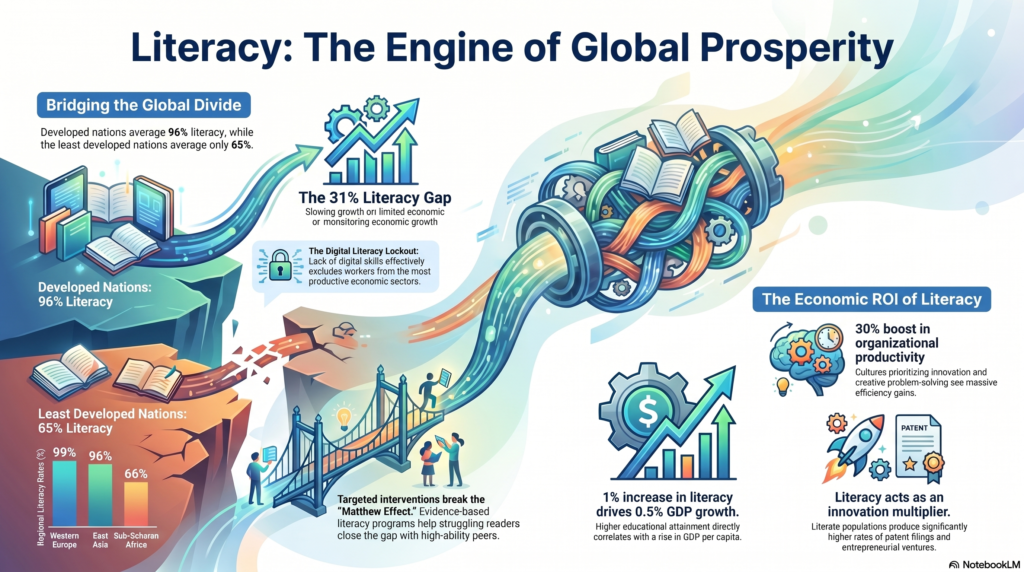
When I look at a spreadsheet of global economic indicators, my eyes don’t immediately jump to GDP or inflation rates; I look for the literacy data. As a data analyst, I’ve learned that while market trends are often just “noise,” literacy is the “signal” that tells us where a nation is actually headed over the next twenty years. We often talk about educational attainment in abstract, lofty terms, but the numbers give us a much more grounded reality: a simple 1% increase in educational attainment can drive a 0.5% rise in GDP per capita.
That isn’t just a dry statistic; it is a profound lever for economic transformation. In my years analyzing large-scale datasets, I’ve seen how higher literacy serves as the fundamental floor for a competent labor pool. It’s the difference between a workforce that just follows instructions and one that innovates and solves complex problems.
We have to stop viewing literacy as merely a social “good-to-have” and start treating it as the most critical institutional performance indicator we have. When we bridge the gap between 65% literacy in developing nations and the 96% seen in developed ones, we aren’t just teaching people to read; we are unlocking a massive, dormant engine of global productivity that has the power to reshape the entire world economy.
Global literacy rates greatly impact economic growth by shaping the workforce’s capabilities. Higher literacy facilitates a more competent and productive labor pool, enhancing innovation and creativity. For instance, a 1% increase in educational attainment can result in a 0.5% rise in GDP per capita. However, regional disparities, particularly in sub-Saharan Africa and South Asia, hinder equitable economic development. Prioritizing literacy initiatives can mitigate these challenges, fostering long-term benefits such as reduced poverty and improved job opportunities. Understanding the nuances of this relationship reveals deeper implications for future economic strategies and policies.
KEY TAKEAWAYS
- Higher literacy rates correlate with a more competent workforce, enhancing overall productivity and economic growth.
- Improved literacy fosters creativity and innovation, driving advancements in various industries.
- A 1% increase in educational attainment can boost GDP per capita by 0.5%, illustrating the economic impact of literacy.
- Disparities in literacy levels, especially in rural areas, hinder economic development and exacerbate inequalities.
- Investment in literacy initiatives leads to better job market outcomes and increased economic mobility opportunities for individuals.
THE LINK BETWEEN LITERACY AND ECONOMY
Literacy serves as a fundamental pillar for economic advancement, underpinning various dimensions of growth and development. The relationship between literacy and economic prosperity is multifaceted, heavily influenced by effective literacy policies and education funding. Countries that prioritize literacy initiatives often witness significant improvements in workforce productivity and innovation, leading to enhanced economic performance.
Digital literacy has emerged as a significant component in today’s economy, where technological proficiency is increasingly demanded. As industries evolve, the ability to navigate digital environments becomes essential for job seekers. Investing in adult education programs that focus on digital skills not only empowers individuals but also fosters a more competent labor force.
Furthermore, community engagement plays a critical role in supporting these educational initiatives, as local partnerships can amplify resources and reach diverse populations. As a whole, the global literacy rate is high. The literacy rate for all males and females that are at least 15 years old is 86.3%. Males aged 15 and over have a literacy rate of 90%, while females lag only slightly behind at 82.7%. However, massive country-to-country differences exist. Developed nations almost always have an adult literacy rate of 96% or better. In contrast, the least developed nations manage an average literacy rate of only 65%. Direct country-to-country comparisons of literacy tend to be inexact. This is due mainly to two confounding factors: Many countries do not report their literacy every year, and many countries have mismatched definitions as to what qualifies as literacy.
In addition, addressing early childhood literacy is essential for long-term economic sustainability. Research indicates that robust early literacy programs can lead to better educational outcomes, reducing the need for remedial interventions later in life.
Additionally, language diversity within a population necessitates thoughtful curriculum development that embraces multicultural perspectives, ensuring that all individuals have equitable access to literacy resources.
Global Literacy Rate Trends
Recent data reveals a gradual yet significant upward trend in global literacy rates over the past few decades. This enhancement can be attributed to a combination of literacy initiatives, educational access improvements, and the increasing integration of technology in educational frameworks. As countries have adopted innovative policy frameworks, there has been a marked increase in community engagement aimed at promoting both youth education and adult literacy.
The table below illustrates the literacy rate trends across different regions, highlighting the effectiveness of global partnerships and targeted reading programs.
| Region | Literacy Rate (%) |
| Sub-Saharan Africa | 66 |
| South Asia | 74 |
| East Asia | 96 |
| Latin America | 94 |
| Western Europe | 99 |
Cultural influences play an essential role in shaping these trends, as they determine the acceptance and implementation of literacy initiatives. Nations that have actively fostered collaboration between governments, NGOs, and local communities have witnessed remarkable improvements in literacy rates. The continued focus on technological integration in educational systems has further enhanced accessibility, particularly in underserved areas.
As we move forward, sustaining this upward trend in global literacy rates will require ongoing commitment to inclusive educational practices and the reinforcement of community-driven programs. By leveraging the strengths of global partnerships, we can guarantee that literacy remains a priority and a fundamental tool for economic growth.
Impact on Workforce Productivity
From a measurement perspective, the correlation between literacy and innovation is one of the most reliable “multipliers” in existence. When a population is literate, they aren’t just consuming information, they are creating it. Countries that prioritize these initiatives consistently see a spike in patent filings and entrepreneurial ventures because their citizens have the foundational tools to translate abstract knowledge into practical, marketable applications. But we have to be careful with the data because regional disparities can hide the real story.
For instance, while the global literacy rate sits at roughly 87%, that number masks the “literacy gaps” found in rural areas and underserved regions like sub-Saharan Africa. These aren’t just gaps in reading ability; they are gaps in economic mobility. If a worker lacks digital literacy in today’s tech-driven market, they are effectively locked out of the most productive sectors of the economy.
My work often involves looking at longitudinal data, and the trend is clear: investment in early childhood and adult education reduces the need for expensive remedial interventions later. By integrating real-world problem solving, much like the practical engineering lessons that encourage analytical thinking, we can foster the exact type of creative mindset that drives a 30% improvement in organizational productivity. Data shows that literacy isn’t just about the individual; it’s about building a resilient, adaptable society.
The relationship between literacy rates and workforce productivity is multifaceted, impacting skilled labor availability, innovation, and economic mobility opportunities. Literacy empowers and liberates people. Beyond its importance as part of the right to education, literacy improves lives by expanding capabilities which in turn reduces poverty, increases participation in the labour market and has positive effects on health and sustainable development. Women empowered by literacy have a positive ripple effect on all aspects of development. They have greater life choices for themselves and an immediate impact on the health and education of their families, and in particular, the education of girl children.
Higher literacy levels correlate with a more competent workforce, enhancing both individual and collective productivity.
Furthermore, improved literacy fosters an environment conducive to creativity and innovation, driving economic growth and expanding employment prospects.
Skilled Labor Availability
A highly skilled labor force is essential for maximizing workforce productivity, as it directly influences a nation’s economic growth and competitive edge. The availability of skilled labor correlates strongly with educational attainment levels within a population.
Countries with higher literacy rates often experience an increase in the number of individuals pursuing advanced education and vocational training, leading to a more competent workforce. Data from the World Bank indicates that a 1% increase in educational attainment can result in a 0.5% increase in GDP per capita. This relationship underscores the importance of investing in education to cultivate a skilled labor pool.
Additionally, the demand for skilled labor continues to rise in various sectors, including technology, healthcare, and engineering, where complex problem-solving and technical skills are paramount.
The implications of skilled labor availability extend beyond mere economic metrics; they also enhance a society’s capacity for resilience in the face of global challenges. By fostering a culture that values education and skill development, nations can guarantee that their workforce is not only productive but also adaptable, ultimately contributing to sustainable economic growth and improved quality of life for all citizens.
Innovation and Creativity
Innovation and creativity serve as critical drivers of workforce productivity, with studies indicating that organizations fostering these elements can experience productivity improvements of up to 30%. The ability to engage in creative thinking allows employees to devise innovative solutions to complex problems, thereby enhancing operational efficiency. Access to educational resources greatly influences this capability, equipping the workforce with the knowledge necessary for effective problem solving.
Moreover, technology integration plays a pivotal role in facilitating collaborative projects, which harness diverse perspectives and skills. Such collaboration not only enriches the creative process but also encourages the entrepreneurial spirit essential for maneuvering today’s fast-paced economic environment.
Cultural influences also shape how creativity manifests within teams, as varied backgrounds foster a broader range of ideas and approaches. Organizations that prioritize a culture of innovation are more adept at adapting to market changes, ultimately leading to sustained economic growth. Educators who integrate real-world problem solving—much like the engineering teacher guiding students through applied technical concepts—can help cultivate the innovative mindset required in modern economies.
Economic Mobility Opportunities
Access to economic mobility opportunities greatly influences workforce productivity by enabling individuals to improve their skills and advance their careers. Educational access is a fundamental component of this equation, as it equips individuals with essential knowledge and competencies. Socioeconomic factors often dictate the level of access one has to quality education and workforce training programs, making it essential for policies to address these disparities.
Community engagement plays a significant role in fostering environments conducive to lifelong learning. Programs that promote family literacy and digital literacy not only empower individuals but also enhance their ability to adapt to evolving job markets.
Moreover, financial literacy enables workers to make informed decisions, contributing to overall economic stability and growth.
Cultural attitudes towards education and skill development markedly impact participation in these opportunities, which can lead to enhanced productivity. The policy implications of improving educational access and promoting workforce training are profound, as they can create a more skilled labor force capable of driving economic growth.
Ultimately, addressing these interconnected factors fosters a cycle of empowerment, benefiting individuals, families, and communities alike.

LITERACY AND INNOVATION CAPABILITIES
High literacy rates play a crucial role in enhancing a country’s innovation capabilities, directly influencing its economic growth trajectory. A well-educated population equipped with strong literacy skills is more adept at engaging with and utilizing emerging literacy technology, fostering an environment conducive to innovative thinking and problem-solving.
Studies indicate that countries investing in education yield higher levels of research and development, which are essential components of innovation. Education investment is paramount in this regard; investing in quality education leads to a workforce that not only understands complex concepts but also possesses the ability to apply them creatively. Integrating STEM-focused approaches, including practical engineering lessons, can further strengthen literacy by encouraging analytical thinking and real-world application of knowledge.
For instance, nations that prioritize literacy and education often witness a significant increase in patent filings and entrepreneurial ventures. These activities are indicative of a vibrant innovation ecosystem, where individuals can translate knowledge into practical applications.
Moreover, high literacy rates correlate with improved communication skills, enabling collaboration across diverse fields. This interdisciplinary approach is crucial in today’s interconnected world, where innovation often arises from the intersection of different domains.
Consequently, countries that enhance literacy through sustained education investment are likely to experience a multiplier effect on their overall economic performance.
Regional Disparities in Literacy
Regional disparities in literacy rates present significant challenges to economic development, as variations in educational access and quality can hinder growth potential. According to data compiled by Our World in Data and the World Bank, the literacy rate of the world’s population from secondary school age onward was only 12 percent in 1820 – around one person in ten. In 1900, it still barely exceeded 20 percent. From the 1950s on, world literacy began to take off, hitting 42 percent in 1960 and 70 percent in 1983. Today, the global literacy rate stands at 87 percent, or almost nine out of ten people worldwide.
Data indicate that regions with lower literacy rates often experience stagnated economic progress, exacerbating inequalities.
This analysis will explore the extent of these literacy gaps by region and their implications for overall economic performance.
Literacy Gaps by Region
How do literacy rates differ across various global regions, and what implications do these disparities hold for economic development?
Literacy gaps remain pronounced across regions, greatly influenced by urban and rural divides. Urban literacy rates typically outpace those in rural areas, where educational access is often limited due to socioeconomic factors, inadequate infrastructure, and insufficient community engagement.
Child literacy rates are particularly concerning in underdeveloped regions, where cultural influences and language barriers hinder educational attainment. For example, countries in sub-Saharan Africa and South Asia exhibit lower levels of child literacy, adversely affecting adult education and lifelong learning opportunities.
Moreover, digital literacy is increasingly essential in a globalized economy; regions with high urban literacy often correlate with better access to digital resources. Conversely, rural education initiatives lag, leaving many individuals unprepared for a technology-driven workforce.
Addressing these disparities requires targeted interventions that enhance educational access and promote inclusivity. By fostering community engagement and leveraging local resources, stakeholders can work to bridge these literacy gaps, ultimately contributing to more equitable economic growth across the globe.
Impact on Economic Development
Across the globe, disparities in literacy rates greatly influence economic development, shaping the potential for growth and innovation within various regions. Regions with high literacy rates tend to experience accelerated economic advancement, as a skilled workforce is essential for attracting investment and fostering entrepreneurship.
Conversely, areas with low literacy face significant challenges, including language barriers and insufficient access to adult education, which hinder workforce participation and productivity.
Early childhood education plays a vital role in establishing a foundation for lifelong learning, while vocational training programs address specific skill gaps in the labor market. The integration of digital literacy into educational curriculums has become increasingly important in a technology-driven economy, as it equips individuals with necessary competencies to thrive in various sectors.
Community engagement initiatives can promote educational equity by ensuring that underserved populations receive targeted support.
Policymakers must recognize the profound policy implications of literacy disparities and prioritize investments in education infrastructure, adult education programs, and inclusive strategies that foster equitable access to resources.
Challenges in Improving Literacy
Improving literacy rates globally faces a multitude of challenges that are often interlinked with socio-economic factors. One of the most pressing issues is the disparity in access to educational resources, particularly in low-income regions. Insufficient funding for schools limits the availability of materials and trained educators, hindering early childhood development and adult education initiatives. Educators may also rely on specialized instructional resources, such as materials available through the engineering teacher shop, to support engaging literacy and STEM-integrated learning experiences.
Moreover, a significant gap exists in digital literacy, as many individuals lack the necessary technology access to benefit from online learning resources, which is increasingly essential in today’s economy.
Cultural barriers also play an important role in literacy challenges. Language diversity within communities can create obstacles for both instruction and learning, as educational materials may not be available in all native languages. This can lead to disengagement from educational programs, further perpetuating low literacy rates.
Policy initiatives aimed at improving literacy must address these barriers while promoting inclusive community programs that cater to diverse populations, ensuring that all individuals have the opportunity to learn.
Additionally, socioeconomic factors contribute to the cycle of illiteracy. Families facing economic hardships may prioritize immediate survival over education, resulting in children dropping out of school to support household income.
To combat these challenges, targeted interventions are essential. By investing in community-based education initiatives and fostering partnerships between governments, NGOs, and local organizations, stakeholders can create a more equitable landscape for literacy advancement.
Addressing these multifaceted challenges is vital for achieving sustainable improvements in global literacy rates.
Long-term Economic Benefits of Literacy
The challenges in improving global literacy rates underscore the importance of addressing these issues not only for individual empowerment but also for broader economic development. Literacy, particularly digital literacy, plays a significant role in fostering lifelong learning and equipping individuals to navigate an increasingly complex job market. As nations invest in educational policies that promote literacy, they lay the groundwork for sustainable economic growth.
The long-term economic benefits of improved literacy extend beyond the individual, influencing community engagement and overall socioeconomic conditions. Higher literacy rates are linked to increased productivity and innovation, which are essential for global competitiveness. However, access barriers remain prevalent, often exacerbated by socioeconomic factors and cultural influences that hinder equitable access to education.
The following table summarizes the key long-term economic benefits of literacy:
| Benefit | Description | Impact on Economy |
| Increased Workforce Productivity | Literate workers contribute more effectively to tasks. | Higher output and efficiency. |
| Enhanced Innovation | A literate population drives creativity and new ideas. | Promotes technological advancements. |
| Better Health Outcomes | Literacy improves understanding of health information. | Reduces healthcare costs. |
| Greater Civic Participation | Literate individuals are more likely to engage in governance. | Strengthens democratic processes. |
| Economic Mobility | Education leads to better job opportunities. | Reduces poverty and inequality. |

RELATED STUDIES ABOUT GLOBAL LITERACY RATES
To sum up, the relationship between global literacy rates and economic growth is unequivocally significant. Although some may argue that factors such as technological advancement or natural resources play a more critical role in economic development, the data consistently demonstrates that a literate workforce enhances productivity, fosters innovation, and drives sustainable growth. Consequently, investing in literacy initiatives emerges as a pivotal strategy for nations aiming to improve their economic prospects and reduce disparities in global development.
Exploring ChatGPT Literacy in Language Education – A Global Perspective and Comprehensive Approach
- Purpose and Background
The rapid integration of Generative AI, particularly ChatGPT, into education presents both transformative opportunities and significant challenges. While its potential for language learning and teaching is immense, there is a critical lack of comprehensive frameworks to guide its effective and ethical use. This study addresses this gap by introducing and validating the concept of ChatGPT literacy specifically for language teachers. The research aims to delineate the essential competencies teachers need to proficiently and ethically use ChatGPT as a pedagogical tool, and to understand current practices and challenges from a global perspective.
- Theoretical Framework
The study proposes a six-construct theoretical framework for ChatGPT literacy, defining it as the competencies involved in leveraging ChatGPT’s educational potential while mitigating its limitations, critically appraising its responses, designing effective prompts, adopting it for assessment, and ensuring its ethical use. The six key constructs are:
- Benefits: Understanding ChatGPT’s pedagogical affordances.
- Limitations: Recognizing its inaccuracies, biases, and shortcomings.
- Prompts: Mastering prompt engineering to elicit useful responses.
- Evaluation: Critically appraising the accuracy, relevance, and bias of ChatGPT’s output.
- Assessment: Using ChatGPT appropriately for formative and summative assessment.
- Ethics: Adhering to principles of privacy, security, and academic integrity.
- Methodology
A mixed-methods approach was employed. An online survey was completed by 492 language teachers from 41 countries across six continents. The survey included:
- 26 Likert-scale items designed to measure the six proposed constructs of ChatGPT literacy.
- Two open-ended questions exploring how teachers use ChatGPT and the challenges they face.
Quantitative data were analyzed using item analysis, reliability testing (Cronbach’s alpha), and Confirmatory Factor Analysis (CFA) to validate the framework. Qualitative data were analyzed using thematic analysis.
- Key Findings
- Validation of the Framework: CFA confirmed that the six-construct model provided an excellent fit to the data, outperforming simpler one-, two-, or three-construct models. This empirically validates the proposed framework for ChatGPT literacy.
- Literacy Levels: Teachers demonstrated a medium-high level of overall ChatGPT literacy. They scored highest on understanding benefits and ethics, and lowest on assessment and prompts, indicating key areas for professional development.
- Integration Across the Instructional Cycle: Qualitative data revealed that teachers integrate ChatGPT across all three phases of instruction: before (material preparation), during (classroom activities, formative assessment), and after (feedback, student self-learning, summative assessment). Writing was the most frequently mentioned skill area.
- Key Challenges: Teachers identified seven main challenges, five of which directly align with the framework’s constructs: limitations (e.g., inaccurate or generic content, fostering student dependency), access (e.g., internet/device restrictions, policy bans), ethics (e.g., privacy, misuse), evaluation (of AI output), prompts (difficulty crafting effective ones), assessment (difficulty measuring true ability), and teacher readiness (lack of knowledge or pedagogical know-how).
- Conclusion and Implications
This study makes a significant contribution by providing a theoretically grounded and empirically validated framework for ChatGPT literacy in language education. It reveals that while teachers are generally aware of ChatGPT’s benefits and ethical considerations, they require targeted support in practical areas like prompt engineering and assessment integration.
Implications for Stakeholders:
- For Language Teachers: Professional development should prioritize training in prompt engineering and assessment design with ChatGPT. Collaborative, TPACK-informed workshops and knowledge-sharing sessions are recommended.
- For Language Learners: ChatGPT can be used for personalized, interactive learning and immediate feedback. Students should be taught to critically evaluate and creatively use AI for higher-level tasks.
- For AI Developers: Tools should be refined to provide contextually appropriate feedback, with features tailored for educational settings. Collaboration with educators is key.
- For Policymakers: Policies must ensure equitable access to technology and prioritize teacher professional development that blends technical skills with pedagogical strategies. A disparity in focus between tertiary and school-level integration was noted, calling for more resources for K-12 educators.
The framework offers a foundational tool for assessing needs, designing training, and guiding the responsible and effective integration of ChatGPT and other GenAI tools in language education and beyond.
| REFERENCE: Qing Ma, Peter Crosthwaite, Daner Sun, Di Zou, Exploring ChatGPT literacy in language education: A global perspective and comprehensive approach, Computers and Education: Artificial Intelligence, Volume 7, 2024, 100278, ISSN 2666-920X, https://doi.org/10.1016/j.caeai.2024.100278. (https://www.sciencedirect.com/science/article/pii/S2666920X2400081X) |
Using the Reading Sciences and Technology for Teaching and Learning in the Global South
- Purpose and Background
Persistent literacy challenges in the Global South, exacerbated by pandemic-related schooling disruptions, threaten the academic and economic futures of millions of children. In Kenya and Rwanda, national assessments reveal that a majority of students leave early primary grades without foundational reading skills. This study evaluates the effectiveness of a comprehensive intervention combining a technology-based blended teacher professional development (TPD) program with the use of ABRA-READS interactive literacy software in early-primary classrooms. The intervention aims to shift teacher practice toward evidence-based, student-centered instruction and improve student reading outcomes, with a particular focus on vulnerable learners—girls and struggling readers.
- Methodology
A quasi-experimental pretest-posttest design was employed with matched experimental and control groups in two countries:
- Kenya: 22 teachers (11 experimental, 11 control) and 1,341 students (Grades 2-3).
- Rwanda: 20 teachers (10 experimental, 10 control) and 1,002 students (Grade 2).
The intervention featured:
- Blended TPD: A 20-week program covering alphabets, fluency, and comprehension, delivered through in-person sessions, online web-conferencing, and WhatsApp support. It was grounded in the science of reading, the TPACK framework, and adult learning principles.
- Classroom Software: ABRA (interactive literacy activities) and READS (digital library with 2,500+ books) were integrated into at least one English lesson per week (~20 hours total exposure).
Student reading was measured using the standardized GRADE test. Teacher practice was assessed via pre/post surveys, classroom observations, and software trace data. Data were analyzed using Hierarchical Linear Modeling (HLM) to account for classroom-level clustering.
- Key Findings
- Student Reading Achievement: Experimental students significantly outperformed control students, with a medium-to-large adjusted effect size (d ≈ 0.75). HLM models showed a consistent treatment effect of 9-15 points on the GRADE posttest after controlling for pretest scores, gender, and classroom clustering.
- Equitable Effects: The intervention was equally effective for boys and girls, demonstrating that gender-sensitive content benefits all learners.
- Largest Gains for Struggling Readers: Although the treatment-by-ability interaction was not statistically significant, subgroup analyses showed the strongest effects for low-ability readers (adjusted d ≈ 1.28). By posttest, struggling readers in experimental classes had nearly closed the gap with higher-ability readers in control classes, suggesting the intervention can mitigate the “Matthew effect” (the tendency for initial advantages to accumulate).
- Teacher Practice Transformation: Experimental teachers shifted significantly toward balanced, student-centered literacy instruction. Classroom observations showed increased frequency of word-level (phonics) and text-level (comprehension) activities, greater use of group work, and improved student-software interaction. Self-reports confirmed significant gains in teaching phonics and comprehension.
- Implementation Fidelity: Trace data showed students averaged 276-400 minutes of software use, primarily on alphabet activities. Teachers successfully integrated technology despite real-world challenges (e.g., power outages, high student-teacher ratios).
- Conclusion and Implications
This research provides robust evidence that a well-designed, technology-supported intervention can significantly improve early-grade reading outcomes in resource-constrained LMIC contexts. The success is attributed to the synergistic combination of:
- Evidence-based TPD that equipped teachers with knowledge, pedagogy, and ongoing support.
- Effective software tools (ABRA-READS) designed around the science of reading, providing differentiated, engaging, and gender-sensitive instruction.
Key Implications:
- For Policy and Practice: The intervention offers a scalable, sustainable model for addressing learning poverty. It demonstrates that with appropriate training and tools, teachers can adopt sophisticated, learner-centered practices that benefit all students, especially the most vulnerable.
- For Equity: The disproportionate gains for struggling readers suggest that such interventions can help break cycles of disadvantage, a core goal of global literacy initiatives (SDG 4).
- For Future Research: Randomized controlled trials with larger samples and longer follow-up are needed to isolate the effects of TPD from the software, assess long-term sustainability, and examine policy factors enabling scale-up.
- Strengths and Limitations
Strengths include the use of standardized assessments, rigorous HLM analyses, robustness checks against regression-to-the-mean, and implementation in authentic, challenging classroom conditions. Limitations include the quasi-experimental design (non-random assignment), sample attrition, and differential implementation timelines between countries. Nevertheless, the consistency of positive effects across contexts strengthens confidence in the findings.
| REFERENCE: Larysa Lysenko, Philip C. Abrami, Alexandra Gottardo, Eileen Wood, Anne Wade, Enos Kiforo, Jean Baptiste Maniraguha, Abraham Shivachi, Rose Iminza, Clifford Ghaa, Nancy Del Col, Maina WaGioko, Egidia Umutesi, Using the reading sciences and technology for teaching and learning in the Global South, Learning and Instruction, Volume 101, 2026, 102259, ISSN 0959-4752, https://doi.org/10.1016/j.learninstruc.2025.102259. (https://www.sciencedirect.com/science/article/pii/S0959475225001835) |
Global Motivation to Learn and Adult Learning – A Nomological Network Analysis and a Four-Year Longitudinal Study
- Purpose and Background
Lifelong learning is essential in modern societies, but adult participation in education and training (PAE) is not fully explained by sociodemographic factors alone. This study investigates the role of a global motivation to learn (MtL) —conceptualized as a relatively stable, context-independent disposition to value and engage in learning activities. The research has two main aims: (1) to establish the nomological network of global MtL by examining its relationship with established motivational and personality constructs, and (2) to test its prospective predictive validity for actual participation in adult education and training using longitudinal data.
- Methodology
The research comprises two studies:
- Study 1 (Nomological Network): An online survey of 747 German adults (65.1% female, mean age 43.2 years) measured MtL alongside mastery goal orientation, intrinsic task value, academic self-concept, need for cognition, locus of control, and the Big Five personality traits (openness, conscientiousness, agreeableness). Confirmatory factor analysis (CFA) and latent variable correlations were used to map the network.
- Study 2 (Longitudinal Predictive Validity): Data from the German extension of the Programme for the International Assessment of Adult Competencies (PIAAC-L), a representative longitudinal study spanning 2012 to 2016. The sample included 4,191 adults at baseline (2012), with follow-ups in 2015 (n=2,502) and 2016 (n=2,370). Structural equation modeling (using WLSMV estimation) tested whether MtL measured in 2012 predicted various forms of PAE (job-related, non-job-related, informal, and planned) up to four years later, controlling for age, sex, education level, employment, and literacy.
- Key Findings
- Study 1 (Nomological Network): MtL was strongly correlated with conceptually related constructs, including mastery goal orientation (r = 0.70), need for cognition (r = 0.66), intrinsic task value (r = 0.57), and academic self-concept (r = 0.56) . It showed moderate correlations with openness (r = 0.40) and conscientiousness (r = 0.29), and a weak, non-significant correlation with agreeableness, supporting discriminant validity. MtL also showed small-to-moderate correlations with past and planned PAE, strongest for informal learning (r = 0.24) and planned informal learning (r = 0.39).
- Study 2 (Longitudinal Predictive Validity): MtL significantly predicted PAE in the majority of models, even after controlling for powerful sociodemographic factors. Key findings include:
- Cross-sectional (2012): MtL significantly predicted both job-related and non-job-related PAE.
- Longitudinal (2012 → 2015): MtL significantly predicted job-related PAE three years later.
- Longitudinal (2012 → 2016): MtL significantly predicted job-related, non-job-related, and informal PAE four years later, as well as planned future participation.
- Robustness: The effect of MtL remained significant even when including literacy, a strong predictor, in most models.
- Openness: When tested, openness did not significantly predict subsequent PAE, highlighting the unique predictive power of MtL.
- Interaction with Education: Although not statistically significant, the pattern of results suggested that MtL may be a stronger predictor for individuals with lower levels of education (non-academic), consistent with the idea that motivation matters more when contextual support is weaker.
- Conclusion and Implications
This research provides robust evidence that global motivation to learn is a distinct and important predictor of adult participation in education and training. It is conceptually related to but distinct from both other motivational constructs (like mastery goals) and personality traits (like need for cognition and openness). Its ability to predict actual learning behavior up to four years later, while controlling for major structural factors, underscores its significance.
Theoretical Implications:
- The study supports a hierarchical model of motivation, distinguishing between global, domain-specific, and situational levels.
- It positions global MtL close to the “seek-learn” dimension of intellect, offering a bridge between motivational and personality research.
Practical Implications:
- MtL may be a lever for increasing PAE, particularly among disadvantaged groups who have lower levels of formal education.
- Interventions known to boost motivation in educational settings (e.g., value-writing exercises, motivational interviewing) could be adapted for adult populations.
- Employers and policymakers should support informal learning opportunities as accessible stepping stones, as MtL showed stronger effects for informal than formal PAE.
- Strengthening children’s and adolescents’ motivation to learn in school may have long-term benefits for their lifelong learning trajectories as adults.
- Limitations and Future Research
Limitations include the reliance on a single, theory-agnostic scale for MtL (from PIAAC), the low reliability of some short personality scales, and the German sample limiting generalizability. Future research should develop theory-based measures of global MtL, explore its developmental trajectory, investigate its malleability through interventions, and test its predictive validity in diverse cultural contexts.
| REFERENCE: Julia Gorges, Global motivation to learn and adult learning: A nomological network analysis and a four-year longitudinal study, Learning and Individual Differences, Volume 123, 2025, 102763, ISSN 1041-6080, https://doi.org/10.1016/j.lindif.2025.102763. (https://www.sciencedirect.com/science/article/pii/S1041608025001396) |
CONCLUSION
As we wrap up this look at the numbers, I want to emphasize that the best insights don’t come from just staring at a chart, they come from understanding the policy implications behind the data. The “multiplier effect” of a literate society is undeniable: it leads to better health outcomes, reduced poverty, and a more stable democratic process. However, the challenges remain multifaceted, ranging from language diversity to simple funding shortages that limit access to trained educators.
We’ve seen through recent studies that even modern tools like Generative AI require a new form of “AI literacy” to be effective in the classroom. Whether we are talking about digital skills or foundational reading in the Global South, the strategy remains the same: we need targeted, inclusive interventions that leverage community engagement. I truly believe that the most important work happens when we stop looking at students as numbers and start looking at numbers as a roadmap for empowerment.
Investing in literacy is quite literally the best “ROI” a nation can achieve. So, the next time you see a spreadsheet of educational metrics, remember that behind every decimal point is a person whose economic future, and ours, depends on their ability to engage with the written word. Let’s move beyond the jargon and make these insights something every teacher and administrator can actually use.