

As an educator who transitioned from the classroom to the world of data research, I often find that the term “literacy” is treated as a simple binary, either you can read, or you can’t. But those of us who have stood in front of a classroom know that literacy is a spectrum of comprehension and a gateway to every other subject we teach. When I look at the national literacy rate of 87%, I don’t just see a percentage; I see the millions of individuals who struggle to make sense of the world around them.
These numbers represent real students who may be brilliant in their own right but are locked out of opportunities because they lack the foundational tools to interpret information. In my time teaching, I saw how a student’s performance in science or math was almost always tethered to their reading level.
If they couldn’t parse the instructions, the experiment was lost before it began. This data isn’t just for statisticians; it is a pulse check on the health of our educational system. We must look past the aggregate averages to see the deep disparities that exist between states and communities, because every child deserves a fair shot at the “light of knowledge” that literacy provides.
Literacy rates vary considerably across U.S. states, influenced by socioeconomic conditions, educational funding, and community initiatives. States with robust adult education programs and improved technology access tend to exhibit higher literacy rates, while rural and underserved urban areas often face challenges. Factors such as parental involvement and effective teaching strategies also play critical roles in fostering literacy. Despite notable improvements, barriers persist, particularly in low-income communities where access to resources is limited. Understanding these trends and the effectiveness of ongoing initiatives sheds light on potential solutions for enhancing literacy across diverse populations. Further exploration reveals even more insights.
KEY TAKEAWAYS
- National literacy rates average 87%, with significant variations across states influenced by adult education initiatives and community engagement.
- Access to technology and digital literacy training correlates positively with improved literacy rates, particularly in underserved areas.
- Socioeconomic status plays a crucial role in literacy outcomes, with disadvantaged families facing barriers to educational resources.
- Successful literacy initiatives often focus on culturally relevant programs and partnerships with local organizations to enhance accessibility.
- Future trends indicate increased technology integration and innovative teaching approaches will further improve literacy rates across diverse populations.
CURRENT LITERACY RATE STATISTICS
Across the United States, literacy rates serve as a critical indicator of educational achievement and social progress. As of the latest data, the national literacy rate stands at approximately 87%, with substantial variations observed across states. States with robust adult education initiatives and community engagement programs often report higher literacy rates.
For instance, regions that prioritize access to technology and digital literacy training show promising advancements, particularly among populations previously marginalized by language barriers.
Reading programs that incorporate family involvement have demonstrated efficacy in enhancing literacy outcomes. By fostering an environment that encourages shared reading experiences, families contribute greatly to the literacy development of their children. Reading programs that incorporate family involvement have demonstrated efficacy in enhancing literacy outcomes, and practical STEM activities guided by the engineering teacher can further strengthen students’ problem-solving and reading comprehension skills.
Additionally, thorough literacy assessments are essential for identifying the specific needs of learners, ensuring that tailored interventions are implemented effectively.
However, challenges persist, particularly in rural and underserved urban areas where limited technology access can hinder progress. The correlation between community resources and literacy success underscores the importance of collaborative efforts among educational institutions, local governments, and non-profit organizations.
These entities must work together to create inclusive reading programs and provide necessary support systems for adult learners.
Factors Influencing Literacy Rates
Numerous factors influence literacy rates across different states, highlighting the intricate relationship between education, socio-economic conditions, and community support systems. Understanding these factors is important for developing targeted interventions that can improve literacy outcomes.
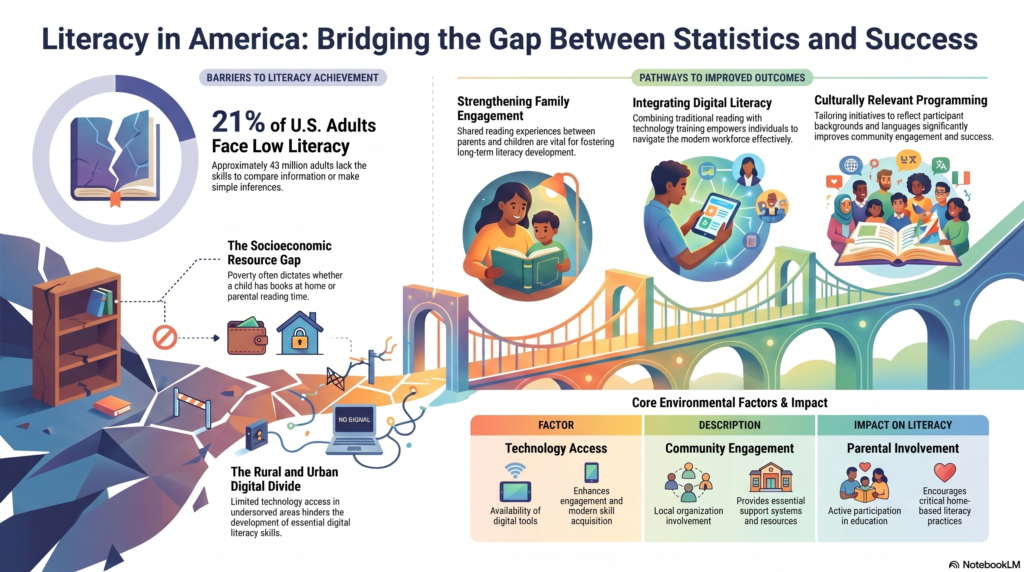
A prominent factor is cultural influences, which shape attitudes toward education and literacy. Additionally, technology access has become increasingly significant, as digital literacy is now synonymous with overall literacy. States with better access to technology tend to show higher literacy rates. Community engagement plays an essential role, fostering environments where literacy is valued and supported.
Parental involvement is another significant factor; children whose parents actively participate in their education often demonstrate higher literacy skills. Moreover, effective teaching methodologies can greatly impact literacy outcomes, with evidence suggesting that diverse approaches cater to varying learning styles.
The following table summarizes key factors influencing literacy rates:
| Factor | Description | Impact on Literacy Rates |
| Cultural Influences | Attitudes and beliefs regarding education | Shapes motivation to learn |
| Technology Access | Availability of digital tools and resources | Enhances engagement and learning |
| Community Engagement | Involvement of local organizations and services | Provides support and resources |
| Parental Involvement | Active participation in children’s education | Encourages home literacy practices |
| Language Diversity | Exposure to multiple languages | Affects comprehension and expression |
Socioeconomic Impact on Literacy
The interplay between socioeconomic status and literacy rates is a vital aspect that underscores the challenges faced by individuals in lower-income brackets. Research indicates that children from economically disadvantaged families often have limited access to educational resources, which can hinder their literacy development. Factors such as parental involvement play a pivotal role; lower-income parents may lack the time or resources to engage in literacy-promoting activities, further exacerbating the literacy gap.
Community engagement initiatives have emerged as powerful tools to combat these disparities. Programs that foster collaboration between schools, families, and local organizations can enhance access equity, ensuring that all children receive the support they need. Additionally, technological advancements present new opportunities for literacy enhancement; however, disparities in access to technology can perpetuate existing inequalities. Awareness campaigns aimed at highlighting the importance of literacy across diverse communities are essential in addressing these challenges.
Cultural influences and language diversity also considerably impact literacy rates. Tailoring literacy programs to reflect the cultural backgrounds and languages of participants can improve engagement and effectiveness. Mentorship programs that connect children with role models can further inspire literacy development, particularly in underserved communities.
Collectively, these strategies underscore the importance of a thorough approach to improving literacy rates. By fostering community engagement and addressing the multifaceted socioeconomic factors that influence literacy, we can work towards a more equitable society where every individual has the opportunity to succeed through strong literacy skills.
Educational Policies and Their Effects
Educational policies play a significant role in shaping literacy outcomes across various demographics, particularly in regions where socioeconomic factors are prevalent challenges. The effectiveness of these policies is often contingent upon several interrelated factors, including funding allocation, teacher training, and curriculum development.
Adequate funding is essential for implementing initiatives that support enhanced literacy programs, which can directly affect student engagement and achievement.
Teacher training is another critical component; professional development opportunities equip educators with contemporary teaching strategies and resources. This investment in human capital fosters a more informed teaching workforce capable of addressing diverse student needs. According to the National Center for Education Statistics, about four out of five U.S. adults (79%) have medium to high English literacy skills. These literacy levels are sufficient to compare and contrast information, paraphrase, and make low-level inferences. This means that about one in five U.S. adults (21%) have low literacy skills, translating to about 43.0 million adults. Of those who have low English literacy skills, 35% are White, 2% of whom are born outside of the U.S.; 23% are Black, 3% of whom are born outside of the U.S.; 34% are Hispanic, 24% of whom are born outside of the U.S.; 8% are of other races/ethnicities. Non-U.S.-born adults comprise 34% of the U.S. population with low literacy skills.
Furthermore, curriculum development must prioritize literacy as a foundational skill, integrating relevant content that resonates with students’ experiences and encourages critical thinking.
Community engagement further amplifies the impact of educational policies on literacy. By fostering partnerships between schools, families, and local organizations, schools can create a supportive environment that enhances learning opportunities.
Parental involvement is particularly influential, as active participation in a child’s education correlates with improved literacy rates.
In addition, technology integration has emerged as an essential tool in modern literacy instruction. Leveraging digital resources and platforms can facilitate personalized learning experiences and foster greater student motivation.
Finally, robust assessment methods are necessary to measure progress accurately and inform instructional practices, ensuring that policies remain responsive to the evolving educational landscape.
Together, these elements underscore the importance of thorough educational policies in promoting literacy and addressing the multifaceted challenges faced by diverse populations.
Successful Literacy Initiatives
Implementing successful literacy initiatives requires a strategic approach that addresses the unique needs of communities while leveraging evidence-based practices. Effective literacy programs often integrate community programs that foster collaboration among various stakeholders, including schools, libraries, and local organizations. In addition, educators often utilize specialized instructional materials from sources such as the engineering teacher shop to design engaging literacy and STEM-integrated learning activities for diverse learners.
This multi-faceted approach not only enhances accessibility but also guarantees that literacy initiatives are culturally relevant and responsive to the specific challenges faced by different populations.
One notable example is the implementation of family literacy programs, which engage parents and children together in learning activities. Research demonstrates that these programs greatly improve literacy outcomes, as they create a supportive learning environment and strengthen the family unit’s involvement in education.
In addition, incorporating digital literacy into these initiatives is critical in our increasingly technology-driven world. Programs that teach digital skills alongside traditional literacy enable individuals to navigate information more effectively, empowering them to participate fully in society.
Data from various states indicate that community programs focusing on both literacy and digital literacy yield remarkable results, often leading to improved academic performance and higher rates of employment.
For instance, initiatives that provide access to technology and resources have shown to enhance digital competencies, bridging the gap between traditional literacy skills and the demands of the modern workforce.

CHALLENGES IN IMPROVING LITERACY
When we dig into the factors influencing these rates, we have to talk about the “so what” for the families living in these statistics. Socioeconomic status isn’t just a variable in a regression model; it’s a tangible barrier that dictates whether a child has books at home or a parent with the time to read to them. I’ve seen firsthand how a lack of resources can snowball into a lifelong achievement gap. It is particularly heartening to see research highlighting the role of technology and digital literacy.
In today’s world, being literate means more than just reading a physical book; it’s about navigating the digital landscape responsibly. However, as someone who values context, I have to point out that technology is a double-edged sword. While it offers incredible learning tools, the “digital divide” in rural or underserved urban areas can actually widen the gap if we aren’t careful about equitable access.
Successful initiatives aren’t just about handing out tablets; they are about fostering community engagement and cultural relevance. We need to support the whole family, recognizing that parental involvement and specialized teaching strategies are just as vital as the curriculum itself.
Improving literacy rates faces significant challenges, primarily rooted in socioeconomic barriers and disparities in educational resources. The expansion of literacy in early-industrialized countries helped reduce within-country inequalities. In the preceding visualization, we showed that England virtually closed literacy gender gaps by 1900. Here, we provide evidence of literacy gaps across races in the US. The following visualization shows illiteracy rates by race for the period 1870-1979. As we can see, in order to reach near-universal levels of literacy, the US had to close the race gap. This was eventually achieved around 1980.
Data indicates that communities with higher poverty rates often struggle with access to quality education, which directly impacts literacy outcomes.
Additionally, inadequate funding and resource allocation in schools exacerbate these disparities, hindering effective literacy programs and support systems.
Socioeconomic Barriers
How do socioeconomic barriers impede literacy development across various states? These barriers create significant access disparities that hinder effective literacy initiatives. Financial obstacles often prevent families from obtaining necessary resources, such as books and educational materials, while also limiting access to early education programs that lay the foundation for literacy skills.
Additionally, the lack of parental involvement is often exacerbated by economic strain, reducing the engagement necessary for fostering literacy at home. Adult literacy remains a foundational pillar for personal advancement and economic opportunity in the United States. While millions of adults continue to face challenges with basic reading and comprehension, improving literacy skills is closely linked to better employment prospects, higher earnings, and stronger family and community outcomes.
Key factors contributing to these socioeconomic barriers include:
- Technological Access: Limited access to technology restricts students from utilizing online resources that enhance learning and reading skills.
- Language Barriers: In multilingual communities, the inability to communicate effectively in the dominant language can impede both student engagement and parental involvement in literacy activities.
- Cultural Influences: Cultural perceptions of education can affect community engagement, leading to disparities in support for literacy-focused initiatives.
Addressing these socioeconomic barriers requires a concerted effort from policymakers, educators, and community leaders to create inclusive strategies that promote equitable literacy access for all students.
Educational Resource Disparities
Educational resource disparities present significant challenges to improving literacy rates across various states. These disparities often stem from unequal resource allocation and funding disparities, which disproportionately affect rural education and urban challenges. For instance, schools in affluent areas frequently benefit from enhanced technology access, teacher training, and curriculum quality, while their counterparts in underfunded districts struggle to provide basic educational resources.
The following table illustrates key factors contributing to educational resource disparities:
| Factor | Rural Education Challenges | Urban Education Challenges |
| Technology Access | Limited internet connectivity | Overcrowded classrooms |
| Teacher Training | Shortage of qualified teachers | High turnover rates |
| Curriculum Quality | Outdated materials | Lack of tailored programs |
Addressing these disparities requires robust community engagement initiatives and targeted investments in teacher training and curriculum development. By prioritizing equitable funding and resource distribution, states can foster an environment that enhances literacy rates and supports the educational needs of all students, regardless of their geographical or socioeconomic circumstances.
Future Trends in Literacy Rates
As we look toward the future, literacy rates across the United States are poised to undergo significant transformations influenced by technological advancements, demographic shifts, and evolving educational methodologies. The integration of technology in educational frameworks is essential, particularly as digital literacy becomes a vital competency in both personal and professional domains. These shifts are also influenced by comparisons with global literacy rates, which provide insight into how national education systems adapt to technological and demographic changes.
The following trends are likely to shape literacy rates moving forward:
- Enhanced Technology Integration: The incorporation of digital tools in classrooms and adult education programs will facilitate more engaging and interactive learning experiences. This integration is important for fostering digital literacy among all age groups.
- Innovative Teaching Approaches: Educators are increasingly adopting innovative teaching strategies that accommodate diverse learning styles. This shift will promote early childhood literacy and support multilingual education, addressing the needs of a diverse student population.
- Community Engagement in Literacy Initiatives: Collaborative efforts among schools, libraries, and community organizations will bolster literacy programs, especially for underrepresented populations. These initiatives will leverage remote learning opportunities to extend educational reach, ensuring that all individuals have access to essential literacy resources.
As these trends develop, it is vital for stakeholders—educators, policymakers, and community leaders—to actively promote and support literacy initiatives.

RELATED STUDIES ABOUT LITERACY RATES BY STATE
To sum up, the pursuit of improved literacy rates remains an urgent imperative, as illiteracy casts a shadow over the potential of entire generations. Addressing the multifaceted challenges requires a concerted effort from policymakers, educators, and communities. Successful initiatives provide a beacon of hope, demonstrating that with strategic interventions, significant progress is possible. As trends evolve, the commitment to fostering literacy must remain unwavering, ensuring that the light of knowledge illuminates every corner of society.
Convergence Analysis of Regional Literacy Rates in India
- Purpose and Background
While economic convergence (e.g., of per capita income) is widely studied, convergence in broader measures of the standard of living, such as literacy, is equally important but less frequently examined. Literacy is a fundamental prerequisite for individual empowerment and a key indicator of regional development. This study investigates whether Indian states have become more similar in their literacy rates over time, applying the neoclassical concept of convergence to a critical social indicator. It goes beyond traditional methods by using a modern club convergence technique to assess regional disparities in total, rural, and urban literacy rates separately.
- Research Gaps and Objectives
The study identifies three key gaps in existing literature:
- Literacy is often treated as just one of many proxy variables for the standard of living, rather than a focal point of dedicated analysis.
- Studies in India typically examine only aggregate literacy rates, overlooking the distinct dynamics of rural and urban areas.
- Most research relies on traditional β and σ convergence tests, which assume a single convergence path for all regions and cannot detect the formation of multiple “convergence clubs.”
The primary objectives are to: (a) determine if total, rural, and urban literacy rates are converging across Indian states; (b) identify the presence of convergence clubs if overall convergence is absent; and (c) derive policy insights from the findings.
- Methodology
The study employs the Phillips and Sul (PS) club convergence technique on state-level panel data from 1991 to 2018 (sourced from the EPWRF database). This method is superior to traditional tests as it is unbiased, accounts for heterogeneity, and can endogenously identify groups of states (“clubs”) that converge to their own equilibrium paths, even if the entire set of states does not. The analysis is conducted separately for total, rural, and urban effective literacy rates across 18 major Indian states and union territories.
- Key Findings
- Total and Rural Literacy Converge: The log(t) test confirms that all sampled states are converging toward a common equilibrium for both total and rural literacy rates. States with initially low literacy (e.g., Bihar, Rajasthan) are “catching up” to frontrunners (e.g., Kerala). The convergence is driven by faster growth in rural areas, which constitute the majority of India’s population.
- Urban Literacy Exhibits Club Convergence: Overall convergence was rejected for urban literacy. Instead, the analysis revealed two distinct convergence clubs:
- Club 1 (14 regions): A large group of states (including Kerala, Tamil Nadu, Bihar, and Delhi) converging toward a higher relative urban literacy rate.
- Club 2 (4 states): A smaller group comprising Andhra Pradesh, Rajasthan, Uttar Pradesh, and Jammu & Kashmir, converging among themselves at a significantly lower relative urban literacy rate.
- Reasons for Divergence in Urban Literacy: States in Club 2 failed to achieve sufficient growth in urban literacy. This is attributed to various factors: political instability and militancy (Jammu & Kashmir); severe underperformance in tribal and interior districts (Andhra Pradesh); and the compounding effects of high population density, poverty, and gender inequality (Uttar Pradesh and Rajasthan).
- Conclusion and Policy Implications
This study reveals a nuanced picture of literacy convergence in India. While national and rural-level trends show promising progress in reducing regional disparities, the persistence of a low-performing club in urban literacy is a significant concern.
Key Policy Implications:
- Targeted Interventions: Policies must move beyond aggregate targets and specifically address the structural challenges hindering urban literacy in Club 2 states. This includes focusing on urban slums, migrant populations, and marginalized communities.
- Focus on Specific States: Urgent and tailored policy attention is needed for Andhra Pradesh, Rajasthan, Uttar Pradesh, and Jammu & Kashmir to improve their urban literacy outcomes. Lessons can be drawn from successful states, but strategies must be context-specific.
- Beyond Basic Literacy: While convergence in basic literacy is a positive sign, policymakers must now focus on reducing regional inequality in higher education and skill development to truly build human capital and sustain economic growth.
- Strengthen Inter-Governmental Cooperation: As education is a concurrent subject, coordinated efforts between central and state governments are crucial, especially for lagging states. This could involve special funding allocations and sharing of best practices (e.g., from Kerala’s community-based models).
- Limitations
The study is limited to data up to 2018, excluding the post-COVID-19 period. It does not examine disparities across gender, caste, or religion, which remain important areas for future research. The analysis also focuses on literacy as a basic outcome, not on higher education or human capital.
| REFERENCE: Jeet Saha, Zafar Iqubal, Convergence analysis of regional literacy rates in India, Social Sciences & Humanities Open, Volume 12, 2025, 101782, ISSN 2590-2911, https://doi.org/10.1016/j.ssaho.2025.101782. (https://www.sciencedirect.com/science/article/pii/S2590291125005108) |
Digital Health Literacy and Trust in Health Information Sources – A Comparative Study of University Students in Japan, the United States, and India
- Purpose and Background
The rapid expansion of the internet and social media has transformed health communication, making digital health literacy—the ability to find, understand, evaluate, and use health information from electronic sources—critically important. This is especially true for university students, a “digital native” generation, who frequently rely on online platforms for health information. This study compares digital health literacy and online health information-seeking behaviors among university students in Japan, the United States, and India—three culturally and technologically diverse countries—to understand global variations and inform targeted interventions.
- Methodology
A cross-sectional online survey was conducted in September 2022 with 1,500 undergraduate students (500 per country), recruited from a global research panel. Students majoring in health-related fields were excluded to avoid bias. The survey measured:
- Digital Health Literacy: Using the Digital Health Literacy Instrument (DHLI), which includes seven subscales (operational skills, navigation, information searching, evaluating reliability, determining relevance, adding self-generated content, protecting privacy). A 12-item composite score (DHLI-12) was used for analysis.
- Information Source Use: Whether students used television, radio, newspapers, magazines, news websites, or social media for health/medical news in the past month.
- Trust in Sources: Perceived trustworthiness of each source.
- Sociodemographics: Age, gender, year in university, major, subjective social status, and health conditions.
Data were analyzed using ANOVA and multiple regression.
- Key Findings
- Digital Health Literacy Varies by Country: DHLI-12 scores were significantly higher in the US (3.10) than in India (2.94) and Japan (2.89) . Students generally had strong operational skills but struggled with evaluating reliability and adding self-generated content, highlighting a universal need for targeted education.
- Privacy Protection Skills are a Concern: The “protecting privacy” subscale score was lower than in previous general population studies, indicating a specific gap among young people.
- Information Source Use and Trust Differ:
- Television was the most used source in Japan and the US, while social media was most used in India.
- Trust in online sources (especially social media) was lower than trust in traditional media (TV, newspapers) across all countries, with Japanese students showing the most skepticism.
- Trust, Not Mere Use, is Key: Multiple regression analysis revealed that trust in online information sources (news websites and social media) was strongly and positively associated with higher DHLI scores, while the simple act of using them was not.
- Country-Specific Patterns:
- In the US, using social media was positively associated with DHLI, likely reflecting the presence of credible public health agencies (like the CDC) on these platforms.
- In India, using social media alone tended to be negatively associated with DHLI, possibly due to a less regulated information environment.
- In Japan, subjective social status was the strongest predictor of DHLI, pointing to socioeconomic disparities in digital health literacy.
- Conclusion and Implications
This study reveals that digital health literacy among university students is not uniform; it is shaped by national context and the interplay between individual skills and the information environment. The critical finding is that trust in online sources, rather than usage frequency, is the key factor associated with higher literacy.
Recommendations:
- A Two-Pronged Strategy is Essential:
- Enhance Individual Skills: Universities should integrate digital health literacy into curricula, focusing on critical evaluation of information, privacy protection, and discerning credible sources.
- Improve the Information Environment: Public health agencies must prioritize the development and dissemination of accessible, evidence-based health information in local languages through official websites and verified social media channels to build public trust.
- Tailor Interventions: Strategies should be culturally and contextually adapted. For example, Japan needs to address socioeconomic disparities; India needs to focus on building trust in digital spaces; the US should leverage existing trusted platforms.
By improving both the availability of trustworthy digital health resources and individuals’ ability to evaluate them, we can better equip the next generation to navigate the complex digital health landscape and make informed decisions.
| REFERENCE: Hirono Ishikawa, Rina Miyawaki, Mio Kato, Jessica Legge Muilenburg, Yuki Azaad Tomar, Yoko Kawamura, Digital health literacy and trust in health information sources: A comparative study of university students in Japan, the United States, and India, SSM – Population Health, Volume 31, 2025, 101844, ISSN 2352-8273, https://doi.org/10.1016/j.ssmph.2025.101844. (https://www.sciencedirect.com/science/article/pii/S2352827325000989) |
Education Literacy Rate Forecasting Using Ensemble Models
- Purpose and Background
Accurate forecasting of literacy rates is essential for effective educational planning, resource allocation, and policy formulation, particularly in a diverse and populous country like India. This study proposes a novel approach using ensemble machine learning models to predict literacy trends by integrating historical data with socio-economic, demographic, and policy-related variables. The goal is to enhance predictive accuracy and provide actionable insights for policymakers to target interventions and improve educational outcomes across Indian states.
- Methodology
The study utilizes a dataset from Kaggle detailing state-wise literacy rates in India from 1951 to 2011. The methodology follows a structured pipeline:
- Data Pre-processing: Cleaning raw data, handling missing values (using dropna()), and organizing it for analysis.
- Geographical Stratification: Data is divided by state and city to enable granular, region-specific analysis.
- Train-Test Split: 80% of the data is used for training models, and 20% is reserved for testing.
- Model Application: Five machine learning models are applied and compared:
- Linear Regression (LR)
- Logistic Regression
- Random Forest (RF)
- Decision Tree (DT)
- Gradient Boosting
- Evaluation Metrics: Model performance is assessed using R² Score, Mean Squared Error (MSE), Mean Absolute Error (MAE), and Root Mean Squared Error (RMSE).
- Key Findings
- Linear Regression Outperforms All Models: The Linear Regression model demonstrated superior predictive performance with an R² score of 0.9635, indicating an exceptionally strong fit between predicted and actual literacy rates. It also achieved the lowest error metrics (MSE = 1.40, MAE = 0.97, RMSE = 1.18).
- Strong Performance of Other Models: Logistic Regression (R² = 0.9438) and Gradient Boosting (R² = 0.9453) also performed well, showing reliable predictive capability.
- Tree-Based Models Lag: Random Forest (R² = 0.8714) and Decision Tree (R² = 0.8606) showed comparatively lower accuracy and higher error rates, suggesting they are less suited for this specific forecasting task.
- Visual Validation: Plots of actual vs. predicted values for 2011 visually confirmed the strong alignment achieved by the Linear Regression model.
- Conclusion and Implications
This study successfully demonstrates that ensemble and regression models can be powerful tools for forecasting literacy rates. The finding that a relatively simple model like Linear Regression outperformed more complex ensemble methods suggests that the underlying relationship between historical literacy data and future trends may be predominantly linear.
Key Implications:
- For Policymakers: The high predictive accuracy of the model provides a reliable tool for anticipating future literacy trends at the state level. This can inform evidence-based decisions on resource distribution, targeted interventions for underperforming regions, and long-term educational strategy.
- For Researchers: The study provides a robust baseline for future forecasting work. The comparative analysis highlights that model selection matters, and that simpler models should not be dismissed in favor of more complex ones without empirical validation.
- For Educational Planning: Accurate forecasts enable proactive planning, allowing governments and institutions to address potential literacy gaps before they widen, particularly in regions with historically slower progress.
- Limitations and Future Work
The study’s primary limitation is its reliance on historical data up to 2011, which may not fully capture recent policy changes, technological impacts, or unforeseen disruptions (e.g., the COVID-19 pandemic). Future research should incorporate more recent data, include a wider range of dynamic variables (e.g., internet access, gender-specific enrollment), and explore more adaptable models that can account for structural breaks and non-linear complexities.
| REFERENCE: Sheshang Degadwala, Jagdish Solanki, Maganbhai N Parmar, Dhairya Vyas, Education Literacy Rate Forecasting Using Ensemble Models, Procedia Computer Science, Volume 252, 2025, Pages 519-528, ISSN 1877-0509, https://doi.org/10.1016/j.procs.2025.01.011. (https://www.sciencedirect.com/science/article/pii/S1877050925000110) |
CONCLUSION
Looking ahead, we have to move beyond just identifying problems and start embracing the innovative solutions that data points us toward. The future of literacy is clearly tied to how we integrate technology and adapt our teaching to a more diverse population. I’ve always said that data should inform, not just describe. Seeing the high predictive accuracy of ensemble models in forecasting literacy trends gives me hope that we can become more proactive in our interventions.
Instead of waiting for a community to fall behind, we can use these insights to allocate funding and professional development where it is needed most. But as we advance, we must never lose the “educator-first” perspective. Literacy is about human connection, the shared reading experience between a parent and child, or the “aha!” moment a student has when they finally grasp a complex text.
My urban garden has taught me that growth requires both the right seeds and the right environment; similarly, literacy thrives when we pair robust educational policies with genuine community support. Let’s use this data to ensure that every individual, regardless of their background, has the opportunity to succeed and contribute to a more equitable society.