

Back when I was navigating my engineering undergrad, I fell into the trap that ensnares thousands of technical students every semester: passive familiarity. I would sit at my desk with highlighters and multi-colored pens, re-reading dense textbook chapters on signal processing or thermodynamics, convincing myself that because the equations made sense on the page, I actually owned the knowledge. Exam day inevitably served up a brutal reality check. When a problem twisted the baseline formula into an unfamiliar scenario, my memory flatlined.
That painful plateau is what initially drove me down the rabbit hole of cognitive learning science. I realized that reading and re-reading is comfortable because it demands very little cognitive friction, but real comprehension is fundamentally generative. That is precisely why the elaboration learning method completely shifted how I approach complex study systems.
Rather than trying to absorb concepts like a dry sponge, elaboration demands that you actively interrogative the material: Why does this step follow that one? How does this circuit law behave if we swap the load? What does this principle actually remind me of in everyday mechanics? Once you begin treating study sessions as a dialogue between what you already know and what you are trying to master, studying stops feeling like rote memorization and starts functioning like true engineering design.
The Elaboration Learning Method integrates new information with existing knowledge, enhancing retention and comprehension. Grounded in cognitive science, it encourages active engagement, critical thinking, and metacognitive awareness. Techniques such as concept mapping and summarization provide visual aids for understanding, while collaborative learning fosters insight-sharing and problem-solving skills. This approach caters to diverse learning needs and promotes deeper connections with material. Continued exploration of its principles reveals more strategies for effective implementation.
KEY TAKEAWAYS
- The elaboration learning method enhances retention by connecting new information to existing knowledge, fostering deeper understanding and critical thinking.
- Cognitive science supports this method by emphasizing the integration of various strategies for meaningful engagement and effective organization of new information.
- Techniques like concept mapping and active note-taking visualize relationships between concepts, aiding memory retention and comprehension.
- Collaboration in learning environments encourages sharing insights and diverse perspectives, further enriching the elaboration process and promoting community building.
- Emotional connections and personal significance in learning enhance cognitive processing, making the material more relevant and memorable.
PRACTICAL BENEFITS OF THE ELABORATION LEARNING METHOD
While many learning strategies aim to enhance retention and comprehension, the Elaboration Learning Method stands out due to its practical benefits in various educational contexts. This approach encourages learners to connect new information with existing knowledge, fostering deeper understanding.
Research indicates that such connections lead to significant elaboration benefits, including improved memory retention and enhanced critical thinking skills. By actively engaging with material, learners can clarify complex concepts, facilitating better learning outcomes.
For instance, students who utilize elaboration techniques often demonstrate superior performance on assessments compared to those employing rote memorization. Additionally, the method promotes metacognitive awareness, enabling individuals to evaluate their learning processes and adjust strategies accordingly.
In environments where educators aim to serve diverse learning needs, the Elaboration Learning Method proves invaluable, as it cultivates a more inclusive and effective learning atmosphere.
Ultimately, its application can lead to transformative educational experiences for both learners and educators alike.
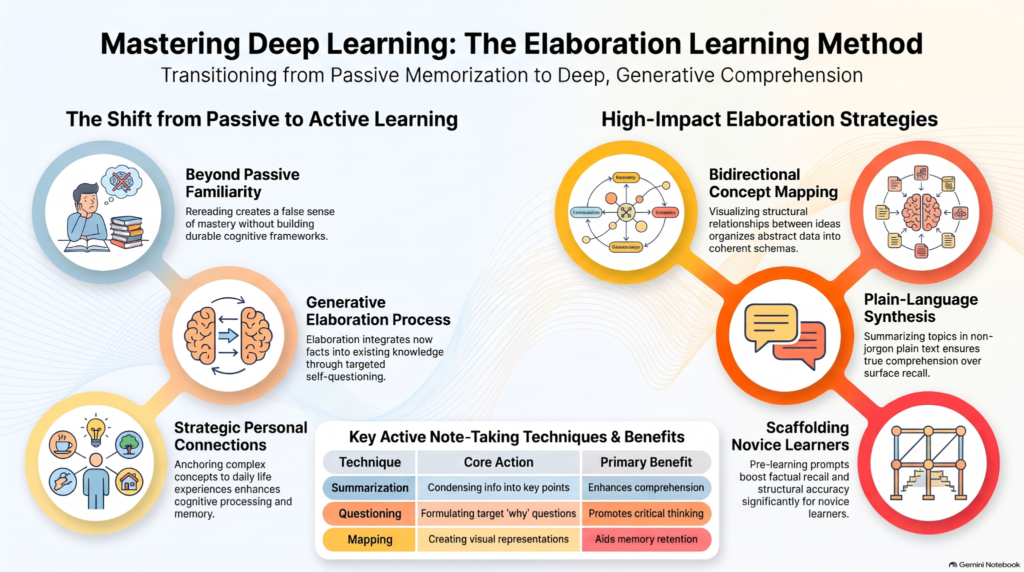
Core Principles of Successful Elaboration Techniques
The term elaboration can be used to mean a lot of different things. However, when we are talking about studying using elaboration, it involves explaining and describing ideas with many details. Elaboration also involves making connections among ideas you are trying to learn and connecting the material to your own experiences, memories, and day-to-day life.
Successful elaboration techniques hinge on two core principles: active engagement strategies and personal connection building.
Research indicates that when learners actively participate in the material, their retention and understanding greatly improve.
Additionally, establishing a personal connection to the content fosters deeper cognitive processing, enhancing the overall effectiveness of the learning experience.
Active Engagement Strategies
Active engagement strategies play an essential role in the effectiveness of elaboration techniques, as they foster deeper cognitive processing among learners.
By incorporating interactive learning methods, educators can facilitate environments where students not only absorb information but also actively manipulate and apply it. Collaborative projects serve as a prime example of such strategies, allowing participants to engage in meaningful dialogue, share diverse perspectives, and collectively construct knowledge.
Research indicates that when learners are actively involved, retention rates improve considerably, as they are more likely to connect new information with existing cognitive frameworks.
Therefore, implementing active engagement strategies is vital for enhancing the educational experience, ensuring that learners achieve a more profound understanding of the material through shared and interactive experiences.
Personal Connection Building
Personal connection building is frequently recognized as a fundamental principle in the application of elaboration techniques, as it enhances the relevance of new information to learners’ lives.
By creating emotional resonance with the material, educators can foster deeper understanding and retention. This method encourages learners to relate new concepts to their personal experiences, thereby facilitating relationship building between the learner and the content.
Research indicates that when individuals see personal significance in what they learn, they are more likely to engage actively and thoughtfully.
This connection not only aids in memory retention but also promotes a more profound appreciation for the subject matter, ultimately empowering learners to apply their knowledge in meaningful ways that benefit both themselves and others.
How Cognitive Science Supports Meaningful Learning
Although cognitive science offers a robust framework for understanding the processes underlying meaningful learning, it also highlights the importance of integrating various strategies to enhance retention and comprehension.
Research in this field emphasizes the role of cognitive constructs, which serve as mental tools for organizing knowledge and facilitating deeper understanding. By encouraging learners to create meaningful connections among new information and existing knowledge, cognitive science illustrates how these constructs can considerably improve learning outcomes. Applying the interleaved practice learning benefits alongside elaboration techniques can help students connect different concepts, recognize relationships between topics, and develop stronger problem-solving and knowledge-retention skills.
For instance, techniques such as concept mapping and analogical reasoning enable learners to visualize relationships between concepts, fostering a more cohesive understanding of the subject matter.
In addition, cognitive load theory underscores the necessity of managing information complexity to optimize mental resources.
Consequently, cognitive science not only provides insights into the mechanics of learning but also advocates for diverse approaches that reinforce meaningful engagement, ultimately benefiting those dedicated to serving others through education.

EFFECTIVE TECHNIQUES FOR THE ELABORATION LEARNING METHOD
When students ask me how to translate elaboration theory into a practical workflow, I always point toward digital note architecture and concept mapping. In my own daily workflow—whether I am breaking down an advanced technical paper or designing a modular study dashboard—I rely heavily on bidirectional linking and intentional self-questioning. If you simply copy formulas and definitions into an app, you are building a digital graveyard of facts, not a mental model. True elaboration requires creating nodes of understanding. Whenever I log a new concept, I force myself to write a two-to-three-sentence synthesis entirely in plain English, completely stripped of academic jargon, answering two core questions: What is this fundamentally doing, and what existing principle does it build upon?
From there, I connect it to at least two previously established notes or real-world mental models. For instance, if you are studying feedback loops in control systems, map it directly back to an everyday thermostat or even the biological mechanisms of human homeostasis. This active synthesis bridges the gap between surface-level recall and functional application.
It forces your working memory to organize abstract data into structured schema, preventing the cognitive overload that typically hits during high-stakes technical exams. When you elaborate through diagrams, mapped links, and targeted questioning, you transform isolated definitions into a coherent cognitive framework that your brain can rapidly retrieve under pressure.
Although retrieval practice and spaced learning may be more well-known, elaboration is an instructional strategy worth our attention. Elaboration strategies refer to the many ways of connecting prior knowledge to what someone has newly learned. What follows are four examples of elaboration strategies that have the potential to make new material more memorable and meaningful.
Effective techniques for the Elaboration Learning Method include the strategic use of visual aids and active note-taking strategies.
Research indicates that visual aids enhance comprehension and retention by providing learners with tangible representations of complex concepts.
Additionally, active note-taking encourages deeper engagement with the material, fostering connections that promote meaningful learning.
Visual Aids Utilization
Numerous studies have demonstrated that the incorporation of visual aids greatly enhances the Elaboration Learning Method by facilitating deeper understanding and retention of information.
Visual representations, such as diagrams, charts, and infographics, play an essential role in cognitive enhancement. They help learners to organize and synthesize complex concepts, making abstract ideas more tangible. By engaging multiple cognitive pathways, visual aids foster connections between new information and existing knowledge, promoting meaningful learning.
Additionally, they can cater to diverse learning styles, ensuring accessibility for a broader audience. Ultimately, the strategic use of visual aids in educational settings not only supports individual learning but also empowers educators to cultivate an environment conducive to thorough understanding and long-term retention of material.
Active Note-Taking Strategies
Visual aids serve as a powerful complement to active note-taking strategies, which further enhance the Elaboration Learning Method. Effective techniques such as summarization, questioning, and mapping facilitate deeper engagement with the material. By integrating active recall and spaced repetition within these strategies, learners can solidify their understanding and retention of information. Insights from memory consolidation spaced learning studies also emphasize the value of reviewing notes at regular intervals, helping learners strengthen their understanding, reinforce connections between concepts, and improve long-term retention.
| Technique | Description | Benefits |
| Summarization | Condensing information into key points | Enhances comprehension |
| Questioning | Formulating questions about the material | Promotes critical thinking |
| Mapping | Creating visual representations | Aids in memory retention |
| Spaced Repetition | Reviewing material at intervals | Strengthens long-term recall |
These methods not only foster meaningful learning but also empower individuals to serve others effectively by sharing knowledge.
The Importance of Existing Knowledge in Learning
The role of existing knowledge in the learning process cannot be overstated; it serves as the foundation upon which new information is built. Prior knowledge acts as a cognitive framework, allowing learners to integrate and organize new concepts effectively. This interaction enhances understanding and retention, making learning more meaningful.
Key aspects of existing knowledge’s importance include:
- Contextualization: Familiarity with related concepts helps learners situate new information within a larger framework.
- Connection-making: Existing knowledge facilitates the creation of links between new and prior information, improving comprehension.
- Problem-solving: A solid knowledge base empowers learners to apply concepts in diverse contexts, fostering critical thinking.
- Motivation: Recognizing the relevance of previously acquired knowledge can increase engagement and enthusiasm for learning.
Understanding these dimensions underscores the necessity of leveraging prior knowledge to enhance educational outcomes.
Practical Uses of the Elaboration Method
Elaboration is the technique of helping students make connections between their lives, and what they’ve previously learned, to grasp new concepts and lessons. More specifically, the elaboration strategy emphasizes that students explore a deeper understanding of what they are learning by asking “why” and “how” questions. “Elaboration was highly aligned with my personal growth goals this year,” Finafrock explains. “My approach is rooted in developing critical thinking, reducing teacher talk and encouraging student discussion, which elaboration serves well.”
Leveraging prior knowledge effectively sets the stage for implementing the elaboration learning method, which enhances understanding through deeper engagement with material.
This method can be practically utilized in various educational settings, particularly through collaborative discussions. In such environments, learners can share elaboration examples, allowing individuals to build upon one another’s insights and experiences. This not only reinforces their existing knowledge but also fosters a community of learning where diverse perspectives are valued.
Teachers can facilitate these discussions by prompting students to relate new concepts to familiar contexts, thereby encouraging richer elaboration. Teachers can also supplement these activities with worksheets, classroom exercises, and educational resources from the engineering teacher shop to help students connect new concepts with prior knowledge and strengthen their understanding.
Additionally, group projects can serve as an effective platform for applying the elaboration method, as participants must articulate their thoughts and connect ideas meaningfully.
How to Tackle Challenges When Using Elaboration Techniques?
Addressing challenges in the application of elaboration techniques requires a strategic approach that acknowledges potential obstacles and implements effective solutions.
Educators and learners must focus on specific strategies to enhance their experience and success in using these methods.
- Identify Resistance: Recognize and analyze the sources of resistance to elaboration techniques among students or peers.
- Adapt Techniques: Tailor elaboration methods to suit individual learning styles, ensuring they are relatable and engaging.
- Provide Support: Offer guidance and resources to facilitate understanding and mastery of elaboration strategies.
- Encourage Collaboration: Foster a collaborative environment where individuals can share their experiences and insights, thereby enhancing collective learning.

RELATED STUDIES ABOUT ELABORATION LEARNING METHOD PSYCHOLOGY
To summarize, the elaboration learning method enhances meaningful learning by fostering connections between new information and existing knowledge. For instance, a case study involving medical students demonstrated that those who employed elaboration techniques, such as integrating personal experiences with clinical concepts, greatly outperformed peers in retention and application of complex material. This underscores the efficacy of elaboration strategies in promoting deeper understanding, ultimately leading to improved educational outcomes across various disciplines.
Socio-educational ecologies for learning, social change, and future thinking: Expanding educational psychology’s boundaries
Conceptual Framework and Societal Imperative
- Historical Entanglement of Educational Psychology and Schooling: Since its inception in the late 19th and early 20th centuries, educational psychology has co-evolved alongside compulsory, universal public schooling. Historically, the discipline established its identity around measuring individual differences (e.g., IQ testing, diagnostic categorization of exceptional children) and identifying internal/external mediating variables that link instructional classroom contexts to discrete learning outcomes.
- The Crisis of Relevance in a Fractured World: The authors argue that contemporary planetary crises—accelerating climate breakdown, persistent structural racism, extreme socioeconomic inequality, warfare, and democratic erosion under rising authoritarianism—threaten global human subsistence. Classical educational psychology, by isolating individual learners within classroom walls and treating the social world as mere background context, has become disconnected from collective societal action.
- Beyond “What Works”: Traditional linear intervention frameworks and “what works” evidence-based paradigms fail to address fundamental political, ethical, and moral questions: What is education for? Who benefits? Who is excluded? To remain socially responsive and responsible, educational psychology must expand its boundaries beyond the learner-versus-instruction dichotomy, engaging “socio-educational ecologies” that integrate schooling with community life and future-making.
Redefining Socio-Educational Ecologies
- Relational Boundaries and Transition Design: Drawing on Akkerman and Bakker’s boundary-crossing theory, educational boundaries are re-conceptualized not as rigid institutional containers, but as relational surfaces characterized by transitions, translations, and multi-directional flows. Drawing from transition design and living systems theory, education is treated as an open, evolving ecosystem responding to structural societal shifts.
- Defining Socio-Educational Ecologies: Collaborative arrangements of schools, families, neighborhoods, community organizations, and social movements organized to generate joint action toward socially just, sustainable, and democratic futures.
- Key Structural Tenets:
- Life-Wide and Life-Deep Learning: Acknowledges that learning unfolds dynamically across home environments, peer networks, physical neighborhoods, digital spaces, and civic activism.
- Community Funds of Knowledge and Identity: Centering local, historical, artistic, cultural, oral, and spiritual legacies as common goods, recognizing the inherent expertise of minoritized students and families rather than operating from deficit models.
- Transformative Agency: Shifting the conceptualization of learners from passive recipients of instruction into agentic historical actors capable of collaborating with adults to transform the objects, tools, and social structures of their communities.
Theoretical Expansions: Four Emerging Units of Analysis
To investigate learning within socio-educational ecologies, the authors advocate for four distinct, non-individualistic units of analysis:
- The Pursuit:
- Contrasting with static views of personal “interest” as an internal psychological trait, a pursuit tracks an interest-driven trajectory of an individual or peer group across time and physical/virtual spaces.
- Focuses on movement, navigation, spatial access, and the social/material infrastructure required to sustain meaningful engagement.
- The Ongoing Shared Endeavor:
- Rooted in Rogoff’s cultural-developmental research, shared endeavors examine informal, consensus-based, joint activities where learning occurs through intent participation, observing, and “pitching in” (e.g., community festivals, collective urban projects).
- Dissolves the artificial adult-child binary, analyzing how roles, responsibilities, and participation transform without reducing activity to standardized curricular “tasks”.
- Social Movements:
- Focuses on collective activism explicitly oriented toward systemic justice, solidarity, and political change.
- Highlights prefiguration—the pedagogical and relational process of enacting and living out the envisioned just future within the current movement’s daily organizing practices.
- Learning Ecosystems (Meshworks):
- Moves beyond Bronfenbrenner’s traditional nested bioecological model (which retains an individual-centered hierarchy and often under-theorizes institutional power dynamics) toward a horizontal, heterarchical “meshwork”.
- Focuses on the ecological health of the whole system, the porosity of boundary zones (“ecotones”), institutional diversity, and the physical/digital infrastructures that enable cross-context transitions.
Methodological Transformations
Mainstream educational psychology has leaned heavily on laboratory experiments, standardized psychometrics, and randomized controlled trials that reify “WEIRD” (Western, Educated, Industrialized, Rich, Democratic) cultural assumptions and linear causality. The authors trace a methodological counter-tradition and outline four expansive research approaches:
- Formative Interventions and Double Stimulation: Grounded in Vygotskian cultural-historical activity theory (CHAT), formative interventions do not test researcher-imposed protocols. Instead, they introduce a contradictory or problematic object embedded in participants’ vital life activities, documenting how practitioners and learners generate new cultural tools and exercise transformative agency to reshape their own activity systems.
- Social Design Experiments (SDEs): Extend design-based research by coupling instructional engineering with explicit historical critique. SDEs intentionally remediate institutional injustices and assist historically marginalized youth in viewing themselves as consequential historical actors.
- Research-Practice Partnerships (RPPs): Long-term, mutualistic collaborations between researchers, educational leaders, teachers, and community members. RPPs decenter academic hierarchies, ensuring non-academic stakeholders share authority in defining problems of practice, designing interventions, and interpreting outcomes.
- Utopian Methodologies: Research strategies designed to envision, implement, and critically examine “concrete, enacted utopias”. These participatory projects bring youth, educators, and community organizers together to build prefigurative alternative systems (such as local environmental sustainability and climate-action initiatives) that challenge status-quo institutional constraints.
Implications for Schooling and Disciplinary Practice
- Re-positioning the School as a Node: The objective is not to abolish schools, but to transform them from isolated, bureaucratic institutions into permeable, civic nodes embedded in wider community ecologies (“open schooling” and “widespread education”).
- Educators as Brokers and Sponsors: Shifts the teacher’s role from delivering closed curricular scripts to “brokering” student connections, sponsoring young people into authentic community endeavors that match their personal concerns and cultural identities.
- Reframing Equity from Access to Thriving: Moves equity away from narrow metrics of equal access to standardized curricula toward cultivating ecological conditions for community flourishing, reparative justice, and sustainable collective survival.
| REFERENCE: Alfredo Jornet, William R. Penuel, Moisès Esteban-Guitart, Sanne Akkerman, Socio-educational ecologies for learning, social change, and future thinking: Expanding educational psychology’s boundaries, Acta Psychologica, Volume 258, 2025, 105156, ISSN 0001-6918, https://doi.org/10.1016/j.actpsy.2025.105156. (https://www.sciencedirect.com/science/article/pii/S000169182500469X) |
Parasocial interactions and relationships in science podcasts: A configurative mapping review on digital trust, engagement, and cognitive elaboration
Conceptual Framework and Research Rationale
- Digital Science Communication in Transition: In a fragmented digital public sphere marked by growing skepticism toward science, communicating complex topics—such as climate change, pandemics, and emerging technologies—demands media formats that foster public trust, emotional resonance, and cognitive understanding.
- The Rise of Science Podcasts: Podcasts have evolved into a major medium for science dissemination due to their on-demand availability, thematic depth, serialized long-form audio exposure, and intimate, conversational communication styles.
- Parasocial Processes (PSI vs. PSR):
- Parasocial Interaction (PSI) describes the momentary, one-sided experience of interpersonal dialogue between a listener and a media figure during a single media exposure.
- Parasocial Relationship (PSR) denotes the cumulative, enduring affective bond that develops across repeated listening episodes over time.
- In audio-based science podcasts, vocal continuity, personal self-disclosure, and conversational tone foster “aural intimacy,” positioning hosts as trusted peers or authoritative guides.
- Research Problem and Review Objective: Despite expanding literature, research on parasocial phenomena in science podcasts remains highly fragmented across disciplines (media psychology, communication studies, science journalism), characterized by conceptual conflation between PSI and PSR, heterogeneous trust definitions, and varied outcome measures. Rather than conducting a statistical meta-analysis of effect sizes, this study delivers an explanatory-configurative mapping review that synthesizes empirical research along conceptual, methodological, and structural configurations to evaluate how parasocial processes relate to digital trust, listener engagement, and cognitive elaboration.
Methodology and Analytical Framework
- Review Typology and Search Strategy:
- Employs an explanatory-configurative mapping review methodology following PRISMA guidelines and SPIDER (Sample, Phenomenon of Interest, Design, Evaluation, Research type) eligibility criteria suited for qualitative, quantitative, and mixed-method evidence.
- Systematic searches were completed through September 2025 across Scopus, Google Scholar, and GESIS, supplemented by backward and forward citation snowballing.
- Screening Corpus:
- 246 records were initially identified; after deduplication, title/abstract screening, and full-text eligibility appraisal against strict inclusion criteria (peer-reviewed empirical studies published in English or German between 2005 and 2024 focused on PSR/PSI in science, health, or environmental podcasts), 13 empirical studies were included in the final synthesis.
- Multi-Layered Conceptual Coding Framework:
- Parasocial Differentiation: Classifying whether studies examined acute episodic interactions (PSI), cumulative bonds (PSR), or producer-driven anticipation (“inverse PSR”).
- Four Analytical Levels of Digital Trust:
- Person-level trust: Perceived honesty, warmth, and benevolence of the host.
- Expertise-level trust: Credibility of the host as a qualified scientific or professional authority.
- Information-level trust: Perceived accuracy, factual reliability, and validity of the communicated content.
- System-level trust: Institutional trust in science and scientific organizations as a societal institution.
- Outcome Domains: Categorizing effects across affective involvement, listening engagement/loyalty, behavioral intentions, and cognitive elaboration/learning.
- Methodological Quality Appraisal:
- Evaluated across 10 domains using an adapted 20-item checklist (0–40 score range) based on AMSTAR 2 and Kmet et al. criteria: Study Design, Sample/Representativeness, Data Sources/Measurement, Confounder Control, Analysis/Statistics, Validity, Transparency, Ethics, Generalizability, and Limitations.
- Quality Stratification: High (30 points; n=0), Medium (20–29 points; n=8), and Low (<20 points; n=5).
Key Empirical Findings: Three Configurative Patterns
The review synthesized empirical findings into three recurring configurations linking podcast communication features with parasocial dynamics and listener responses:
- Proximity to Science as a Trust-Building Relationship (Expert-Source Pathways):
- Mechanism: Parasocial bonding functions as an epistemic and social bridge connecting audiences to scientific figures, particularly in high-uncertainty or crisis contexts.
- Empirical Evidence:
- Longitudinal panel studies during the COVID-19 pandemic (e.g., Utz et al., 2022) revealed that regular exposure to an expert virologist’s voice fostered strong parasocial attachment, which was directly associated with elevated information-level trust, reduced news-related anxiety (“comforting function”), and higher compliance with public health recommendations.
- Experimental work (Kirkpatrick & Lee, 2021) demonstrated that expert host status (physicians/scientists vs. lay hosts) elicited significantly higher competence and credibility attributions, which interacted with message relevance to drive behavioral compliance.
- Large-scale computational text analyses of 12,000 listener reviews (Vilceanu, 2025) confirmed that hosts act as central anchors of trust and intimacy over years of broadcasting.
- Primary Trust Focus: Expertise-level trust and information-level trust.
- Emotional Closeness and Story-First Communication (Narrative/Dialogic Proximity):
- Mechanism: Leverages auditory intimacy and narrative transportation rather than overt persuasion, establishing a personal connection through conversational authenticity, humor, and self-disclosure.
- Empirical Evidence:
- Qualitative and survey data (Perks & Turner, 2018; Tobin & Guadagno, 2022) show that listening during intimate daily routines (commuting, cooking) fosters perceptions of the host as an authentic friend or peer companion.
- Constructive journalism case studies (Lindgren & Jorgensen, 2023) demonstrated that narrative storytelling, personal vulnerability, and solution-oriented framing made highly complex, abstract topics (e.g., antimicrobial resistance) emotionally accessible, promoting reflective engagement and prosocial attitudes toward science.
- Primary Trust Focus: Person-level trust grounded in warmth, perceived authenticity, and relational familiarity.
- Technological Design and Backchannel Dynamics (Relational UX & “Inverse PSR”):
- Mechanism: Parasocial dynamics are treated as engineerable user experiences (UX) designed to drive audience retention, community building, and active platform feedback.
- Empirical Evidence:
- Experimental interventions (Marx et al., 2021) showed that host self-disclosure, inclusive relational language, and emotional openness intensified situational PSI, which significantly increased interactive backchannel behaviors (sharing, rating, commenting).
- Qualitative producer studies (Sharon & John, 2024/2026) introduced the concept of “inverse parasocial relationships”: podcast creators actively construct and anticipate an “imagined listener” through deliberate vocal pacing, conversational pauses, and calculated intimacy markers prior to reception.
- Systematic community reviews (Wendland, 2024) identified shared intimacy, transmedia backchannels (Discord, social media), and liveness as key enablers that convert private parasocial listening into sustained community engagement.
Theoretical, Ethical, and Medium-Specific Insights
- Theoretical Integration:
- Dual-Processing Dynamics (ELM): Parasocial attachment operates as a potent peripheral credibility cue that fosters message acceptance, but when paired with personal relevance and narrative framing, it can motivate central-route cognitive elaboration and deeper conceptual learning.
- Uses and Gratifications (U&G): Science podcasts satisfy cognitive information-seeking while concurrently fulfilling emotional needs for companionship, stress reduction, and social orientation.
- Auditory Distinctiveness vs. Other Media:
- Unlike television (which remains distant, formal, and visually distracting) or short-form social media like TikTok/Instagram (which foster fragmented attention and viral superficiality), podcasts facilitate sustained, unhurried attention to nuanced scientific discourse.
- Long-form audio continuity fosters deep personal attachment, although the lack of visual modalities requires supplementary materials (websites, transcripts, figures) for visually dense data.
- Ethical Dilemmas and Risks:
- Parasocial Fragility and Nostalgia: Audience attachment is sensitive to structural changes; sudden host replacements or tonal shifts can rupture perceived relational contracts, triggering audience backlash, nostalgic alienation (“used to be better”), and mass unsubscribing (Vilceanu, 2025).
- Uncritical Emotionalization and Misinformation: Strong parasocial bonds carry the risk of promoting uncritical acceptance of personal opinions, blurring the boundary between scientific consensus and personal conjecture. Over-identification with charismatic hosts can suppress healthy critical skepticism.
Methodological Quality and Corpus Limitations
- Absence of High-Quality Ratings: No included study met the high-quality threshold (30/40), driven by widespread methodological deficits: lack of statistical control for confounding variables, reliance on self-selected convenience samples, and incomplete psychometric validation of adapted trust/PSR scales.
- Correlational Dominance and Directionality: The vast majority of studies are cross-sectional surveys. The literature faces an unresolved “chicken-and-egg” dilemma: it remains empirically unconfirmed whether parasocial closeness actively generates trust and engagement, or whether pre-existing science interest and high baseline institutional trust predispose individuals to form parasocial bonds with science communicators.
- Western and Socioeconomic Bias: Studies are almost exclusively situated in Western, academic, and technologically advanced settings (US, Germany, UK, Australia), failing to capture diverse sociocultural, linguistic, and educational demographics.
- Neglect of System-Level Trust: While studies frequently track person- and expertise-level trust, virtually no empirical work investigates whether parasocial attachment to a single podcast host transfers into broader system-level trust in the scientific enterprise or academic institutions.
Practical Recommendations and Future Research Agenda
- For Scientists and Podcasters:
- Balance authentic personal openness with transparent communication of scientific uncertainty, clearly separating empirical evidence from subjective opinion.
- Practice proactive “change management”: transparently announce format, thematic, or hosting transitions to avoid rupturing listener trust and community attachment.
- For Educators and Communicators:
- Integrate science podcasts as interactive social learning environments rather than passive audiobooks, pairing episodes with guided critical analysis to build scientific literacy and media skepticism.
- Future Research Directions:
- Execute longitudinal panel studies and pre-registered laboratory experiments to establish causal directionality between parasocial processes, trust development, and cognitive elaboration.
- Expand demographic and cross-cultural investigations into non-Western and marginalized communities to evaluate equitable access and representation.
- Investigate emerging technological frontiers, including AI-generated podcast hosting, synthetic voices, and automated conversational backchannels, assessing how artificial personas reshape authenticity, relational cues, and trust in scientific knowledge.
| REFERENCE: Angelika Taetz-Harrer, Jan P. Ehlers, Parasocial interactions and relationships in science podcasts: A configurative mapping review on digital trust, engagement, and cognitive elaboration, Computers in Human Behavior Reports, Volume 22, 2026, 101072, ISSN 2451-9588, https://doi.org/10.1016/j.chbr.2026.101072. (https://www.sciencedirect.com/science/article/pii/S2451958826001466) |
Prompting in-depth learning in immersive virtual reality: Impact of an elaboration prompt on developing a mental model
Conceptual Framework and Research Rationale
- Potential and Pitfalls of Immersive Virtual Reality (VR): Immersive virtual reality learning environments (VRLEs) provide situated, multisensory, and three-dimensional representations that allow learners to experience complex phenomena from an internal, interactive perspective. However, meta-analyses and empirical studies show that immersive VR does not automatically guarantee effective or in-depth learning; highly immersive displays can induce cognitive overload, promote seductive distraction, or lead to passive, superficial observation rather than active conceptual processing.
- Instructional Scaffolding via Pre-VR Prompts: To turn the affordances of VR into meaningful learning without interrupting the immersive experience itself (such as requiring learners to pause and write summaries mid-session), strategic scaffolding can be delivered immediately before entering the virtual environment. Cognitive elaboration prompts act as strategy activators by prompting learners to process information semantically, identify relationships between novel concepts, connect new ideas to prior knowledge, and prepare to explain principles in their own words.
- Dual-Method Assessment of Mental Models: Learning complex technological systems requires constructing an integrated, analog mental model (guided by the Cognitive Theory of Multimedia Learning and the Integrated Model of Text and Picture Comprehension). To evaluate mental model formation comprehensively, the authors utilized a multi-method assessment:
- Functional Dimension: Performance across distinct cognitive levels based on Bloom’s taxonomy—surface recall (Knowledge) requiring sub-semantic processing, versus deeper relational and causal understanding (Comprehension and Application) requiring semantic integration.
- Structural Dimension: The Structural Assessment of Knowledge (SAK) technique, which uses pairwise concept relatedness ratings to map the undirected organizational network and distance between mental representations against an expert referent model.
- Core Research Objectives:
- Investigate the impact of a pre-VR elaboration prompt on functional learning outcomes across knowledge, comprehension, and application levels in robotics education.
- Examine whether the prompt improves post-learning structural knowledge accuracy and whether this effect depends on pre-existing structural knowledge (pre-accuracy).
- Evaluate the relationship between functional application scores and structural mental model accuracy.
Methodology and Experimental Design
- Participants and Experimental Design:
- Between-subjects randomized experiment involving 64 university students (mean age 24.056.05 years; 70% female, primarily psychology undergraduates) after excluding 3 participants due to technical errors.
- Prompt Group (n=31): Received a targeted elaboration prompt prior to immersion.
- Control Group (n=33): Received standard orientation instructions without an elaboration prompt.
- Baseline equivalence was confirmed across age, gender, prior robotics knowledge, verbal ability (measured via the IST 2000-R similarities module), pre-accuracy on the SAK, and subjective presence.
- Immersive VRLE Simulation:
- Implemented in Unity and delivered via an HTC Vive Pro head-mounted display.
- Learners were placed in a virtual kitchen where a humanoid service robot (modeled after the PAL Robotics REEM platform) entered and delivered a narrated overview of its technical specifications, kinematics, locomotive drive systems, PID controllers, sensor data fusion, and local versus global navigation algorithms.
- Learners could walk freely around the room, explore visual objects, and observe the robot’s physical movement trajectory, but could not directly manipulate the robot.
- Prompt Intervention:
- Prior to entering the VRLE, the prompt group received explicit instructions to identify new technical terms, attend to how concepts related to one another, and mentally prepare to explain the material to a peer lacking prior knowledge. Learners repeated the prompt in their own words to verify comprehension.
- Assessment Battery:
- Functional Knowledge Test: 12 open-ended items evaluated by two independent raters (r=0.88), categorized into 4 Knowledge questions (e.g., terminology recall), 4 Comprehension questions (e.g., contrasting industrial vs. service robots), and 4 Application questions (e.g., predicting motor responses when drive pulse spacing is altered).
- Structural Assessment of Knowledge (SAK): Pairwise relatedness ratings across 6 key concepts (PID controller, transition, kinematics, actuator technology, sensor technology, environment model) yielding 36 pairwise ratings. Scaled via JPathfinder against a referent structure established by four robotics and instructional experts (inter-expert agreement = 0.91) to generate structural accuracy scores ranging from 0 to 1.
- Attention Tracking: Head-tracking data recorded the proportion of time the robot remained centered within the user’s field of view.
Key Empirical Findings
- Functional Learning Outcomes (Bloom’s Taxonomy Levels):
- Knowledge Level: Controlling for verbal ability and prior knowledge, learners in the prompt group achieved significantly higher recall scores on the knowledge level compared to the control group (F(1,55)=3.42,p=.036,p2=.042).
- Comprehension and Application Levels: The elaboration prompt produced no significant benefit for comprehension (F(1,55)=0.03,p=.432,p2=.006) or application (F(1,55)=0.03,p=.436,p2=.007).
- Overall Score: Total learning scores did not differ significantly between the prompt (39.93% pm 12.62%) and control groups (37.54% pm 12.78%; F(1, 55) = 0.19, p = .661). Hypothesis 1b was rejected, as the prompt supported surface-level factual recall rather than deeper semantic comprehension.
- Structural Mental Model Accuracy and Pre-Knowledge Interaction:
- Overall, participants across both groups exhibited a significant increase from pre-test structural accuracy to post-test structural accuracy (t(62)=-3.31,p<.001,r=0.79).
- A statistically significant interaction emerged between the prompt condition and baseline pre-accuracy on post-learning structural accuracy (F(1,52)=3.11,p=.042,p2=.056):
- Low Pre-Accuracy Learners: Benefited substantially from the elaboration prompt, achieving higher post-accuracy knowledge structures compared to unprompted peers.
- High Pre-Accuracy Learners: Exhibited an expertise reversal effect; prompted learners with high initial structural knowledge achieved lower post-accuracy scores than their unprompted counterparts, suggesting the prompt interfered with pre-existing, self-regulated schema organization.
- Cross-Methodological Coherence (Functional vs. Structural Alignment):
- In line with Hypothesis 3, a moderate, statistically significant positive correlation emerged between functional performance on the application level and post-learning structural accuracy (r=0.36,p=.004).
- In contrast, structural accuracy showed no significant correlation with the knowledge level (r=0.19,p=.141) or comprehension level (r=0.09,p=.460). Both high structural network accuracy and functional application require an understanding of broader relational topologies rather than isolated definitions.
- Visual Attention Distribution:
- Perceived presence was high across both conditions (M=5.14–5.52 out of 7).
- Head-tracking video analysis (n=42) revealed that prompted learners visually focused on the robot for a higher descriptive percentage of the learning duration (88% pm 18%) than unprompted controls (79% pm 35%), though this difference was not statistically significant (t(40)=-1.20,p=.117,d=0.32).
Cognitive and Theoretical Interpretations
- The Text-Surface to Mental Model Shortcut: Under the Integrated Model of Text and Picture Comprehension (IMTPC), propositional knowledge must undergo semantic translation to integrate into an analog mental model. The finding that the prompt enhanced knowledge scores and structural SAK accuracy without improving comprehension or application suggests learners utilized an informational “shortcut”. Concepts presented contiguously were encoded as structurally related, allowing learners to approximate expert network proximity without mastering the underlying functional cause-and-effect mechanics.
- Cognitive Load Constraints in Immersive Settings: The abstract technical content (kinematics, control loops), paired with the sensory immersion of the VRLE, likely imposed high cognitive demands that consumed working memory resources, leaving insufficient capacity for the deep generative processing required for complex problem-solving.
- Aptitude-Treatment Interaction and Expertise Reversal: The prompt effectively structured learning for novices who lacked organizational schemas. However, for learners entering with high structural accuracy, imposing an explicit prompt created redundant processing demands, documenting that pre-training prompts in VR must be adapted to individual prior knowledge.
Study Limitations and Practical Recommendations
- Prompt Modality: The intervention relied on a single, general pre-immersion prompt. Combining cognitive elaboration with metacognitive monitoring prompts, or embedding adaptive in situ cues, may be required to sustain semantic processing.
- Interactivity Constraints: While learners possessed spatial freedom, they could not dismantle or directly manipulate the robot’s physical components. Integrating direct object manipulation could make functional relationships more concrete.
- Assessment Considerations: The SAK technique required passive relatedness ratings rather than active verbalization or concept mapping (such as network elaboration techniques), and floor effects on the comprehension/application scales suggest test items may have possessed high intrinsic difficulty.
- Guidance for Educational VR Design: Instructional designers should not rely solely on immersive virtual environments to generate deep conceptual understanding. Pre-VR elaboration prompts are recommended for novices to establish baseline factual and structural familiarity, but advanced learners should be allowed unconstrained exploration to avoid expertise reversal.
| REFERENCE: Andrea Vogt, Franziska Babel, Philipp Hock, Martin Baumann, Tina Seufert, Prompting in-depth learning in immersive virtual reality: Impact of an elaboration prompt on developing a mental model, Computers & Education, Volume 171, 2021, 104235, ISSN 0360-1315, https://doi.org/10.1016/j.compedu.2021.104235. (https://www.sciencedirect.com/science/article/pii/S0360131521001123) |
CONCLUSION
Reflecting on how we approach technical education today, I believe we often place far too much emphasis on brute-force persistence and not enough on cognitive strategy. Mastering challenging coursework is rarely a contest of who can sit motionless with a textbook for twelve hours straight. Instead, sustainable academic success comes down to the quality of mental processing taking place during each study block. The elaboration learning method matters because it acknowledges how human memory actually functions: knowledge does not sit in sterile, isolated silos; it anchors onto pre-existing cognitive networks through intentional association and active inquiry.
As a former student who transitioned into building structured learning systems, my biggest takeaway is simple: never let new information remain a passive spectator in your notes. Challenge it, contextualize it, map it to your personal projects, and explain it aloud until the mechanics feel intuitive.
Whether you are prepping for licensing exams, mastering complex mathematical frameworks, or simply trying to stay afloat in a rigorous STEM curriculum, embedding elaboration into your daily routine is one of the highest-leverage investments you can make. It transforms studying from an exhausting sprint of last-minute cramming into an organized, enduring mastery of the concepts that shape your field.
