
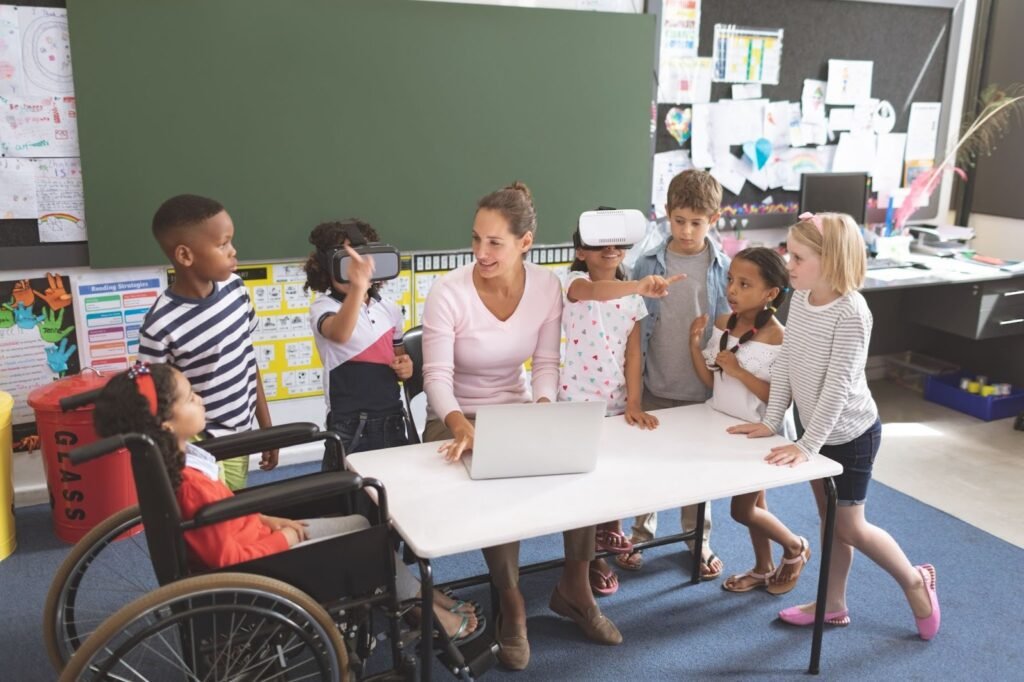
Technology is essential for supporting students with special education needs. Assistive tools like visual aids, speech-to-text applications, and communication devices empower these learners. Interactive software adapts to individual strengths, fostering engagement and motivation while providing personalized learning paths. Additionally, virtual environments and customizable platforms guarantee accessibility and facilitate collaboration among peers. Data tracking and analytics play a significant role in monitoring progress and tailoring interventions to optimize outcomes. These technologies not only enhance learning experiences but also encourage independence and confidence. Discover how each tool can create impactful learning opportunities for students with unique needs.
KEY TAKEAWAYS
- Assistive technology tools, like visual aids and sensory tools, empower students with special education needs through tailored support and enhanced engagement.
- Communication devices, such as voice output communication aids, facilitate expression for nonverbal students, bridging communication gaps effectively.
- Speech-to-text applications promote independence by converting spoken words into written text, enhancing communication and improving writing skills.
- Interactive learning software offers personalized learning paths and immediate feedback, fostering engagement and motivation among students with diverse needs.
- Accessibility features, including adaptive assessments and differentiated instruction tools, create inclusive environments that cater to diverse learning styles and challenges.
ASSISTIVE TECHNOLOGY TOOLS
Assistive technology tools play an essential role in empowering students with special education needs by providing tailored support that enhances their learning experiences. These tools encompass a wide range of resources designed to meet diverse learning styles and challenges, ensuring inclusivity in education.
Visual aids, such as graphic organizers and interactive displays, help students grasp complex concepts through engaging imagery. Complementing this, auditory supports—including audiobooks and speech-enhancing software—cater to learners who benefit from auditory input. Sensory tools like fidget devices and weighted blankets provide calming effects, facilitating focus and concentration in the classroom environment.
Adaptive hardware, including specialized keyboards and touchscreens, allows students to interact with technology in ways that align with their capabilities. Mobile applications designed for educational purposes often incorporate gamified learning, making the acquisition of knowledge enjoyable and motivating, with many educators also exploring creative classroom resources from the engineering teacher shop to supplement technology-based activities. These apps can also include feedback systems that offer real-time assessments of a student’s progress.
Task managers assist students in organizing their assignments and responsibilities, promoting independence and time management skills. Collaboration tools foster teamwork among peers, encouraging social interaction while working on group projects.
Additionally, behavior tracking systems enable educators and parents to monitor progress and adjust strategies as needed, ensuring a personalized approach to learning.
Speech-to-Text Applications
One of the standout innovations in assistive technology is the emergence of speech-to-text applications, which greatly enhance communication and learning for students with special education needs.
These applications utilize advanced speech recognition technology to transform spoken words into written text, providing a valuable tool for students who may struggle with traditional writing methods. By enabling students to articulate their thoughts verbally, these applications foster independence and confidence in their academic pursuits.
The user interface of many speech-to-text applications is designed to be intuitive and accessible, allowing students to navigate the technology easily. This user-friendly approach is vital for promoting engagement and ensuring that students can focus on their learning rather than the mechanics of the tool itself.
Key benefits of speech-to-text applications include:
- Enhanced Communication: Students can express their ideas and emotions more effectively, reducing frustration and increasing participation in classroom activities.
- Improved Writing Skills: By allowing students to dictate their thoughts, these applications can help them develop their writing skills without the barriers of physical writing constraints.
- Personalized Learning Experience: Tailored functionalities can cater to individual needs, accommodating various learning styles and preferences.
Interactive Learning Software
Interactive learning software offers students with special education needs engaging experiences that foster motivation and curiosity. Screen reader applications such as JAWS along with specially designed Braille keyboards allow visually challenged students to use the computer.
By providing personalized learning paths, these tools adapt to individual strengths and challenges, ensuring that every student can progress at their own pace.
Furthermore, the accessibility features integrated into such software help create an inclusive environment where all learners can thrive.
Engaging Learning Experiences
Many educators and specialists recognize the transformative potential of engaging learning experiences tailored for students with special education needs. Such experiences are essential for fostering an inclusive learning environment, where each student’s unique abilities are celebrated.
By utilizing engaging interactive learning software, we can implement inclusive strategies that promote collaborative learning among students, enhancing their educational journey. Tablets/Handheld Touchscreen Computers can help students with motor impairments improve their coordination and those with reading disabilities comprehend written information via text-to-speech apps.
Key elements of engaging learning experiences include:
- Interactive Activities: Providing hands-on opportunities that cater to various learning styles.
- Feedback Mechanisms: Offering immediate, constructive feedback to encourage student growth and confidence.
- Social Interaction: Facilitating collaborative projects that build communication skills and teamwork.
These elements not only keep students motivated but also help them develop critical thinking and problem-solving skills in a supportive atmosphere.
By adopting these engaging learning experiences, educators can create an environment that values diversity and promotes academic success.
Ultimately, the goal is to empower students with special education needs, ensuring they feel included and valued within their learning communities.
Through thoughtful integration of technology and inclusive strategies, we can help pave the way for a brighter future for all students.
Personalized Learning Paths
Personalization in education is a powerful approach that can greatly enhance the learning experiences of students with special education needs. By employing interactive learning software, educators can develop personalized learning paths that cater to the unique strengths and challenges of each student. This tailored approach not only fosters engagement but also promotes a sense of autonomy and motivation among learners.
Adaptive assessment methods play a vital role in this process. These methods enable educators to continuously evaluate student progress and adjust instructional strategies accordingly. By identifying specific areas where a student may struggle, educators can modify their teaching interventions, guaranteeing that every learner receives the support they need.
Furthermore, individualized curriculum design is essential to creating effective personalized learning paths. Through collaboration with special education professionals, educators can craft tailored content that aligns with each student’s learning objectives and interests. This guarantees that students are not merely passive recipients of information but active participants in their educational journey.
Ultimately, personalized learning paths empower students with special education needs to thrive, fostering not only academic success but also confidence and resilience in their abilities. By embracing these innovative strategies, we can create a more inclusive and supportive learning environment for all.
Accessibility Features Overview
A thorough understanding of accessibility features in interactive learning software is crucial for supporting students with special education needs. These features embody the principles of universal design, ensuring that learning environments are adaptable and inclusive.
By leveraging sensory integration strategies, interactive software can cater to diverse learning styles, thereby reducing learning barriers and promoting engagement.
Key accessibility features include:
- Adaptive Assessments: Tailored assessments that adjust to individual student needs, providing a more accurate measure of understanding and skill acquisition.
- Differentiated Instruction Tools: Resources that allow educators to modify content delivery based on students’ unique learning profiles, fostering an inclusive classroom atmosphere.
- Emotional and Cognitive Support: Features designed to offer real-time feedback and emotional guidance, empowering students to navigate challenges effectively.
When implemented thoughtfully, these accessibility features promote collaborative learning and student empowerment.
They provide essential emotional support while helping students enhance their cognitive skills.

COMMUNICATION DEVICES
Communication devices play an essential role in supporting students with special education needs by enhancing their ability to express thoughts and participate in classroom activities. For motor or visual impairments, voice recognition software can perform a student’s request at the sound of their voice. Students can speak to their teachers, create assignments and direct apps.
These devices come in various forms, each offering unique benefits that promote engagement and interaction among peers and educators.
Understanding the different types of communication devices and their effective implementation can greatly enrich the learning experience for these students.
Types of Communication Devices
For many students with special education needs, effective communication is essential for academic success and social interaction. Various types of communication devices can facilitate this necessary interaction, particularly for those who rely on augmentative communication strategies. These devices help bridge communication gaps, allowing students to express themselves and connect with others while supporting inclusive practices that align with the principles and protections outlined in special education law.
Some common types of communication devices include:
- Symbol-Based Systems: These devices utilize images or symbols to represent words, enabling students to convey their thoughts even when they struggle with verbal expression.
- Voice Output Communication Aids (VOCAs): VOCAs convert text or symbols into spoken words, providing a voice for students who are nonverbal or have difficulty articulating their thoughts.
- Adaptive Communication Boards: These boards can incorporate various nonverbal cues and symbols, allowing students to communicate through pointing or selecting images, fostering engagement and understanding.
Understanding the different types of communication devices empowers educators and caregivers to select the most appropriate tools, ensuring that every student can participate fully in their learning environment.
This not only enhances their communication skills but also promotes social inclusion and confidence.
Benefits for Student Engagement
Effective communication devices play a fundamental role in enhancing student engagement among individuals with special education needs. These tools facilitate active participation, allowing students to express themselves and contribute meaningfully in collaborative activities. By integrating communication devices into learning environments, educators can greatly boost motivation enhancement, as students experience a sense of autonomy and empowerment.
Moreover, communication devices foster peer interaction, creating opportunities for students to connect with their classmates. This social engagement is essential for developing relationships and building a supportive community. The incorporation of gamified learning into these devices stimulates curiosity-driven exploration, making education not only accessible but also enjoyable.
Communication devices offer diverse content and sensory engagement, appealing to various learning styles and needs. They incorporate feedback mechanisms that help students understand their progress, providing critical emotional support that encourages persistence and resilience.
As students navigate their learning journeys, these devices serve as important instruments that foster intrinsic motivation, ultimately leading to enriched educational experiences. By prioritizing student engagement through effective communication tools, we can promote an inclusive atmosphere where every learner thrives.
Implementation in Classrooms
Incorporating communication devices into classroom settings requires thoughtful planning and adaptation to meet the diverse needs of students with special education requirements. Effective implementation of these devices can foster inclusive practices, enhancing student engagement and participation.
To achieve this, schools must prioritize several key areas:
- Teacher Training: Providing educators with professional development opportunities to learn about communication devices is essential for effective classroom management and student support.
- Collaborative Strategies: Utilizing peer support and fostering a collaborative environment allows students to interact meaningfully, enriching the learning experience.
- Parental Involvement: Engaging parents in discussions about curriculum modifications and resource allocation helps guarantee that communication devices meet the unique needs of their children.
Gathering student feedback also plays a critical role in evaluating the effectiveness of these devices. Continuous evaluation, combined with adaptive practices, supports a responsive learning environment.
Virtual Learning Environments
Leveraging technology, virtual learning environments (VLEs) have transformed the educational landscape for students with special education needs. These environments facilitate an inclusive space for learning, enabling students to engage through various interactive platforms tailored to individual needs, an approach that is particularly valuable in early childhood special education where early support can significantly influence developmental progress. This adaptability is essential, as it allows for personalized instruction that can be adjusted in real-time, enhancing the effectiveness of remote instruction.
VLEs promote digital inclusivity, ensuring that all students, regardless of their unique challenges, have access to educational resources. Online accessibility features such as screen readers, text-to-speech tools, and customizable display options are integral in supporting diverse learning styles.
In addition, the incorporation of engagement strategies—such as gamification and collaborative projects—fosters virtual collaboration among peers, creating a sense of community and reducing feelings of isolation.
Adaptive learning technologies within these environments further empower students by providing tailored educational experiences that respond to their individual progress and needs. Virtual assessments enable educators to evaluate student learning in a dynamic and flexible manner, allowing for timely feedback and adjustment of instructional strategies.
Ultimately, VLEs represent a significant advancement in supporting students with special education needs. By leveraging technology to create an inclusive and engaging learning environment, educators can enhance the educational experience for these students, ensuring they have equitable opportunities to thrive and succeed in their academic journeys.
Customizable Learning Platforms
Customizable learning platforms are at the forefront of enhancing educational experiences for students with special education needs. These platforms offer a unique opportunity to create tailored learning environments that address individual learning styles and requirements. By integrating adaptive learning technologies, educators can guarantee that each student receives personalized support, facilitating a more effective learning journey.
The user interface of these platforms is vital, as it must accommodate diverse abilities and preferences. A well-designed interface allows for easy navigation, enabling students to engage with the material at their own pace. Additionally, curriculum alignment is essential; customizable platforms can connect educational content directly to specific learning objectives, guaranteeing that each student’s educational path is both relevant and targeted.
Key features of customizable learning platforms include:
- Adaptive Learning: This allows for real-time adjustments based on student performance, fostering an environment where learners can thrive.
- User Interface: Intuitive design enhances accessibility, making it easier for students to interact with content and tools.
- Student Feedback: Incorporating feedback mechanisms empowers students, giving them a voice in their learning process and enhancing their motivation.
Incorporating these elements into customizable learning platforms fosters an inclusive atmosphere where all students, regardless of their unique challenges, can engage meaningfully with their education.
Data Tracking and Analytics
Data tracking and analytics play an essential role in enhancing the educational experience for students with special education needs. By leveraging data visualization tools, educators can effectively monitor progress and identify patterns in student performance. These insights enable the development of tailored intervention strategies that cater to each student’s unique learning requirements.
Through continuous progress monitoring, teachers can assess performance metrics that inform their instructional approaches. This data-centric approach fosters student engagement by allowing educators to adapt lessons in real-time, guaranteeing that all learners remain motivated and challenged.
Additionally, individualized assessments provide a clearer understanding of each student’s strengths and areas for growth, guiding educators in their decision-making processes.
Predictive analytics takes this a step further by anticipating potential challenges students may face in their learning journeys. By analyzing historical data, educators can proactively implement strategies that mitigate obstacles, thereby enhancing student outcomes. The actionable insights derived from these analyses create a robust framework for supporting students with special education needs.
Ultimately, the integration of data tracking and analytics not only empowers educators but also enriches the learning experience for students. By fostering a culture of data-informed decision-making, we can guarantee that every child receives the support they need to thrive academically and socially.
Embracing these technologies is not just about improving metrics; it’s about cultivating a nurturing environment where all students can flourish.
RELATED STUDIES ABOUT SPECIAL EDUCATION NEEDS
In the evolving landscape of education, technology stands as a beacon of hope for students with special education needs. The integration of assistive tools and innovative platforms not only enhances learning experiences but also fosters independence and confidence. As educators and institutions embrace these advancements, the potential for transformation becomes palpable. Yet, the journey has only just begun—will the commitment to inclusivity and accessibility reveal the full potential of every learner? The answer awaits discovery.
Parent Perceptions Of Cycle Training For Children With Special Education Needs And Disabilities: What Drives Intention To Cycle?
- Overview and Purpose
Children with Special Educational Needs and Disabilities (SEND) are at a significantly higher risk of physical inactivity and its associated long-term health consequences compared to their typically developing peers. While cycling offers a promising avenue for increasing physical activity, improving well-being, and fostering independence, standard cycle training is often inaccessible or inappropriate for children with SEND. Tailored programs have shown success in teaching cycling skills, but it is unclear whether this translates into a sustained intention to cycle.
This study addresses this gap by evaluating a tailored, off-road Bikeability Level 1 cycle training program for young people with SEND in the UK. Using parent-reported data, the research investigates how parents perceive the training, what factors predict their intention to cycle more with their child in the future, and what ongoing barriers remain.
- Key Research Questions
The study is guided by four questions:
- How do parents perceive tailored SEND cycle training in terms of their child’s cycling ability, enjoyment, and the importance of specific training characteristics?
- What are the relationships between these perceptual variables?
- What predicts a parent’s intention to cycle more with their child after the training?
- What are the ongoing barriers to future cycling?
- Methodology
- Design: A cross-sectional study using a tailored, co-created questionnaire distributed to parents after their child completed the training.
- Participants: 49 parents of young people (10-19 years old) with SEND who participated in the training. The sample was predominantly male (76%) and included a range of needs, with Autism (60%) and Down’s Syndrome (12.5%) being the most frequently reported.
- Intervention: Level 1 Bikeability training, delivered off-road at a dedicated cycle circuit. The training was tailored to SEND needs, featuring small groups, one-to-one support from knowledgeable instructors, and the availability of adapted cycles.
- Measures: The questionnaire gathered data on:
- Child’s cycling ability and frequency before training.
- Child’s enjoyment of the training.
- Parent’s rating of the importance of tailored training features.
- Parent’s perception of their child’s cycling improvement and their own confidence in their child’s ability post-training.
- Parent’s intention to cycle more as a family.
- Open-ended questions on overall opinions and ongoing barriers.
- Analysis: Quantitative data were analyzed using descriptive statistics, exploratory factor analysis, Pearson correlations, and linear regression. Open-ended responses were analyzed using content analysis with inter-rater reliability checks.
- Major Findings
The study provides strong evidence for the positive impact of tailored cycle training and offers novel insights into the drivers of future cycling intentions.
- Positive Perceptions of Training (RQ1):
- Improvement: 76% of parents agreed or strongly agreed that their child’s cycling ability had improved.
- Confidence: 84% of parents reported increased confidence in their child’s ability to cycle independently.
- Enjoyment: 96% of parents stated their child enjoyed or very much enjoyed the training.
- Importance of Tailoring: All tailored features (e.g., small groups, one-to-one training, instructor knowledge) were rated as highly important, with a median score of 5 out of 5.
- Key Relationships (RQ2): A factor analysis grouped the variables into three core components:
- Factors Important in Training: The perceived importance of the tailored features.
- Cycle Training Outcome: A composite of the child’s enjoyment and the parent’s perception of improved cycling ability and confidence.
- Cycling Prior to Training: How regularly the child cycled before the course.
A significant positive correlation was found between Factors Important in Training and Cycle Training Outcome, indicating that parents who valued the tailored approach also perceived a more positive result for their child.
- Predictors of Future Intention (RQ3): The regression model was significant, explaining 38.6% of the variance in parents’ intention to cycle more.
- Strongest Positive Predictor: Cycle Training Outcome (enjoyment and perceived improvement) was the most powerful driver of a parent’s intention to cycle more with their child.
- Significant Negative Predictor: Cycling Prior to Training had a negative relationship, meaning parents of children who already cycled frequently were less likely to plan an increase, likely due to capacity.
- Non-Predictor: The perceived importance of the tailored factors did not independently predict future intention.
- Ongoing Barriers (RQ4): Despite the training’s success, parents identified significant barriers to continued cycling. The most frequently cited barriers related to the child (lack of road safety knowledge, low confidence, limited skill), followed by environmental factors (lack of adapted equipment, unsuitable local infrastructure), and parental factors (lack of time).
- Implications for Practice
The findings have clear and actionable implications for policymakers, educators, and cycling instructors.
- Invest in Tailored, SEND-Specific Programs: The high ratings for tailored features and their correlation with positive outcomes underscore the necessity of providing specialized, not just generic, cycle training. This requires investment in smaller groups, one-to-one support, and instructor training on SEND needs.
- Focus on Fun and Mastery: The finding that enjoyment and perceived improvement are the strongest drivers of future intention is crucial. Programs must prioritize creating a fun, successful, and confidence-boosting experience, not just skill acquisition.
- Address the “Intention-Behavior Gap” by Tackling Barriers: While parents intend to cycle more, significant barriers remain. To translate intention into action, there is a need for:
- Post-Training Pathways: Offering “Level 2” on-road training to build road safety knowledge and confidence.
- Access to Equipment: Widespread availability of adapted cycles and funding to support their purchase or loan.
- Safer Infrastructure: Continued advocacy for safer cycling routes, quieter roads, and better infrastructure that is accessible to all.
- Promote Inclusive Cycling in Special Schools: Given the low uptake of standard training by special schools, proactive efforts are needed to integrate tailored cycling programs into SEND school settings.
- Conclusion
This study demonstrates that tailored cycle training for children with SEND is highly effective, not only in improving cycling skills but, most importantly, in creating an enjoyable and confidence-building experience. This positive outcome is the single most significant predictor of a parent’s intention to continue cycling with their child. However, the study also reveals that intention alone is insufficient. To realize the full health, social, and independence benefits of cycling for this vulnerable group, continued investment is needed in post-training support, accessible equipment, and safer environments to overcome the persistent barriers to participation.
| REFERENCE: K. Wilmut, C. Purcell, Parent perceptions of cycle training for children with special education needs and disabilities: What drives intention to cycle?, Heliyon, Volume 9, Issue 5, 2023, e16173, ISSN 2405-8440, https://doi.org/10.1016/j.heliyon.2023.e16173. (https://www.sciencedirect.com/science/article/pii/S2405844023033807) |
Print And Digital Reading Habits And Comprehension In Children With And Without Special Education Needs
- Overview and Purpose
Text comprehension is a significant challenge for many primary school students with special educational needs (SEN). While reading frequency is known to support comprehension development, the increasing digitalization of reading—both for leisure and academic purposes—raises critical questions about the effectiveness of different reading media. This study investigates how reading frequency (for leisure and academic purposes) and reading medium (print vs. digital) are associated with text comprehension in a large sample of Spanish primary school students (grades 4-6), comparing students with and without SEN.
- Key Research Questions and Hypotheses
The study tested four main hypotheses:
- H1: Text comprehension will show a larger positive association with print leisure reading than with digital leisure reading, regardless of SEN status.
- H2: The association between leisure reading and comprehension will be weaker for students with SEN than for those without.
- H3: Text comprehension will show a larger positive association with print academic reading than with digital academic reading.
- H4: The association between academic reading and comprehension will be weaker for students with SEN than for those without.
- Methodology
- Participants: 2,289 students from 4th to 6th grade (ages 9-12) in the Valencia region of Spain, of whom 212 (9.3%) had an official decision of SEN (excluding students with high-capacities). The sample reflects Spain’s inclusive education model, where most students with SEN are educated in mainstream classrooms.
- Design: A cross-sectional, correlational study.
- Measures:
- Text Comprehension: Standardized ACL test, which yields a score from 1 (severe difficulties) to 10 (high skill).
- Reading Habits: Students self-reported the frequency of their reading activities using two purpose-built scales (Leisure and Academic), each with items for print and digital reading. Responses were on a 4-point scale from “Never” to “Every day.”
- Control Variables: Socioeconomic status (SES, measured by the number of books at home) and grade level were included as covariates. The analysis also controlled for classroom-level clustering.
- Analysis: Multiple regression models with a robust maximum likelihood estimator (MLR) were used. Interaction terms between reading habits and SEN status were tested to see if associations differed for the two groups.
- Major Findings
The study revealed distinct patterns for leisure and academic reading, with important implications for digital versus print media.
- Leisure Reading Habits (H1 Supported, H2 Not Supported):
- Print leisure reading frequency was a significant positive predictor of text comprehension for all students.
- Digital leisure reading frequency showed no significant association with comprehension.
- Crucially, this pattern was the same for students with and without SEN; the interaction between leisure reading and SEN status was not significant. This refutes H2, showing that students with SEN benefit from print leisure reading just as much as their peers.
- Academic Reading Habits (H3 Partially Supported, H4 Not Supported):
- Print academic reading frequency showed no significant association with text comprehension.
- Digital academic reading frequency was a significant negative predictor of text comprehension for all students. The more students reported reading digital materials for academic purposes (e.g., on tablets, searching the internet for homework), the lower their comprehension scores.
- Again, this negative association was the same for students with and without SEN; the interaction term was not significant.
- SEN Status and Comprehension (Control Variable): As expected, SEN status was the strongest predictor in the model. Students with SEN scored, on average, 0.25 standard deviations lower in text comprehension than their peers without SEN, even after accounting for all other factors. This confirms the significant reading gap identified in prior research.
- Socioeconomic Status (SES): Higher SES (more books at home) was a significant positive predictor of comprehension for all students.
- Implications for Practice
The findings have clear, actionable recommendations for educators, parents, and policymakers, applicable to all students but particularly critical for those with SEN.
- Promote Leisure Reading in Print: Schools and families should actively cultivate a culture of reading for pleasure using physical books. Strategies include giving students choice in what they read, providing access to diverse books, dedicating class time to independent reading, and encouraging parents to establish reading routines at home.
- Exercise Caution with Digital Academic Texts: The negative association between academic digital reading and comprehension is a significant concern. This finding advises caution against the uncritical adoption of digital textbooks and online resources for independent study, especially when the goal is deep comprehension and knowledge acquisition. This does not mean abandoning digital tools, but using them thoughtfully.
- Adopt a Balanced, Evidence-Based Approach to Digitalization: The “screen inferiority effect” is real and matters for learning. Educators should discern the most suitable medium for the task. Extended, focused reading for study may be better suited to print, while digital tools can be leveraged for their strengths, such as searching, multimedia integration, and interactive elements, or for providing specific supports like text-to-speech for struggling readers.
- Support All Students Equally in Reading Development: The lack of interaction effects is a positive finding. It suggests that interventions to promote print leisure reading and to manage digital academic reading will benefit students with SEN just as much as their peers without SEN. The goal is to ensure all students have access to the medium that best supports their learning.
- Conclusion
This large-scale study provides robust evidence that the medium in which children read matters for their comprehension development. While leisure reading in print is universally beneficial, independent academic reading on digital devices is negatively associated with comprehension for all students, including those with SEN. The findings challenge the assumption that digital is always better and underscore the need for a balanced, thoughtful approach to integrating technology in education. They also offer a hopeful message: the powerful tool of print leisure reading is equally effective at supporting the comprehension of students with SEN as it is for their peers, making it a key strategy for narrowing the persistent reading achievement gap.
| REFERENCE: Cristina Vargas, Lidia Altamura, Mari Carmen Blanco-Gandía, Laura Gil, Amelia Mañá, Sandra Montagud, Ladislao Salmerón, Print and digital reading habits and comprehension in children with and without special education needs, Research in Developmental Disabilities, Volume 146, 2024, 104675, ISSN 0891-4222, https://doi.org/10.1016/j.ridd.2024.104675. (https://www.sciencedirect.com/science/article/pii/S0891422224000076) |
Facilitating Inclusive Education: Assessing Faculty Awareness And Attitudes Towards Students With Special Educational Needs At Qatar University
- Overview and Purpose
The number of students with special educational needs (SEN) attending higher education institutions has increased dramatically, driven by international declarations and national legislation promoting inclusive education. Faculty members are the key players in the successful implementation of inclusive policies, as their attitudes, knowledge, and willingness to accommodate diverse needs are critical to creating a supportive and non-stigmatizing learning environment. However, negative faculty attitudes can be a major barrier to inclusion.
This study assesses the attitudes of faculty at Qatar University (QU) toward students with SEN and their awareness of the support services provided by the university. It also investigates how previous contact with SEN students and demographic factors influence these attitudes and levels of awareness. The findings are intended to inform targeted interventions, professional development, and policy to foster a more inclusive campus.
- Key Research Questions
The study addresses four main questions:
- What are the attitudes of QU faculty towards students with SEN?
- To what extent are QU faculty aware of the support services provided by the university for SEN students?
- How does previous exposure to SEN students impact faculty attitudes?
- What demographic factors (gender, years of experience, academic discipline) are associated with faculty attitudes and awareness?
- Methodology
- Design: A cross-sectional, descriptive study using an online survey.
- Participants: 331 academic faculty members from Qatar University responded to the survey, representing a 30% response rate from the total faculty population (N=1107). The sample was 66.2% male, 90.3% non-Qatari, and predominantly aged 40-59 (70.7%).
- Measures: The survey collected demographic data and used:
- A 7-item, 5-point Likert scale to measure attitudes toward SEN students (Cronbach’s alpha = 0.7).
- Three questions to assess awareness of university support services (workshops and assistive technology).
- Questions on previous contact with SEN students and the types of needs encountered.
- Analysis: Data were analyzed using SPSS. Descriptive statistics, chi-square tests, and ANOVA were used to examine associations between variables and group differences. Bonferroni corrections were applied for multiple pairwise comparisons.
- Major Findings
The study reveals a complex picture where positive attitudes do not always align with awareness, and where direct experience with SEN students has nuanced effects.
- Prevalence of Contact: The vast majority of respondents (84.3%) reported having had previous contact with SEN students. The most commonly reported needs were visual impairment (19%), dyslexia (14.2%), and dysgraphia (13.7%).
- Attitudes and Contact: Faculty with no previous contact with SEN students reported significantly more positive attitudes than those who had contact. While counterintuitive, the authors suggest this may reflect the quality of contact—if prior experiences were negative or challenging, they could lead to less favorable attitudes.
- Low Awareness of Support Services: A striking finding was the widespread lack of awareness:
- Only 37% of faculty were aware that QU offers workshops on supporting SEN students.
- Only 33% were aware of the assistive technology services available for SEN students.
- Of those aware of the workshops, only 53% had actually attended one. The primary reason given for non-attendance was workload (55%).
- Contact Improves Awareness: Faculty with prior contact with SEN students were significantly more likely to be aware of both the workshops and the assistive technology services. They were less likely to be “unsure” about their existence. This suggests that direct experience with SEN students prompts faculty to seek out or retain information about available support.
- Demographic Differences:
- Age: Faculty aged 40-59 were more aware of workshops than younger faculty (25-39).
- Gender: Female faculty were significantly more likely to have attended SEN workshops than their male counterparts.
- Nationality: Non-Qatari faculty were more aware of workshops and assistive technology than Qatari faculty.
- College: Faculty from non-health colleges were more likely to have attended workshops than those from health colleges.
- Implications for Practice
The findings have clear and urgent implications for Qatar University and similar institutions seeking to advance inclusive education.
- Address the Awareness Gap Proactively: A major communication failure exists. The university must significantly improve how it advertises and promotes its support services (ISNSC workshops, assistive technology) to all faculty. This information cannot be passive; it needs to be integrated into onboarding, departmental meetings, and regular communications.
- Make Professional Development Accessible and Valued: Workload is the primary barrier to attendance. Institutions must address this by:
- Offering workshops at varied times and in flexible formats (e.g., online, recorded).
- Providing incentives for attendance or making foundational SEN training a mandatory component of faculty development.
- Protecting faculty time by officially recognizing workshop attendance as part of their professional duties.
- Improve the Quality of Contact: The finding that those with prior contact have less positive attitudes is a red flag. It suggests that simply having SEN students in class is not enough. Faculty need support and training to ensure those interactions are positive and successful. This includes equipping them with practical strategies and a deeper understanding of diverse needs.
- Targeted Outreach: While awareness needs to be universal, specific groups may benefit from targeted messaging. For example, younger faculty, male faculty, and those in health colleges showed lower engagement with workshops. Understanding the specific barriers for these groups is key.
- Foster a Culture of Inclusion: Beyond one-off workshops, the goal should be to create a supportive community where faculty can share best practices, learn from SEN students themselves, and feel that inclusive teaching is a valued and supported aspect of their professional role.
- Conclusion
This study provides a crucial baseline for understanding faculty engagement with inclusive education at Qatar University. While faculty generally hold positive attitudes toward SEN students, a significant knowledge-to-practice gap exists. Awareness of the very support systems designed to help both faculty and students is alarmingly low, and attendance at professional development opportunities is hindered by workload. The findings underscore that promoting inclusion requires more than policy; it demands a concerted, institution-wide effort to communicate, support, and empower faculty. By addressing these gaps, Qatar University can move closer to realizing its goal of creating a truly inclusive and equitable learning environment for all students.
| REFERENCE: Halah Al-Korbi, Mohammed A. Al-Hamdani, Alia Ghareeb, Maha Al-Asmakh, Atiyeh M. Abdallah, Facilitating inclusive education: Assessing faculty awareness and attitudes towards students with special educational needs at Qatar university, Heliyon, Volume 10, Issue 10, 2024, e31076, ISSN 2405-8440, https://doi.org/10.1016/j.heliyon.2024.e31076. (https://www.sciencedirect.com/science/article/pii/S240584402407107X) |
