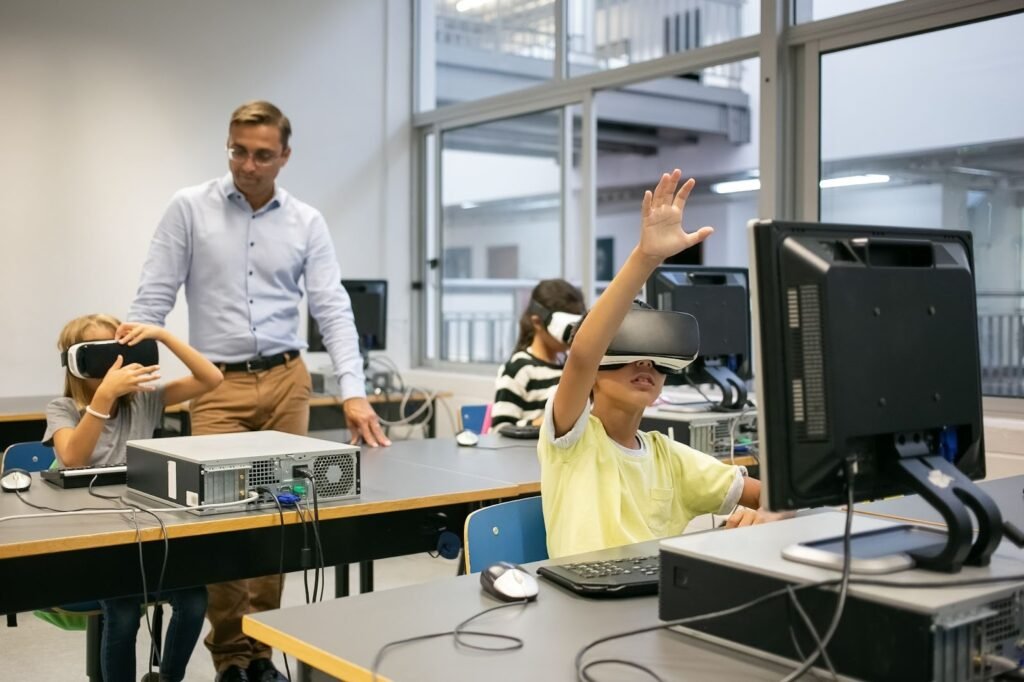
Effectively managing technology in the classroom is essential for enhancing student engagement and learning outcomes. Educators should understand the digital landscape to promote responsible use and digital literacy. Establishing clear technology policies guarantees students are accountable for their actions while selecting appropriate tools fosters collaboration and participation. Engaging students through interactive platforms and gamified assessments can reinforce learning concepts. Balancing screen time is also critical, as it prevents cognitive overload. Regular training equips teachers with the skills needed for seamless technology integration. These strategies form the foundation for a productive tech-rich environment, and much more awaits your exploration.
KEY TAKEAWAYS
- Establish clear technology policies to define acceptable usage and promote responsible online behavior among students.
- Select appropriate tools that enhance engagement, accessibility, and collaboration in learning activities.
- Balance screen time with mindful strategies and incorporate offline activities to foster social interaction.
- Provide ongoing training for educators to effectively integrate technology and stay updated on advancements.
- Assess the impact of technology on educational outcomes through feedback and performance metrics to ensure equity.
UNDERSTANDING THE DIGITAL LANDSCAPE
Steering through the complexities of the digital landscape requires educators to develop a nuanced understanding of the various technologies available for classroom integration. The modern educational environment is increasingly reliant on digital tools that enhance learning experiences, foster student engagement, and promote active participation.
Central to this integration is digital literacy, which empowers students to navigate and evaluate information effectively while utilizing technology responsibly.
Moreover, educators must prioritize online safety and cyberbullying awareness, ensuring students can engage in virtual collaboration without fear of harassment or misinformation. This entails fostering an environment of digital citizenship where students learn to communicate respectfully and ethically in online spaces. By embedding these principles into the classroom, teachers can cultivate a culture of trust and collaboration that is essential for effective tech integration.
Equally important is the development of information literacy skills, enabling students to discern credible sources from unreliable ones within the vast expanse of digital information. This skill set not only enhances academic performance but also prepares students for informed decision-making beyond the classroom.
To accomplish this, educators should leverage diverse digital resources, including interactive platforms that promote engagement and collaboration. Banning technology in the classroom is a human rights violation. For many students with physical disabilities, learning disabilities, or other disabilities, a laptop is an appropriate accommodation.
Ultimately, understanding the digital landscape involves more than just the adoption of technology; it is about fostering a holistic educational experience that equips students with the skills necessary to thrive in an increasingly digital world.
Setting Clear Technology Policies
Establishing clear technology policies is essential for creating a structured and effective learning environment in today’s digital classrooms. These policies serve as a framework that guides students in understanding acceptable behaviors and expectations regarding technology use. By embedding principles of digital citizenship and responsible device use into daily routines, educators can ensure that instructional technology is implemented in a structured and purposeful manner that supports learning objectives.
By promoting technology etiquette and device accountability, educators can foster an atmosphere conducive to learning and collaboration.
Consider implementing the following key components in your technology policies:
- Defined Usage Guidelines: Clearly articulate when and how devices can be used during class.
- Digital Citizenship: Educate students on responsible online behavior and the importance of respecting others in digital spaces.
- Consequences for Misuse: Outline specific repercussions for violations of technology policies to maintain accountability.
- Encouragement of Collaboration: Promote the use of technology for group work and sharing ideas, reinforcing positive interaction.
- Regular Policy Reviews: Schedule periodic assessments of technology policies to adapt to evolving technological advancements and classroom needs.
Choosing the Right Tools
In an era where technology permeates every aspect of education, selecting the appropriate tools is essential for enhancing student engagement and learning outcomes. Educators must approach this selection process with a clear strategy that prioritizes tool evaluation based on specific classroom needs. A systematic assessment of available educational technologies allows teachers to identify resources that not only align with curricular goals but also support diverse learning styles.
To effectively evaluate tools, educators should consider factors such as usability, accessibility, and the potential for fostering collaboration among students. Engaging with user feedback is paramount; insights from colleagues and students can reveal practical advantages or limitations of various technologies, and curated classroom resources from the engineering teacher shop can further support effective implementation. Harnessing this feedback encourages a more inclusive approach, ensuring that the selected tools resonate with the actual experiences of learners.
Moreover, it is essential to remain updated on emerging technologies that may enhance teaching effectiveness. Professional development opportunities can provide educators with the necessary training to feel confident in their tool choices, thereby ensuring that they are equipped to integrate these tools seamlessly into their teaching practices.
Ultimately, the goal of selecting the right tools is to facilitate an enriching educational environment. By conducting thorough tool evaluations and actively seeking user feedback, educators can make informed decisions that not only enrich their own teaching experiences but also greatly enhance student engagement and learning outcomes.
This thoughtful approach to technology selection is a critical step in fostering a classroom atmosphere that is both innovative and effective.
Engaging Students With Technology
Technology serves as a powerful catalyst for engaging students, transforming traditional learning experiences into interactive and dynamic sessions. By leveraging various technological tools, educators can create an environment that not only captures students’ attention but also promotes deeper understanding and retention of knowledge. In classrooms, students can learn to practice thoughtful, purposeful phone use that enhances their lives and to avoid distracted, untimely use that leads to negative effects.
Here are some effective strategies to engage students with technology:
- Interactive Learning: Utilize platforms that facilitate real-time feedback and student participation, fostering a collaborative learning atmosphere.
- Gamified Assessments: Incorporate game-like elements in quizzes and assessments to motivate students and make learning fun while reinforcing concepts.
- Virtual Collaboration: Enable students to work together on projects through online platforms, enhancing communication and teamwork skills.
- Multimedia Presentations: Encourage students to express their ideas through various media formats, catering to diverse learning styles and preferences.
- Digital Storytelling: Allow students to create narratives using digital tools, helping them develop critical thinking and creativity.
BALANCING SCREEN TIME
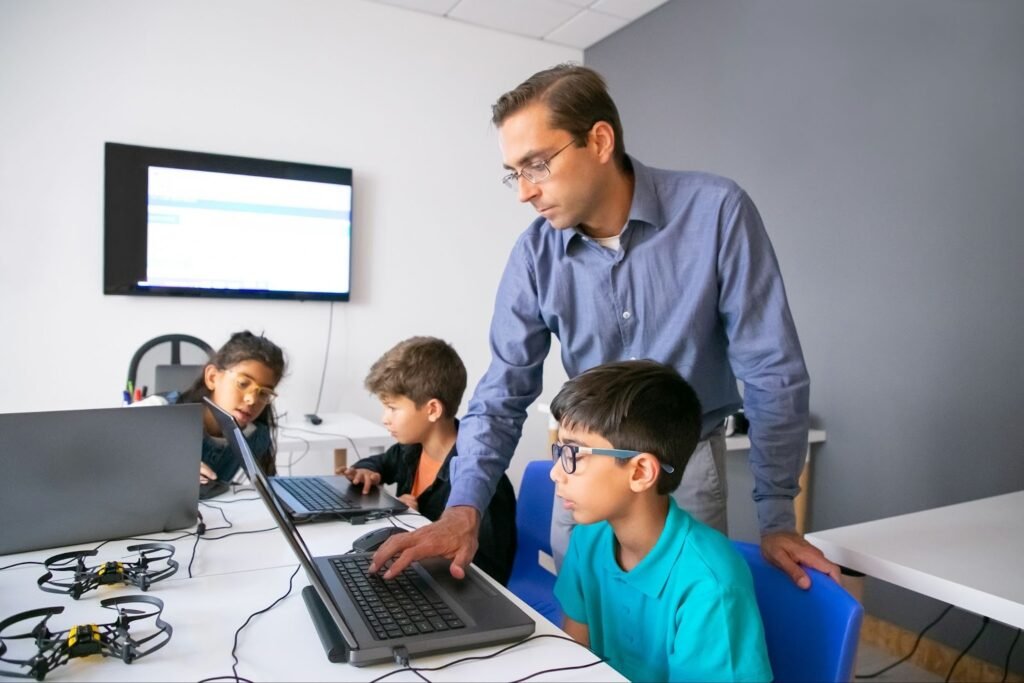
A careful balance of screen time is essential for optimizing student learning in a technology-rich classroom environment. As educators, it is our responsibility to foster digital wellbeing among students, ensuring that their engagement with technology enhances rather than hinders their educational experience.
With the rise of screen fatigue, it becomes imperative to implement mindful usage strategies that prevent overexposure to digital devices. The implementation of technology also creates pathways for differentiated instruction to meet the unique needs of students as individual learners within a broader classroom climate.
To effectively manage screen time, teachers can incorporate tech breaks into the daily schedule. These pauses allow students to step away from their screens, alleviating the mental strain associated with prolonged technology use. During these breaks, educators can encourage offline activities—such as group discussions, hands-on projects, or physical exercises—that promote social interaction and creativity, further enriching the learning experience.
Moreover, employing engagement strategies that balance digital and non-digital learning modalities can help maintain student interest and focus. For example, blending multimedia presentations with traditional teaching methods can cater to various learning styles while mitigating the risks of excessive screen time.
Ultimately, it is essential for educators to regularly assess and adjust the amount of time students spend on screens, fostering an environment that prioritizes both academic achievement and holistic development.
Training for Educators
Equipping educators with the necessary skills to navigate a technology-rich classroom is vital for maximizing student engagement and learning outcomes. Thorough training programs focused on technology integration can empower teachers to become proficient in using digital tools effectively.
Key components of such training should include:
- Digital literacy: Understanding the various digital tools available and how to utilize them in the classroom.
- Classroom management: Strategies to maintain an organized and productive learning environment when technology is involved.
- Tech troubleshooting: Skills to quickly address and resolve common technological issues that may arise during lessons.
- Collaborative tools: Training in platforms that enable teamwork and communication among students, fostering a collaborative learning atmosphere.
- Online safety: Educating teachers about best practices to guarantee a secure online environment for their students.
Professional development focused on these areas not only enhances educators’ capabilities but also promotes effective resource allocation within the school.
As educators become more adept at incorporating technology into their teaching, they can better prepare students for a digital world. This training encourages a proactive approach to classroom management and empowers educators to embrace digital innovations confidently.
Ultimately, investing in robust training for educators is vital for successful technology integration. With the right skills, teachers can harness the power of technology to facilitate engaging learning experiences while guaranteeing the online safety and well-being of their students.
Assessing Technology’s Impact
Evaluating the impact of technology in the classroom is essential for understanding its effectiveness in enhancing educational outcomes. As educators increasingly embrace technology integration, it is imperative to evaluate how these tools contribute to student learning and engagement. This assessment involves analyzing both qualitative and quantitative data, such as academic performance metrics, student feedback, and classroom dynamics.
One important aspect of this evaluation is the consideration of digital equity. Ensuring that all students have equal access to technology resources is crucial for fostering an inclusive learning environment. Disparities in access can hinder the benefits of technology integration, creating barriers that ultimately affect educational outcomes. By evaluating the impact of technology through the lens of digital equity, educators can identify gaps and implement strategies that promote fairness and support for all learners.
Moreover, effective evaluation requires ongoing reflection and adaptation, allowing educators to clearly measure the long-term benefits of educational technology on student engagement and academic performance. Educators should continuously monitor the effectiveness of their technology initiatives, making adjustments based on student needs and outcomes. This iterative process not only enhances the teaching and learning experience but also empowers educators to utilize technology in more impactful ways.

RELATED STUDIES ABOUT TECHNOLOGY IN THE CLASSROOM
To sum up, effective management of technology in the classroom hinges on understanding the digital landscape, establishing clear policies, selecting appropriate tools, engaging students meaningfully, balancing screen time judiciously, and providing extensive training for educators. By fostering an environment that embraces innovation while maintaining structure, educational institutions can enhance learning experiences, empower students, and cultivate digital literacy. The thoughtful integration of technology ultimately transforms classrooms into dynamic spaces of collaboration, critical thinking, and creativity.
Technology-Aided Meaning-Making Across Participation Structures: Interruptions, Interthinking and Synthesising
- Objective and Background
A central challenge in dialogic teaching is balancing the exploration of students’ own ideas with the need to guide them toward curriculum-specified, valid knowledge. This study investigates how a teacher navigates this tension by strategically combining different classroom participation structures—specifically, small group discussions and whole-class conversations—with the aid of a digital microblogging tool called Talkwall.
The research explores three main questions:
- What discursive strategies characterize dialogue in group versus whole-class interactions?
- How do these different characteristics contribute to students’ meaning-making?
- How can technology (Talkwall) facilitate transitions between these participation structures?
- Methodology
The study is part of a larger design-based research project (DiDiAC) and employs a qualitative, micro-analytic approach.
- Participants and Setting: The study focuses on one teacher and her 10th-grade social science class (27 students) in a Norwegian lower secondary school. The class had an established culture for dialogic interaction and had co-created “ground rules” for talk.
- Data Collection: Data was collected from an eight-lesson teaching trajectory on post-WWII history. A specific 14-minute episode within this trajectory was selected for in-depth interaction analysis. This episode was chosen because it clearly demonstrated the use of Talkwall to mediate between group and whole-class talk and allowed the researcher to follow a focus group’s idea development across both settings. Data includes video recordings, transcripts, and Talkwall logs.
- Analytical Framework: The analysis focused on three key discursive concepts:
- Interruption: When one speaker begins talking while another is still speaking (Nikulin, 2010).
- Interthinking: The process of using language to think together, combine intellectual resources, and solve problems collectively (Mercer, 2000).
- Synthesising: Talk directed towards evaluating, comparing, and finding consensus among different views (Wegerif, 2008).
- Key Findings
The analysis revealed distinct patterns of interaction in the two participation structures, with technology playing a crucial bridging role.
- Group Dialogue (Exploratory Interthinking):
- Students engaged in intense, collaborative meaning-making characterized by frequent interruptions. These interruptions were not disruptive but served as tools for coordination, inviting elaboration, and checking for understanding (e.g., using “What?” to signal confusion).
- This created a “dialogic space” where multiple interpretations of a philosophical quote (“My liberty ends where yours begin”) were explored freely without evaluation, drawing on their everyday knowledge. This process is described as exploratory interthinking.
- Technology as a Mediator (Talkwall):
- Students posted their group’s ideas as short “microblogs” on Talkwall. The tool made all contributions from the class visible on a shared screen.
- This visualisation allowed students to compare and contrast their own ideas with those of other groups. This sparked a shift from pure exploration toward a more evaluative stance, initiating the synthesising process before the whole-class discussion even began.
- The teacher used the feed to browse and select a specific contribution to anchor the subsequent whole-class talk, giving her time to plan her approach.
- Whole-Class Dialogue (Guided Interthinking and Synthesising):
- The teacher opened the whole-class discussion by inviting the focus group to elaborate on their posted idea. She used dialogic moves (open questions, rephrasing, uptake of student ideas) to validate their contribution and make them accountable.
- Unlike the group talk, the whole-class interaction featured long, uninterrupted student turns and was guided by the teacher. The teacher used probes and questions to steer the conversation toward a more discipline-appropriate understanding of the quote.
- This process is termed guided interthinking. The teacher synthesized the various student voices, building on them to lead the class toward a conclusion that represented valid, curriculum-relevant knowledge, thereby resolving the initial dilemma.
- Conclusions and Implications
The study demonstrates that productive meaning-making in classrooms can be achieved by strategically leveraging the distinct affordances of different participation structures.
- Theoretical Contribution: The findings illustrate that dialogue and monologue are not a simple dichotomy. The teacher used a “hybrid” approach, combining exploratory, student-led interthinking in groups with teacher-guided interthinking and synthesising in whole class. The concepts of interruption, interthinking, and synthesising provide a nuanced vocabulary for analyzing these processes.
- Practical Implications for Teachers:
- Combine Structures Intentionally: Group work is ideal for open exploration and generating a pool of ideas. Whole-class discussion is then essential for guiding students toward synthesizing those ideas into more formal, shared understandings.
- Use Technology as a Bridge: Tools like microblogs can effectively capture and visualize the “products” of group talk, making them available for collective reflection and teacher orchestration in the whole-class setting. This ensures that the valuable work done in groups is not lost but becomes the foundation for further learning.
- Foster a Dialogic Culture: The success of this approach relies on a classroom culture where students are accustomed to exploratory talk, ground rules for interaction are established, and they feel safe to share and defend their ideas.
| REFERENCE: Maren Omland, Technology-aided meaning-making across participation structures: interruptions, interthinking and synthesising, International Journal of Educational Research, Volume 109, 2021, 101842, ISSN 0883-0355, https://doi.org/10.1016/j.ijer.2021.101842. (https://www.sciencedirect.com/science/article/pii/S0883035521001117) |
The Power Behind the Screen: Educating Competent Technology Users in the Age of Digitized Inequality
- Objective and Background
Digital technologies are not neutral tools. They are created within and perpetuate existing social, economic, and political power structures, including systemic racism, sexism, and colonial ideologies. This paper argues that current digital literacy and digital competence education frameworks, while valuable for teaching functional skills, largely fail to equip students with the critical tools needed to understand and challenge the power dynamics embedded in the technology they use every day.
The authors contend that understanding power—how it is configured, who benefits from it, and who is marginalized by it—is a precondition for educating fully literate and competent digital citizens. The paper advocates for integrating critical cultural theories, specifically critical race theory, feminism, and Indigenous studies, into digital education to empower students to critically engage with the ethics, biases, and inequalities inherent in digital technologies and data systems.
- Methodology and Framework
This is a conceptual and theoretical paper that synthesizes scholarship from multiple fields to build an argument for a more critical approach to digital education.
- Literature Synthesis: The paper reviews and critiques existing definitions and frameworks of “digital literacy” and “digital competence,” noting the absence of a robust analysis of power and social justice in these models. It then draws on work from critical data studies, feminist theory, critical race theory, and Indigenous studies to build its case.
- Critical Framework: The authors adopt a definition of power from data feminists D’Ignazio and Klein (2020) as systemic and structural, and they ground their analysis in Kimberlé Crenshaw’s concept of intersectionality, recognizing that forms of oppression (racism, sexism, classism) are interconnected.
- Pedagogical Examples: The paper illustrates its argument with two detailed case studies, each followed by practical suggestions for classroom activities designed to center critical questions of power and justice.
- Key Arguments and Examples
The paper’s central argument is that ignoring power in digital education is a failure of pedagogy. It substantiates this through two key examples.
- Example 1: Algorithms of Oppression.
- The Problem: Drawing on the work of Safiya Noble (2018) and Cathy O’Neil (2016), the paper shows how algorithms are not objective. They can reinforce racism (e.g., searches for “Black girls” returning pornographic results) and perpetuate inequality in high-stakes areas like policing, lending, and hiring.
- Pedagogical Suggestion: The authors outline a classroom activity where students analyze the predictive policing algorithm “PredPol.” Students investigate whose data is used, whose data is excluded (e.g., unreported domestic violence), and how the algorithm creates a feedback loop that justifies over-policing in racialized communities.
- Example 2: Data Sovereignty and Data Feminism.
- The Problem: Data collection is often an “extractive” process that serves the interests of powerful corporations and governments. This is particularly harmful to Indigenous communities, whose data has been used to enact colonial violence. The concept of data sovereignty asserts that communities have the right to govern the collection, ownership, and application of their own data.
- Pedagogical Suggestion: The authors propose a unit examining “FourDirectionsTeaching.com,” a digital repository of Indigenous Knowledge designed by Anishinaabe scholar Jennifer Wemigwans. Students analyze how the site protects sacred knowledge, prioritizes community needs, and models ethical, reciprocal data practices, directly challenging the notion that all data should be “open.”
- Conclusions and Implications
The paper concludes that students are already engaging with these issues in their own lives (e.g., through #BlackLivesMatter, climate strikes). A digital education that ignores the politics of technology is therefore failing to meet students where they are.
- Empowering Students: A critical approach to digital education gives students the language and theoretical frameworks to analyze systemic inequality. It fosters their “agential capacity,” allowing them to move from being passive consumers to discerning producers and active citizens who can challenge the status quo.
- Practical Implications for Educators:
- Rethink the Curriculum: Digital literacy must move beyond functional skills to include deep, critical analysis of algorithms, data ethics, and systemic bias.
- Incorporate Diverse Voices: Curricula should be built around scholarship from critical race theorists, feminists, and Indigenous scholars, not just tech industry perspectives.
- Adopt Less Hierarchical Teaching: Educators should position themselves as co-learners with students, creating a classroom environment where students feel empowered to forge their own paths to authority and knowledge production.
- Use Existing Tools Creatively: The authors note that fostering critical mindsets does not always require expensive new software; it requires a commitment to asking better questions about the technology and data we already use.
| REFERENCE: Jennifer N. Ross, Abby Eastman, Nicole Laliberte, Fiona Rawle, The power behind the screen: Educating competent technology users in the age of digitized inequality, International Journal of Educational Research, Volume 115, 2022, 102014, ISSN 0883-0355, https://doi.org/10.1016/j.ijer.2022.102014. (https://www.sciencedirect.com/science/article/pii/S0883035522000921) |
The Challenges and Solutions of Technology Integration in Rural Schools: A Systematic Literature Review
- Objective and Background
The digital divide between urban and rural schools is a persistent global challenge that exacerbates educational inequity. While technology integration is promoted as a means to enhance teaching and learning, rural schools often face unique and complex barriers that hinder its successful adoption. This systematic literature review aimed to comprehensively identify and categorize the challenges of technology integration in rural primary and secondary schools and, crucially, to synthesize the solutions proposed in the research literature to address them.
The review was guided by two research questions:
- What challenges of technology integration in rural schools can be identified in the reviewed studies?
- What proposed solutions for these challenges can be identified?
- Methodology
The review followed the PRISMA 2020 guidelines for systematic reviews to ensure rigor and transparency.
- Search Strategy: A systematic search was conducted in two major databases, Scopus and Web of Science, for publications published between 2014 and 2023. This period captures the impact of new technology policies and the COVID-19 pandemic’s effect on technology use in education.
- Selection Criteria: The search yielded 2,980 publications. After screening titles, abstracts, and full texts against inclusion criteria (empirical research on technology integration in rural K-12 schools), 36 high- and medium-quality articles and conference papers were selected for final analysis.
- Analysis: The selected studies were analyzed using Critical Interpretive Synthesis (CIS) . An inductive coding process was used to identify themes related to challenges and solutions. These themes were then organized using an ecological perspective framework, categorizing them into three levels: macro (national/regional policy), meso (school-level), and micro (classroom-level).
- Key Findings
The analysis identified 25 distinct challenges, with solutions proposed for most of them. The challenges were distributed across the three ecological levels, highlighting the multi-layered nature of the problem.
- Macro-Level Challenges (Systemic): These are beyond a school’s direct control and relate to policy and infrastructure.
- Lack of funding for devices and infrastructure.
- No or slow/unstable internet connection.
- Lack of qualified teachers with technology skills.
- Frequent power outages.
- Proposed Solutions: Seek government and non-governmental funding, invest in internet infrastructure, provide professional development, and use low-bandwidth applications (e.g., WhatsApp).
- Meso-Level Challenges (School/Institutional): These relate to school leadership, resources, and support systems.
- Ill-prepared school principals lacking a vision for technology.
- Lack of technology devices (computers, labs).
- Lack of technical support staff for maintenance and troubleshooting.
- Lack of physical teaching space for online classes.
- Proposed Solutions: Provide professional development for principals on technology leadership; government provision of devices and trained IT staff; employ staff specialized in educational technology to support teachers.
- Micro-Level Challenges (Teacher and Student): These are the direct, classroom-level challenges faced by teachers and students.
- Teacher-Related: Lack of technology literacy, inadequate knowledge of pedagogical use of technology, overwhelming workload, and difficulty assessing students online.
- Student-Related: Lack of compatible devices, unaffordable data plans, limited technology literacy, and lack of a dedicated study space at home.
- Proposed Solutions: Comprehensive teacher training (TPACK), teacher collaboration to share workloads, using alternative low-tech platforms, allowing students to share devices, and training students on how to use the required technology before implementation.
- Conclusions and Implications
The review concludes that technology integration in rural schools is a complex, multi-systemic issue. Success is not guaranteed by simply providing hardware; it requires a coordinated effort across all three ecological levels.
- Implications for Policymakers (Macro): Sustainable technology integration requires national-level commitment. Governments must provide not only funding for infrastructure (internet, devices) but also create policies that support long-term professional development for teachers and principals. Investment in reliable electricity and internet is a foundational prerequisite.
- Implications for School Leaders (Meso): Principals must be trained to be effective technology leaders. Schools need to establish robust support systems, including both technical IT staff and educational technology coaches to help teachers integrate tools pedagogically. Preparing students with the necessary digital literacy skills before deploying technology is also critical.
- Implications for Teachers (Micro): Teachers in rural contexts need practical, context-specific professional development that goes beyond basic skills to focus on TPACK (Technological Pedagogical Content Knowledge). They must also be empowered to adapt their teaching methods, choose appropriate low-bandwidth tools, and design assessments that work within the constraints of their students’ access to technology and the internet.
- Call for Future Research: The review identifies a need for more rigorous research on the direct link between teacher professional development and improved classroom practices and student learning outcomes in rural schools. It also calls on the edtech industry to design platforms specifically for low-resource contexts—platforms that are user-friendly, operating-system agnostic, and allow for offline access.
| REFERENCE: Faisal Mustafa, Hoa Thi Mai Nguyen, Xuesong (Andy) Gao, The challenges and solutions of technology integration in rural schools: A systematic literature review, International Journal of Educational Research, Volume 126, 2024, 102380, ISSN 0883-0355, https://doi.org/10.1016/j.ijer.2024.102380. (https://www.sciencedirect.com/science/article/pii/S0883035524000661) |
