

Whenever parents sit down across from me during parent-teacher conferences, their questions almost always start with mechanics: “How many hours should they be studying?” or “Which workbook will fix their test scores?” But over my past twelve years teaching secondary school and designing curricula, I’ve found that academic achievement rarely comes down to worksheets alone. Long before a student tackles an equation or opens a textbook, they bring an invisible lens into the classroom—a lens shaped almost entirely by what their families believe about them.
I see this play out constantly, particularly in math and science. When a student enters my room convinced that “our family just isn’t good at math,” that belief didn’t materialize in a vacuum; it was absorbed quietly at home. Conversely, when parents view academic struggle not as a deficiency but as a natural phase of cognitive stretching, their children arrive at school with an extraordinary buffer against discouragement.
It’s a vivid reminder that parental involvement isn’t merely about monitoring homework logs or enforcing rigid study schedules. It is about emotional climate and narrative framing. The attitudes we project around our kitchen tables become the internal voices our students use to talk to themselves when the work gets tough.
Parent beliefs greatly influence student motivation, which in turn affects learning behaviors and academic achievement. Supportive parental attitudes promote a growth mindset, enhancing resilience and engagement. High expectations from parents encourage goal setting and effort, leading to improved academic outcomes. Conversely, negative beliefs can diminish motivation and hinder progress. Additionally, emotional and psychological support plays an essential role. Understanding these dynamics reveals deeper insights into the factors shaping student success and the implications for parental involvement.
KEY TAKEAWAYS
- Positive parental beliefs enhance student self-perception, fostering resilience and increasing engagement in learning behaviors.
- High parental expectations motivate students to set goals and exert greater academic effort, driving achievement.
- Confidence and a growth mindset, supported by parental feedback, lead to improved academic outcomes and perseverance in challenges.
- Emotional and psychological support from parents significantly influences student motivation and engagement, beyond academic assistance.
- Collaborative efforts between parents and educators create a supportive environment that enhances student achievement and fosters shared learning goals.
HOW DO PARENT BELIEFS IMPACT STUDENT MOTIVATION?
Parental involvement in homework is a home-based type of involvement in children’s education. Research and theory suggest that it is beneficial for learning and achievement under certain conditions and for particular groups of individuals.
While it is often assumed that student motivation primarily stems from intrinsic factors, research indicates that parent beliefs play an essential role in shaping students’ motivational landscapes.
Parental attitudes, encompassing expectations and values, considerably influence students’ self-perception and goal orientation, aligning closely with various motivation theories. For instance, the expectancy-value theory posits that students are more likely to engage in learning when they perceive their parents’ beliefs as supportive and optimistic.
Furthermore, constructivist theories highlight how positive parental feedback fosters a growth mindset, encouraging resilience and persistence in academic challenges. Conversely, negative parental beliefs may lead to diminished motivation, reinforcing avoidance behaviors.
Understanding these dynamics is vital for educators and stakeholders aiming to foster environments that promote student success. By acknowledging the impact of parent beliefs on motivation, interventions can be developed that engage families, thereby enhancing the overall educational experience for students.
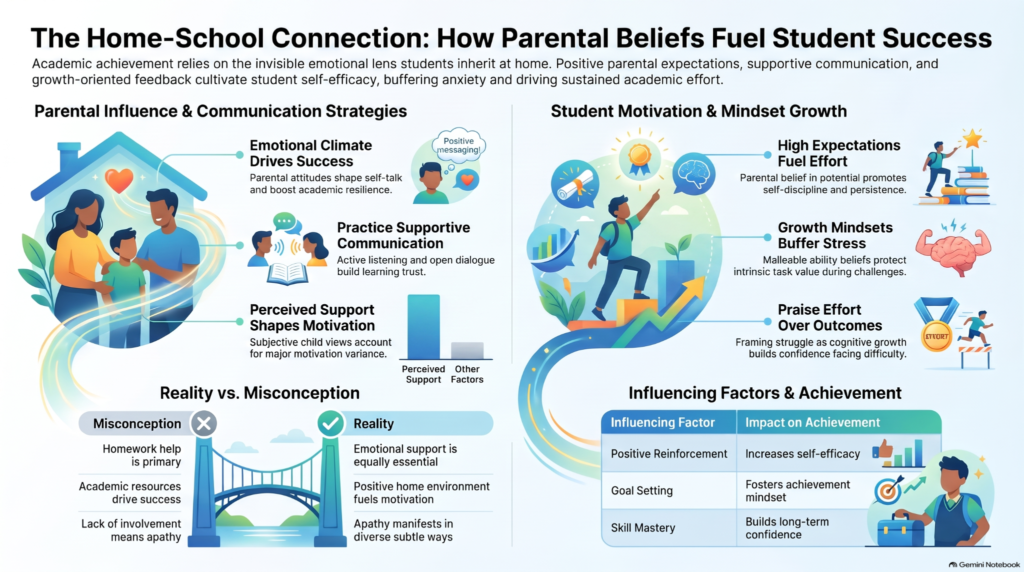
How Positive Parent Engagement Fuels Academic Success
Parents play a vital role as social ac tors in the development of children’s academic achievement by motivating them. Their active participation in children’s learning process is quite important for them to influence their children for a better learning outcome. Parental involvement in literature has been defined in a variety of ways. It is generally the involvement of parents in the children’s education process with the aim of improving their academic as well as social wellbeing.
Research indicates that active parental involvement and supportive communication can greatly enhance student academic outcomes.
By employing effective engagement strategies, parents may create an environment that fosters motivation and resilience in learners.
Understanding the mechanisms behind these practices could reveal critical insights into optimizing student success.
Active Involvement Strategies
Parental engagement greatly influences student motivation and academic success, as various active involvement strategies can create a supportive learning environment.
Engaging in homework help not only reinforces academic concepts but also fosters a sense of partnership between parents and students. This collaboration can enhance students’ confidence and interest in learning.
Furthermore, providing volunteer opportunities for parents within the school community can strengthen connections and create a culture of support. Such initiatives allow parents to model positive behaviors and demonstrate the value of education, which can directly impact students’ motivation. Parents and educators can explore the engineering teacher shop for practical teaching resources and classroom materials that reinforce academic concepts, support engaging learning activities, and encourage students to develop stronger study habits.
Ultimately, these active involvement strategies serve to cultivate a collaborative atmosphere, which is essential for enhancing student achievement and fostering lifelong learning habits.
Supportive Communication Practices
Effective communication between parents and students plays an essential role in academic success, as it establishes a foundation of trust and support.
Supportive communication practices foster an environment conducive to learning by encouraging student motivation and engagement.
Three critical elements of such practices include:
- Active Listening: Parents who actively listen demonstrate empathy, making students feel valued and understood.
- Effective Feedback: Constructive feedback from parents helps students recognize their strengths and areas for improvement, guiding their academic journey.
- Open Dialogue: Maintaining an open line of communication allows for a safe space where students can express concerns and aspirations.
The Role of Expectations in Shaping Learning Behaviors
Research indicates that parental expectations substantially influence students’ learning behaviors and academic outcomes.
Additionally, the self-expectations students cultivate in response to these parental beliefs are essential in driving their effort and motivation.
Cultural beliefs also play a pivotal role in shaping these dynamics, suggesting a complex interplay between expectations and achievement in educational contexts.
Parental Expectations Impact Learning
While expectations can greatly influence student outcomes, the nuances of how parental beliefs shape learning behaviors remain an area ripe for exploration.
Parental expectations serve as a pivotal influence, fostering a sense of academic resilience in students. Understanding the relationship between parental expectations academic achievement can help families establish realistic goals, encourage consistent effort, and provide the support students need to succeed academically. When parents actively engage in their child’s education, they create an environment conducive to success.
- Encouragement of Goal Setting: Parents who express high expectations often prompt students to set achievable academic goals.
- Promotion of Effort: These expectations can drive students to exert greater effort in their studies.
- Development of Self-Discipline: A strong belief in a child’s potential nurtures self-discipline, enhancing learning behaviors.
Understanding these dynamics can help educators and parents collaborate effectively to support student achievement.

STUDENT SELF-EXPECTATIONS DRIVE EFFORT
One of the biggest missteps I see well-intentioned families make—and something I even have to consciously check myself on when helping my own nephews with their science projects—is confusing parental involvement with micromanagement. Many parents assume being supportive means hovering over every problem, demanding flawless completion, or setting punitive timers at the kitchen table. In reality, that kind of high-pressure vigilance often backfires.
When the emotional stakes are dialed too high, homework morphs into an anxiety trap. Students end up freezing, not because they lack the ability to grasp the concepts, but because their working memory is entirely consumed by the fear of falling short of parental expectations. What research confirms, and what I see in my classroom every single term, is that students don’t need their parents to be subject-matter experts or strict drill sergeants.
They need parents to act as emotional shock absorbers. That means asking open-ended questions like, “Which problem felt the most interesting today?” or simply sitting nearby offering calm reassurance when frustration peaks. When you validate the emotional strain of a tough concept rather than obsessing over the final score, you preserve your child’s intrinsic desire to try. Genuine support isn’t about policing the work; it’s about creating a safe, low-stress environment where making a mistake is treated as valuable information rather than a failure.
Self-expectations play a crucial role in shaping student motivation and effort in the learning process. Research indicates that students with strong self-efficacy beliefs are more likely to engage in intrinsic motivation, which fosters a commitment to their educational goals.
When learners set high self-expectations, they tend to invest greater effort, demonstrating resilience in the face of challenges. This intrinsic drive often leads to enhanced learning behaviors, as students perceive their abilities positively and are motivated to achieve their desired outcomes.
Consequently, understanding the dynamics of self-expectations can empower educators and parents to cultivate environments that nurture these beliefs, thereby increasing student engagement and ultimately improving academic achievement.
Cultural Beliefs Shape Achievement
Cultural beliefs greatly influence student achievement by shaping expectations that drive learning behaviors. These expectations are inherently tied to cultural values, which can considerably affect achievement motivation among students.
For instance, students raised in cultures that prioritize education may exhibit:
- High aspirations: Expecting to excel academically and pursue further education.
- Resilience: Demonstrating persistence in the face of academic challenges, viewing setbacks as learning opportunities.
- Community support: Engaging with family and peers who reinforce educational goals and values.
Understanding how cultural beliefs shape these expectations is essential for educators and policymakers.
How Confidence Drives Academic Achievement
Confidence plays a pivotal role in driving academic achievement, serving as a catalyst for students to engage deeply with their learning. The relationship between confidence building and an achievement mindset is essential, as higher self-efficacy often leads to better performance. Students who believe in their abilities are more likely to tackle challenges, persist through difficulties, and achieve their academic goals.
| Factors Influencing Confidence | Impact on Achievement |
| Positive reinforcement | Increases self-efficacy |
| Goal setting | Fosters achievement mindset |
| Peer support | Enhances motivation |
| Self-reflection | Promotes resilience |
| Skill mastery | Builds confidence |
Empirical studies suggest that fostering an environment conducive to confidence building can lead to significant improvements in academic outcomes. By nurturing students’ belief in their potential, educators can cultivate an achievement mindset that empowers learners to excel.
How Parents Can Encourage a Growth Mindset
Parental influence plays a significant role in shaping a child’s mindset towards learning and achievement. To foster a growth mindset, parents can implement various strategies that emphasize effort and resilience. Engaging in targeted growth mindset activities and utilizing effective praise strategies can enhance a child’s perception of their abilities.
- Encourage challenges: Parents should promote the idea that challenges are opportunities for growth, rather than obstacles.
- Emphasize effort over outcome: Acknowledging the effort put into tasks, rather than solely the results, reinforces the value of perseverance.
- Model learning from failure: By sharing personal experiences of overcoming setbacks, parents can illustrate that failure is a part of the learning process.
These approaches not only cultivate a growth mindset but also empower children to embrace learning with enthusiasm and resilience. Ultimately, this influences their academic and personal achievements.
Debunking Myths: Misconceptions About Parental Influence on Learning
As children mature, they tend to develop a fixed mindset in math, which has been identified as a contributor to declining confidence and widespread anxiety in math. Both parents and teachers can function as critical socializers in shaping children’s fixed mindsets.
While many believe that parental influence is solely about providing academic support or resources, a deeper examination reveals that misconceptions abound regarding the true nature of this impact on children’s learning. Misguided beliefs often suggest that parental involvement is limited to direct academic assistance, neglecting the importance of emotional and psychological factors. For instance, parental apathy can notably hinder a child’s motivation, creating an environment where students may feel unsupported.
| Misconceptions | Reality |
| Parents should only help with homework | Emotional support is equally essential |
| Academic resources alone drive success | Motivation stems from a positive home environment |
| A lack of involvement indicates indifference | Apathy can manifest in various ways |
Understanding these nuances allows for a more thorough approach to fostering student achievement, moving beyond simplistic views of parental roles in education.
Encouraging Collaboration Between Parents and Educators for Better Outcomes
Collaboration between parents and educators serves as a critical factor in enhancing student outcomes. This partnership fosters an environment where shared learning goals can flourish, ultimately benefiting students’ academic and social development. Establishing effective teacher parent communication helps ensure that families and educators share important updates, address students’ learning needs, and work together to create a supportive environment that promotes academic success.
To achieve effective parent-teacher collaboration, the following strategies can be employed:
- Open Communication: Establish regular channels for dialogue, ensuring both parties are informed and engaged.
- Joint Workshops: Organize sessions that allow parents and educators to learn about effective teaching methods and support strategies together.
- Feedback Mechanisms: Implement systems that encourage constructive feedback, enabling continuous improvement in the learning process.

RELATED STUDIES ABOUT PARENT BELIEFS AND STUDENT MOTIVATION
In the intricate tapestry of education, parent beliefs serve as both the loom and the threads, weaving together student motivation and achievement. Just as a gardener nurtures the soil to cultivate vibrant blooms, so too do informed parental expectations foster a fertile environment for academic growth. By dismantling misconceptions and nurturing collaboration with educators, parents can transform potential into performance, ensuring that the fruits of learning are not merely harvested but thrive in the sunlight of support and encouragement.
A framework for teachers’ culturally responsive teaching beliefs: Links to motivation to teach Aboriginal curriculum and relationships with Aboriginal students
Conceptual Framework and Research Rationale
- The Imperative for Culturally Responsive Teaching (CRT) in Indigenous Education: Culturally responsive teaching seeks to align instructional design, curriculum, and pedagogy with students’ cultural backgrounds, identities, and Indigenous knowledges, challenging Eurocentric and Western pedagogical hegemony. In Australia, bridging disparities between non-Aboriginal and Aboriginal students remains an ethical and professional mandate (stipulated by AITSL professional teaching standards and ACARA cross-curriculum priorities), yet institutional progress in “closing the gap” has remained stubbornly limited.
- The Methodological Gap in CRT Research: Extant CRT literature is predominantly qualitative, relying on small, localized case studies that explore teacher dispositions and classroom practices. While vital for conceptual discovery, qualitative inquiry alone cannot easily isolate complex psychological beliefs, verify construct differentiation, or evaluate how specific subcomponents of CRT link to teacher motivation, classroom relationships, and perceptions across broader teacher populations.
- Disentangling CRT Beliefs from Generic “Good Teaching”: Prior quantitative frameworks frequently conceptualized CRT as a broad, higher-order unidimensional construct or merged cultural responsiveness with generic pedagogical competencies (e.g., general ethic of care, standard pedagogical expertise). Consequently, an empirical framework was required to isolate dimensions of cultural responsiveness specific to Indigenous community partnerships, curriculum transformation, and professional reflexivity.
- The Culturally Responsive Teaching Beliefs (CRTB) Framework: Grounded in extensive systematic reviews of Aboriginal education (e.g., the Aboriginal Voices project), the authors conceptualized a multidimensional model comprising five distinct, interrelated belief dimensions:
- Understanding Community: Deep knowledge of local Aboriginal and Torres Strait Islander communities, historical colonization, racism, and contemporary socio-structural realities.
- Curriculum Work: Proactive design and delivery of curricula that center local Aboriginal and Torres Strait Islander histories, languages, and cultures while critically auditing instructional resources.
- Reflexive Discussions: Deliberate engagement in professional, critical dialogue within school communities regarding how race, history, systemic barriers, and pedagogy intersect in Indigenous education.
- Collaborative Teaching Practices: Enacting relational pedagogies, collaborative planning, and critical reflection with peers to adapt instruction to local place and community contexts.
- Learning through Cultural Mentorship: Professional openness to learning on Country alongside Cultural Mentors, Community Elders, and Aboriginal Education Officers as primary pedagogical authorities.
- Core Research Questions:
- RQ1: What is the construct validity and factorial structure of the newly developed CRTB Framework as examined via exploratory and confirmatory factor analysis?
- RQ2: How do the distinct dimensions of the CRTB Framework associate with external validation constructs, including teachers’ motivation to teach Aboriginal perspectives (self-efficacy and valuing), teacher-student relationships, and teacher beliefs regarding Aboriginal students’ academic motivation and engagement?
Methodology and Psychometric Design
- Research Context and Sample Profile:
- Embedded within the Culturally Nourishing Schooling (CNS) project—a whole-of-school reform initiative spanning eight public (government) schools located across urban, regional, and remote Aboriginal Countries, Communities, and Nations in New South Wales (NSW), Australia.
- Participating schools served student bodies with high proportions of Aboriginal or Torres Strait Islander youth ($M = 30.5\%$, range = 14% to 50%).
- Sample Size: 119 in-service teachers (73.1% female [n=87], 26.1% male [n=31], 1 gender non-conforming).
- Professional Demographics: 77.3% held >5 years of teaching experience (n=92); 48.7% held postgraduate qualifications (n=58). 5.9% identified as Aboriginal (n=7), and 94.1% did not identify as Aboriginal or Torres Strait Islander (n=112).
- Instrumentation and Measurement Architecture:
- Culturally Responsive Teaching Beliefs (CRTB) Scale: Initially developed as a 17-item self-report questionnaire using a 5-point Likert scale (1 = Strongly Disagree to 5 = Strongly Agree) assessing the five hypothesized dimensions.
- External Validation Constructs (Standardized Scales):
- Teachers’ Motivation to Teach Aboriginal Perspectives: Adapted from the Motivation and Engagement Scale–Work (Martin, 2010), capturing Self-Efficacy (4 items, =.98) and Valuing of Aboriginal perspectives (4 items, =.98).
- Teacher-Student Relationships: Adapted from Ang (2005), assessing Relationship Satisfaction (5 items, =.98), Students Seeking Instrumental Help (5 items, =.97), and Lack of Connection (5 items, =.96).
- Teacher Beliefs About Aboriginal Students’ Motivation and Engagement: Adapted from the Motivation and Engagement Scale–High School (Martin), measuring perceived Adaptive Motivation (=.93), Adaptive Engagement (=.97), Maladaptive Motivation (=.86), and Maladaptive Engagement (=.95).
- Statistical Modeling Procedures:
- Estimated using Mplus (version 8.2) under robust maximum likelihood (MLR) estimation to account for non-normality and missing data.
- Exploratory Factor Analysis (EFA): Executed on the initial 17 items with oblique GEOMIN rotation across 1- to 7-factor solutions, evaluating fit indices (2, CFI, RMSEA), 2 nested difference testing, and scree eigenvalues.
- Confirmatory Factor Analysis (CFA): Conducted on the refined item set to confirm factorial stability and estimate latent factor correlations.
- External Construct Evaluation: Modeled the five finalized CRTB factors as fully latent variables alongside error-corrected manifest mean scores of the external validation constructs.
- Demographic invariance screening via Multivariate Analysis of Variance (MANOVA) with Bonferroni correction (p<.003) examined potential mean differences across teacher gender, qualification level, and career stage.
Key Empirical Findings
- Factorial Structure and Psychometric Validation (RQ1):
- EFA Extraction and Model Selection:
- The 5-factor model demonstrated the best parsimonious fit to the data (2(61)=62.63,p=.42,CFI=.99,RMSEA=.02).
- Chi-square difference testing confirmed that the 5-factor solution was a statistically significant improvement over a 4-factor solution (2(13)=210.01,p<.001), whereas 6- and 7-factor models provided no significant gains (p>.09).
- A competing 4-factor model inappropriately collapsed Reflexive Discussions and Collaborative Teaching Practices into a single dimension and exhibited poor global fit (CFI=.85,RMSEA=.13).
- Item Refinement:
- One intended Curriculum Work item (“I am confident in being able to work with local Aboriginal and Torres Strait Islander families…“) demonstrated a low primary factor loading (=.44) and cross-loaded heavily onto Understanding Community (=.59); it was removed from the final instrument.
- The resulting 16-item scale exhibited clean, high standardized factor loadings (=.64–.96) across all five latent dimensions.
- CFA Model Fit and Subscale Reliability:
- The finalized 16-item 5-factor CFA showed good structural fit (2(94)=165.05,p<.001,CFI=.93,RMSEA=.08).
- Internal reliability across all five subscales was high (McDonald’s =.97–.99):
- Understanding Community (3 items, =.97,M=3.730.84).
- Curriculum Work (3 items, =.99,M=3.870.79).
- Reflexive Discussions (3 items, =.98,M=3.730.83).
- Collaborative Teaching Practices (3 items, =.98,M=3.560.81).
- Learning through Cultural Mentorship (4 items, =.98,M=3.651.02).
- Rejection of Higher-Order Unidimensionality:
- Testing a higher-order model where all five factors loaded onto a single general “CRT” super-factor yielded inferior fit (2(99)=187.69,p<.001,CFI=.91,RMSEA=.09).
- Latent inter-factor correlations ranged from small to moderate (r=.13–.67), confirming that the dimensions represent distinct, non-redundant facets of culturally responsive beliefs.
- MANOVA tests revealed no significant differences in CRTB scores across gender, postgraduate education, or teaching experience (p>.003).
- Bivariate Associations with External Professional Constructs (RQ2):
- Links to Teacher Motivation:
- Self-Efficacy to Teach Aboriginal Perspectives: Strongly and positively associated with Understanding Community (r=.65,p<.001), Curriculum Work (r=.62,p<.001), Reflexive Discussions (r=.42,p<.001), and Collaborative Teaching Practices (r=.32,p<.01).
- Valuing of Aboriginal Perspectives: Strongly correlated across Curriculum Work (r=.62,p<.001), Reflexive Discussions (r=.50,p<.001), Collaborative Practices (r=.49,p<.001), Understanding Community (r=.41,p<.001), and Cultural Mentorship (r=.27,p<.01).
- Links to Teacher-Student Relationships:
- Relationship Satisfaction: Positively correlated with Understanding Community (r=.42,p<.001), Curriculum Work (r=.42,p<.001), Collaborative Practices (r=.37,p<.001), and Reflexive Discussions (r=.34,p<.001).
- Students Seeking Instrumental Help: Positively associated with Curriculum Work (r=.46,p<.001), Collaborative Practices (r=.42,p<.001), Understanding Community (r=.38,p<.001), and Reflexive Discussions (r=.32,p<.01).
- Lack of Connection: Demonstrates moderate to strong negative correlations across Understanding Community (r=-.51,p<.001), Curriculum Work (r=-.47,p<.001), Collaborative Practices (r=-.43,p<.001), and Reflexive Discussions (r=-.27,p<.01), indicating that stronger CRT beliefs directly alleviate feelings of relational detachment.
- Links to Teacher Beliefs About Aboriginal Students:
- Adaptive Motivation: Positively predicted by Understanding Community (r=.31,p<.01), Curriculum Work (r=.28,p<.05), and Cultural Mentorship (r=.27,p<.05).
- Adaptive Engagement: Positively associated with Curriculum Work (r=.39,p<.001), Understanding Community (r=.29,p<.01), Collaborative Practices (r=.26,p<.05), and Reflexive Discussions (r=.25,p<.01).
- The Unique Profile of Cultural Mentorship: While Learning through Cultural Mentorship exhibited weaker associations with teachers’ self-efficacy (r=.13,p=.18) and general relationship satisfaction (r=.07,p=.45), it emerged as the sole dimension significantly and negatively correlated with perceived Maladaptive Student Engagement (r=-.32,p=.008).
Theoretical, Cultural, and Practical Interpretations
- Disentangling Cultural Responsiveness from Generic Practice: Rather than viewing CRT as a vague pedagogical orientation, the empirical validation of five correlated yet distinct factors confirms that cultural responsiveness in Indigenous education operates across structural, relational, and curricular dimensions. Educators may feel competent in school-based collaboration while remaining disconnected from local Community history or hesitant to engage with cultural mentors.
- Relational Counter-Narratives Against Deficit Views: Teachers who actively engage in understanding local communities and transforming their curriculum report significantly lower relational detachment and hold more positive views of Aboriginal students’ academic motivation and persistence. Deepening cultural responsiveness directly counteracts persistent deficit narratives that historically attributed educational disparities to student or family deficits.
- The Transformative Value of Cultural Mentorship: The unique inverse association between Cultural Mentorship and student maladaptive engagement (r=-.32) highlights the role of Cultural Mentors and Community Elders. When non-Indigenous teachers position community leaders as authoritative co-educators, they develop a broader understanding of student behavior, replacing punitive or deficit interpretations of disengagement with culturally grounded pedagogical adaptations.
Implications for Teacher Professional Development and Limitations
- Targeted Professional Development Framework:
- Diagnostic Self-Assessment: School leaders and teacher educators can deploy the 16-item CRTB Scale as a reflective diagnostic tool. Rather than treating CRT as an all-or-nothing credential, the profile enables teachers to pinpoint specific areas needing growth (e.g., differentiating between peer collaboration and deep engagement with local Aboriginal history).
- Institutionalizing Cultural Mentorship: Schools must formalize paid, respected positions for Aboriginal Cultural Mentors and Education Officers, embedding them in curriculum planning and team teaching rather than relegating cultural consultation to tokenistic, one-off events.
- Scaffolding Critical Reflexive Dialogues: Professional learning communities must provide psychologically safe spaces for staff to examine how institutional racism, colonization, and curriculum selection intersect in daily classroom practice.
- Methodological Limitations:
- Sample Size and Invariance Constraints: The sample of 119 teachers across eight NSW schools precluded split-half cross-validation (running EFA on one half and CFA on the second) and full multi-group measurement invariance testing across career stages or school locations.
- Cross-Sectional Self-Report Architecture: Measures relied on teacher self-reports without longitudinal tracking, preventing causal conclusions regarding whether developing CRT beliefs directly produces measurable academic or behavioral growth among students.
- Absence of Student-Reported and Observational Metrics: The study analyzed teachers’ perceptions of student motivation rather than directly surveying Aboriginal students or conducting blinded classroom observations of pedagogical practice.
| REFERENCE: Keiko C.P. Bostwick, Andrew J. Martin, Kevin Lowe, Greg Vass, Annette Woods, Tracy L. Durksen, A framework for teachers’ culturally responsive teaching beliefs: Links to motivation to teach Aboriginal curriculum and relationships with Aboriginal students, Teaching and Teacher Education, Volume 161, 2025, 105020, ISSN 0742-051X, https://doi.org/10.1016/j.tate.2025.105020. (https://www.sciencedirect.com/science/article/pii/S0742051X25000964) |
The relationships between homework anxiety and homework effort among junior high school students: A moderated mediation model of homework motivation and growth mindset
Conceptual Framework and Research Rationale
- The Educational Role of Homework Effort: As an extension of classroom learning, homework reinforces curriculum content, prepares students for academic assessments, and develops self-discipline and study habits. Within Trautwein’s domain-specific homework model, homework effort—reflecting behavioral investment, compliance, concentration, and completion—is a stronger predictor of academic achievement than time spent on homework, particularly in mathematics.
- The Emotional Toll of Mathematics Homework Anxiety: Completing mathematics homework independently requires logical deduction and sustained cognitive focus, making it a frequent source of emotional discomfort, worry, and cognitive tension. Homework anxiety involves intrusive cognitive worries regarding evaluation, mistakes, and negative performance consequences, which often lead to task avoidance, decreased concentration, and reduced effort.
- Expectancy-Value Theory as an Explanatory Lens: Grounded in Eccles and Wigfield’s Expectancy-Value Theory, student effort on academic tasks depends on two distinct motivational pillars:
- Homework Expectancy: The student’s confidence in their personal capability to complete assignments successfully.
- Homework Value: The student’s appraisal of the subjective usefulness, relevance, and importance of homework.
- Heightened anxiety undermines both beliefs, making tasks feel less manageable and more burdensome, which subsequently impairs behavioral effort.
- Growth Mindset as an Interpretive Buffer: Dweck’s implicit theories of ability propose that individuals differ in whether they view competence as fixed or malleable through effort and strategy use. In mathematics contexts, students holding a growth mindset may interpret anxiety and task difficulty as manageable learning challenges rather than evidence of inherent inability, potentially shielding their motivational beliefs from the detrimental effects of anxiety.
- Core Research Hypotheses:
- Hypothesis 1 (H1): Mathematics homework anxiety is negatively associated with homework effort.
- Hypothesis 2 (H2a & H2b): Homework expectancy and homework value mediate the association between homework anxiety and homework effort.
- Hypothesis 3 (H3): Growth mindset moderates the negative direct association between homework anxiety and homework effort.
- Hypothesis 4 (H4a & H4b): Growth mindset moderates the negative associations of homework anxiety with homework expectancy and homework value.
- Hypothesis 5 (H5a & H5b): The indirect associations between homework anxiety and homework effort through expectancy and value differ across levels of growth mindset.
Methodology and Analytical Architecture
- Sample Composition and Research Context:
- Participants were seventh-grade students sampled across randomly assigned classrooms from a district in a Chinese city characterized by standardized educational curricula and shared teacher development groups. Midterm examination scores across classes were comparable (p=.860), confirming balanced baseline mathematics instruction.
- Out of 617 collected surveys, 42 cases were removed due to missing data or invalid response patterns, resulting in an analytic sample of 575 seventh-graders (49.57% male [n=285], 50.43% female [n=290]; valid inclusion rate = 93.19%).
- Instrumentation and Measurement Scales (Adapted to Mathematics Context):
- Homework Anxiety: Measured via a 3-item scale adapted from Goetz et al. assessing worry and emotional distress (e.g., “I feel distressed when thinking about my mathematics homework”), exhibiting high reliability (=0.930, factor loadings 0.869 to 0.952).
- Homework Effort: Modeled as a single unified latent construct comprising investment, compliance, concentration, and completion (e.g., “I complete my mathematics homework in one go without interruptions”), exhibiting acceptable structural fit and internal consistency (=0.77, CFI=0.988, TLI=0.964, RMSEA=0.075, SRMR=0.027).
- Homework Motivation: Evaluated via a two-factor structure based on Trautwein et al., separating Homework Expectancy (3 items; confidence in mastering content; =0.80) and Homework Value (4 items; perceived usefulness; =0.82). CFA supported the two-factor structure (CFI=0.998, TLI=0.995, RMSEA=0.030, SRMR=0.013).
- Growth Mindset: Assessed via Ilhan and Cetin’s 4-item scale measuring beliefs in the malleability of mathematics ability (=0.87, CFI=1.00, TLI=1.00, RMSEA=0.00).
- Covariates: Student gender (0=male,1=female), actual mathematics examination scores, and family socioeconomic status (SES, standardized composite index M=0,SD=1 derived from parental education, occupation, and home possessions using principal component analysis).
- Statistical Modeling Strategy:
- Conducted using SPSS 26.0 and Mplus 8.3.
- Common method bias was ruled out via Harman’s single-factor test, with the first factor accounting for 41.4% of total variance (below the 50% threshold).
- Evaluated through Latent Moderated Structural Equation Modeling (LMS) using the XWITH command and numerical integration to estimate latent interactions without measurement error distortion. A baseline model without interaction terms established acceptable global fit (2/df=3.44, CFI=0.930, TLI=0.915, RMSEA=0.067, SRMR=0.048).
- Bootstrapping (1,000 resamples) with 95% bias-corrected percentile confidence intervals evaluated conditional indirect effects, complemented by simple slope analyses at 1SD of growth mindset.
Key Empirical Findings
- Direct and Parallel Mediating Associations (H1, H2a, H2b Supported):
- Direct Negative Association (H1 Supported): Mathematics homework anxiety was significantly and negatively associated with homework effort (B=-0.24,SE=0.05,p<.001).
- Negative Path to Motivational Beliefs: Homework anxiety was strongly negatively related to both homework expectancy (B=-0.49,SE=0.03,p<.001) and homework value (B=-0.35,SE=0.05,p<.001).
- Positive Path from Motivation to Effort: In turn, homework expectancy (B=0.35,SE=0.08,p<.001) and homework value (B=0.17,SE=0.05,p=.001) significantly and positively predicted homework effort.
- Parallel Mediation (H2a & H2b Supported): The indirect association between homework anxiety and homework effort through homework expectancy was significant (B=-0.17,p<.001), as was the indirect path through homework value (B=-0.06,p=.014). Because the direct link between anxiety and effort remained significant, expectancy and value functioned as partial parallel mediators (total indirect effect B=-0.23,p<.001).
- The Moderating Role of Growth Mindset (H4a & H4b Supported; H3 Not Supported):
- Buffering of Motivational Beliefs (H4a & H4b Supported): The interaction between homework anxiety and growth mindset was positive and statistically significant for both homework expectancy (B=0.13,SE=0.05,p=.007) and homework value (B=0.18,SE=0.04,p<.001). Simple slope analyses confirmed that the negative impact of homework anxiety on expectancy and value was significantly weaker for students possessing high growth mindsets (+1 SD) than for those with low growth mindsets (–1 SD).
- Failure to Buffer Direct Behavioral Effort (H3 Not Supported): The interaction between homework anxiety and growth mindset predicting direct homework effort was statistically significant but negative (B=-0.08,SE=0.03,p=.015). Growth mindset did not buffer or weaken the direct negative association between anxiety and effort.
- Moderated Mediation and Conditional Indirect Effects (H5a & H5b):
- The index of moderated mediation was statistically significant through homework value (B=0.03,p=.032) and marginally significant through homework expectancy (B=0.05,p=.057). The overall total index of moderated mediation was significant (B=0.08,p=.019).
- Analysis of conditional indirect effects across growth mindset tiers demonstrated a clear gradient:
- At Low Growth Mindset (–1 SD): The negative indirect effect of anxiety on effort via motivation was strongest (B=-0.29,SE=0.06,p<.001).
- At Mean Growth Mindset: The negative indirect effect was moderate (B=-0.23,SE=0.04,p<.001).
- At High Growth Mindset (+1 SD): The negative indirect effect was weakest (B=-0.16,SE=0.03,p<.001).
Theoretical and Psychological Interpretations
- Expectancy and Value as Cognitive Transmitters of Anxiety: Anxiety does not act on behavioral effort solely as an emotional drain; rather, it dismantles the student’s cognitive appraisal of success (expectancy) and intrinsic utility (value). When early adolescents experience anxiety, they doubt their mathematical competence and view assignments as punitive chores, which saps the behavioral persistence needed to finish tasks.
- The Selective Buffering Mechanism of Growth Mindset: Growth mindset does not act as a universal panacea. It functions effectively at the level of cognitive-motivational appraisals: students believing intelligence is malleable can reframe math homework anxiety as a challenge, preserving their confidence and perceived task value.
- The Immediate Working Memory Choke in Math Tasks: The inability of growth mindset to buffer the direct path to homework effort reflects the acute cognitive demands of mathematical problem-solving. High anxiety consumes central executive resources and working memory capacity with intrusive worries (e.g., fear of failure or peer evaluation). Even if a student believes effort can improve intelligence, cognitive overload during solitary homework completion physically disrupts focus, leading to behavioral disengagement unless explicit self-regulation strategies are deployed.
Educational Implications and Study Limitations
- Implications for Schools and Mathematics Educators:
- Design Calibrated, Tiered Homework: Avoid excessive task volume and high-stakes homework grading; assignments should be calibrated to students’ proximal zone of competence to build self-efficacy and prevent anxiety-induced avoidance.
- Explicitly Communicate Homework Value: Teachers should articulate the conceptual rationale of assignments, connecting tasks to real-world applications to sustain perceived value.
- Pair Mindset Interventions with Anxiety-Reduction Techniques: Fostering a growth mindset is insufficient on its own; schools must concurrently train students in emotional regulation, time management, and step-by-step problem-solving heuristics to mitigate working memory fatigue.
- Implications for Family Support Systems:
- Parents should provide structured, low-distraction study environments and avoid punitive reactions to homework struggles, reframing math errors as informative learning milestones.
- Methodological Limitations:
- Cross-Sectional Design: Relies on concurrent survey data, which establishes directional associations rather than definitive developmental causality.
- Geographical and Cohort Specificity: Confined to seventh-graders within a single urban Chinese district; results may vary in non-STEM subjects, other grade transitions, or diverse cultural environments.
- Absence of Multi-Source Triangulation: Homework effort and anxiety were assessed via self-reports; future inquiries should triangulate student responses with parent observations, teacher ratings, and objective homework submission tracking.
| REFERENCE: Hui-bo Ma, Jing-bo Guo, Li-bao Wu, Lian-chun Dong, Bo-hao Gao, Ya-han He, The relationships between homework anxiety and homework effort among junior high school students: A moderated mediation model of homework motivation and growth mindset, Acta Psychologica, Volume 269, 2026, 107424, ISSN 0001-6918, https://doi.org/10.1016/j.actpsy.2026.107424. (https://www.sciencedirect.com/science/article/pii/S0001691826012254) |
Young learners’ and parents’ views on how parental support shapes English learning motivation and task engagement
Conceptual Framework and Research Rationale
- Parental Scaffolding and Socioeconomic Foundations in Early Language Learning: Young learners’ (YLs) academic attitudes and motivation in English as a Foreign Language (EFL) contexts are shaped through complex interactions between personal psychological processes, family resources, and parental behaviors. Family socioeconomic status (SES)—capturing parental education, occupation, and household income—conditions access to learning materials, extracurricular activities, and language-rich home environments.
- The Dyadic Perception Gap in Non-Western Parenting Contexts: While parental involvement is widely recognized as a predictor of achievement, most empirical studies rely solely on parent self-reports, ignoring how children subjectively interpret these behaviors. Parental actions can be perceived by children as autonomy-supportive or excessively controlling. In collectivist Indonesian settings, parenting often reflects a division of labor—where fathers traditionally emphasize discipline and behavioral compliance, while mothers provide emotional warmth. This makes dyadic measurement essential to understanding how children internalize support.
- Theoretical Integration of Self-Determination Theory (SDT) and Task Engagement: Grounded in Self-Determination Theory (Ryan & Deci), supportive social environments promote autonomous motivation (distinguishing intrinsic enjoyment from extrinsic reward/pressure-driven motives). In turn, motivation acts as an internal engine that translates social support into active, multidimensional task engagement spanning four domains: behavioral, emotional, cognitive, and social engagement.
- Core Research Objectives:
- Investigate direct and indirect relationships among young learners’ perceptions of parental roles, parents’ self-reported roles, family SES, English learning motivation, and multidimensional task engagement.
- Evaluate whether motivation acts as a central mediator linking family-level factors to classroom task engagement.
- Determine whether children’s subjective interpretations of parental support have a stronger predictive relationship with motivation and engagement than parents’ self-reported involvement or structural SES.
Methodology and Structural Equation Modeling Design
- Research Design, Setting, and Participant Cohort:
- A cross-sectional quantitative design conducted across 15 elementary schools (8 public, 7 private) in Padang, Indonesia. Fifth-grade pupils received approximately 70 minutes of weekly EFL instruction.
- Utilizing cluster random sampling, matched dyadic data were collected from 598 fifth-grade children (aged ~11 years; 303 boys, 295 girls) and 598 parents (528 mothers, 70 fathers), totaling 1,196 respondents.
- Socioeconomic Diversity: Parental education ranged from high school (43.6%) to bachelor’s degrees (36.0%) and postgraduate qualifications (13.5%). Monthly household income distribution: 62.5% lower-income (1–5 million IDR), 15.7% middle-income (6–10 million IDR), and 21.8% higher-income (>10 million IDR).
- Instrumentation and Measurement Scales:
- Children’s Questionnaire (25 items): Assessed four latent constructs:
- Students’ Perspectives of Parents (SPPt; 8 items): Capturing Parental Involvement and Expectation (PIPE; e.g., parental interest, homework help) and Access to Resources (AR; e.g., books, videos, extra classes).
- English Learning Motivation (M; 6 items): Measuring Intrinsic Motivation (e.g., enjoyment, fun free-time use) and Extrinsic Motivation (e.g., parent expectations, external rewards).
- Task Engagement (TE; 13 items): Comprising Behavioral (effort, focus), Cognitive (idea organization, inferring word meaning), Social (peer collaboration, active listening), and Emotional engagement (task enjoyment, feedback appreciation).
- Socioeconomic Status (SES; 3 items): Reporting parental education level, occupation status, and household income.
- Parents’ Questionnaire (PPR; 19 items across 5 dimensions): Assessed parents’ self-views on Parental Involvement (4 items), Parental Expectations (5 items), Access to Resources (5 items), Enrichment Activities (3 items), and Extracurricular Activities (2 items).
- Children’s Questionnaire (25 items): Assessed four latent constructs:
- Psychometric Validation and Diagnostic Thresholds:
- Evaluated via IBM SPSS AMOS Version 26 using maximum likelihood estimation.
- Multivariate normality was supported (Mardia’s kurtosis = 2.033, critical ratio = 1.911, within the 1.96 boundary).
- Convergent validity and construct reliability were established across all five latent variables: Average Variance Extracted (AVE) ranged from 0.528 to 0.631 (exceeding 0.50), and Composite Reliability (CR) ranged from 0.710 to 0.872 (exceeding 0.70).
- Discriminant validity was confirmed via the Fornell-Larcker criterion, with the square root of each construct’s AVE exceeding all inter-construct correlations.
Key Empirical Findings
- Structural Model Fit and Predictive Power:
- The hypothesized structural model demonstrated an excellent fit to the empirical data: 2=73.181,df=30, CMIN/df=2.404 (below the 3.0 threshold), RMSEA=0.048, RMR=0.047, CFI=0.970, TLI=0.962, GFI=0.954, and AGFI=0.935.
- High Variance Explained (R2):
- The model explained 63.6% of the variance in children’s English learning motivation (R2=0.636,p<.001) via children’s views of parents, parents’ self-views, and SES.
- The model explained 77.7% of the variance in children’s task engagement (R2=0.777,p<.001) through the combined influences of perceived parental roles, parents’ self-views, SES, and motivation.
- Direct Structural Pathways:
- Children’s Views of Parents (SPPt): Emerged as the dominant direct predictor of both English learning motivation (=0.66,p<.001) and task engagement (=0.38,p<.001).
- Parents’ Self-Reported Roles (PPR): Exhibited a moderate direct path to motivation (=0.40,p<.001) and task engagement (=0.30,p<.001).
- Motivation (M) to Task Engagement (TE): Displayed the strongest direct relationship in the entire model (=0.70,p<.001), confirming that motivation is the primary internal catalyst for classroom behavioral, cognitive, emotional, and social engagement.
- Socioeconomic Status (SES): Had a moderate direct link to motivation (=0.23,p<.001).
- Indirect Mediation and Total Effects:
- Motivation functioned as a statistically significant mediator across all antecedent paths to task engagement:
- SPPt Motivation Task Engagement: Moderate indirect effect of =0.46 (p<.001), yielding a total effect of =0.84 on children’s task engagement.
- PPR Motivation Task Engagement: Small indirect effect of =0.30, producing a total effect of =0.58.
- SES Motivation Task Engagement: Modest indirect effect of =0.16, yielding a total effect of =0.16.
- Effect Size Profiling (f2):
- For predicting motivation, children’s perceptions of parental roles contributed moderately (f2=0.223), while parents’ self-views (f2=0.144) and SES (f2=0.125) had small effects.
- For predicting task engagement, children’s views contributed strongly (f2=0.362), followed by motivation (f2=0.249) and parents’ views (f2=0.201), whereas SES had a negligible contribution (f2=0.099).
Theoretical, Psychological, and Cultural Interpretations
- The Primacy of Child-Perceived Support Over Parental Self-Reporting: The empirical findings confirm that children’s subjective interpretations of parental support are more influential in driving their motivation and engagement than parents’ own self-reported involvement. Even when parents believe they are providing supportive environments, involvement translates into active learning behaviors only when children interpret those behaviors as supportive rather than intrusive.
- The Mediating Role of Autonomous Motivation: In alignment with Self-Determination Theory, external home resources and parental encouragement do not directly compel classroom engagement on their own. Instead, they fulfill fundamental emotional needs, nurturing intrinsic motivation and task value that subsequently energize sustained cognitive, social, and behavioral effort.
- Parental Support as a Buffer Against Socioeconomic Disadvantage: While higher family SES facilitates access to private tutors, English media, and books, SES exerted a relatively minor total effect (=0.16,f2=0.099) compared to perceived parental encouragement (=0.84). Emotionally responsive, engaged parenting can mitigate resource deficits in lower-income households by sustaining children’s motivation to learn English.
Pedagogical, Parental, and Policy Recommendations
- Recommendations for Schools and Educators:
- Strengthen Home-School Collaboration: Primary schools should establish regular communication channels (such as parent-teacher workshops or digital discussion groups) to guide parents on constructive support strategies.
- Train Parents in Autonomy-Supportive Practices: Programs should teach parents how to praise effort, encourage curiosity, and avoid coercive, control-oriented pressure that can undermine intrinsic motivation.
- Guidance for Parents:
- Parents should focus on creating low-anxiety, language-rich home environments—such as listening to English songs, watching videos together, or reading simple bilingual storybooks—rather than relying solely on formal drill tasks or external rewards.
- Policy and Equity Initiatives:
- Educational authorities must implement policies that distribute supplementary English learning materials, graded readers, and digital language tools to under-resourced public elementary schools, helping bridge motivational and resource gaps stemming from socioeconomic inequalities.
Study Limitations and Future Directions
- Cross-Sectional Architecture: The study gathered cross-sectional data at a single time point, precluding definitive claims of causality regarding how parental support dynamically shapes motivation over developmental transitions.
- Geographic and Grade-Level Specificity: The sample was drawn exclusively from fifth graders within urban Padang, Indonesia; findings should be generalized cautiously to other grade levels, rural regions, or non-Asian cultural contexts.
- Absence of Dyadic Mother–Father Differentiation: Surveys captured general parental involvement (completed predominantly by mothers, 88.3%) without examining whether paternal and maternal support exert differentiated impacts in traditional Indonesian family structures.
- Omission of Classroom Factors: The model focused on family-level antecedents and did not incorporate teacher support, classroom climate, or peer relationship dynamics, which also condition task engagement. Future work should employ multi-wave longitudinal panel tracking and multi-source observations to evaluate home-school interaction over time.
| REFERENCE: Mai Sri Lena, Marianne Nikolov, Edit Tóth, Young learners’ and parents’ views on how parental support shapes English learning motivation and task engagement, Acta Psychologica, Volume 269, 2026, 107608, ISSN 0001-6918, https://doi.org/10.1016/j.actpsy.2026.107608. (https://www.sciencedirect.com/science/article/pii/S0001691826014095) |
CONCLUSION
Looking back across my teaching career, the most transformative student breakthroughs have never happened through isolated efforts. They happen when educators and parents stop viewing learning as two separate halves of a child’s day and start operating as genuine partners. As teachers, we bring pedagogical frameworks, curriculum sequencing, and diagnostic tools to the table. But parents bring something irreplaceable: the daily foundation of unconditional safety, values, and emotional belonging that allows a child to take intellectual risks without fear.
When we align those two worlds—celebrating productive struggle instead of effortless perfection, and keeping honest, transparent lines of communication open—we give students permission to believe in their own growth. It is easy for young learners, particularly those navigating complex STEM subjects, to feel overwhelmed by shifting benchmarks and demanding expectations. Yet, when they look up and see that their teachers and their parents share the exact same steady faith in their capability, their anxieties begin to shrink.
We aren’t just helping them pass an upcoming exam or finish tonight’s assignment; we are actively rewiring how they face difficulty for the rest of their lives. That shared confidence is the greatest, most enduring gift we can offer any student.
