

When I first transitioned from mechanical engineering into the classroom, I viewed educational attainment through a purely analytical framework: clear inputs yield predictable outputs. If an educator provides robust instruction and a parent establishes uncompromising standards, the student naturally builds the cognitive stamina required for high performance. Yet, more than a decade of teaching engineering fundamentals—coupled with raising two curious, headstrong teenagers of my own—quickly dismantled that simplistic equation.
At our kitchen table, during late-night geometry homework or science fair brainstorms, I observed firsthand that expectations do not exist in a vacuum. A standard isn’t merely an arbitrary target grade or a future degree benchmark; it is an emotional frequency that children detect and internalize long before they open a textbook. When parents project confidence without empathy, expectations feel like a brittle, unbending load that threatens structural failure under stress.
Conversely, when expectations are rooted in emotional connection, genuine curiosity, and shared problem-solving, they serve as the structural framework that helps a young person build real resilience. In education research, we often examine data points and tracking trajectories, but in daily family life, the real work lies in calibrating high standards so they function as a launching pad rather than an anchor weighing down a child’s natural enthusiasm for learning.
Parental expectations greatly impact children’s academic achievement and long-term educational outcomes. High expectations correlate with increased motivation, engagement, and resilience, fostering an achievement mindset. Conversely, unrealistic expectations can lead to anxiety and disengagement. Effective communication between parents and children is essential to negotiate realistic expectations and support individual aspirations. Additionally, involved parents enhance academic performance and social competencies, paving the way for successful career aspirations. Exploring these dynamics reveals deeper insights into their broader implications.
KEY TAKEAWAYS
- High parental expectations drive children’s motivation, leading to improved academic performance and engagement in educational activities.
- Unrealistic expectations can create anxiety and disengagement, highlighting the need for balanced and realistic goals.
- Effective communication between parents and children fosters a supportive environment that clarifies expectations and nurtures resilience.
- Parental involvement and emotional support are linked to higher academic achievement and enhanced self-esteem in children.
- The correlation between parental expectations and career aspirations shows that elevated expectations lead to greater long-term educational success.
UNDERSTANDING PARENTAL EXPECTATIONS: THEIR IMPORTANCE IN EDUCATION
Parental expectations are critical to higher education participation, given parents’ close observation and knowledge of their children’s abilities, as well as their home, school and communal environments. Consequently, parental views of their children’s future educational achievement correlate strongly with eventual educational outcomes (Pinquart & Ebeling, 2020; Yamamoto & Holloway, 2010). In part, this is due to the way parental perceptions of these factors combine to determine both their attitudes and opinions—and actions—in relation to the educational trajectories of their children.
Although parental expectations are often perceived as mere aspirations for their children’s academic success, they play an essential role in shaping educational outcomes. Research indicates that parental influence considerably affects children’s attitudes towards education and their academic performance.
Expectation dynamics, where parents communicate their beliefs about their child’s abilities, can lead to increased motivation and engagement in schoolwork. Studies suggest that high parental expectations correlate with better academic achievement, as children internalize these beliefs and endeavor to meet them.
Conversely, unrealistic or excessively high expectations can lead to anxiety and disengagement. Understanding the balance of expectations is vital for educators and policymakers. By fostering a supportive environment that encourages realistic yet aspirational goals, they can help families navigate the complexities of parental influence.
Ultimately, recognizing the importance of parental expectations can inform strategies that promote positive educational outcomes for all children, ensuring that aspirations translate into tangible academic success.
How Parental Expectations Influence Academic Motivation
Educational expectation is a key determinant of adolescents’ academic achievement, influencing their sustained engagement in school activities. However, existing research has been controversial regarding the relationship between parents’ educational expectations and academic performance across diverse racial and ethnic groups.
Research indicates that parental expectations notably shape a child’s academic motivation by establishing a framework of support and high standards.
When parents express confidence in their children’s abilities and set ambitious goals, students are more likely to engage deeply with their studies.
This dynamic creates an environment where academic achievement becomes a shared objective, reinforcing the importance of parental involvement in educational outcomes.
Parental Support Impact
When parents establish high expectations for their children, they often inadvertently shape their children’s academic motivation and performance. Research indicates that parental involvement, paired with emotional support, greatly enhances a child’s academic engagement. High expectations can foster an environment conducive to perseverance and resilience, vital traits for academic success.
| Type of Support | Impact on Motivation | Long-Term Outcomes |
| Emotional Support | Increases self-esteem | Higher educational attainment |
| Academic Involvement | Boosts engagement | Improved cognitive skills |
| Feedback | Enhances performance | Greater career readiness |
Thus, the interplay of parental expectations and support mechanisms is essential in cultivating a positive academic trajectory for children.
Setting High Standards
The character of parental expectations in affecting children’s academic improvement has acknowledged substantial attention from sociologist and psychologists over the previous half century. In general, parental expectations have been found to play a serious role in children’s academic success. Students whose parents hold high expectations get higher grades, achieve higher scores on standardized tests, and proceed longer in school than do those whose parents hold comparatively near to the ground expectations.
Parental expectations serve as a significant determinant of academic motivation, influencing how children perceive their capabilities and potential.
Research indicates that when parents set high standards, they foster an achievement mindset in their children, encouraging them to engage in goal setting. This dynamic creates a framework within which children are motivated to pursue success, often resulting in higher academic performance.
Studies show that children whose parents articulate clear expectations are more likely to adopt a proactive approach to learning, viewing challenges as opportunities for growth.
Consequently, the establishment of high parental expectations not only enhances immediate academic outcomes but also cultivates long-term educational aspirations, equipping children with the resilience and determination needed to navigate future academic landscapes.
Why Communication Matters in Setting Expectations
Effective communication between parents and children plays an essential role in establishing realistic academic expectations.
Research indicates that employing active listening techniques fosters an environment where children feel valued and understood, which can enhance their motivation and engagement.
In addition, encouraging open dialogue allows for the negotiation of expectations, enabling parents to tailor them to their child’s unique abilities and aspirations. Understanding parental rights in education also helps families participate meaningfully in decisions about their children’s learning, ensuring that academic expectations reflect their needs, interests, and individual goals.
Active Listening Techniques
Although communication often serves as the backbone of setting academic expectations, the role of active listening remains critically underexplored. Active listening, defined as fully engaging with the speaker through verbal and non-verbal cues, enhances communication skills essential for effective parental engagement.
Research indicates that when parents utilize active listening techniques, such as paraphrasing and asking clarifying questions, they foster a supportive environment that promotes their child’s academic success. Strong teacher parent communication can further reinforce this support by keeping families informed about students’ progress, addressing learning challenges early, and ensuring that classroom goals align with parental expectations. This approach encourages children to articulate their thoughts and feelings, thereby aligning parental expectations with the child’s individual aspirations.
Additionally, active listening demonstrates respect for the child’s perspective, reinforcing a sense of agency and motivation. Ultimately, the integration of active listening in communication strategies can lead to improved educational outcomes for students.

ENCOURAGING OPEN DIALOGUE
In mechanical systems, applying force to a structure without installing dynamic feedback mechanisms almost guarantees mechanical fatigue. Early in my teaching career, I watched bright students buckle under the weight of uncalibrated pressure—not because their parents didn’t love them, but because neither side possessed the vocabulary to renegotiate the load. I brought those hard-learned lessons directly home to my own kids. Whenever we tackle challenging school projects, restore discarded vintage bicycles, or test weekend workshop experiments, the primary rule is continuous, two-way communication.
Active listening is an engineering principle in disguise: you must continuously evaluate the actual operating conditions of the learner rather than assuming the system is running smoothly. When my teenagers express frustration over a complex calculus assignment or an exhausting testing schedule, my role as an educator and father is not to instantly lower the bar or demand blind compliance. Instead, we break down the problem together, separating normal cognitive stretch from debilitating panic.
The research confirms what every observant parent senses at the dinner table: high expectations act as powerful protective factors only when perceived stress is kept manageable through warmth and open dialogue. When children realize their worth isn’t tethered to a pristine report card, they take genuine creative risks and build lasting academic independence.
How can fostering open dialogue between parents and children shape academic expectations?
Research indicates that open discussions greatly enhance expectation management by allowing children to express their thoughts and concerns regarding academic performance. When parents engage in meaningful conversations, they not only clarify their expectations but also gain insights into their child’s aspirations and challenges.
This reciprocal communication fosters a supportive environment where children feel valued and understood, which can lead to heightened motivation and academic resilience.
In addition, studies suggest that children who participate in these dialogues are more likely to develop self-regulation skills, enabling them to pursue their educational goals effectively.
Consequently, the establishment of open dialogue is vital for aligning parental expectations with children’s educational outcomes.
Success Stories of Parental Support in Education
While parental involvement in education has often been linked to enhanced student outcomes, numerous success stories illustrate the profound impact that supportive parenting can have on academic achievement.
These narratives reveal how dedicated parent engagement fosters resilience and motivation in children, leading to remarkable educational accomplishments.
- Increased Academic Performance: Students with involved parents consistently achieve higher grades.
- Enhanced Social Skills: Supportive parenting cultivates social competencies, aiding peer interactions.
- Higher Graduation Rates: Parental encouragement correlates with increased likelihood of completing secondary and post-secondary education.
- Improved Mental Well-being: Children with active parental support experience lower stress levels and greater self-esteem.
These success stories emphasize the critical role of parental involvement in shaping not just academic success, but also holistic development.
Ultimately, this underscores the importance of fostering strong parent-child relationships to create a nurturing educational environment.
How Parental Expectations Affect Educational Attainment
Parental expectations greatly influence students’ educational attainment, shaping their aspirations and approaches to learning. Research indicates that when parents communicate high expectations, students are more likely to exhibit academic resilience, persisting through challenges and aiming for success. Expectation alignment between parents and students fosters a supportive environment, encouraging goal-setting and motivation.
| Expectation Type | Impact on Students | Example Outcomes |
| High Expectations | Increased motivation | Higher graduation rates |
| Moderate Expectations | Consistent performance | Steady academic progress |
| Low Expectations | Decreased ambition | Lower educational attainment |
This alignment not only enhances academic performance but also cultivates a long-term commitment to education. Understanding the intricate relationship between parental expectations and educational outcomes is essential for fostering environments that support student achievement and holistic development.
Effective Strategies for Parents to Set Positive Academic Expectations
Setting positive academic expectations is essential for fostering student success, as research demonstrates that structured and supportive approaches greatly influence educational outcomes. Parents can implement effective strategies to encourage goal setting and utilize positive reinforcement, thereby enhancing their children’s academic engagement. Parents and educators can explore the engineering teacher shop for practical educational resources and classroom materials that support structured learning activities, reinforce academic skills, and encourage children’s continued progress.
- Establish Clear Goals: Setting specific, measurable, attainable, relevant, and time-bound (SMART) goals helps students understand what is expected of them and motivates them to achieve these targets.
- Provide Constructive Feedback: Offering feedback that focuses on effort and improvement reinforces positive behaviors and encourages a growth mindset.
- Celebrate Achievements: Recognizing both small and significant accomplishments fosters self-esteem and reinforces the value of academic efforts.
- Encourage a Supportive Environment: Creating a home atmosphere that values education and promotes open dialogue about academic challenges nurtures resilience and persistence in students.
These strategies collectively contribute to a positive academic culture that can lead to enhanced educational outcomes.
Long-Term Impacts of Parental Expectations on Career Success
How do the expectations set by parents influence their children’s long-term career trajectories? Research indicates that parental expectations greatly shape children’s career aspirations and outcomes. When parents align their expectations with their children’s interests and abilities, it fosters a conducive environment for success. This alignment can lead to increased motivation, resilience, and higher aspirations in their chosen fields.
| Parental Expectation Level | Career Aspiration Level | Long-Term Career Success |
| Low | Low | Low |
| Moderate | Moderate | Moderate |
| High | High | High |
| Aligned | Aligned | Optimized |
The table illustrates the correlation between expectation alignment and career success. Ultimately, established expectations can propel children toward fulfilling careers, emphasizing the importance of thoughtful and supportive parental involvement in shaping future generations.

RELATED STUDIES ABOUT PARENTAL EXPECTATIONS ACADEMIC ACHIEVEMENT
To sum up, while some may argue that individual student motivation is the primary driver of academic success, the evidence underscores the significant role parental expectations play in shaping educational outcomes. Research consistently demonstrates that supportive and clearly communicated expectations not only enhance academic motivation but also foster long-term career success. By actively engaging in their children’s educational journeys, parents can create a nurturing environment that cultivates resilience and ambition, ultimately leading to more favorable educational and professional trajectories.
On the contribution of parental expectations to the academic progress of youngsters
Conceptual Framework and Research Rationale
- Parental Expectations as a Primary Driver of Academic Success: Across diverse dimensions of parental involvement (e.g., homework monitoring, school volunteering, parent-child communication), parental educational expectations consistently emerge as the strongest predictor of students’ academic achievement. Grounded in the Wisconsin Model of Status Attainment, family socioeconomic status (SES) conditions educational expectations, which in turn drive cognitive engagement, self-concept, and educational attainment.
- The Methodological Hurdle of Endogeneity: The vast majority of existing literature relies on cross-sectional survey data, which is vulnerable to endogeneity bias. Omitted variables—such as innate student ability, unobserved family motivation, and genetic endowments—can simultaneously inflate parental expectations and academic outcomes, leading conventional regression analyses to overestimate associations.
- Regional Context and Educational Disparities: The study focuses on Andalusia, the most populous region in Spain, which presents notable educational challenges: historically below-average scores on international assessments (PISA), high grade repetition rates (~36.7% repeating at least once during compulsory schooling), and pronounced gender gaps in tertiary dropout rates (34.86% for males vs. 22.74% for females).
- Gender-Typed Expectations and Domain Differences: Societal gender stereotypes often condition parental perceptions and aspirations. While parents in Western cultures frequently hold higher educational expectations for daughters than sons, the question of whether male and female academic progression responds differently to these expectations remains under-researched, particularly across distinct academic domains (mathematics reasoning vs. reading comprehension).
- Core Research Objectives:
- Measure the influence of parental educational expectations on academic progression during the critical transition from primary (5th grade) to secondary (8th grade) education in reading and mathematics.
- Tackle the endogeneity of expectations using two complementary quasi-experimental identification strategies: time fixed-effects models and an instrumental variable unobserved-ability proxy.
- Investigate gender differences in parental expectations and evaluate whether boys’ and girls’ academic performance responds symmetrically to parental aspirations.
Methodology and Econometric Identification Strategies
- Longitudinal Census Data Source:
- Utilizes full administrative census data from the Diagnostic Assessment (Evaluación de Diagnóstico [DA]) conducted annually across Andalusia by the Andalusian Agency of Educational Evaluation (AGAEVE) under Organic Law 2/2006 (LOE).
- Tracking Cohort: Tracks a cohort of 78,413 students assessed in 5th grade (primary education) during the 2008–2009 academic year, linking them to their 8th grade (2nd course of secondary education) assessments in 2011–2012, as well as the 2012–2013 wave to account for grade repeaters.
- Final Analytic Sample: 70,131 students followed longitudinally, yielding ~64,600 to 65,000 students with complete standardized testing records in reading and mathematics (~129,000–130,000 student-year panel observations).
- Key Variables and Operationalization:
- Academic Performance: Standardized test scores (mean = 0, standard deviation = 1) in Spanish reading comprehension and mathematical reasoning.
- Parental Educational Expectations: Categorical parental questionnaire response on expected attainment: Lower Secondary Education (compulsory benchmark/reference), Medium-Grade Vocational Education, High School (Baccalaureate), High-Grade Vocational Education, and University Degree. 47.5% of parents changed their expectations between 5th and 8th grade (21.7% increased, 25.9% decreased), ensuring substantial longitudinal variation.
- Control Covariates: Socioeconomic status index (terciles derived from parental occupation, educational status, and home educational resources), school governance (public vs. semi-private / concertado), school change indicators between primary and secondary cycles, and grade repetition history. Missing responses were adjusted using missing flag indicator variables.
- Econometric Identification Strategy 1: Time Fixed-Effects (FE):
- Eliminates all time-invariant, unobservable student, family, and baseline school characteristics (i=0) by modeling score progression (yi=yi1-yi0) as a function of changes in parental expectations (Expi) and changing covariates, supplemented by school transition dummies and year fixed effects.
- Exploits the temporal asymmetry of the DA: parental expectations were collected prior to the release of current-term academic scores, mitigating immediate reverse causality.
- Econometric Identification Strategy 2: Unobserved Ability Proxy Model:
- Addresses potential time-varying unobservables by extracting residuals from the 5th-grade baseline estimation (ri0=0i0+ui0) and incorporating them as an extra regressor in the 8th-grade outcome equation to proxy and control for unmeasured innate ability.
Key Empirical Findings
- Impact of Parental Expectations on Academic Progression:
- Parental educational expectations are a statistically significant, positive predictor of students’ academic progress from primary to secondary education across both subjects (p<0.001).
- OLS vs. Fixed-Effects Attenuation: Standard Ordinary Least Squares (OLS) models severely overestimate the relationship (reporting coefficients up to six times higher due to unobserved confounding). Under time fixed-effects (FE) specifications:
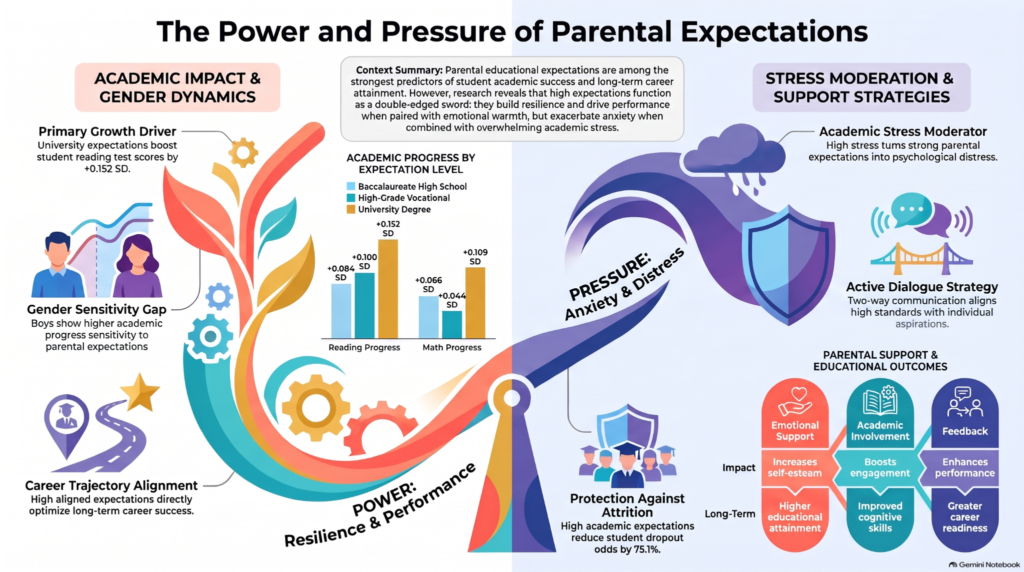
- Expecting a University Degree (compared to lower secondary education) associates with an improvement of +0.152 SD in reading and +0.109 SD in mathematics (p<0.001).
- Expecting High-Grade Vocational Education yields gains of +0.100 SD in reading and +0.044 SD in mathematics (p<0.001).
- Expecting High School (Bachillerato) yields +0.084 SD in reading and +0.066 SD in mathematics (p<0.001).
- Magnitude Relative to SES: Within the fixed-effects model, the positive association of holding university expectations (+0.152 SD in reading; +0.109 SD in math) substantially exceeds the direct effect of moving from the lowest to highest socioeconomic tercile (+0.027 SD in reading; +0.041 SD in math).
- Disciplinary Asymmetry (Reading vs. Mathematics):
- Parental expectations exert a consistently larger positive influence on student progress in reading comprehension than in mathematical reasoning.
- Conversely, results from the unobserved ability model reveal that the proxy for innate student ability plays a significantly larger predictive role in mathematics (=0.410–0.424) than in reading (=0.319–0.331).
- This aligns with psychological theories that literacy acquisition is viewed as socially cultivated through home learning environments, whereas mathematical aptitude is culturally perceived as more reliant on innate ability.
- Gender Disparities in Expectations and Sensitivity:
- Asymmetry in Parental Demands: Parents systematically hold higher educational expectations for daughters than for sons in both 5th and 8th grades. In 8th grade, 77.59% of parents expect daughters to obtain a university degree compared to 68.56% for sons.
- Differential Sensitivity (Boys Benefit More): Subsample regressions demonstrate that boys’ academic progress is significantly more sensitive to parental expectations than girls’:
- In mathematics, university expectations associate with a +0.130 SD gain for boys versus +0.080 SD for girls.
- In reading, university expectations associate with +0.173 SD for boys versus +0.123 SD for girls.
- For boys, academic benefits appear across lower thresholds (starting at High School expectations, +0.080 SD in math and +0.114 SD in reading). For girls, significant gains occur primarily at the university tier, pointing to higher baseline parental exigency for female students.
- Contextual and Institutional Predictors:
- School Transitions: Changing schools between primary and secondary education exerts a persistent negative penalty on academic progression (-0.105 SD in reading; -0.104 SD in math, p<0.001) relative to students who remain in integrated continuous centers.
- Grade Repetition: Retaining a grade before 5th or between 5th and 8th grade associates with massive cumulative score reductions (-0.44 to -0.68 SD, p<0.001).
- School Governance: Students attending semi-private (concertado) schools demonstrate modest positive score gains (+0.20 to +0.28 SD in unobserved ability models) over public school peers.
Sociological, Pedagogical, and Policy Interpretations
- Expectations as Compensatory Protective Factors for Boys: Because male students in Spain face significantly higher risks of premature school dropout and lower behavioral engagement, high parental expectations act as an essential protective buffer that prevents academic detachment. For girls, who generally exhibit higher self-regulation, conscientiousness, and academic compliance, high parental aspirations are largely normalized, resulting in lower marginal performance sensitivity.
- Permanence of Gender Role Stereotyping: The elevated educational bar set for girls (where only university expectations generate significant gains) indicates persistent gender-role pressures: parents perceive that young women require higher formal credentials to succeed and overcome workplace penalties in the labor market.
- Parental Scaffolding in Literacy vs. Numeracy: Because adult numeracy levels in the general population are lower than literacy levels, parents possess more confidence and effective home tools to support reading comprehension, whereas mathematical struggles are often chalked up to fixed, innate student ability.
Policy Recommendations and Study Limitations
- Targeted Policy and Instructional Implications:
- Strengthening School-Family Diagnostic Communication: Schools serve as the primary source of objective information regarding student competence; institutional guidance should help parents calibrate realistic, high expectations rather than lowering aspirations during early adolescence.
- Easing Primary-to-Secondary School Transitions: Given the measurable penalty of changing schools, regional education authorities should expand formal transition programs, cluster feeder primary schools with high schools, and provide specialized pedagogical training for 7th- and 8th-grade instructors.
- Overcoming Gender Stereotypes in Teacher Curricula: Teacher professional development programs must incorporate awareness of gendered expectations to help educators identify and dismantle bias in classroom feedback and academic tracking.
- Methodological Limitations:
- Residual Unobservable Confounders: While time fixed-effects and ability proxy models mitigate omitted variable bias, unobserved time-varying dynamics (e.g., shifts in private tutoring or evolving student motivation) cannot be fully eliminated; estimates must be interpreted as conditional associations rather than definitive causal parameters.
- Regional Census Specificity: The sample is restricted to the public and semi-private educational system of Andalusia, Spain, which may limit generalizability to regions with lower repetition rates or different vocational training infrastructures.
- Survey Non-Response: Missing questionnaire flags were required to address parent non-response (particularly on SES items), which may introduce minor selection bias.
| REFERENCE: Oscar David Marcenaro-Gutierrez, Claudia Prieto-Latorre, Luis Alejandro Lopez-Agudo, On the contribution of parental expectations to the academic progress of youngsters, International Journal of Educational Research, Volume 133, 2025, 102746, ISSN 0883-0355, https://doi.org/10.1016/j.ijer.2025.102746. (https://www.sciencedirect.com/science/article/pii/S0883035525002198) |
Navigating the Zhongkao: How perceived parental expectations shape adolescents’ transition choices in China
Conceptual Framework and Research Rationale
- The High-Stakes Nature of Secondary Educational Tracking: Within global education systems, secondary tracking determines the division between academic and vocational streams. While the European model (e.g., Germany) emphasizes early dual-track apprenticeships and the American model prioritizes comprehensive high schools, the Asian model revolves around examination-based selective tracking. In China, the senior high school entrance examination (zhongkao) operates as a high-stakes turning point that funnels junior secondary graduates into either academic senior high schools or secondary vocational/technical institutions under a national policy targeting roughly equal enrollment shares.
- The Problem of Tracking and Attrition in Underdeveloped Regions: Despite high numbers of junior high graduates, a substantial proportion do not advance to general academic high schools. In less economically developed regions, parents frequently hold narrow, instrumental views of education—viewing schooling primarily as immediate job preparation or family burden relief—which accelerates premature school dropout and workforce entry.
- Parental Expectations as Multidimensional Determinants: Although prior tracking literature has focused on macro-level labor market returns or treated parental expectations as secondary mediator variables, expectations act as primary independent drivers of adolescent choices. Grounded in classical sociology, adolescents internalize implicit and explicit parental cues, which shape their academic self-concept, perceived utility, and transition intentions.
- Integrated Theoretical Foundations:
- Human Capital Theory (Schultz, Becker): Frames schooling as a specialized investment where general high schools cultivate cognitive/analytical capital and vocational tracks develop applied technical capital. Parents function as primary investors whose educational aspirations direct family resource allocations.
- Expectancy-Value Theory (Eccles): Explains how parental beliefs shape children’s expectancies for academic success and the subjective task value (interest, utility, cost) they assign to competing educational pathways.
- Core Research Objectives:
- Profile the multidimensional characteristics of perceived parental expectations among junior high students in Western China.
- Map how adolescents conceptualize their post-junior-secondary tracking intentions across academic, vocational, employment, and dropout pathways.
- Quantify the precise predictive impact of five distinct dimensions of perceived parental expectations on students’ post-zhongkao pathway choices using unordered multinomial logistic regression.
Methodology and Empirical Data Architecture
- Sampling Design and Regional Setting:
- Conducted across six randomly selected cities in Western China using multi-stage stratified random sampling across public schools.
- Sample Size: 1,077 valid student responses (from 1,235 distributed questionnaires; valid response rate = 89.7%).
- Demographic Distribution: Balanced gender ratio (49.0% male [n=528], 51.0% female [n=549]); 56.5% rural (n=609), 43.5% urban (n=468); 87.5% ethnic minority (n=942), 12.5% Han (n=135). Grade breakdown spanned Grade 7 (37.2%, n=401), Grade 8 (29.8%, n=321), and Grade 9 (33.0%, n=355).
- Socioeconomic Background: Household monthly income was heavily concentrated in lower tiers: 57.8% earned 1,000–5,000 RMB, 17.6% earned below 1,000 RMB, 20.3% earned 5,000–10,000 RMB, and 4.2% earned 10,000 RMB or more.
- Instrumentation and Measurement Dimensions:
- Perceived Parental Expectations: Adapted from the Adolescent Future Expectations Scale for Parents (AFES-p), measuring five dimensions on a validated scale (=0.89, composite reliability =0.91, average variance extracted =0.62):
- Academic Performance Expectations (Mean =4.542.04).
- Behavioral Conduct Expectations (Mean =4.791.65).
- Physical and Mental Well-Being Expectations (Mean =3.951.06).
- Future Career Achievement Expectations (Mean =2.760.79).
- Interpersonal Relationship Expectations (Mean =1.600.67).
- Dependent Outcome Variables: Post-compulsory educational tracking intentions operationalized through two multinomial logistic models:
- Model 1 (Broad Graduation Pathway): Continuing formal education (reference group) vs. Immediate employment/workforce entry vs. Dropout/domestic idleness.
- Model 2 (School-Type Choice within Continued Education): General academic high school (reference group) vs. Secondary technical school vs. Secondary vocational high school.
- Control Covariates: Student gender, grade level, urban/rural school location, city of residence, maternal education, paternal education, and household monthly income.
- Perceived Parental Expectations: Adapted from the Adolescent Future Expectations Scale for Parents (AFES-p), measuring five dimensions on a validated scale (=0.89, composite reliability =0.91, average variance extracted =0.62):
- Statistical Modeling Specifications:
- Unordered multinomial logistic regression estimated via maximum likelihood in SPSS 26.0.
- Model 1 demonstrated strong fit: -2LogLikelihood dropped from 1,551.8 to 873.69 (2=881.83,p<0.001), with pseudo-R2 metrics of Cox & Snell =0.700, Nagelkerke =0.805, and McFadden =0.606 (overall classification accuracy = 83.40%).
Key Empirical Findings
- Descriptive Profiling of Intentions and Parental Authority:
- Asymmetric Parental Focus: Parents placed high priority on behavioral conduct (M=4.79) and academic scores (M=4.54), while largely overlooking broader interpersonal and social skill development (M=1.60).
- Adolescent Transition Intentions: 78.1% of students planned to continue formal education, 20.1% intended to enter the workforce immediately, and 1.9% planned to drop out/stay idle at home. Among those continuing studies, 62.5% favored general academic high schools, 21.0% chose technical schools, and only 5.5% opted for vocational high schools.
- Parental Dominance in Tracking: 60.7% of adolescents identified parents as the decisive authority in their tracking decisions, while 22.2% cited personal autonomy, and 11.8% attributed the decision to school teachers.
- Systemic Guidance Deficits: 88.5% of students viewed the government’s 1:1 general-to-vocational tracking ratio as unnecessary, and 63.0% reported limited or no familiarity with vocational education pathways. 64.9% relied solely on teachers for tracking policies, while only 9.8% obtained information from school digital resources and 9.1% from official government outreach.
- Model 1 Results (Predicting Dropout and Employment vs. Continuing Education):
- Academic Expectations Protect Against Attrition: Higher perceived parental academic expectations strongly reduced the likelihood of dropout (B=-1.390,p=0.001,OR=0.249), meaning each 1-point increase reduced dropout odds by 75.1% relative to continuing education. Likewise, higher academic expectations reduced the odds of entering the workforce by 84.0% (B=-1.832,p<0.001,OR=0.160).
- Protective Roles of Conduct and Health: Behavioral conduct expectations significantly lowered dropout odds by 61.8% (OR=0.382,p=0.009) and employment odds by 48.1% (OR=0.519,p=0.005). Higher physical/mental quality expectations reduced employment odds by 37.2% (OR=0.628,p=0.062).
- The Interpersonal Relationship Paradox: Higher perceived parental expectations for interpersonal relationships was associated with an increase in dropout likelihood (B=0.938,p=0.014,OR=2.554, a 155.4% increase in odds) and nearly doubled the odds of immediate employment (B=0.683,p=0.003,OR=1.981). In rural/underdeveloped settings, strong peer networks often facilitate entry into local migrant labor markets rather than academic schooling.
- Contextual Disparities: Urban students were 3.42 times more likely to choose immediate employment over continuing education compared to rural peers (B=-1.378,p=0.008,OR=0.252 for rural location), indicating that rural families view senior high school credentials as an indispensable vehicle for socio-economic mobility. Each advance in grade level increased workforce entry odds by 56.1% (OR=1.561,p=0.032).
- Model 2 Results (Predicting Technical/Vocational vs. Academic High School):
- Academic Expectations Suppress Vocational Tracking: Among students continuing their education, higher academic performance expectations decreased the odds of choosing technical schools by 69.0% (B=-1.171,p<0.001,OR=0.310) and vocational high schools by 78.4% (B=-1.530,p<0.001,OR=0.216) relative to general academic high schools.
- Future Career Expectations Diverge: Higher perceived parental expectations for future career achievement increased the relative odds of selecting technical schools by 67.0% (B=0.513,p=0.008,OR=1.670) and vocational high schools by 179.1% (B=1.026,p<0.001,OR=2.791). Parents prioritizing technical employability push students toward specialized vocational training rather than broader academic curricula.
- Physical/Mental Health and Interpersonal Influences: Higher physical and mental quality expectations reduced the odds of selecting technical schools by 66.7% (OR=0.333,p<0.001), while higher interpersonal expectations increased technical school selection odds by 95.6% (OR=1.956,p<0.001).
Sociological, Psychological, and Policy Interpretations
- Expectation Internalization and Resource Alignment: Perceived parental academic expectations operate through psychological and material mechanisms. Culturally, Chinese adolescents internalize parental academic hopes into their own self-concept and achievement value. Materially, high parental expectations are accompanied by targeted family investments (private tutoring, study space, direct supervision) that sustain learning persistence.
- The Stigmatization of Vocational Education: Secondary vocational high schools were selected by only 5.5% of respondents, reflecting entrenched cultural perceptions that associate vocational education with academic failure and social reproduction. Under the national 1:1 quota mandate, this creates an acute mismatch: while institutional policy seeks balanced tracking, familial expectations treat general academic high schools as the only acceptable choice.
- Pervasive Overparenting and Restricted Student Agency: With over 60% of students deferring completely to parental authority, adolescents exhibit limited autonomous career planning. Protective family dynamics in China insulate youths from decision-making, which can lead to friction when tracking outcomes fail to align with parental desires.
Practical Implications and Study Limitations
- Curricular and School-Based Interventions:
- Establish Structured Career Counseling: Address the guidance vacuum by creating formal career education curricula in junior high schools, reducing exclusive reliance on classroom teachers for tracking information.
- Bridge General and Vocational Curricula: Implement credit-transfer systems and dual-enrollment pathways that allow fluid cross-recognition between academic and technical subjects, reducing the rigid binary divide of the zhongkao.
- Family and Community Engagement:
- Organize Parent Educational Workshops: Schools should facilitate parent-adolescent dialogue sessions to align parental expectations with children’s genuine aptitudes and emotional well-being, mitigating transition-related stress.
- Multilingual Policy Communication: In ethnic minority regions of Western China, governments must use digital platforms (WeChat, Douyin, Weibo) to disseminate vocational training outcomes, career prospects, and subsidy policies in native minority languages to counter educational stigma.
- Methodological Limitations:
- Cross-Sectional Design: Relied on cross-sectional data, precluding causal conclusions regarding how expectations and tracking choices evolve dynamically across the full three-year junior high span.
- Self-Report Measurement: Perceived expectations were gathered solely through adolescent self-reports without dyadic verification from parent questionnaires, introducing possible reporting or social desirability bias.
- Regional Specificity: The sample was drawn exclusively from Western China, characterized by high ethnic minority representation (87.5%) and lower family income levels; findings should be generalized cautiously to affluent eastern coastal provinces.
| REFERENCE: Dilihumaer Aizizi, Navigating the Zhongkao: How perceived parental expectations shape adolescents’ transition choices in China, Acta Psychologica, Volume 263, 2026, 106142, ISSN 0001-6918, https://doi.org/10.1016/j.actpsy.2025.106142. (https://www.sciencedirect.com/science/article/pii/S0001691825014568) |
Parental Educational Expectations, Academic Pressure, and Adolescent Mental Health: An Empirical Study Based on CEPS Survey Data
Conceptual Framework and Research Rationale
- Global and Regional Adolescent Mental Health Burdens: According to the World Health Organization and UNICEF, approximately 20% of adolescents worldwide experience mental health disorders, which account for roughly 16% of the global disease and injury burden in this cohort. In Asian nations such as China and Vietnam, high academic stakes, structural family pressures, and exam-oriented systems have led to elevated rates of psychological distress, depression, and anxiety.
- Controversies Surrounding Parental Educational Expectations: In Bronfenbrenner’s ecological systems theory, the family microsystem represents the most immediate environment shaping adolescent psychological development. While parental expectations are established predictors of academic success, literature regarding their impact on psychological well-being remains divided:
- Negative Impact View: Many studies argue that high parental expectations impose severe psychological stress, especially within Confucian-heritage cultures where filial piety and family honor can transform high aspirations into feelings of shame, anxiety, and depression.
- Protective/Positive View: Conversely, several Western studies report that high parental expectations reflect parental involvement, warmth, and faith in the child’s potential, thereby enhancing self-concept and reducing internalizing symptoms.
- Academic Pressure as an Overlooked Moderator: Grounded in Higgins’s Self-Discrepancy Theory, psychological distress emerges when an individual experiences a painful discrepancy between their actual self (their real academic capacity and felt stress) and the ideal self projected by significant others (parental educational expectations). Prior empirical research has treated academic pressure almost exclusively as a mediating mechanism. The authors hypothesize that perceived academic pressure functions as a critical moderator: high expectations foster emotional resilience when perceived stress is low or manageable, but become psychologically damaging when perceived stress is overwhelming.
- Core Research Hypotheses:
- Hypothesis 1: Parental educational expectations are significantly associated with adolescent mental health problems.
- Hypothesis 2: Perceived academic pressure is significantly and positively associated with adolescent mental health problems.
- Hypothesis 3: Academic pressure moderates the relationship between parental expectations and mental health: when academic pressure is high, high expectations exacerbate psychological distress, whereas when academic pressure is low, high expectations associate with fewer mental health problems.
Methodology and Empirical Data Architecture
- Large-Scale Population-Based Dataset:
- Utilizes baseline data from the China Education Panel Survey (CEPS; 2013–2014 academic year), designed and implemented by the National Survey Research Center (NSRC) at Renmin University of China.
- Applied a four-stage Probability Proportionate to Size (PPS) sampling design: 28 county-level units across China 112 middle schools 438 classrooms across Grades 7 and 9.
- Sample Size: Initial survey of 19,958 students; following data cleaning and removal of missing entries, the effective analytic sample comprised 16,344 middle school students aged 11 to 18 years (mean age 13.911.33 years).
- Demographic Distribution: Balanced gender ratio (50% male [n=8,172], 50% female [n=8,172]); 54% rural household registration (hukou), 46% urban; 44% only children, 56% with siblings. Average maternal education was 9.433.48 years and paternal education was 10.213.11 years.
- Operationalization of Key Constructs:
- Adolescent Mental Health Problems (Dependent Variable): Measured via the validated 5-item CEPS A18 scale assessing the frequency of negative emotional states over the past 7 days: feeling depressed, feeling down, feeling unhappy, feeling that life is meaningless, and feeling sad. Items were scored on a 5-point Likert scale (1 = never to 5 = always; total composite score 5–25; =0.85), where higher scores indicate greater psychological distress.
- Parental Educational Expectations (Core Predictor): Student-reported item (B31) indicating the highest level of education parents expect them to achieve, coded from 1 to 9 (higher scores reflect higher academic benchmarks, up to graduate/doctoral degrees; Mean =6.631.56).
- Academic Pressure (Moderator): Student-reported item (B32) rating subjective academic stress on a 5-point scale from 1 (no stress) to 5 (very high stress; Mean =3.061.10).
- Demographic Control Variables: Age, gender (male = 1), household registration (hukou; agricultural = 1), only-child status (yes = 1), paternal completed education years, and maternal completed education years.
- Statistical Modeling Strategy:
- Hierarchical Ordinary Least Squares (OLS) multiple linear regression analysis conducted in Stata 16.0 across four sequential models:
- Model 1: Demographic control variables only.
- Model 2: Adding the core independent variable (parental educational expectations).
- Model 3: Adding the moderating variable (academic pressure).
- Model 4: Full moderated model incorporating the mean-centered interaction term (ExpectationsPressure).
- Simple slope analyses (floodlight/spotlight probing at 1SD) were plotted to interpret interaction slopes.
- Hierarchical Ordinary Least Squares (OLS) multiple linear regression analysis conducted in Stata 16.0 across four sequential models:
Key Empirical Findings
- Demographic Disparities in Adolescent Mental Health:
- Gender Gap: Female students reported significantly more mental health problems than male students (M=10.54 vs. 10.31,p<0.01; regression =-0.360,p<0.001), indicating elevated emotional vulnerability among adolescent girls.
- Only-Child and Family Background: Non-only children exhibited significantly more mental health problems than only children (M=10.61 vs. 10.20,p<0.01; =-0.159,p<0.05). Maternal educational attainment was a significant protective factor (=-0.045,p<0.001), whereas older adolescent age was associated with worse mental health (=0.260,p<0.001).
- Main Direct Effects (H1 & H2 Supported):
- Direct Protective Impact of Parental Expectations: In contrast to common assumptions about Asian academic pressure, parental educational expectations had a statistically significant negative main effect on adolescent mental health problems. In Model 2, each 1-unit increase in expectations reduced mental health problem scores by 0.157 units. In the fully controlled Model 4, this direct protective association strengthened to =-0.195 (p<0.001), confirming Hypothesis 1. High expectations convey family investment, care, and belief in the child’s potential.
- Direct Detrimental Impact of Academic Pressure: Subjective academic pressure was strongly and positively associated with mental health problems (=0.649,p<0.001 in Model 4; =0.661 in Model 3), confirming Hypothesis 2. Academic stress represents the single largest risk factor for adolescent depression and distress in the model.
- Moderating Effect of Academic Pressure (H3 Supported):
- In Model 4, the interaction term between parental educational expectations and perceived academic pressure was positive and statistically significant (=0.082,p<0.001), confirming that academic pressure negatively moderates the protective effect of parental expectations.
- Simple Slope Probing Dynamics:
- Low Academic Pressure Condition (–1 SD): High parental educational expectations were associated with a significant decrease in mental health problems (the downward slope in Figure 2), supporting adolescent well-being and psychological resilience.
- High Academic Pressure Condition (+1 SD): The relationship reversed; the interaction slope turned upward, demonstrating that when adolescents already experience severe academic stress, high parental educational expectations exacerbate mental health problems (M rises from ~10.0 to ~11.8).
Sociological, Psychological, and Family Systems Interpretations
- The “Double-Edged Sword” of Educational Expectations: High parental expectations do not act as an inherently destructive force. When adolescents possess adequate academic confidence and low subjective stress, parental aspirations serve as motivational anchors that reflect care and enhance self-worth. However, when expectations collide with perceived inadequacy and high exam pressure, they trigger cognitive dissonance and self-discrepancy, intensifying feelings of failure and anxiety.
- Confucian Cultural Specifics in Modern China: In East Asian societies, education is viewed as the primary vehicle for social mobility and family honor. Filial obligations often make adolescents reluctant to openly express learning difficulties to parents. Consequently, uncalibrated parental expectations easily transform into unmanageable pressure if family communication channels remain closed.
- Perception and Coping Capacity: The findings underscore Lazarus’s cognitive appraisal theory: external stressors (parental goals) do not directly determine emotional outcomes; rather, the adolescent’s subjective evaluation of whether they possess the resources to meet those demands determines whether the expectation acts as a motivating challenge or a distress-inducing threat.
Policy Recommendations and Practical Implications
- Guidelines for Parents: Parents must balance high aspirations with continuous observation of their child’s perceived stress levels. When adolescents display symptoms of burnout, anxiety, or emotional fatigue, parents should flexibly recalibrate their academic expectations rather than escalating pressure.
- School-Mediated Parent-Child Dialogue: Because traditional Chinese family communication often discourages children from voicing vulnerability, schools should establish structured workshops and parent-child interactive forums. These platforms can foster transparent, intimate communication, helping parents align their educational goals with students’ realistic coping capacities.
- Implications for the “Double Reduction” Policy: The findings provide empirical justification for educational reforms (such as China’s Double Reduction policy) aimed at curbing excessive homework loads and private tutoring. However, policies must also address parental anxiety; reducing school workloads without mitigating competitive parental expectations may simply displace stress into domestic conflict.
Study Limitations and Future Directions
- Cross-Sectional Architecture: The study relies on baseline survey data, preventing definitive causal conclusions regarding how changes in expectations track with fluctuating psychological symptoms across developmental phases. Future research should utilize multi-wave longitudinal panel data.
- Historical Data Horizon: CEPS baseline data were gathered during 2013–2014, preceding recent major educational policy shifts and the post-pandemic digital schooling era.
- Ethnic Homogeneity: The CEPS survey predominantly represents the Han ethnic majority; minority ethnic groups—who often experience different college entrance policies (e.g., examination bonus points) and distinct family dynamics—warrant targeted investigation.
- Measurement Specificity: Parental expectations and academic stress were assessed via single-item self-reports from students, which may not capture multidimensional parental parenting styles or dyadic parent-reported perspectives.
| REFERENCE: Tao Xu, Fangqiang Zuo, Kai Zheng, Parental Educational Expectations, Academic Pressure, and Adolescent Mental Health: An Empirical Study Based on CEPS Survey Data, International Journal of Mental Health Promotion, Volume 26, Issue 2, 2024, Pages 93-103, ISSN 1462-3730, https://doi.org/10.32604/ijmhp.2023.043226. (https://www.sciencedirect.com/science/article/pii/S1462373024000361) |
CONCLUSION
Reflecting on my years in educational research, teacher training, and domestic family life, the central takeaway is clear: sustainable academic achievement is forged in the partnership between classroom pedagogy and household culture. Educational outcomes are not determined solely by socioeconomic background or standardized test scores; they are deeply shaped by the quiet, daily conversations parents hold across kitchen tables and the constructive bridges built between families and schools.
When we treat expectations as dynamic blueprints rather than rigid ultimatums, we invite children to become co-designers of their own futures. In engineering, the most durable structures are intentionally designed with flexibility to absorb unpredictable shocks without collapsing. Our children’s educational journeys require that exact same balance. By pairing high, aspirational standards with authentic emotional safety and consistent parental presence, we equip students to navigate high-stakes exams, career transitions, and life setbacks with steady confidence.
The true measure of our educational expectations is not whether a child secures a specific title or test metric, but whether they leave our homes equipped with the curiosity, critical thinking, and emotional resilience needed to engineer a meaningful, fulfilling life of their own.
