

Whenever I review district-wide assessment portfolios or sit down with school leadership teams, I am struck by how quickly conversations reduce human potential to cold, deficit-laden numbers. In educational psychology, we often remind ourselves that test scores and GPA trends are lagging indicators; they do not measure raw cognitive capacity, nor do they capture a child’s intrinsic drive to learn. What the data actually documents is the cumulative, physiological toll of navigating unequal systems.
When a child walks into a classroom carrying chronic stress—whether born from housing instability, systemic marginalization, or the subtle weight of low expectations—their working memory and executive functioning are actively taxed before instruction even begins. Over my years consulting across diverse school systems, I have watched brilliant young minds disengage simply because the learning environment felt completely alien to their lived realities.
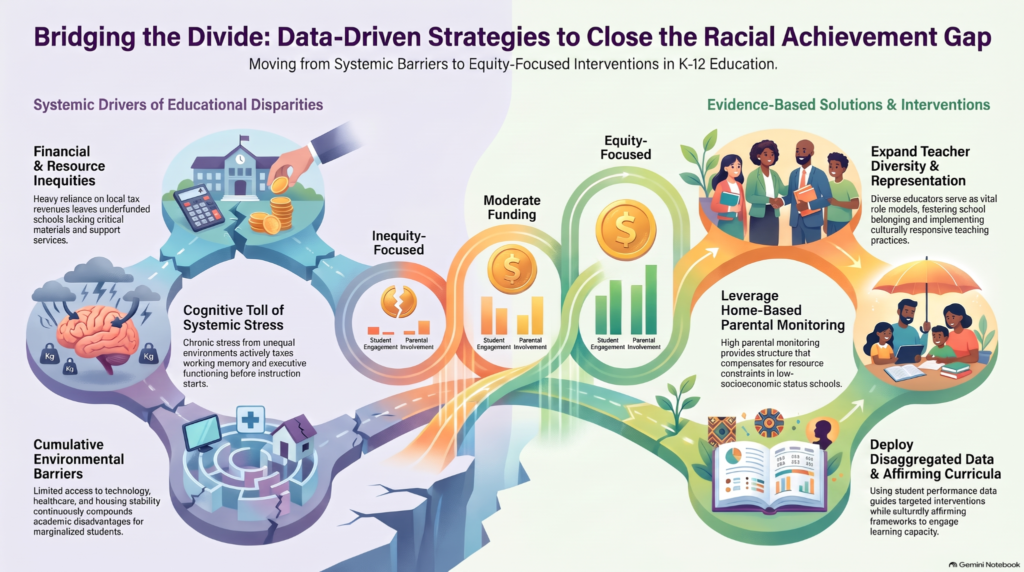
We cannot evaluate academic achievement in a vacuum while ignoring the structural architecture supporting each student. If we treat the persistent achievement gap merely as a testing discrepancy rather than an institutional and cognitive well-being issue, our interventions will continue to fall short. Bridging this divide requires examining how school climates, relational safety, and resource equity directly shape how a student’s brain engages with the learning process.
The racial achievement gap in education stems from multiple interacting factors, including socioeconomic status, systemic barriers, and disparities in school funding. Research shows that cultural biases and limited resources hinder engagement among marginalized students. Teacher diversity plays an essential role in fostering belonging and encouraging student success. Data-driven strategies highlight specific achievement gaps, guiding interventions. Understanding how these elements interconnect sheds light on effective approaches to closing the gap and promoting educational equity across various demographic groups.
KEY TAKEAWAYS
- Data analysis reveals systemic disparities in educational performance among racial groups, highlighting areas needing targeted intervention.
- Disaggregated student performance data helps identify specific challenges faced by marginalized students, guiding responsive educational strategies.
- Predictive analytics can forecast which students require additional support, allowing for timely and effective interventions.
- Successful case studies demonstrate that culturally relevant curricula and mentorship programs significantly improve engagement and outcomes for underrepresented populations.
- Addressing funding disparities through equity-focused models is crucial for promoting educational equity and improving student success across demographics.
WHAT YOU NEED TO KNOW ABOUT THE RACIAL ACHIEVEMENT GAP?
The racial achievement gap in the United States are disparities in educational achievement between differing ethnic/racial groups. It manifests itself in a variety of ways: African-American and Hispanic students are more likely to earn lower grades, score lower on standardized tests, drop out of high school, and they are less likely to enter and complete college than whites, while whites score lower than Asian Americans.
What factors contribute to the racial achievement gap in education? Multiple elements intertwine to create this persistent disparity.
Cultural biases often shape educational policies and practices, leading to curriculum relevance issues that fail to connect with diverse student backgrounds. This disconnect undermines engagement and motivation among students from marginalized communities.
Additionally, systemic racism manifests in various forms, including assessment disparities that disadvantage minority students, creating a cycle of underachievement.
Parental involvement is imperative; however, barriers often limit participation, weakening support for students. Community engagement plays an essential role as well, yet many schools struggle to foster meaningful relationships with local organizations.
Effective mentoring programs can mitigate these challenges, providing students with guidance and support tailored to their unique experiences.
Addressing these interconnected factors is fundamental for closing the racial achievement gap and promoting equity in education.
Socioeconomic Status and Other Systemic Barriers Affecting the Achievement Gap
Although socioeconomic status is often cited as a primary factor in the racial achievement gap, it is essential to recognize that this issue is compounded by various systemic barriers that disproportionately affect marginalized communities. These barriers, which include limited access to quality education, healthcare, and stable housing, severely hinder socioeconomic mobility and perpetuate the cycle of disadvantage.
| Systemic Barriers | Impact on Achievement Gap |
| Limited access to technology | Reduces learning opportunities |
| Inadequate educational resources | Hinders skill development |
| Housing instability | Affects concentration and performance |
| Lack of healthcare access | Impairs cognitive function |
| Transportation challenges | Limits access to educational facilities |
Addressing these systemic barriers is vital for fostering an equitable educational environment, as they collectively create an environment that undermines the potential of students from marginalized backgrounds.
The Role of School Funding and Resources in Equity
While the disparities in educational outcomes are influenced by various factors, the role of school funding and resources emerges as a critical determinant of equity in education. Funding formulas considerably impact the distribution of financial resources among schools, often perpetuating existing inequalities.
Schools in affluent areas typically benefit from higher local tax revenues, leading to better facilities, instructional materials, and extracurricular programs. In contrast, underfunded schools in low-income communities struggle with inadequate resources, hindering their ability to provide quality education. Understanding the educational inequality definition helps explain how unequal access to funding, instructional materials, and support services creates disadvantages for students from marginalized communities and limits their opportunities for academic success.
Resource allocation further exacerbates these disparities, as schools with limited funding may lack essential support services, such as counseling and special education. This inequity not only affects academic performance but also influences students’ overall well-being and engagement in the learning process.
Addressing school funding and resource allocation is essential for creating a more equitable educational landscape, ultimately fostering an environment where all students can thrive and succeed.
The Impact of Teacher Diversity on Student Success
The presence of diverse teachers in schools plays an essential role in influencing student success and closing the racial achievement gap.
Teacher representation can foster a sense of belonging and cultural competence, which enhances the learning experience for all students. Addressing teacher burnout is equally important, as providing educators with adequate support, manageable workloads, and professional development helps them maintain a positive classroom environment and better support students from diverse backgrounds.
Additionally, educators who serve as role models can inspire and motivate students, positively impacting their academic performance and aspirations.
Teacher Representation Matters
Teacher diversity plays an essential role in shaping student success and addressing the racial achievement gap in education. Research indicates that a diverse teaching workforce positively influences student outcomes through various mechanisms:
- Role Models: Diverse teachers serve as relatable role models, inspiring students from different backgrounds to envision their own success.
- Culturally Relevant Pedagogy: A diverse faculty is more likely to implement teaching methods that resonate with all students, fostering engagement and understanding.
- Enhanced Teacher Recruitment: Increased representation can attract a wider pool of candidates in teacher recruitment, enriching the educational environment.
Moreover, mentorship programs aimed at supporting teachers of color can further strengthen this diverse workforce, ultimately benefiting all students and contributing to equity in educational achievement.
Cultural Competence Enhances Learning
Cultural competence among educators greatly enhances learning outcomes by fostering an inclusive environment that acknowledges and values diverse perspectives.
By cultivating cultural awareness, teachers can better connect with students from various backgrounds, thereby improving engagement and participation. An inclusive curriculum that reflects the diverse experiences of all students not only enriches learning but also promotes a sense of belonging.
Research indicates that when educators implement culturally relevant teaching strategies, students demonstrate increased motivation and academic achievement.
Additionally, diverse teaching staff serve as critical resources for developing these competencies, enabling schools to address the unique needs of their student populations.
Ultimately, prioritizing cultural competence in education not only benefits individual learners but also contributes to a more equitable educational landscape.
Role Models Influence Achievement
Diversity among educators plays an essential role in shaping student success and fostering a positive learning environment. Because these achievement gaps seem to appear as early as kindergarten, the study recommends school systems invest in high-quality early childhood education, adopt curricula that reflect diverse cultures, and launch programs that specifically support underrepresented students.
The presence of diverse role models in educational settings can enhance student engagement and achievement through various mechanisms:
- Cultural Relevance: Diverse teachers can connect with students from different backgrounds, bridging cultural gaps and making learning more relatable.
- Positive Role Models: Representation matters; students benefit from seeing educators who share similar experiences, which can inspire aspirations and ambitions.
- Mentorship Programs: Implementing mentorship initiatives that pair students with diverse educators can cultivate supportive relationships, encouraging academic and personal development.
Incorporating diversity within the teaching workforce not only promotes equity but also contributes to a richer educational experience, ultimately addressing the racial achievement gap in education.

EFFECTIVE DATA-DRIVEN STRATEGIES TO CLOSE THE RACIAL ACHIEVEMENT GAP
During my school site consultations and clinical observations, one pattern consistently stands out: structural diversity on paper means very little if a student feels invisible inside the classroom walls. I frequently observe teachers who mean well but rely on a “colorblind” approach, believing that treating everyone the same is the highest form of equity. Yet, developmental research and cognitive science reveal the opposite. When an adolescent’s ethnic and cultural background is ignored or treated as an afterthought, their sense of school belonging deteriorates.
A child’s ethnic-racial identity is not an extracurricular detail—it is a central psychological asset. In middle school especially, when students undergo rapid neurodevelopmental changes and evaluate where they fit in the social hierarchy, feeling racially isolated or culturally disconnected triggers real cognitive defense mechanisms. I recall working with an eighth grader whose math performance collapsed after transitioning into an under-resourced, culturally mismatched school.
Her previous teachers labeled her unmotivated. In reality, once we paired her with a mentor who validated her identity and integrated culturally relevant frameworks into her coursework, her cognitive engagement rebounded dramatically. Relational security and culturally affirming teaching free up vital attentional bandwidth, allowing students of color to move from defensive survival modes into confident, higher-order academic learning.
While the racial achievement gap in education remains a persistent challenge, effective data-driven strategies can provide actionable insights for addressing this inequity. Through rigorous data analysis, educators and policymakers can identify specific areas where disparities exist, enabling targeted intervention strategies.
For instance, disaggregating student performance data by race can reveal systemic weaknesses in curriculum implementation and resource allocation.
Moreover, employing predictive analytics can help in forecasting which students may require additional support, allowing for timely and impactful interventions.
Professional development programs that focus on culturally responsive teaching can also be informed by data regarding student engagement and performance metrics. Educators can also explore the engineering teacher shop for practical classroom resources and teaching materials that support inclusive instruction, encourage student engagement, and help address diverse learning needs.
In addition, tracking the efficacy of these interventions through continuous data evaluation guarantees that strategies remain adaptive and effective.
Ultimately, leveraging data-driven approaches can facilitate informed decision-making, fostering an equitable educational environment that supports all students in achieving their full potential.
How Different Funding Models Impact Educational Equity
Racial achievement gaps in schools are well documented and remain a significant cause of concern in education. Troubling too is that the role of socioeconomic disparities in mediating these gaps remains unresolved.
Funding disparities among school districts greatly influence educational equity and student outcomes.
Variations in funding models can lead to unequal resources, impacting the quality of education available to students from different racial and socioeconomic backgrounds.
Analyzing these funding mechanisms reveals critical insights into how financial inequities perpetuate the racial achievement gap in education.
Funding Disparities Among Districts
As educational funding models vary greatly across districts, the disparities in financial resources often exacerbate existing inequalities among students.
The impact of funding allocation on educational equity is significant, with certain districts receiving considerably more financial support than others. This financial imbalance can lead to inequitable access to quality educational opportunities.
Key factors contributing to funding disparities include:
- Local Property Taxes: Many districts rely heavily on local taxes, leading to wealthier areas receiving more funds.
- State Funding Formulas: Variations in state policies can favor certain districts over others, affecting overall funding.
- Federal Support: Disparities in federal aid can further widen the gap, leaving underfunded districts struggling to meet basic educational needs.
Addressing these funding disparities is essential for promoting educational equity.
Impact on Student Outcomes
Examining the effects of different funding models reveals a direct correlation between financial resources and student outcomes in education. Increased funding often leads to improved student engagement and higher levels of parental involvement, fostering an environment conducive to learning. Conversely, inadequately funded schools may struggle to provide essential resources and support, perpetuating educational inequities.
| Funding Model | Student Engagement | Parental Involvement |
| High Funding | High | High |
| Moderate Funding | Moderate | Moderate |
| Low Funding | Low | Low |
| Equity-Focused | High | High |
| Inequity-Focused | Low | Low |
This table illustrates how varying funding models can substantially affect both engagement and involvement, ultimately impacting educational equity.
Successful Case Studies: Closing the Racial Achievement Gap
While numerous educational institutions grapple with the persistent racial achievement gap, several successful case studies demonstrate effective strategies for fostering equity and improving outcomes. These examples highlight the importance of targeted interventions and community partnerships in addressing disparities.
- Targeted Academic Programs: Schools implementing tailored tutoring and mentoring initiatives have reported significant improvements in student performance, particularly among underrepresented populations.
- Family and Community Engagement: Institutions that actively involve families and local organizations in the educational process see enhanced student motivation and support, leading to higher academic achievement.
- Culturally Relevant Curriculum: Schools adopting curricula that reflect the diverse backgrounds of their students foster a sense of belonging and relevance, contributing to increased engagement and success.
These successful interventions serve as a blueprint for other institutions aiming to close the racial achievement gap and create equitable educational environments for all students.

RELATED STUDIES ABOUT RACIAL ACHIEVEMENT GAP IN EDUCATION
In traversing the complex landscape of the racial achievement gap, it becomes evident that underlying factors extend beyond mere academic performance. Systemic barriers, funding disparities, and the imperative for diverse teaching staff collectively illuminate the path toward educational equity. By embracing data-driven strategies and learning from successful case studies, educators and policymakers can foster an environment where all students flourish. Ultimately, addressing these disparities is not merely an educational challenge but a profound moral obligation to future generations.
Racial/ethnic disparities in academic achievement in U.S. middle schools: An integrated multilevel modeling approach
Conceptual Framework and Research Rationale
- Persistent Racial and Ethnic Disparities: Racial and ethnic achievement gaps remain an enduring challenge in U.S. public education, linked to differential rates of disciplinary suspension, school dropout, and diminished adult socioeconomic attainment. Although student demographics in K–12 schools are diversifying rapidly, most empirical literature has focused on binary racial comparisons (e.g., Black-White) rather than evaluating multiracial cohorts embedded within varied school contexts.
- The Vulnerability of the Middle School Transition: The shift into middle school (Grade 6) coincides with early adolescence, characterized by physical maturation, an intensified desire for autonomy, shifting peer dynamics, and more impersonal school structures. Consequently, academic motivation, student engagement, and grade point averages (GPA) often decline during this developmental window, making middle school academic trajectories strongly predictive of high school completion and postsecondary access.
- Sociocultural and Ecological Systems Theory: Grounded in Vygotsky’s sociocultural theory and Bronfenbrenner’s ecological systems model, academic outcomes are shaped by interactions within immediate microsystems (family and classroom) and across mesosystem linkages (intersections between home, teacher relationships, and school demographic contexts):
- Parental Monitoring (Home Microsystem): Tracking children’s whereabouts, peer networks, and homework completion communicates academic expectations, reinforces self-regulation, and curbs behavioral disruptions that undermine learning.
- Student-Teacher Relationships (School Microsystem): Caring, respectful relational bonds satisfy early adolescents’ psychological need for belonging, which supports classroom engagement. However, cultural mismatches and racial disparities in teacher expectations can alter these dynamics for students of color.
- School Racial/Ethnic Diversity (School Context): Greater diversity balances intergroup numerical power, reduces minority vulnerability, and triggers cognitive growth through exposure to multiple perspectives.
- Core Research Objectives:
- Examine the simultaneous, independent longitudinal associations between Grade 6 predictors (parental monitoring, student-teacher relationships, school racial/ethnic diversity) and Grade 8 academic achievement (GPA), controlling for baseline performance.
- Test cross-level mesosystem interactions to determine whether school socioeconomic status (SES) and school racial/ethnic diversity moderate the protective influence of parental monitoring and student-teacher relationships differently across Black, Latina/o, and White students.
Methodology and Longitudinal Multilevel Design
- Sample Composition and Geographic Setting:
- Drawn from a 3-year longitudinal study following students from the fall of sixth grade (2010) through the spring of eighth grade (2013) across 36 urban public middle schools in the Midwestern United States (Illinois and Kansas).
- Final Analytic Sample: 3,115 students (48% female; mean baseline age = 11 years; 81% 3-year longitudinal retention rate).
- Racial/Ethnic Composition: 40% Latina/o (n=1,243), 31% Black (n=972), and 29% White (n=900). Other racial categories (Asian, multiracial, other) were excluded due to small sample sizes or missing district categorization.
- School Diversity Profiles: 8 schools (22%) were classified as diverse (no racial majority), 3 schools (8%) were balanced across two large groups, and 25 schools (69%) had a clear racial majority (13 majority Black, 7 majority Latina/o, 5 majority White).
- Instrumentation and Measurement Architecture:
- Academic Achievement (GPA): Self-reported GPA on a 7-point reverse-coded scale (1 = mostly D’s and F’s [64] to 7 = mostly A’s [90–100]), collected at the fall of sixth grade (M=5.531.37) and spring of eighth grade (M=4.951.58).
- Parental Monitoring: 8 items from the Communities That Care Youth Survey assessing parental tracking of schoolwork, attendance, and whereabouts (4-point scale; Cronbach’s =0.85).
- Student-Teacher Relationships: 3 items adapted from the Psychological Sense of School Membership (PSSM) scale capturing teacher respect, fairness, and adult support (4-point scale; =0.55).
- School Racial and Ethnic Diversity: Calculated using Simpson’s Diversity Index (DS=1-pi2), representing the probability that two randomly selected students belong to different racial/ethnic groups (M=0.530.20, range = 0.00 to 0.73).
- Control Covariates: Individual family SES (parental completed education), school SES (proportion of students eligible for Free or Reduced-Price Lunch [% FRPL]), numerical minority/majority status at school ($\le 15\%$ vs. $\ge 50\%$), student sex, baseline Grade 6 GPA, and school intervention trial status.
- Multilevel Modeling Strategy:
- Analyzed using three-step Hierarchical Linear Modeling (HLM):
- Step 1 (Unconditional Model): Partitioned between-school variance (00) and estimated the Intraclass Correlation Coefficient (ICC = 0.06; 2(35)=93.24,p<.001).
- Step 2 (Individual-Level Main Effects): Added student-level predictors group-mean centered, explaining 21% of student-level achievement variance.
- Step 3 (Cross-Level Interaction Model): Added grand-mean-centered school contextual factors and interaction terms, explaining 16% of the between-school achievement variance.
- Analyzed using three-step Hierarchical Linear Modeling (HLM):
Key Empirical Findings
- Independent Main Effects on Eighth-Grade Achievement:
- Baseline Stability: Prior achievement in sixth grade was the strongest predictor of eighth-grade GPA (b=0.42,SE=0.08,p<.001). Across all groups, GPA declined between sixth and eighth grade.
- Parental Monitoring: Consistently and positively associated with eighth-grade GPA (b=0.36,SE=0.08,p<.001 in the final model; b=0.31,p<.001 in Step 2). Its effect size was larger than that of student-teacher relationships.
- Student-Teacher Relationships: Exhibited a positive association with achievement in Step 2 (b=0.12,SE=0.06,p=.030).
- School Racial and Ethnic Diversity: Functioned as the strongest contextual predictor in the model (b=1.08,SE=0.51,p=.044), indicating that students attending more diverse schools attained significantly higher GPAs, holding school SES and minority/majority status constant.
- Mesosystem Cross-Level Interactions:
- Parental Monitoring Buffers Low-SES Schools: A statistically significant cross-level interaction emerged between parental monitoring and school-level SES (b=0.92,SE=0.30,p=.002):
- For students attending low-SES schools (+1 SD in % FRPL), high parental monitoring (+1 SD) served as a strong compensatory buffer, resulting in higher eighth-grade GPAs.
- For students in high-SES schools (–1 SD in % FRPL), high parental monitoring showed a slight negative association with GPA, suggesting that excessive home surveillance in resource-rich environments may trigger autonomy conflicts or indicate reactive monitoring to emerging academic problems.
- Three-Way Mesosystem Interaction (Race Diversity Teacher Relationships): A significant three-way interaction linked Latina/o ethnicity, student-teacher relationships, and school diversity (b=0.42,SE=0.14,p=.002):
- For Latina/o Students: Attending a racially diverse school was associated with higher overall GPA; however, the achievement benefits of school diversity were maximized when paired with positive student-teacher relationships.
- For White Students: Overall GPAs were higher in less diverse (predominantly White, higher-SES) schools. However, when White students attended racially diverse schools, their achievement became significantly dependent on positive teacher relationships (b was positive and steep), whereas teacher relationships had a weaker association in less diverse settings.
- Three-Way Interaction (Race Baseline GPA Minority Status): A significant interaction emerged between Latina/o ethnicity, sixth-grade GPA, and school-level minority status (b=-0.05,SE=0.02,p=.021):
- Latina/o students who were numerical minorities ($\le 15\%$ of the student body) experienced lower eighth-grade GPAs across all performance levels compared to those in schools with higher Latina/o representation.
- In contrast, White students with high baseline sixth-grade GPAs who were numerical minorities at school maintained high eighth-grade GPAs, showing no minority-status penalty.
Sociological, Cultural, and Contextual Interpretations
- The Protective Power of Home-Based Monitoring in Under-Resourced Schools: In high-poverty schools facing limited resources, large classes, and frequent teacher turnover, home-based parental monitoring provides critical structure and academic socialization that buffers adolescents against institutional shortcomings.
- Deconstructing the “Double Segregation” Dynamic: In U.S. urban centers, racial segregation and economic segregation frequently overlap. For White students, low-diversity schools typically represent high-SES environments with abundant resources, whereas for Latina/o and Black students, low-diversity schools often concentrate poverty. When Latina/o students attend diverse schools with a balanced distribution of power, structural isolation decreases, reducing stereotype threat and vulnerability.
- The Relational Bridge for Students of Color: For Latina/o youth navigating cultural differences between home and school, structural school diversity alone is insufficient to guarantee academic gains. Positive relationships with teachers provide the emotional security and personalized academic guidance necessary to translate an integrated school environment into tangible achievement.
- The Asymmetry of Numerical Minority Status: Latina/o students experienced an achievement penalty when in the numerical minority, reflecting cultural values of collectivism and the social vulnerability of lacking same-ethnicity peer networks. Conversely, White minority students did not experience this penalty, likely because nationwide, 79% of public school teachers are White, ensuring that White students maintain cultural and demographic representation among school authorities even when they are a minority among peers.
Practical Implications and Educational Policy Recommendations
- Prioritize School Integration and Boundary Desegregation:
- School district policymakers must support policies that foster socioeconomic and racial/ethnic integration, countering trends toward re-segregation. Balanced student compositions reduce intergroup polarization and support academic achievement for students of color.
- Invest in Culturally Responsive Teacher-Student Relationship Building:
- Schools should incorporate professional development focused on building positive teacher-student relationships, particularly across cultural and racial divides. Ensuring that youth of color feel respected and fairly treated by school adults is critical to maximizing the benefits of integrated schools.
- Recruit and Retain Educators of Color:
- Educational authorities must recruit and retain Black and Latina/o teachers to reduce demographic mismatches, ensuring students of color have access to role models who share their cultural backgrounds.
- Strengthen Home-School Partnerships in High-Poverty Schools:
- Intervention efforts in Title I and high-poverty middle schools should provide families with actionable, non-intrusive strategies to monitor homework and academic progress at home, leveraging parental monitoring as an effective lever for student success.
Study Limitations and Future Directions
- Measurement Constraints of Key Constructs: Student-teacher relationships were assessed via a 3-item subscale that displayed low internal consistency (=0.55), focusing on general school membership rather than direct academic expectations. Future research should employ multidimensional teacher-student relationship inventories.
- Omission of Teacher Demographics and Specific Subjects: The dataset lacked data on teachers’ race and ethnicity, precluding formal testing of student-teacher racial matching effects. Additionally, GPAs were evaluated as omnibus indicators rather than disaggregating performance across specific subjects (e.g., mathematics, science, English).
- Family SES Measurement: Family socioeconomic status was operationalized solely through student-reported parental educational attainment, omitting household income and occupational prestige.
- Underrepresentation of Fast-Growing Demographics: Asian and multiracial students were excluded from analytical modeling due to small cell counts, limiting the generalizability of findings across the full spectrum of U.S. diversity.
| REFERENCE: Hye-Young Yun, Sabina Low, Racial/ethnic disparities in academic achievement in U.S. middle schools: An integrated multilevel modeling approach, Journal of School Psychology, Volume 107, 2024, 101377, ISSN 0022-4405, https://doi.org/10.1016/j.jsp.2024.101377. (https://www.sciencedirect.com/science/article/pii/S0022440524000979) |
Supporting students’ ethnic-racial identity: Considerations for teacher practices, professional development, and preparation
Conceptual Framework and Research Rationale
- Student Disengagement and Contextual Disconnect: Public school districts across the United States face widespread student disengagement, driven in part by a cultural and experiential disconnect between students’ everyday lives at home/in their communities and their formal schooling experiences.
- Demographic Realities in U.S. Schools: Over 53% of U.S. school-aged children identify as non-White (27% Latinx, 14% Black, 6% Asian, 5% multiracial, 1% American Indian/Alaska Native, and <0.5% Native Hawaiian/Pacific Islander), and one in four children has at least one foreign-born parent. Meeting the social, emotional, and academic needs of this population requires bridging personal and school contexts.
- Ethnic-Racial Identity (ERI) as a Central Asset: Ethnic-racial identity—encompassing an individual’s ethnic heritage, cultural affiliation, and racialized experiences—is a primary developmental asset situated at the intersection of personal self-concept and the social world. A positive ERI functions as a psychological buffer against racial discrimination, enhances scholastic self-esteem, boosts civic beliefs, and supports academic achievement across childhood and adolescence.
- Transformative Social and Emotional Learning (tSEL): Traditional SEL frameworks emphasize behavioral compliance and individual emotion regulation. The newer tSEL framework reframes core competencies (such as self-awareness and relationship skills) through an equity and cultural responsiveness lens. It explicitly positions ERI within self-awareness, fosters critical reflection on systemic oppression, promotes student agency, and encourages co-learning between youths and adults.
- Core Paper Objectives:
- Review the developmental trajectory of ERI from early childhood through adolescence.
- Connect the tSEL framework to state-level standards, using the Illinois Culturally Responsive Teaching and Leading (CRTL) Standards as an implementation case study.
- Present an integrated, developmentally sequenced continuum of four sociocultural practices (curriculum referents, restorative practices, project-based learning, family/community engagement) from preschool to high school.
- Propose systemic reforms for teacher preparation, licensure, and professional learning communities.
Developmental Trajectory of Ethnic-Racial Identity (ERI)
- Early Childhood (Ages 3–5): Emerging ethnic-racial awareness begins as early as age five, when young children identify physical attributes and notice race and ethnicity. Parental racial socialization serves as the primary external mechanism shaping early group attitudes and awareness.
- Middle Childhood (Kindergarten to Elementary): During the transition from early to middle childhood, children develop ethnic self-identification (categorizing themselves as members of a specific group) and ethnic constancy (understanding that one’s racial and ethnic background remains stable over time). Enhanced perspective-taking and cognitive understanding allow school-age children to explore what group membership means within their peer and family networks.
- Adolescence (Middle to High School): As cognitive regulation, abstract thinking, and meta-awareness mature, ERI crystallizes across three primary dimensions:
- Exploration: Actively seeking out cultural practices, family histories, and community knowledge.
- Resolution: Resolving and defining what ethnic-racial group membership means within one’s broader identity.
- Affirmation: Developing positive feelings and pride toward one’s ethnic-racial group.
- Heightened awareness of macro-level discrimination during this stage makes ERI a protective buffer against bias and a driver of critical consciousness and civic action.
The Illinois CRTL Standards as a Policy Mechanism for tSEL
- Aligning State Policy with tSEL: The Illinois Culturally Responsive Teaching and Leading (CRTL) Standards illustrate how state education boards can operationalize tSEL principles to dismantle systemic educational disparities.
- Key Educator Commitments Under CRTL Standards:
- Adopting an asset-based mindset that values students’ cultural, linguistic, and familial backgrounds.
- Centering student agency and positioning youths as active co-creators of their learning.
- Engaging with families, elders, and community organizations outside the classroom walls.
- Developing critical awareness of institutional power, historical inequities, and classroom biases.
Developmentally Sequenced Sociocultural Educational Practices
The authors propose a multi-tiered continuum applying four core educational practices across distinct developmental stages, illustrated primarily through the lived experiences of Black boys:
- Cultural Referents in Curricula:
- Preschool & Early Childhood: Counteracting systemic anti-Blackness by integrating strengths-based literature celebrating African heritage, royalties, family traditions, and diaspora contributions. Grounding young children in cultural assets builds foundational self-worth before negative stereotypes take root.
- Middle & High School: Providing counter-narrative literature, ethnically diverse historical texts, and student-relevant texts (e.g., teaching Asian American and Native American histories). Culturally relevant curricula sustain learning engagement and stimulate adolescent ERI exploration.
- Restorative Practices vs. Exclusionary Discipline:
- Early Childhood: Disrupting the “school playground-to-prison pipeline” where Black boys’ normal developmental play is criminalized or labeled aggressive. Reallocating disciplinary approaches from suspension/expulsion toward restorative inquiries (“What was the hardest thing for you?”) validates developmental emotions and protects emergent self-concept.
- Middle & High School: Creating restorative circles that acknowledge institutional disparities in disciplinary enforcement. Fostering feelings of institutional safety and belonging reinforces adolescent ERI affirmation and encourages growth mindsets.
- Project-Based Learning (PBL) and Agency:
- Middle Childhood: Utilizing small-group collaborative inquiries to provide safe spaces for emotional vulnerability, countering stereotypes that pressure older Black boys to suppress emotional distress.
- Adolescence: Implementing structured interventions (e.g., the Identity Project) where youths explore family trees, interview community members about cultural practices, and examine structural inequities. PBL nurtures ERI resolution, advanced perspective-taking, and peer relational trust.
- Family and Community Engagement:
- Middle School: Creating school spaces for families (particularly Black fathers) to share cultural traditions, validate lived experiences, and guide culturally responsive play.
- High School: Partnering with local organizations (e.g., local food pantries or advocacy groups) to co-design service-learning projects. Older adolescents with high ERI exploration and resolution translate critical awareness into civic action, building adult responsible decision-making skills.
Systemic Implementation and Education Policy Recommendations
- Mandating SEL and tSEL in Educator Preparation and Licensure:
- State education departments should embed culturally responsive SEL into initial teacher and administrator licensing and renewal requirements.
- Educator preparation programs (EPPs) must partner with interdisciplinary departments (sociology, ethnic studies, social work) to deliver courses on systemic oppression, culturally sustaining pedagogy, and child play theories.
- Teacher candidates should engage in required critical self-reflection practicums (e.g., through university centers for engaged learning) to examine their own racial/cultural identities, positionality, and implicit pedagogical biases.
- Institutionalizing Professional Learning Communities (PLCs):
- Schools should structure PLCs as spaces where educators collaboratively practice tSEL self-reflection and examine meeting dynamics to elevate marginalized voices.
- School districts should fund and deploy dedicated student engagement specialists to coach teachers on classroom tSEL delivery and manage resource-intensive community-based learning projects.
- Reframing Accountability and Expanding State Networks:
- District leadership should transition from top-down hierarchical metrics to mutual accountability models focused on inclusive school climate and community relationships.
- States should sponsor statewide Communities of Practice (modeled after programs like the CalHOPE SEL initiative) and federally funded programs (similar to the National Professional Development program) to facilitate cross-district sharing of culturally sustaining instructional resources.
Study Implications and Future Research Directions
- Advancing Implementation Science in tSEL: Rather than relying on generic, one-size-fits-all SEL packages, educational systems must coordinate child development, ethnic-racial identity, and culturally responsive teaching into an integrated model.
- Future Empirical Priorities:
- Longitudinal research evaluating how specific educator tSEL practices impact students’ ERI exploration, resolution, and academic persistence over multi-year transitions.
- Multi-method studies investigating how school climate, teacher preparation coursework, and district-wide professional learning communities influence educator retention and reduce disciplinary disproportionality among culturally and linguistically diverse youth.
| REFERENCE: Maria Radulescu, Christine Pajunar Li-Grining, Zahra Naqi-Hasnain, Sybil Madison, Guadalupe López Hernández, Jematur Chepkoit, Brian Boleaga, Supporting students’ ethnic-racial identity: Considerations for teacher practices, professional development, and preparation, Social and Emotional Learning: Research, Practice, and Policy, Volume 7, 2026, 100201, ISSN 2773-2339, https://doi.org/10.1016/j.sel.2026.100201. (https://www.sciencedirect.com/science/article/pii/S2773233926000239) |
Identity in the school context: a systematic review and theoretical integration of research on school diversity climate and ethnic-racial identity
Conceptual Framework and Research Rationale
- Ethnic-Racial Identity (ERI) as a Core Developmental Asset: Ethnic-racial identity (or cultural heritage identity) captures individuals’ beliefs, feelings, and developmental processes regarding their ethnic, racial, and cultural group memberships. While traditionally examined in minoritized youth as a protective buffer promoting academic achievement and socioemotional adjustment, recent scholarship increasingly addresses majority-group youth, for whom ERI exploration can foster anti-racist orientations and challenge systemic privilege.
- The School as an Overlooked Socialization Arena: Although developmental literature has extensively investigated familial racial-ethnic socialization, syntheses examining school-level socialization remain fragmented. Specifically, how schools institutionalize norms, pedagogical practices, and interpersonal expectations regarding diversity—encapsulated by the construct of school diversity climate—has lacked comprehensive cross-dimensional mapping.
- The Identity-in-School-Context Framework: The authors formulate an integrative ecological framework positing that school diversity climates and student ERI development operate through reciprocal, multi-layered pathways:
- Five Multidimensional ERI Facets: Differentiates between process dimensions (Exploration [active search] and Resolution [commitment to group meaning]) and content dimensions (Centrality [identity importance], Affect [private regard, affirmation, belonging], and Public Regard [perceptions of societal evaluation]).
- Five School Diversity Climate Dimensions: Spans a continuum from identity-blind approaches (Colorblind Climate: ignoring differences, assimilation, uniqueness) to intermediary settings (Optimal Contact Conditions: equal status, cooperation, common goals, authority support) to identity-conscious settings (Multiculturalism Climate: learning about differences vs. affirming cultural backgrounds; Critical Consciousness Climate: addressing systemic racism, power, and oppression; Polyculturalism Climate: emphasizing mutual, historical interconnections among cultures).
- Ecological Stratification: Models the dynamic interplay between these climates and individual developmental stages (childhood vs. early/middle adolescence), social position markers (minoritized vs. majority status, intersectionality), school/class compositional characteristics, and macro-level sociopolitical contexts.
Systematic Review Methodology and Literature Corpus
- Search Protocol and Inclusion Criteria:
- Adhered to PRISMA 2020 guidelines and preregistered protocols across Web of Science and PsycINFO (final search October 2024), supplemented by forward/backward citation screening and Google Scholar tracking.
- Included quantitative, peer-reviewed empirical studies examining K–12 student cohorts that explicitly investigated links between at least one of the five diversity climate dimensions and at least one ERI dimension, including reciprocal, intervention, and moderation/mediation models.
- Synthesis Corpus Profile:
- Comprised 22 eligible empirical studies encompassing a total sample of 10,709 K–12 students and evaluating 63 unique climate–identity dimension combinations.
- Geographic Distribution: Heavily Western-skewed, led by the United States (13 studies) and Europe (6 studies; 5 in Germany, 1 including Italy, 1 in the Netherlands), with 3 studies conducted in Asia (2 in South Korea, 1 in China); no studies were identified from the Global South.
- Educational Tiers and Demographics: Predominantly secondary schooling (86%; 7 middle school, 4 high school, 8 mixed), with only 14% (n=3) focusing on primary/elementary education; average participant age was 13.401.64 years.
- Methodological Designs: 50% cross-sectional (n=11), 36% longitudinal panel designs (n=8), and 14% school-based intervention trials (n=3).
Mapping the 63 Climate–Identity Intersections
The matrix synthesis revealed severe structural asymmetries across research areas:
- Climate Dimensions Investigated:
- Optimal Contact Conditions (27 combinations): By far the most studied climate, focused primarily on Affect (n=10), Exploration (n=5), Resolution (n=5), and composite indices (n=4), with only two studies exploring Centrality and one assessing Public Regard.
- Multiculturalism Climate (19 combinations): Balanced evenly across Exploration (n=6), Resolution (n=6), and Affect (n=5), with zero studies investigating Centrality or Public Regard.
- Critical Consciousness Climate (11 combinations): Heavily concentrated on process dimensions (Exploration [n=5] and Resolution [n=5]), with only a single study examining Affect and zero addressing Centrality or Public Regard.
- Colorblind Climate (4 combinations): Severely under-researched, assessed only twice for Exploration and twice for Resolution.
- Polyculturalism Climate (2 combinations): The least examined dimension, identified in only a single study evaluating Exploration and Resolution.
- Identity Dimensions Investigated:
- Research is dominated by process dimensions (Exploration: 19 studies; Resolution: 19 studies) and positive Affect (16 studies).
- In stark contrast, Centrality (n=2) and Public Regard (n=1) remain nearly unexamined in relation to school diversity climate.
Synthesized Empirical Findings
- Optimal Contact Conditions (Mixed and Level-Dependent Outcomes):
- Inconsistent Associations: Contact conditions demonstrated mixed empirical links with ERI, showing positive effects (e.g., composite contact predicting resolution over time), null effects (e.g., authority support showing no link to exploration/resolution), and negative effects (e.g., cross-ethnic association opportunities predicting lower composite ERI).
- Composite vs. Isolated Conditions: Positive associations emerged primarily when studies deployed comprehensive composite scales combining multiple contact conditions rather than isolating equal status alone. When equal status is emphasized in isolation, it can inadvertently convey colorblind norms that treat equality as sameness.
- Mainstream vs. Heritage Assimilation: In European studies of immigrant-origin youth, contact conditions at the classroom level positively predicted mainstream national identity while negatively predicting heritage culture identity, functioning as an assimilationist driver rather than supporting heritage retention.
- Multiculturalism Climate (The Primacy of Cultural Affirmation):
- Consistent Positive Trajectories: Multiculturalism climate showed consistently positive associations across both process (exploration, resolution) and content (affect) dimensions, with zero documented negative associations.
- The Critical Facet Distinction: The review revealed a divergence between the two facets of multiculturalism:
- The Important Differences facet (instruction focused on abstractly learning about other cultures) was generally unrelated to ERI development.
- The Being Affirmed facet (active instructional validation and curriculum representation of students’ own backgrounds) consistently predicted higher ERI exploration, resolution, and subsequent GPA. Validating in-group identities is necessary to spark meaningful identity exploration.
- Critical Consciousness Climate (Targeting Exploration and Majority Youth):
- Process Specificity: Critical consciousness climate was positively related to identity exploration rather than resolution, with no significant links to negative affect.
- Differential Social Position Effects: In multigroup path modeling, school critical consciousness climate significantly predicted ERI exploration among White (majority) adolescents, but was non-significant for minoritized youth. For majority youth lacking home racial socialization, classroom critical reflection on systemic inequality provides an external catalyst for examining racial positionality. For minoritized youth, peer cultural socialization played a stronger role than school-level critical discussions.
- Colorblind and Polyculturalism Climates:
- Colorblind Disruption: A colorblind climate emphasizing the ignoring of group differences was negatively associated with ERI resolution, confirming that minimizing cultural backgrounds hinders adolescents’ ability to resolve what their heritage means to them.
- Polyculturalism Nascent Stage: Evaluated solely within pilot adaptations of the Identity Project in Germany, showing minimal direct baseline effects and highlighting the need for specialized measurement tools capturing fluid, multifaceted cultural identification.
- Intervention Impacts and Reciprocal Dynamics:
- Intervention Evidence: Implementations of the Identity Project curriculum in Germany and Italy demonstrated that structured reflection on diversity fostered ERI exploration and resolution, which subsequently led to modest increases in students’ perceptions of an equitable school climate. Culturally responsive arts interventions (e.g., multiethnic music education in China) similarly yielded gains across ERI achievement, affirmation, and cultural behaviors.
- Directionality and Reciprocity: While within-person panel modeling confirmed that school multiculturalism climate drives subsequent ERI exploration and resolution, evidence also revealed reciprocal effects: among White youth, higher initial ERI exploration and resolution predicted more favorable subsequent perceptions of school contact conditions.
- Mesosystemic Interactions and Contextual Alignment:
- Compensatory and Congruence Effects: Studies evaluating cross-level interactions found that strong ERI private regard buffered minoritized youth against unsupportive school contact conditions. Concurrently, person-context congruence (high contact conditions paired with high ERI private regard) yielded the highest intrinsic school motivation.
- Cross-Context Dissonance: In immigrant-origin youth, familial promotion of mistrust predicted lower heritage identity only when schools exhibited low equal treatment; high equal treatment in schools neutralized the negative impact of familial mistrust.
Theoretical and Developmental Interpretations
- Process vs. Content Temporal Dynamics: Socioemotional climates (contact conditions) operate primarily on proximal content dimensions (affect, private regard) over shorter time horizons. In contrast, identity-conscious climates that foster cognitive reflection on history and power (critical consciousness, cultural affirmation) exert cumulative, distal effects on process dimensions (exploration, resolution) across developmental transitions.
- In-Group Centering vs. Out-Group Exposure: Applying the ethnic-racial composition meta-construct reveals why the “affirmation” facet of multiculturalism outperforms generic “learning about diversity”. For minoritized youth, in-group validation provides the psychological safety and self-worth necessary for identity commitment. Conversely, for majority youth, out-group centering via critical consciousness disrupts the taken-for-granted “invisible norm” of racial privilege, prompting first-time identity exploration.
- Deprovincialization and Mainstream Drift: Contact conditions emphasizing equal treatment without cultural affirmation risk inducing deprovincialization, where minoritized youth assimilate into the dominant national identity while experiencing an erosion of heritage cultural pride.
Methodological Limitations in the Field and Future Research Priorities
- Critical Measurement and Methodological Gaps:
- Monoculture of Student Self-Reports: All 22 reviewed studies relied exclusively on student questionnaire perception surveys, introducing shared method variance and perceptual bias. Future studies must integrate objective indicators, including school policy document audits, physical artifact coding (e.g., hallway displays, library books), and structured classroom observation protocols of teacher-student interactions.
- Neglect of Multilevel Nesting: Many studies analyzed hierarchical classroom data at the student level without adjusting for clustering or partitioning within-classroom from between-classroom climate variance.
- Geographic and Population Constraints: The literature is confined to North America, Western Europe, and East Asia, with zero representation from South America, Africa, or the Middle East.
- Roadmap for Future Research:
- Expand Under-Researched Intersections: Prioritize empirical studies examining the impact of colorblind, assimilationist, and polyculturalism climates on public regard and identity centrality.
- Investigate Ecological and Micro-Longitudinal Dynamics: Deploy Experience Sampling Methods (ESM) and daily diary designs to examine how momentary classroom diversity cues trigger real-time shifts in ERI salience and affect.
- Adopt Person-Centered Multilevel Approaches: Utilize multilevel latent profile analyses to identify how complex, naturally co-occurring configurations of diversity climates (e.g., high contact paired with high assimilation) shape adolescent adjustment profiles.
| REFERENCE: Lisa Bardach, Valentin Emslander, Aki Schumacher, Myriel Kopatz, Amedeo Viccari, Michiko Sakaki, Ming-Te Wang, Miriam Schwarzenthal, Identity in the school context: a systematic review and theoretical integration of research on school diversity climate and ethnic-racial identity, Developmental Review, Volume 80, 2026, 101265, ISSN 0273-2297, https://doi.org/10.1016/j.dr.2026.101265. (https://www.sciencedirect.com/science/article/pii/S0273229726000213) |
CONCLUSION
Reflecting on the research and the countless classrooms I have stepped into, I am convinced that closing the achievement gap is fundamentally a question of institutional courage and systemic accountability. Moving the needle will not happen through isolated test-prep drills or generic, one-size-fits-all intervention packets. As an educational psychologist, I see clearly that academic outcomes improve only when we build schools that honor both the cognitive needs and the socioemotional humanity of historically underserved students.
This means reforming archaic, inequitable funding formulas that leave high-poverty districts under-resourced, actively recruiting and sustaining educators of color, and equipping our existing teaching workforce with transformative, culturally responsive pedagogical tools. When school systems invest in protective home-school partnerships and create environments where every child’s heritage is affirmed rather than muted, the psychological barriers to achievement begin to dissolve.
We have the empirical evidence, the multilevel modeling, and the classroom case studies showing what works. The real task now is honoring that data by transforming our educational institutions into spaces of genuine belonging, where every child’s intellectual curiosity is nurtured, validated, and given the resources it deserves to thrive.