

When parents ask me how to design the ideal home learning environment, they often begin with the physical logistics: which desk promotes posture, how to organize color-coded bins, or how to eliminate every stray sound. While physical structure matters, both developmental research and my own daily life as a parent have taught me that an environment is fundamentally an emotional climate before it is a physical layout.
In developmental psychology, we frequently observe that a child’s cognitive availability—their capacity to solve an equation, parse syntax, or persist through a confusing concept—hinges directly on their feeling of psychological safety. At home, our children do not just absorb facts; they absorb our reactions to their struggles. If our household atmosphere treats mistakes as crises or equates quiet compliance with productive learning, even the most ergonomically pristine study corner will feel stifling.
I often look at my own home, particularly when work deadlines loom and school projects scatter across the living room, and remind myself that resilience does not blossom under artificial perfection. It grows when a child knows the dining table is a safe harbor for intellectual vulnerability. Before we set rigid boundaries or introduce new apps, our primary task is establishing an environment where curiosity outweighs the anxiety of falling short.
The home learning environment greatly affects student academic success. A well-structured space promotes focus and encourages exploration. Essential features include designated areas for study, creativity, and collaboration. Involving parents through communication and resource sharing enhances engagement. Utilizing technology, such as learning apps, personalizes the educational experience. Additionally, fostering a growth mindset in children and establishing daily routines supports resilience and perseverance. These evidence-based strategies can transform home learning into a productive experience, revealing further insights ahead.
KEY TAKEAWAYS
- Establish a structured Home Learning Environment (HLE) to enhance academic success and foster a positive learning atmosphere.
- Designate specific learning zones to improve focus and organization, such as study, creative, and interactive areas.
- Involve parents through regular communication and resource sharing to support student learning goals effectively.
- Integrate technology with educational apps and virtual platforms to personalize learning experiences and facilitate collaboration.
- Foster a growth mindset by encouraging resilience, setting goals, and viewing challenges as opportunities for learning.
BUILDING A HOME LEARNING ENVIRONMENT: IMPORTANCE AND IMPACT
Although many factors influence a child’s academic success, the importance of a well-structured home learning environment (HLE) cannot be overstated. Research demonstrates that a supportive HLE fosters home engagement, which is critical for enhancing learning motivation.
Parents and caregivers play a pivotal role by creating an atmosphere conducive to exploration and curiosity. This includes providing access to educational materials and encouraging discussions about learning.
Furthermore, an organized HLE promotes routines that help children focus on their studies, reinforcing the value of education. Practical strategies, such as setting specific times for homework and minimizing distractions, can greatly impact a child’s ability to thrive academically.
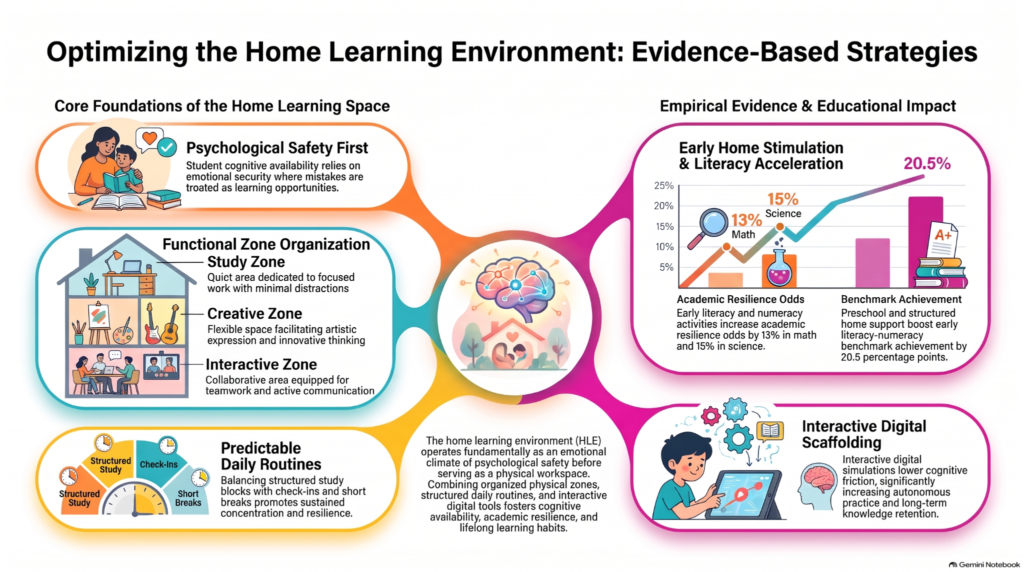
Essential Features of an Effective Learning Space
The home learning environment is the earliest contact learning environment in early childhood development, which plays an important role in the development of children’s social-emotional competence. However, previous studies have not clarified the precise mechanisms by which the home learning environment influences children’s social-emotional competence. Therefore, the purpose of the study is to explore the relationship between the home learning environment and its intrinsic structure (i.e. structural family characteristics, parental beliefs and interests, and the educational processes) and children’s social-emotional competence, and whether gender plays a moderating role in the relationship.
An effective learning space is characterized by designated learning areas that promote focus and organization.
Additionally, access to various resources is critical, as it enables learners to engage with a wide array of materials and tools that support their educational endeavors.
These features collectively enhance the learning experience by fostering an environment conducive to exploration and discovery.
Designated Learning Areas
It is the quality of the home learning environment that has the most significant impact on children’s speech, language, and communication skills and their social-emotional development. We know that parents want the best for their children. Unfortunately, when families lack confidence, skills and resources it can lead to gaps in learning and wellbeing which last for a lifetime.
Effective learning spaces are characterized by designated learning areas that cater to various educational activities and foster engagement.
The organization of these learning zones is essential in optimizing student outcomes. Research indicates that effective space organization includes:
- Study Zone: A quiet area dedicated to focused work, minimizing distractions.
- Creative Zone: A flexible space for artistic expression, encouraging innovative thinking.
- Interactive Zone: An area equipped for collaborative projects, promoting teamwork and communication skills.
- Resource Zone: A well-organized space for books and materials, facilitating easy access to necessary learning tools.
Access to Resources
Access to resources is a critical component in creating an effective learning environment that supports diverse educational needs. Resource availability greatly influences student engagement and achievement, necessitating a strategic approach to integrating community support. Families and educators can also explore the engineering teacher shop for useful teaching resources and classroom materials that help make home learning more engaging, organized, and accessible for students. Schools and families can collaborate to guarantee access to essential materials and technologies, fostering a more inclusive educational experience.
| Resource Type | Community Support Example |
| Educational Materials | Local libraries providing books |
| Technology Access | Community centers offering computers |
| Learning Programs | Nonprofits hosting tutoring sessions |
| Parental Involvement | Workshops on educational strategies |
How to Involve Parents in Learning?
While engaging parents in their children’s education can pose challenges, research underscores its significance in enhancing academic outcomes. Understanding the relationship between parent beliefs and student motivation can help caregivers recognize how their attitudes toward education influence children’s confidence, willingness to learn, and academic engagement.
Effective strategies for involving parents in learning include:
- Communication Strategies: Establish clear channels for regular updates on student progress and learning activities to foster meaningful conversations at home.
- Resource Sharing: Provide parents with tools and resources that support learning goals, such as educational materials or links to online activities.
- Educational Workshops: Organize workshops that equip parents with techniques to assist in their children’s education, focusing on fostering family involvement in learning.
- Supportive Feedback: Encourage parents to offer constructive feedback on their children’s work, thereby creating a supportive home environment that values academic effort.

UTILIZING TECHNOLOGY TO ENHANCE HOME LEARNING
In my lectures and clinical observations, one pattern consistently stands out: no two nervous systems process challenging academic tasks in the exact same manner. When we look at rigorous STEM fields, traditional schooling frequently rewards sequential, rapid recall and stillness. Yet many children—particularly neurodivergent learners or those who lean heavily into visual and spatial thinking—experience deep cognitive fatigue in standardized settings. At home, we have the rare, valuable chance to deconstruct those rigid expectations.
Take technology and digital tools, for example. We often hear polarized debates: screens are either entirely ruinous or the ultimate pedagogical panacea. In practice, thoughtful digital simulations and interactive tools can transform abstract, intimidating concepts into tangible models that a child can touch, test, and revisit at their own pace without fear of public judgment in a classroom.
When my own child hits a wall with complex homework, stepping away from textbook drills to experiment with an interactive model—or simply taking a mindful walk to talk through the problem out loud—frequently unlocks insights that hours of forced sitting never could. Effective support does not mean policing every minute of study; it means observing your specific child, understanding how their attention flows, and adapting tools to serve their emotional and cognitive wiring rather than forcing them to fit a monolithic mold.
The integration of technology in the home learning environment offers significant opportunities for enhancing educational outcomes.
Learning apps and tools can provide personalized experiences, while virtual collaboration platforms facilitate engagement and interaction among students.
Additionally, the accessibility of online resources guarantees that learners have a wealth of information at their fingertips, thereby enriching the educational experience.
Learning Apps and Tools
As families increasingly integrate technology into their daily routines, learning apps and tools have emerged as pivotal resources for enhancing the home learning environment.
These educational apps and interactive tools provide opportunities for personalized learning and engagement, which can notably benefit students.
Effective strategies for utilizing these resources include:
- Selecting age-appropriate apps** that align with educational standards.
- Encouraging collaboration among siblings or peers to foster a sense of community.
- Monitoring progress through built-in assessments to tailor learning experiences.
- Setting specific learning goals to maintain focus and motivation.
Virtual Collaboration Platforms
The home environment is regarded as one of the most important factors influencing learners’ performance and academic achievement (Younas et al., 2020). Education is interpreted differently in each home. Each house has a unique understanding of time and place. Parents and guardians have the responsibility to train their children to be more competitive in terms of local ideas and actual and achievable global principles. Both home and school principals influence students’ academic performance, either positively or negatively (Arsalan, 2019).
Though technology has transformed many aspects of education, virtual collaboration platforms have proven particularly effective in enhancing the home learning environment.
These platforms facilitate virtual classrooms where students can engage in collaborative projects and interactive sessions, fostering a sense of community even in remote learning contexts. By employing digital communication tools, educators can share resources that promote student engagement and encourage peer feedback.
Online workshops and teamwork activities further enhance the learning experience, allowing students to develop critical skills essential for future success. The integration of these technologies not only supports academic achievement but also nurtures essential social interactions, making virtual collaboration platforms an invaluable asset in the contemporary educational landscape.
Online Resources Accessibility
Numerous studies highlight the significant role of online resources in enhancing the home learning environment, particularly during periods of remote education.
The accessibility of online platforms has transformed how educational resources are utilized, emphasizing the importance of resource availability for effective learning.
Key considerations include:
- Diverse Learning Materials: Online platforms provide access to a variety of educational content, catering to different learning styles.
- Interactive Tools: Many resources offer interactive features that engage students and promote active learning.
- Support Networks: Online forums and communities facilitate peer support, enhancing motivation and collaboration.
- Flexible Learning: Students can access resources anytime, allowing for personalized pacing and the ability to revisit challenging concepts.
These factors collectively contribute to a more supportive and enriching home learning environment.
How to Foster a Growth Mindset in Children?
Fostering a growth mindset in children is essential for their academic and personal development, particularly as it encourages resilience and a love for learning. Techniques such as positive reinforcement and constructive feedback can promote challenge acceptance, enabling children to view obstacles as opportunities for growth. Implementing self-reflection practices aids in understanding personal progress, while goal setting and perseverance techniques further enhance their resilience building.
| Strategy | Description |
| Positive Reinforcement | Encouraging effort and persistence to boost confidence. |
| Self Reflection Practices | Guiding children to assess their learning journeys. |
| Challenge Acceptance | Teaching children to embrace difficulties as chances to learn. |
| Learning from Failure | Emphasizing lessons gained from setbacks to encourage resilience. |
How to Build a Daily Routine for Learning?
Establishing a daily routine for learning can greatly enhance a child’s educational experience by providing structure and consistency. A well-structured routine encourages engagement and fosters a positive learning environment.
To effectively build this routine, consider the following strategies:
- Set Specific Learning Times: Designate specific blocks of time for learning activities, allowing for flexible scheduling based on the child’s needs and energy levels.
- Incorporate Daily Check-Ins: Regular check-ins help assess progress and adjust goals, creating a supportive atmosphere.
- Include Breaks and Leisure: Short breaks between learning sessions can improve focus and retention, making the routine sustainable.
- Encourage Reflection: At the end of each day, facilitate a brief reflection period where the child can evaluate their learning experiences and set intentions for the next day.
Evaluating and Adjusting Your Home Learning Environment
Although the home learning environment plays an essential role in a child’s educational outcomes, it is important to regularly evaluate and adjust this setting to optimize learning experiences. Conducting a thorough home assessment can reveal strengths and weaknesses within the environment that may impact student engagement and academic success.
Key areas to take into account include the organization of learning materials, the availability of resources, and the overall atmosphere conducive to study.
Gathering environment feedback from both students and parents can provide valuable insights into the effectiveness of the current setup. This feedback can highlight specific challenges, such as distractions or inadequate study areas, enabling caregivers to make informed adjustments. Maintaining strong family teacher relationships and mental health also allows parents and educators to recognize children’s emotional needs, address learning difficulties, and provide consistent support for their overall development.
Implementing evidence-based strategies such as designated study zones, consistent routines, and interactive learning materials can further enhance the home learning experience. Regular evaluations guarantee that the home learning environment evolves to meet the changing needs of the child, fostering a supportive atmosphere for lifelong learning.

RELATED STUDIES ABOUT HOME LEARNING ENVIRONMENT EFFECTS
To sum up, the contrast between a chaotic and a structured home learning environment underscores the profound impact on student outcomes. While a disorganized space may hinder engagement and motivation, an intentional and resource-rich setting fosters academic growth and resilience. By integrating evidence-based strategies, such as parental involvement and the use of technology, families can create a nurturing atmosphere that not only supports learning but also cultivates a lifelong love of education, illustrating the critical role of home in academic success.
The role of pre-primary school attendance in school readiness in Bangladesh: Exploring the interaction effects with socioeconomic status and home learning environment
Conceptual Framework and Research Rationale
- Pre-Primary Education and School Readiness in LMICs: Preparing young children across cognitive, socio-emotional, and executive functioning domains is essential for foundational learning, grade progression, and lifelong well-being. In low- and middle-income countries (LMICs), early childhood interventions have been highlighted as critical human capital investments, aligning with United Nations Sustainable Development Goal Target 4.2.
- Policy Expansion in Bangladesh: Over the past two decades, the Government of Bangladesh has institutionalized pre-primary education (PPE) through national frameworks, including the Operational Framework for Pre-Primary Education (2008), the National Education Policy (2010), and the Primary Education Development Programs (PEDP), expanding formal, play-based preschool access for children aged 3 to 5 years.
- The “Equalizer” vs. “Cumulative Advantage” Debate: An ongoing theoretical dispute centers on who benefits most from preschool attendance:
- Compensatory (Equalizer) Hypothesis: Disadvantaged children (low socioeconomic status or low home stimulation) gain larger marginal benefits from early interventions, narrowing baseline developmental gaps.
- Cumulative Advantage (Matthew Effect) Hypothesis: Children from wealthier, higher-capital backgrounds benefit disproportionately because families reinforce early preschool gains with superior private resources or higher-quality schooling.
- Additive Hypothesis: The developmental returns of preschool attendance are uniform across socioeconomic strata.
- Methodological and Empirical Gaps: Prior literature in LMICs has struggled to model interaction effects within nonlinear probability frameworks (e.g., logit models) without severe estimation bias. Furthermore, research in Bangladesh has rarely disaggregated school readiness into distinct cognitive versus non-cognitive subdomains while simultaneously examining the dual moderating roles of family wealth and the home learning environment.
- Core Research Objectives:
- Examine the empirical association between preschool attendance and multidimensional school readiness (overall and domain-specific) using nationally representative data from Bangladesh.
- Test whether family wealth and the home learning environment moderate these associations using advanced nonlinear interaction modeling.
Methodology and Econometric Design
- Data Sources and Sample Composition:
- Pooled cross-sectional microdata from two rounds of the nationally representative Multiple Indicator Cluster Survey (MICS 2012/13 and MICS 2019), administered by the Bangladesh Bureau of Statistics in partnership with UNICEF.
- Utilized a two-stage stratified random probability sampling design.
- Target Population: Children aged 36 to 59 months (M=47.386.92 months; 51.8% male, 48.2% female; 17.3% urban, 82.7% rural).
- Final Analytic Sample: 18,023 children (2,940 enrolled in preschool [16.3%] and 15,083 non-enrolled [83.7%]) with complete records (listwise deletion for ~1.5% missingness).
- Dependent Variables (Early Childhood Development Index – ECDI):
- Measured using UNICEF’s internationally standardized 10-item ECDI instrument, classifying whether a child is developmentally on track across four specific domains:
- Literacy-Numeracy: Identifying 10 letters, reading 4 simple words, and recognizing numbers 1–10 (on track if 2 criteria are met).
- Approaches to Learning: Following simple instructions and executing tasks independently (on track if 1 criterion is met).
- Social-Emotional: Peer cooperation, absence of aggressive behaviors (kicking/biting), and sustained attention (on track if 2 criteria are met).
- Physical Development: Fine motor skills (picking up small objects with two fingers) and absence of chronic illness (on track if 1 criterion is met).
- Overall ECDI: A child is classified as developmentally on track overall if on track in at least 3 of the 4 domains.
- Measured using UNICEF’s internationally standardized 10-item ECDI instrument, classifying whether a child is developmentally on track across four specific domains:
- Independent and Moderating Constructs:
- Preschool Attendance: Binary indicator (1=attendedorganizedpreschool/kindergarten/daycare, 0=didnotattend).
- Family Wealth Index Quintile: Asset- and housing-based wealth index categorized into quintiles (poorest [28.2%], poor [21.4%], middle [18.3%], rich [17.3%], richest [14.9%]).
- Home Learning Environment (HLE): Constructed via Principal Component Analysis (PCA; KMO=0.82–0.88) across eight home stimulation indicators (reading books, storytelling, counting/naming, playing, singing, taking child outside, book count, and toy availability) and grouped into five stimulation quintiles (least to most stimulating).
- Econometric Modeling and Interaction Identification:
- Logit regression models reporting Average Marginal Effects (AME) with robust standard errors clustered at the district level (N=64 districts).
- Models controlled for maternal education, household head gender, sibling structure, urban/rural residence, child age, child sex, height-for-age nutritional z-score flags, district fixed effects, and survey year fixed effects.
- Nonlinear Interaction Modeling (ginteff): To overcome the methodological limitations of simple interaction product terms in nonlinear logistic models (where coefficients do not equal true marginal effects), the study implemented the newly developed Stata command ginteff (Radean, 2023) to compute discrete interaction changes across moderator levels.
Key Empirical Findings
- Baseline Disparities and Direct Returns of Preschool Attendance:
- Descriptive Milestones: Overall, 82% of preschool attendees were developmentally on track on the ECDI compared to 69% of non-attendees. The gap was most striking in literacy-numeracy (54% on track for preschoolers vs. 19% for non-attendees).
- Domain-Specific Marginal Effects: In fully adjusted logit models:
- Preschool attendance increased the probability of being on track in overall ECDI by 12.0 percentage points (p<0.001).
- Attendance increased the probability of being on track in literacy-numeracy by 20.5 percentage points (p<0.001).
- Attendance increased the probability of being on track in approaches to learning by 4.4 percentage points (p<0.001).
- Associations with social-emotional development (=-0.010,p>.05) and physical development (=0.005,p>.05) were statistically non-significant.
- Confirmation of Cumulative Advantage via Family Wealth:
- The developmental benefits of preschool attendance were positive across all socioeconomic tiers, but the magnitude of gains expanded substantially as household wealth increased:
- Overall ECDI Returns Across Wealth Quintiles: The marginal gain from preschool was +4.7 percentage points for the poorest quintile, rising to +11.8 in the poor, +15.0 in the middle, +12.4 in the rich, and +15.3 percentage points in the richest quintile.
- Literacy-Numeracy Returns Across Wealth Quintiles: Marginal effects rose from +16.9 percentage points among the poorest to +29.5 percentage points among the richest.
- Discrete Interaction Tests (ginteff): Discrete change tests confirmed statistically significant positive interaction effects between attendance and family wealth. Moving from the poorest to the richest quintile increased the probability of being on track in overall ECDI by an additional 10.6 percentage points (p<0.001) and in literacy-numeracy by an additional 12.6 percentage points (p<0.001). These results reject the compensatory equalizer hypothesis in favor of the cumulative advantage (Matthew effect) theory.
- Non-Significant Moderation by the Home Learning Environment:
- In direct models, a stimulating home learning environment strongly predicted early childhood development (children in the most stimulating homes exhibited an 8.6 percentage point gain in overall ECDI and a 17.7 percentage point gain in literacy-numeracy, p<0.001).
- However, the home learning environment did not significantly moderate the impact of preschool attendance. Estimated marginal gains remained virtually identical across home stimulation levels (+9.7 to +11.6 percentage points for overall ECDI; +16.9 to +21.0 percentage points for literacy-numeracy), and interaction terms were non-significant (p>.05).
Structural, Pedagogical, and Policy Interpretations
- The Academic Bias of Pre-Primary Schooling in Bangladesh: The strong impact of preschool on literacy and numeracy contrasted with negligible gains in social-emotional and physical competencies. In Bangladesh, preschool instruction is traditionally structured around whole-class teacher lecturing, rote memorization, and early preparation for primary school admissions. Teachers frequently lack training in experiential, play-based learning and socio-emotional scaffolding.
- Wealth-Driven Sorting and Institutional Quality Gaps: The cumulative advantage observed among wealthier households is primarily driven by institutional differentiation rather than home stimulation differences. Wealthier urban families have the financial and social capital to enroll children in well-resourced private or NGO preschools that maintain smaller teacher-child ratios, structured learning environments, and better teaching aids. In contrast, public and rural facilities serving disadvantaged children often suffer from high student-teacher ratios, uncertified staff, and inadequate infrastructure.
- Whole-Class Instruction Limits Home-Preschool Synergies: The lack of interaction between home stimulation and preschool suggests that pedagogical practices inside typical Bangladeshi classrooms are rigid. Because one-on-one differentiated teacher-child interaction is minimal, children arriving from highly stimulating homes cannot leverage their background into compounding advantages during classroom hours; their preschool gains remain additive rather than synergistic.
Policy Recommendations and Educational Implications
- Reform Pre-Primary Teacher Training and Pedagogy:
- Transition professional development from one-off orientation lectures to continuous classroom-embedded coaching focused on play-based learning, socio-emotional care, and diagnostic developmental tracking.
- Revise the national early childhood curriculum to elevate social-emotional, behavioral, and fine-motor development alongside foundational alphabet and numeracy drills.
- Target Quality Upgrades to Disadvantaged Facilities:
- Universal preschool access (such as the national expansion of free preschool for four-year-olds launched in 2023) is insufficient on its own to promote equity.
- Educational authorities must disproportionately allocate learning resources, classroom play materials, and certified teachers to rural and low-income government pre-primary schools to prevent preschool expansion from widening socioeconomic learning gaps.
- Support Home Stimulation Across Disadvantaged Households:
- Community-based parental education workshops should guide low-income caregivers in low-cost cognitive and emotional stimulation practices (e.g., verbal storytelling, interactive play with household objects), providing an essential home foundation prior to formal school entry.
Study Limitations and Future Directions
- Binary Outcome Constraints: School readiness was operationalized through the binary ECDI milestone index, which cannot capture continuous gradations or subtle micro-developmental gains in child cognitive functioning. Future research should incorporate continuous psychometric instruments such as IDELA (International Development and Early Learning Assessment) or the Bayley Scales.
- Absence of Institutional and Quality Metadata: The MICS dataset does not capture preschool provider types (e.g., government primary annexes vs. BRAC/NGO centers vs. for-profit private kindergartens), class sizes, per-pupil spending, or classroom observation scores (e.g., ECERS).
- Cross-Sectional Architecture: While survey weights and extensive covariates were controlled, the cross-sectional nature limits definitive causal claims regarding long-term academic trajectories.
- Future Research: Longitudinal evaluations using upcoming national rounds (such as MICS 2026) are recommended to evaluate the long-term impact of Bangladesh’s recent policy reforms expanding free early schooling to four-year-olds.
| REFERENCE: Kohei Uno, Keiichi Ogawa, The role of pre-primary school attendance in school readiness in Bangladesh: Exploring the interaction effects with socioeconomic status and home learning environment, International Journal of Educational Development, Volume 118, 2025, 103412, ISSN 0738-0593, https://doi.org/10.1016/j.ijedudev.2025.103412. (https://www.sciencedirect.com/science/article/pii/S073805932500210X) |
Effects of a serious game on undergraduate nursing students’ learning motivation, engagement and outcomes in community nursing home visit education: A cluster quasi-experimental study
Conceptual Framework and Research Rationale
- Demographic Pressures and Primary Healthcare Mandates: With China’s population aged 60 and above exceeding 310 million (over 22% of the national population) and approximately 180 million older adults living with chronic conditions, primary healthcare delivery has become a strategic priority under the “Healthy China” initiative. Community nursing home visits constitute a core frontline clinical competency, demanding holistic environmental risk assessment, clinical reasoning under uncertainty, and emergency triage.
- Pedagogical Contradictions in Traditional Home Visit Training: Conventional community nursing curricula face systemic barriers, including a severe shortage of clinical preceptors at community health centers, unequal student access to authentic home visits, and high variability in teaching standards. While text-based case studies paired with team-based learning (TBL) have been utilized as classroom substitutes, static texts lack spatial and cultural context (e.g., household layouts, sanitation hazards), provide overly explicit cues that undermine independent diagnostic reasoning, and fail to engage digital-native learners.
- Situated Cognition Theory (SCT) and Serious Games (SGs): Situated cognition posits that meaningful learning occurs when knowledge is actively constructed through immersion in authentic problem-solving environments rather than through abstract knowledge transmission. Serious games (SGs) translate SCT into digital practice by providing low-risk, immersive simulations with real-time feedback loops and exploratory learning pathways that reduce extraneous cognitive load.
- Core Research Objective: To develop and evaluate the pedagogical effectiveness of the serious mobile game Home Visit Navigator (HVN) compared to traditional text-based case studies in enhancing undergraduate nursing students’ learning outcomes (short- and long-term retention), learning engagement, and situational motivational profiles.
Methodology and Empirical Data Architecture
- Study Design and Reporting Framework:
- A cluster quasi-experimental study adhering to the Transparent Reporting of Evaluations with Nonrandomized Designs (TREND) guidelines.
- Protocol power analysis conducted via G*Power (d=0.573,=0.05,1-=0.80) established a target sample of 49 per arm, adjusted upward to 62 to account for potential attrition.
- Participant Cohort and Educational Setting:
- 134 full-time undergraduate nursing students enrolled in the Community Nursing course during the autumn semester of 2024 at a medical university in China.
- Intact parallel class clusters were randomly assigned to either the Experimental Group (EG; n=67), which completed home visit learning via the Home Visit Navigator serious game, or the Control Group (CG; n=67), which completed identical case content via static text-based case studies.
- Baseline Equivalence: Demographic characteristics—including age (median 20–21 years), sex (77.6% female in EG, 83.6% in CG), ethnicity (94.0% Han in EG, 86.6% in CG), and rural/urban origin (59.7% rural in EG, 52.2% in CG)—showed no statistically significant differences (p>.05), confirming baseline homogeneity.
- Design and Structure of Home Visit Navigator (HVN):
- Developed through an interdisciplinary team (nurse educators, clinical preceptors, instructional designers, software engineers) using the Empathize-Define-Ideate-Prototype-Test (EDIPT) design thinking framework, deployed as a lightweight WeChat mini-program.
- Prototyping usability yielded an above-average System Usability Scale (SUS) score of 73.006.93.
- Instructional Progression (Non-Linear Exploration within a Linear Structure):
- Role Induction & Environment Familiarization: Taking on the professional persona of a community nurse in a virtual clinic.
- Case Review & Autonomous Planning: Reviewing family health records to prioritize visits and prepare diagnostic supplies.
- Emergency Management (“Lele’s Family”): Managing an acute infant fever under simulated time pressure.
- Assessment-Based Execution (“Mr. Zhang”): Assessing a post-stroke hemiplegic patient, adjusting home environmental hazards (e.g., rearranging virtual furniture, removing trip hazards), and drafting tailored rehabilitation plans.
- Embedded Scaffolding Feedback: Multi-tiered feedback including consequential feedback (changes in patient vitals or caregiver emotions), explanatory prompt boxes, and summative performance scoring with repeatable decision branches.
- Outcome Measures and Instruments:
- Primary Outcomes (Learning Retention):
- Post-Lesson Knowledge Assessment: 100-point standardized objective test (multiple-choice, fill-in-the-blank, short-answer items across Bloom’s memory, comprehension, and application levels) administered immediately following a 7-day learning window.
- Final Theoretical Examination: 28-point home-visitation section embedded within the final course examination administered 3 months post-intervention, subjected to double-blind scoring.
- Secondary Outcomes (Engagement and Motivation):
- Student Learning Engagement (SLE): Quantified automatically via backend platform access frequency (number of interactive game runs vs. text case access sessions; unannounced to participants to prevent Hawthorne bias).
- Situational Motivation Scale (SIMS): Validated 16-item scale measuring four distinct regulatory dimensions: Intrinsic Motivation, Identified Regulation, External Regulation, and Amotivation (7-point Likert scale, Cronbach’s =0.792–0.833).
- Primary Outcomes (Learning Retention):
- Statistical Analysis:
- Evaluated using IBM SPSS 26.0 via independent-samples t-tests (normal continuous variables), Mann-Whitney U-tests (non-normal continuous variables), and chi-square tests (2), reporting Cohen’s d, r, and effect sizes. Data analysts remained blinded to group allocations.
Key Empirical Findings
- Significant Enhancements in Short- and Long-Term Learning Retention:
- Post-Lesson Knowledge Assessment: The experimental group achieved a median score of 96.00 (IQR: 89.50, 100.00), significantly outperforming the control group’s median of 71.70 (IQR: 61.30, 92.80; Mann-Whitney U=-6.751,p<0.001,r=-0.583, large effect size).
- Long-Term Retention (3-Month Final Exam): On the unannounced final theoretical exam questions, the experimental group retained significantly higher proficiency (median 21.00, IQR: 19.00, 22.00) compared to the control group (median 20.00, IQR: 18.00, 21.00; U=-2.306,p=0.021,r=-0.199).
- Marked Increases in Behavioral Learning Engagement:
- Objective platform logs demonstrated that experimental students engaged with the gamified scenarios a median of 4.00 times (IQR: 3.00, 6.00), whereas control students completed their text-based case studies exactly 1.00 time (IQR: 1.00, 1.00).
- This difference in autonomous, voluntary practice was statistically significant with a massive effect size (p<0.001,r=-0.892).
- Qualitative Restructuring of Situational Motivation:
- Autonomous Motivation Profiles:
- Intrinsic Motivation: The experimental group exhibited significantly higher intrinsic motivation (21.873.84) than the control group (20.394.05;t=2.167,p=0.032, Cohen’s d=0.375).
- Identified Regulation: Students in the game condition recognized higher personal and professional value in the task (21.403.61) compared to controls (20.013.95;t=2.124,p=0.036, Cohen’s d=0.367).
- Controlled Motivation and Disengagement:
- Amotivation: The experimental group reported dramatically lower amotivation (10.813.56) compared to the control group (13.673.97;t=-4.403,p<0.001, Cohen’s d=-0.759, medium-to-large effect size).
- External Regulation: No statistically significant difference was detected between the two groups on external regulation (16.00 vs. 17.00,U=-0.650,p=0.516), proving that game gains were not driven by external academic pressure or institutional coercion.
Pedagogical, Psychological, and Theoretical Interpretations
- Cognitive Load Reduction Through Spatial Concreteness: In contrast to static text cases that force students to mentally construct domestic spatial layouts, HVN visually represented patient homes. By directly manipulating environmental modifications (e.g., physically altering furniture and bathroom accessibility in “Mr. Zhang’s” case), students transferred abstract safety principles into declarative and procedural memory with lower cognitive friction.
- The “Decision-Feedback-Reflection” Learning Loop: HVN replaced passive reading with non-linear clinical problem-solving. Experiencing the immediate consequences of decisions—such as fluctuating vital signs in febrile infants or altered emotional reactions from family members—created an active hypothesis-testing loop that fostered diagnostic intuition and clinical judgment.
- Internalization of Professional Identity (Identified Regulation): Serious game mechanisms functioned beyond superficial entertainment. Role-playing as licensed community nurses prompted students to identify with core clinical values—such as empathy, dignity, and patient advocacy—transforming external curriculum requirements into internalized professional commitments.
- Autonomous Mastery Over Rote Dependency: The repeatability of game branches enabled students to test alternative decision paths safely, demystifying medical errors and fostering self-efficacy without the risk of real-world patient harm.
Practical Implications and Study Limitations
- Curricular Recommendations for Nursing Education:
- Integrate Micro-Simulations into Blended Frameworks: Nursing faculties should adopt lightweight, mobile-accessible serious games (e.g., mini-programs or web apps) as post-lecture consolidation tools to standardize community training prior to physical home clinical rotations.
- Focus on Decision Complexity Over Simple Gamification: Game design must prioritize realistic, non-linear decision points and consequential patient feedback rather than superficial reward loops (e.g., points or badges) to ensure genuine clinical transfer.
- Methodological Limitations:
- Single-Institution Scope: Conducted with a single cohort under a single instructor at one Chinese medical university, which may limit generalizability across varied institutional curricula.
- Absence of Direct Clinical Observational Testing: Learning outcomes were evaluated through written theoretical assessments; objective structured clinical examinations (OSCEs) or home visit field performance rubrics were not evaluated.
- Baseline Motivation Omission: Baseline situational motivation was not measured prior to the intervention, and engagement metrics (clicks vs. game iterations) possessed inherent structural differences across platforms.
- Future Research: Subsequent inquiries should implement multi-center randomized controlled trials (RCTs) tracking objective clinical skills transfer into post-graduation community practice and exploring the integration of generative AI conversational agents within virtual home visit simulations.
| REFERENCE: Xiaohua Chen, Yanling Yang, Yan Wang, Ling Shen, Zhuzhu Wang, Shaodong Chu, Jiayuan Zhuang, Effects of a serious game on undergraduate nursing students’ learning motivation, engagement and outcomes in community nursing home visit education: A cluster quasi-experimental study, Nurse Education in Practice, Volume 93, 2026, 104785, ISSN 1471-5953, https://doi.org/10.1016/j.nepr.2026.104785. (https://www.sciencedirect.com/science/article/pii/S1471595326000879) |
Academic resilience of disadvantaged students in 58 countries: The role of early home learning activities and instructional clarity
Conceptual Framework and Research Rationale
- Educational Inequality and Academic Resilience in STEM: Despite growing socioeconomic disparities worldwide, certain students from impoverished backgrounds achieve high academic outcomes—a phenomenon termed academic resilience. Resilience is particularly vital in mathematics and science, where early academic failure can induce anxiety, diminish self-efficacy, and restrict access to future STEM careers.
- Ecological and Multisystemic Lens: Grounded in Bronfenbrenner’s bioecological model and modern resilience frameworks (e.g., Masten, Luthar, Ungar), resilience is conceptualized as a dynamic process in which environmental protective factors buffer against socioeconomic adversity. Two pivotal environmental systems operate during early childhood:
- The Home Microsystem (Early Literacy and Numeracy Activities): Early shared reading, storytelling, counting games, and size comparisons build foundational cognitive resources, language processing, and spatial-numerical reasoning before formal schooling begins.
- The Classroom Microsystem (Teachers’ Instructional Clarity): Clear, well-structured instruction, explicit step-by-step guidance, and effective feedback reduce cognitive load, scaffold complex concepts, and support persistence among disadvantaged learners.
- The Interaction Dilemma: Compensatory vs. Synergistic: Literature remains divided regarding how home and school protective factors interact:
- Compensatory Hypothesis: High instructional clarity can offset or compensate for a lack of early home learning opportunities.
- Synergistic (Cumulative Advantage) Hypothesis: Strong foundational home learning magnifies the benefits of clear classroom instruction, with both supports mutually reinforcing each other.
- Core Research Objectives:
- Identify and quantify the proportions of socioeconomically disadvantaged students who demonstrate academic resilience in mathematics and science across 58 educational systems using both cross-national (fixed) and within-country (relative) benchmarks.
- Examine the moderating role of early home literacy and numeracy activities on the association between teachers’ instructional clarity and academic resilience in both subjects, testing pooled cross-country patterns and within-country variations.
Methodology and Comparative Data Architecture
- Large-Scale International Data Source:
- Utilizes Grade 4 assessment and questionnaire microdata from the Trends in International Mathematics and Science Study (TIMSS 2019), administered by the International Association for the Evaluation of Educational Achievement (IEA).
- Full Sample: 308,609 fourth-grade students across 58 participating countries and economies (50.7% male, 49.3% female; ~12.9% foreign-born; ~28.9% speaking a language other than the test language at home).
- Subgroup of Interest (Adversity Operationalization): Socioeconomically disadvantaged students were defined as those in the bottom one-third (lowest 33%) of the SES distribution within their respective country (N=101,173).
- SES Scale Construction: Rather than using the TIMSS Home Resources for Learning scale (which suffered from severe parental non-response in several nations), SES was constructed via Confirmatory Factor Analysis (CFA) using six standardized student-reported items (number of books, computer/tablet, study desk, mobile phone, internet connection, and own room; CFI=.992,RMSEA=.033). Alignment optimization confirmed measurement invariance (16.9% non-invariance, well within acceptable thresholds) across all 58 systems.
- Dual Thresholds for Academic Resilience (Positive Adaptation):
- Resilience was evaluated across all five TIMSS plausible values in mathematics and science, requiring a student to meet the proficiency standard in at least three of five plausible values:
- Fixed Performance Threshold (Cross-National Benchmark): Scoring at or above 475 points (surpassing the TIMSS Intermediate International Benchmark). Identifies whether disadvantaged students achieve an internationally recognized standard of competence.
- Relative Performance Threshold (Within-Country Benchmark): Scoring in the top one-third (highest 33%) of their own country’s performance distribution. Captures resilience relative to local opportunities and performance norms.
- Resilience was evaluated across all five TIMSS plausible values in mathematics and science, requiring a student to meet the proficiency standard in at least three of five plausible values:
- Key Independent and Moderating Constructs:
- Early Home Learning Activities (NumLit): Parent-reported scale summarizing the frequency (often, sometimes, never) of engaging children in nine early literacy and nine early numeracy activities before primary school (Rasch partial credit model; Cronbach’s =0.82–0.94). Countries without parent questionnaires (Australia, England, Netherlands, USA) or with parental non-response $>50\%$ (Denmark, Ireland, New Zealand, Norway, UAE) were excluded from moderation modeling, leaving 49 countries.
- Instructional Clarity: Student-reported 7-item Rasch scales assessing teacher clarity, step-by-step explanations, checking for understanding, and clear expectations in mathematics (=0.62–0.89) and science (=0.64–0.89).
- Statistical Modeling Specifications:
- Student-level logistic regression estimated in Mplus 8.10 using Full Information Maximum Likelihood (FIML) and Monte Carlo integration.
- Adjusted standard errors for classroom-level clustering (TYPE = COMPLEX) using the CLUSTER command and incorporated total student sampling weights to account for complex survey designs.
- All continuous predictors were standardized (z-scores) prior to computing interaction product terms.
Key Empirical Findings
- Prevalence and Distribution of Academic Resilience (RQ1):
- Fixed vs. Relative Benchmark Divergence:
- Fixed Threshold (475 points): The proportion of resilient disadvantaged students varied dramatically across systems, ranging from $<3\%$ in low-performing countries (e.g., Pakistan: 2.9% in math, 2.7% in science; Philippines: 3.2% in math; South Africa: 4.8% in math) to $>30\%$ in high-performing systems (e.g., South Korea: 30.6% in math; Hong Kong: 30.5% in math; Russia: 30.6% in math).
- Relative Threshold (Top National Third): Produced a much narrower, context-stable distribution (~5% to 11%). Countries that ranked lowest on the international fixed benchmark ranked among the highest in relative resilience within their national contexts (e.g., Pakistan reached 10.5% in math and 11.5% in science). Conversely, high-performing East Asian systems showed marked drops under relative thresholds (e.g., South Korea dropped to 6.5% in math).
- Subject-Specific Asymmetry: Under the fixed threshold, disadvantaged students were generally more likely to demonstrate resilience in mathematics than in science. Gaps favoring mathematics were pronounced in Azerbaijan (14.3% higher), Hong Kong (9.5% higher), and Belgium-Flemish (6.9% higher). Under the relative threshold, subject disparities narrowed to $<2\%$ across most systems.
- Pooled Cross-National Moderation Dynamics: Compensatory Buffering (RQ2):
- In the pooled 49-country sample using the fixed threshold, both environmental supports were significant positive predictors of academic resilience:
- Mathematics: Early home learning was associated with 13% higher odds of resilience (OR=1.131,=0.123,p<.001,d=0.068), and instructional clarity was associated with 12% higher odds (OR=1.120,=0.113,p<.001,d=0.062).
- Science: Early home learning was linked to 15% higher odds of resilience (OR=1.147,=0.137,p<.001,d=0.076), and instructional clarity was linked to 10% higher odds (OR=1.103,=0.098,p<.001,d=0.054).
- Significant Negative Interaction (Compensatory Pattern):
- Mathematics interaction: OR=0.983,=-0.017,p<.001,d=0.009.
- Science interaction: OR=0.973,=-0.027,p<.001,d=0.015.
- The negative interaction confirms a compensatory effect: the positive impact of teachers’ instructional clarity was strongest among students who lacked early home literacy and numeracy activities. Conversely, students who entered school with strong early home learning foundations were less dependent on high classroom instructional clarity to achieve resilience. The compensatory buffering was slightly stronger in science than in mathematics.
- Within-Country Moderation Heterogeneity (RQ2):
- Mathematics (Relative Benchmark):
- Early home learning was significant in 32 of 49 countries; instructional clarity was significant in 30 countries.
- Significant interactions emerged in seven countries: six systems (Armenia, Azerbaijan, Chinese Taipei, Kuwait, South Korea, Turkey) displayed positive interactions (synergistic effects), where strong home foundations and clear classroom instruction reinforced one another.
- Only one country—the Slovak Republic—displayed a statistically significant negative (compensatory) interaction in mathematics.
- Science (Relative Benchmark):
- Early home learning was significant in 35 countries; instructional clarity was significant in 28 countries.
- Significant interactions emerged in six countries (Kuwait, Oman, Philippines, Poland, Qatar, Sweden).
- Five nations exhibited positive synergistic patterns. Sweden displayed a “pure interaction” where neither main effect was significant in isolation, but their joint interaction was positive and significant, reflecting an equitable educational system where home-school alignment matters more than independent resources.
- Predominance of Main Effects Without Interaction: In the majority of countries, the interaction term was statistically non-significant, indicating that early home learning and instructional clarity operated as independent, parallel protective assets rather than systematically moderating one another.
Sociological, Pedagogical, and Comparative Interpretations
- The Subject Disparity and Linguistic Barrier: Disadvantaged students showed higher resilience rates in mathematics than in science under fixed international benchmarks. Primary mathematics relies more heavily on standardized numerical symbols and procedural algorithms, making it less vulnerable to home language deficits. In contrast, elementary science is heavily mediated by specialized academic vocabulary and expository discourse, penalizing disadvantaged students with lower early literacy exposure unless teachers provide explicit instructional scaffolding.
- Compensatory Capacity of Teaching Quality: The global pooled model demonstrates that high-quality classroom pedagogy can counteract early domestic disadvantages. Explicit, clear instruction reduces the cognitive burden of deciphering academic tasks, providing socioeconomically disadvantaged children with the foundational knowledge their families could not supply.
- Contextual Divergence Between Global and National Models: The tension between the pooled compensatory pattern and the within-country synergistic patterns illustrates how educational systems structure opportunity. In competitive, exam-driven systems (e.g., East Asia), students who enter school with early parental enrichment are better equipped to leverage classroom explanations into superior performance. In more homogeneous or decoupled systems, home stimulation and classroom instruction operate along independent tracks with minimal cross-setting coordination.
Policy Recommendations and Educational Implications
- Dual-Track Equity Strategies:
- Compensatory Focus in High-Poverty Schools: In under-resourced schools where early childhood home stimulation is chronically low, policy must prioritize teacher instructional clarity. Professional development should train educators in structured direct instruction, step-by-step cognitive modeling, checking for understanding, and making scientific vocabulary linguistically accessible.
- Synergistic Home-School Bridges: In systems showing synergistic returns, interventions should establish structured home-to-school transitions. Providing low-income parents with accessible numeracy games, shared reading toolkits, and simple nature-observation routines creates continuity between home practices and primary curricula.
- Context-Sensitive Monitoring of Resilience: Educational policymakers must evaluate disadvantaged student progress using both international benchmarks (to monitor global competitiveness) and relative national distributions (to evaluate internal equity and identify high-performing students within local constraints).
Study Limitations and Future Directions
- Cross-Sectional and Retrospective Measurement: The study utilizes cross-sectional Grade 4 data, where early literacy and numeracy activities were recalled retrospectively by parents, introducing potential recall bias. Longitudinal studies tracking cohorts from preschool through secondary school are needed to establish causal developmental pathways.
- Binary Outcome Constraints: Academic resilience was operationalized as a dichotomous indicator (resilient vs. non-resilient), which can obscure continuous performance nuances near cut-off boundaries.
- Unobserved School-Level Heterogeneity: Due to sparse clustering of disadvantaged students within individual classrooms in certain nations, multilevel random-slope modeling was replaced with single-level cluster-adjusted regressions, preventing full partitioning of school-level variance.
- Future Research: Subsequent investigations should explore how the interaction between home learning and instructional clarity evolves in lower-secondary grades (e.g., TIMSS Grade 8), where curricula become more abstract and parental academic support typically declines.
| REFERENCE: Nani Teig, Wangqiong Ye, Daniel Caro, Daniel April, Academic resilience of disadvantaged students in 58 countries: The role of early home learning activities and instructional clarity, Studies in Educational Evaluation, Volume 89, 2026, 101604, ISSN 0191-491X, https://doi.org/10.1016/j.stueduc.2026.101604. (https://www.sciencedirect.com/science/article/pii/S0191491X26000477) |
CONCLUSION
As we look at empirical studies across dozens of educational systems, a sobering truth surfaces: external interventions, elite software, and intensive curricula cannot replace the stabilizing foundation of a grounded, supportive domestic routine. Yet in our earnest desire to give our children every possible edge in an increasingly competitive world, parents frequently fall into the trap of over-structuring every hour, unintentionally turning the home into a high-pressure annex of the school testing center.
Whenever I tend to the herbs on my small balcony garden after a demanding day at the university, I am grounded by a simple principle: growth cannot be forced through constant pressure; it requires fertile soil, consistent nourishment, and room to breathe. When we focus on fostering intrinsic motivation and genuine emotional resilience, we must also leave room for unstructured play, restful silence, and unconditional acceptance.
High academic expectations only serve our children when paired with equal measures of emotional well-being. By letting go of clinical perfectionism and focusing on compassionate, predictable routines, we offer our children something far more enduring than high test marks—we give them the confidence, agency, and grounded security to navigate an uncertain world as lifelong, autonomous learners.
