
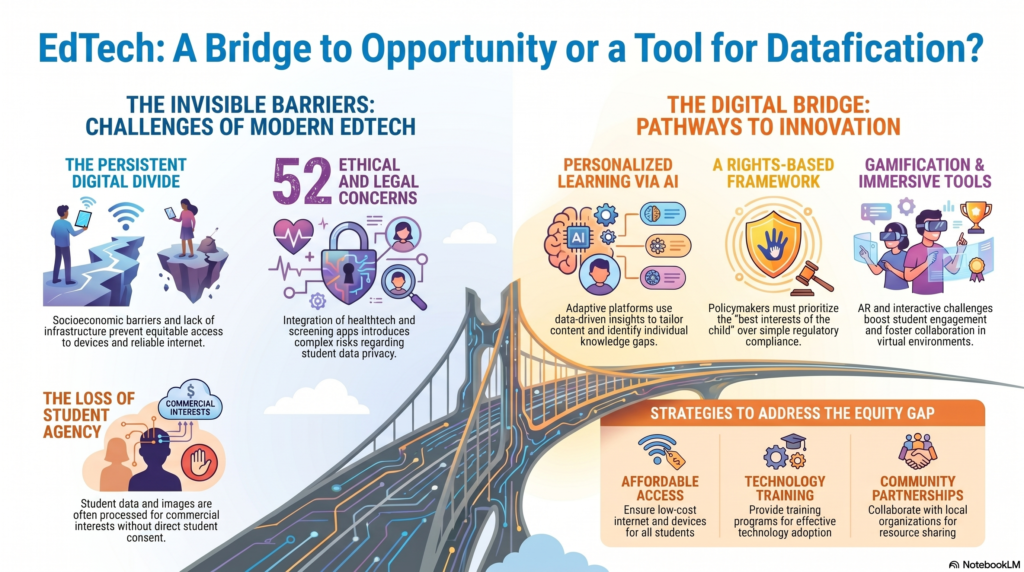
In my fifteen years researching STEM education reform, I have watched the classroom transform from a space of chalkboards and static textbooks into a dynamic, “digital by default” environment. While it is inspiring to see how technology can democratize information, we must be incredibly wary of how this shift impacts children’s fundamental rights. Every time a student interacts with a new EdTech platform, their actions, learning progress, and even their images are captured and processed. This creates a profound tension between the educational value of these tools and the commercial interests of the companies behind them. As someone who advocates for equitable education, I am concerned that we are moving so fast that our regulatory frameworks cannot keep up.
We often talk about the “digital divide” in terms of hardware, but it is also a divide of privacy and agency. Students like “Omar,” mentioned in recent studies, can feel a significant loss of agency when their photos or data are shared without their direct consent, even if their parents have signed a waiver.
We need to shift our focus from just “does this tool teach math better?” to “does this tool protect the child’s right to be heard and their right to privacy?”. As we integrate these innovations, we must ensure they serve as bridges to opportunity rather than invisible tools of datafication.
Technology greatly impacts current educational issues by transforming learning experiences and promoting accessibility. The integration of digital tools facilitates personalized learning, while adaptive platforms respond to diverse student needs. However, challenges remain, such as the digital divide, which exacerbates inequities among learners with varying access to technology and internet connectivity. Remote education can lead to disengagement due to reduced peer interaction. In addition, ensuring data privacy and security in the use of online resources is essential. Understanding these dynamics is vital for educators and policymakers as they navigate the evolving landscape of education technology and its implications for future learning.
KEY TAKEAWAYS
- The integration of digital tools in education enhances learning experiences and promotes active participation among students.
- Remote learning exposes the digital divide, creating inequities in access to technology and hindering educational opportunities for disadvantaged families.
- Gamification and interactive platforms improve student engagement, fostering motivation and collaboration in virtual learning environments.
- Personalized learning through adaptive platforms tailors educational content to individual needs, promoting inclusivity and ownership of learning.
- Compliance with accessibility standards and collaboration among stakeholders is essential for providing equitable access to digital resources for all learners.
EVOLUTION OF EDUCATIONAL TECHNOLOGY
The evolution of educational technology over the past few decades has fundamentally transformed the landscape of teaching and learning, with an estimated 90% of educational institutions now integrating some form of digital tools into their curricula. This integration has led to the emergence of virtual classrooms, allowing educators and students to engage in real-time learning regardless of geographical barriers.
The utilization of interactive tools has fostered a more engaging learning environment, enabling students to participate actively in their educational journey. Gamified learning has become a cornerstone of modern pedagogy, leveraging game mechanics to enhance motivation and retention of knowledge.
Mobile applications and educational apps have further democratized access to learning resources, facilitating continuous education and skill development outside traditional classroom settings. Collaborative platforms have encouraged teamwork and communication among students, promoting a culture of shared knowledge and collective problem-solving.
Moreover, the integration of online assessments has streamlined evaluation processes, offering immediate feedback and analytics to inform instructional strategies. Multimedia resources have enriched the learning experience, providing diverse content formats that cater to various learning styles.
Teacher training programs have evolved to encompass these technological advancements, equipping educators—particularly the engineering teacher—with the skills necessary to effectively utilize these tools in their teaching practices. As educational technology continues to advance, it is imperative for stakeholders to remain adaptable, ensuring that these innovations are harnessed to serve the diverse needs of learners and educators alike, ultimately fostering an inclusive and dynamic educational ecosystem.
Remote Learning Challenges
Remote learning presents significant challenges, particularly regarding the digital divide, which exacerbates inequities in access to technology and reliable internet. According to UNESCO, the first two years of the Syria crisis erased all the country’s educational progress since the start of the 21st century. Recovering these missed years also takes more time and effort, with many Syrian children requiring psychosocial care that hinders a “normal” learning curve.
Additionally, fostering engagement and motivation among students in a virtual environment remains a complex issue, as traditional methods of interaction may not translate effectively online.
Addressing these concerns is essential for maximizing the potential of remote education and ensuring that all learners can succeed.
Digital Divide Concerns
Amidst the rapid expansion of digital learning platforms, significant concerns regarding the digital divide have emerged, highlighting the disparities in access to technology that hinder equitable education. The challenges of remote learning are exacerbated by socioeconomic barriers, where families with limited financial resources struggle to secure adequate internet access and device availability.
Connectivity issues are particularly pronounced in rural areas, where infrastructure often lags behind urban counterparts, leaving students without reliable means to engage in online learning. Teacher shortages and supply mismatches continued to dominate headlines in 2023. In 2024, look for expanded focus on efforts to address the issue.
Furthermore, the lack of technology literacy can impede students’ ability to navigate digital environments effectively. Many educators also face significant hurdles, as funding disparities limit their capacity to provide necessary support systems for students.
Without sufficient training and resources, both teachers and learners are at a disadvantage, perpetuating a cycle of inequality.
Innovative solutions are critical to bridge this divide. Initiatives aimed at increasing broadband access, enhancing technology literacy, and providing necessary devices can empower marginalized communities.
Addressing these digital divide concerns is not merely a logistical issue; it is a moral imperative that calls for collective action to guarantee that all students can thrive in an increasingly digital educational landscape.
Engagement and Motivation Issues
Engagement and motivation remain pivotal factors in the success of online education, yet these elements are often compromised in remote learning environments. The absence of physical presence can diminish peer interaction, making it imperative for educators to leverage innovative strategies.
Implementing gamification techniques can enhance student engagement by introducing competition and rewarding progress. Interactive platforms that facilitate real-time collaboration through tools like discussion boards and breakout rooms foster a sense of community.
Moreover, incorporating mobile applications and virtual reality experiences can make learning more immersive, allowing students to engage with content dynamically. Utilizing learning analytics enables educators to tailor instruction based on student feedback, identifying areas where motivation may wane.
Social media can serve as a supplementary tool to promote peer interaction and build informal learning communities, reinforcing connections among students.
Teacher training is essential in equipping educators with the skills to effectively integrate these technologies, ensuring they can create engaging and motivating learning experiences.
Digital Resources Accessibility
In an increasingly interconnected world, the availability of digital resources has become a cornerstone of modern education. The surge in online learning platforms and digital content accessibility has transformed the educational landscape, creating opportunities for diverse learners. However, the challenge remains: ensuring that all students can utilize these invaluable online resources equitably.
Digital resource availability is critical for fostering an inclusive educational environment. It encompasses not only the presence of content but also the usability of that content for individuals with varying abilities and learning styles. In this situation, educational institutions must prioritize the development and implementation of accessible digital resources that comply with established standards, such as the Web Content Accessibility Guidelines (WCAG). This commitment not only adheres to legal requirements but also reflects a broader ethos of equity and empowerment in education.
Innovative technologies, such as adaptive learning software and assistive devices, play a pivotal role in enhancing online resource availability. These tools can provide tailored support to learners, enabling them to engage with digital content in ways that suit their unique needs. By embracing these innovations, educators can cultivate an environment where every student has the opportunity to thrive, irrespective of their challenges.
Furthermore, collaboration among educators, technologists, and policymakers is essential to create a cohesive framework that promotes digital content accessibility. Such partnerships can lead to the development of best practices and resources that enhance the accessibility of online materials, ultimately enriching the educational experience for all learners.
Personalized Learning Experiences
The day-to-day reality of modern teaching is far more complex than any policy brief can capture. We see this clearly in the struggle between individual rights and collective needs. For instance, the rise of healthtech, like mental health screening apps and wearables, offers incredible potential for student well-being, but it also introduces 52 distinct ethical, legal, and social concerns. In Japan, researchers are already grappling with the “right to be forgotten” and the risk of “overquantification,” where a student’s complex mental state is reduced to a simple, potentially rigid digital score. This is not just a technical issue; it is a fundamental question of how we value human diversity in our schools.
Furthermore, we cannot ignore the raw, emotional challenges shared by educators on platforms like Quora and Reddit. There is a growing sentiment that the rights of a single, highly disruptive student sometimes supersede the rights of the other twenty students to a safe, focused learning environment. I’ve heard accounts of classrooms being physically destroyed and lessons interrupted for hours.
While our legal systems strive for inclusion, we must find a way to support students in distress without forcing the rest of the class to suffer “collateral damage” or mental distress. Balancing the best interests of a single child with the collective best interests of the classroom is perhaps the most difficult policy challenge we face today.
Personalized learning experiences have become increasingly feasible through the implementation of adaptive learning platforms that tailor educational content to individual student needs. Mobile applications and educational apps have further democratized access to learning resources, supporting interactive subjects such as engineering lessons that benefit from simulations and multimedia demonstrations.
By harnessing data-driven insights, educators can identify learning patterns and adjust strategies to enhance student engagement and performance.
This innovative approach not only fosters a more inclusive learning environment but also empowers students to take ownership of their educational journeys.

ADAPTIVE LEARNING PLATFORMS
Adaptive learning platforms represent a significant advancement in the educational landscape, leveraging technology to tailor learning experiences to individual student needs. These platforms utilize adaptive assessments to gauge student understanding and progress, allowing educators to provide targeted interventions based on real-time data.
By employing sophisticated algorithms, adaptive learning systems can identify knowledge gaps and adjust content delivery accordingly, ensuring that each learner receives a personalized educational journey.
The integration of learning analytics into these platforms further enhances their effectiveness. Educators can access detailed insights into student performance, enabling them to make informed decisions about instructional strategies and resource allocation.
This data-driven approach fosters a more responsive educational environment, where teachers can adapt their methods to better support diverse learners. The lack of available resources and budget constraints combined with the shortages across most education professional groups and increased job responsibilities have led to high rates of burnout and mental health concerns among educators.
Moreover, adaptive learning platforms promote student engagement by offering customized pathways that align with individual interests and strengths. This personalization cultivates a sense of ownership over the learning process, motivating students to take an active role in their education.
In this way, adaptive learning platforms not only address current challenges in education but also empower educators and students alike, fostering a more inclusive and effective learning experience.
Data-Driven Insights
Harnessing data-driven insights has become essential for creating personalized learning experiences that cater to the unique needs of each student. By employing learning analytics, educators can analyze performance metrics to identify strengths and weaknesses in individual student profiles. This data-driven approach allows for the effective integration of educational software tailored to enhance learning outcomes.
Technology integration in the classroom facilitates innovation in instructional design, enabling the development of adaptive learning environments. Assessment tools and feedback mechanisms, powered by data visualization, provide educators with actionable insights that inform instruction and resource allocation. Such tools not only streamline assessment processes but also foster a culture of continuous improvement. Additionally, assessment tools and feedback mechanisms, powered by data visualization, provide educators with actionable insights that can be enhanced by structured digital resources available through the engineering teacher shop.
Furthermore, online collaboration platforms enhance communication between students and educators, ensuring that personalized learning experiences are supported by real-time feedback and resources.
As data-driven insights become integral to educational strategies, the potential for individualized pathways for each learner emerges, promoting equity in education. This focus on personalized learning experiences, driven by technology and data, empowers educators to better serve their students and enhances overall educational effectiveness.
Student Engagement Strategies
Engaging students through tailored learning experiences is essential for fostering motivation and enhancing academic achievement. Personalized learning strategies leverage technology to create environments that respond to individual needs, preferences, and learning styles. By utilizing innovative tools, educators can facilitate deeper connections between students and the content.
Key strategies include:
- Gamified learning: Transforming lessons into interactive challenges to boost enthusiasm.
- Interactive tools: Utilizing quizzes and simulations to create immersive learning experiences.
- Collaborative platforms: Encouraging teamwork through shared online workspaces that promote peer feedback.
- Multimedia content: Incorporating videos and podcasts to cater to diverse learning modalities.
- Community involvement: Engaging students with local organizations to apply their knowledge in real-world contexts.
Additionally, virtual classrooms enable flexible learning environments, while mobile applications provide access to resources anytime. The integration of social media fosters communication and collaboration among students.
Equity and the Digital Divide
How can we guarantee that all students have equal access to the educational opportunities offered by technology? The digital divide, often influenced by socioeconomic factors, remains a critical issue in fostering equity in education. To bridge this gap, we must prioritize affordable access to technology, making certain that every student, regardless of their background, has the means to engage with digital learning tools.
Effective strategies include community partnerships that can provide resources and support systems, alongside policy implications that advocate for inclusive design and equitable resource allocation. It is crucial to invest in infrastructure to guarantee robust internet connectivity in underprivileged areas, as well as to offer technology training that empowers both students and educators.
The following table outlines key strategies for addressing equity and the digital divide:
| Strategy | Description |
| Affordable Access | Ensure low-cost internet and devices for all students |
| Technology Training | Provide training programs for effective technology adoption |
| Community Partnerships | Collaborate with local organizations for resource sharing |
Improving digital literacy is equally essential, as it equips students with the skills necessary to navigate technology confidently. By fostering an inclusive educational environment where technology is a tool for empowerment rather than a barrier, we can promote equitable learning opportunities. Ultimately, the collective commitment to addressing these challenges will determine the future landscape of education, ensuring that technology serves as a bridge rather than a barrier for all learners.
Data Privacy Concerns
In an increasingly digital educational landscape, the issue of data privacy has emerged as a paramount concern for students, educators, and institutions alike. The integration of technology in education has led to the collection of vast amounts of personal information, raising critical questions regarding student consent and data ownership.
As educational institutions adopt various platforms, they must navigate complex regulatory frameworks and guarantee compliance with privacy legislation.
The proliferation of surveillance practices in schools, including monitoring tools and analytics, further complicates the landscape. These practices, although aimed at enhancing security and performance, can lead to potential data breaches and misuse of sensitive information, undermining trust between stakeholders.
Consequently, ethical considerations surrounding information security and transparency policies are crucial in maintaining the integrity of educational environments.
To address these concerns, it is imperative to foster parental awareness and engagement in discussions about data privacy. Educators must prioritize the following:
- Implement clear student consent processes.
- Develop robust information security measures.
- Establish transparency policies regarding data usage.
- Guarantee regular training on privacy legislation and ethical considerations.
- Promote open dialogues between schools, parents, and students.
Future Trends in Education Technology
As educational institutions grapple with data privacy challenges, they must also keep an eye on the horizon to adapt to emerging trends in education technology. The future of education is poised to be shaped considerably by innovations such as augmented reality (AR) and gamified learning, which promise to create immersive experiences that enhance student engagement.
AR can transform traditional learning environments by overlaying digital information onto the physical world, while gamified learning introduces elements of competition and reward, making education more appealing.
Moreover, AI tutors are emerging as personalized learning assistants, capable of adapting to individual student needs and providing real-time feedback. This trend is complemented by the rise of mobile education, which allows learners to access resources and collaborate anytime, anywhere.
Virtual classrooms are becoming increasingly sophisticated, utilizing collaborative tools to facilitate interaction among students and educators across geographical boundaries.
Learning analytics is playing an essential role in optimizing educational outcomes by analyzing data to inform instructional strategies. In addition, blockchain credentials are beginning to revolutionize how academic achievements are verified and shared, ensuring security and authenticity.

RELATED STUDIES ABOUT CURRENT ISSUES IN EDUCATION
In the ever-evolving landscape of education, technology serves as both a bridge and a barrier, illuminating pathways while casting shadows of inequality. As digital resources transform learning experiences, the challenge lies in ensuring accessibility and equity for all. The future beckons with promise, yet vigilance is essential to navigate the complexities of data privacy and the digital divide. Embracing these advancements with a critical eye will define the next chapter in educational innovation and inclusivity.
Special Issue: Datafied By Default: Examining The Intersect Between Children’s Digital Rights And Education
- Overview and Purpose
This editorial introduces a special issue of Computers and Education Open dedicated to examining the pervasive and often invisible phenomenon of children’s datafication in education. The central premise is that children’s lives, particularly within educational settings, are now “digital by default.” Their actions, communications, learning progress, and even images are continuously captured, processed, and commodified by digital systems, platforms, and tools.
The editorial argues that this default datafication raises critical questions about children’s digital rights. It calls for a shift in education technology research, moving beyond a narrow focus on pedagogical effectiveness to critically examine the broader socio-technical, legal, and ethical implications of these technologies. The goal is to make visible the often-obfuscated tensions between educational value, commercial interests, and children’s rights.
- Key Themes and Tensions
The editorial uses a powerful opening narrative about a fictional EdTech platform, “PlatformLearn,” to illustrate the real-world tensions and unintended consequences of datafication across three interconnected levels of the education system. This narrative frames the three core “inquiry gazes” explored in the special issue:
- Government Regulation: The narrative highlights how a government’s attempt to update privacy laws to protect children can be circumvented by EdTech companies. This points to the challenge of regulating fast-moving technology and powerful commercial interests to ensure meaningful protection for children.
- Institutional Governance Structures: School principals, like the fictional “Mei,” often lack the technical expertise and support to properly evaluate the data privacy risks of new technologies. This leads to a “compliance culture” where schools default to government-endorsed tools without fully understanding the implications, shifting responsibility without providing adequate capacity.
- Socio-Technical Practices of Individuals and Groups: Teachers and families are caught in the middle. The teacher “Alex” struggles to align platform features with his pedagogy and questions the validity of “learning insights,” while also worrying about consent for sharing student images. The student “Omar” experiences a loss of agency and privacy, feeling embarrassed by photos shared without his consent, even though his parents have given permission. This reveals the gap between adult-proxied consent and a child’s right to be heard.
- Thematic Overview of the Special Issue Articles
The nine articles in the special issue are organized around the three inquiry gazes, providing empirical and theoretical depth.
- Government Regulation (1 article): Livingstone et al. examine the UK’s data protection landscape, showing how regulation can positively shape technical design and social practice, but also highlighting ongoing challenges in protecting children’s data in schools.
- Education Governance Structures (4 articles): These papers explore how institutions implement (or fail to implement) rights-based approaches.
- Stockman & Nothingham highlight the powerful but often conflicted role of School Data Protection Officers (SDPOs) in the UK.
- Pangrazio & Bunn analyze Australia’s school technology assessment framework (ST4S), revealing tensions like a lack of transparency, a compliance-focused culture, and the exclusion of children’s voices.
- Bessant examines school social media use in the UK, finding that consent guidance often seeks permission from parents, not children, thereby ignoring the child’s right to decisional privacy.
- Bunn & Dobson identify how cumbersome school research approval processes in Australia are inadvertently silencing children’s voices and hindering research on their digital lives.
- Socio-Technical Practices (4 articles): These papers provide empirical accounts of datafication in action.
- Zomer critiques the use of engagement data by EdTech platforms, arguing it oversimplifies complex student behavior and can narrow the educational experience.
- Zhao et al. introduce the “EdTech Database” as a tool to make platform data practices more transparent and empower users to critically evaluate technology.
- Pritchard et al. analyze millions of social media posts from U.S. schools, revealing the widespread public sharing of children’s personally identifiable information (PII).
- Beckman, Apps & Bennett examine the practice of “schoolfeeds”—schools sharing children’s data on social media—from principals’ perspectives, highlighting the unintended consequences for children’s right to privacy.
- A Children’s Rights-Based Approach
The editorial synthesizes the articles by mapping them to key articles of the UN Convention on the Rights of the Child (UNCRC). It demonstrates how a rights-based approach can be operationalized in research:
- Right to Privacy (Article 16): Central to several papers examining data protection systems, platform design, and social media use (e.g., Pangrazio & Bunn; Beckman et al.).
- Best Interests of the Child (Article 3): Explored in papers questioning whether policies and school practices truly prioritize children’s welfare over commercial or institutional interests (e.g., Bessant; Pritchard et al.).
- Right to Education (Articles 28 & 29): Examined by papers that show how platforms can shape pedagogy and educational opportunities (e.g., Zomer; Livingstone et al.).
- Right to be Heard (Article 12): A significant gap is identified, with only one article (Livingstone et al.) including children’s voices. Bunn & Dobson directly address the barriers to this participation.
- Future Research Agenda
The editorial concludes with a call for a critical and multidisciplinary research agenda to address the challenges of children’s datafication. It poses a set of “provocations” to guide future inquiry:
- How do regulation and governance structures impact children’s digitally mediated educational experiences across different jurisdictions?
- How can children be genuinely empowered to enact their digital rights in schools?
- What are promising solutions to promote children’s rights, such as greater transparency and data access for researchers?
- How can a children’s digital rights approach fundamentally underpin the design of EdTech?
- How can theory and methodology be extended to better understand the technical, social, legal, and ethical complexities of datafication?
The editors argue that education technology research is uniquely positioned to respond to these questions, building on its methodological expertise and capacity to engage with children, educators, and communities. The ultimate aim is to disrupt uncontested relationships with data and ensure that children’s rights are centered in the digital environments of education.
| REFERENCE: Tiffani Apps, Karley Beckman, Rebecca Ng, Special Issue: Datafied by default: Examining the intersect between children’s digital rights and education, Computers and Education Open, 2024, 100237, ISSN 2666-5573, https://doi.org/10.1016/j.caeo.2024.100237. (https://www.sciencedirect.com/science/article/pii/S2666557324000776) |
Conditional Single-Issue Political Entrepreneurship: The Impact Of Education And Attitudinal Predictors On Support For The Finns Party
- Overview and Purpose
In the 2023 Finnish parliamentary election, the populist far-right Finns Party achieved its best-ever result, securing 20.1% of the vote and entering the governing coalition. This success marked a significant shift for a party that had transformed over the previous decade from a nationalist-populist group into a vocally anti-immigrant force. This study investigates the individual-level factors that drove this support, focusing on the attitudes that distinguish Finns Party voters from those of other parties. It specifically examines the party’s strategy of political entrepreneurship—staking out a unique and uncompromising position on a previously neglected but salient issue—and explores how a voter’s education level conditions the relationship between their attitudes and their vote choice.
- Key Research Questions and Hypotheses
The study was guided by two main hypotheses:
- H1: The main predictor of Finns Party support is attitudes towards immigration. While the party also holds positions on climate, LGBTQ+ rights, and economic policy, the researchers hypothesized that anti-immigrant sentiment would be the dominant, single issue driving its support.
- H2: The impact of anti-immigrant attitudes on Finns Party support is conditioned by education level. The researchers theorized that higher education fosters critical thinking and cosmopolitan values, making highly educated individuals less susceptible to single-issue populist appeals, even if they hold negative views on immigration.
- Methodology
- Data Source: An original, nationally representative survey of 2,797 Finnish respondents, conducted in Autumn 2022, approximately six months before the parliamentary election.
- Method: The study employed multinomial logistic regression. This advanced technique allowed the researchers to compare Finns Party voters directly against voters for each of the other eight major Finnish parties individually, rather than lumping all “other” voters together as is common in simpler binary models. This provides a more nuanced and accurate picture of what makes Finns Party supporters unique.
- Key Variables:
- Dependent Variable: Vote choice intention for the 2023 election.
- Independent Variables: Sociodemographic controls (age, gender, education, income) and four key attitudinal measures: views on immigration, support for a market economy, prioritizing the environment over growth, and support for strengthening LGBTQ+ rights.
- Interaction Term: An interaction between education level and attitudes towards immigration was included to test H2.
- Major Findings
The results strongly supported both hypotheses, revealing a clear profile of the Finns Party voter.
- Immigration is the Dominant Issue (H1 Supported): Attitudes towards immigration were, by a substantial margin, the most powerful predictor of Finns Party support. A voter with the most negative views on immigration had a 0.51 higher probability of voting for the Finns Party than a voter with the most positive views. In contrast, the combined effect of attitudes on the market, environment, and LGBTQ+ rights was minimal. This confirms that the Finns Party’s success is built on successful single-issue entrepreneurship on immigration.
- The “Education Effect” (H2 Supported): The relationship between anti-immigrant attitudes and Finns Party support was strongly conditioned by education level.
- Among voters with the lowest education level and the most negative views on immigration, the probability of voting for the Finns Party was 0.65.
- Among voters with the same negative views on immigration but the highest education level, this probability dropped by 20 points to 0.45.
- For those with positive views on immigration, Finns Party support was negligible regardless of education, but the small amount of support that did exist disappeared entirely among the most highly educated.
- A Broader Pattern: A robustness check revealed a similar conditional pattern for environmental attitudes and Green Party support, but in the opposite direction. The effect of pro-environment attitudes on Green Party voting was strongest among the highly educated and non-existent among the least educated. This suggests a general phenomenon: higher education amplifies support for parties whose issue positions align with cosmopolitan values (Greens) and dampens support for parties using divisive, single-issue appeals (Finns Party).
- Implications
The findings have significant implications for understanding populist far-right politics.
- The Primacy of the Immigration Issue: The study confirms that for the Finns Party, and likely similar parties, the anti-immigrant stance is not just one policy among many but the core of its electoral appeal. Mainstream parties cannot simply compete on other issues; as long as immigration remains salient and they do not adopt similarly hardline positions, the Finns Party will retain a loyal voting base.
- Education as a Moderating Force: The research highlights the critical role of education in mitigating the appeal of extremist or single-issue populist parties. Higher education appears to equip individuals with the capacity to critically evaluate simplistic narratives and consider a broader range of issues, even when they hold a negative view on the party’s core issue. This suggests that investment in education could be a long-term strategy to build resilience against such political appeals.
- The Complexity of “Single-Issue” Voting: The finding that the effect of a single issue (immigration for the Finns Party, environment for the Greens) is conditional on education underscores that voters are not simply “single-issue voters” in a uniform way. Their social and cognitive resources shape how a given issue translates into a political choice.
- Methodological Contribution: The study demonstrates the value of using multinomial (rather than binary) models in multi-party systems. For instance, it showed that pro-market attitudes increased the likelihood of voting for the Finns Party, the Centre Party, and the Coalition Party, a nuance that would have been lost in a simple Finns/non-Finns comparison.
- Conclusion
This study provides a compelling analysis of the Finns Party’s electoral success, demonstrating that it is fundamentally a case of successful political entrepreneurship on the immigration issue. However, it also reveals that this effect is not uniform across the electorate. The powerful relationship between anti-immigrant sentiment and Finns Party support is significantly weaker among voters with higher levels of education. This finding suggests that education fosters a form of political reasoning that is less susceptible to reductive, single-issue populism, offering a valuable insight into the social and psychological underpinnings of far-right support.
| REFERENCE: Michael A. Hansen, Mikko Leino, Conditional single-issue political entrepreneurship: The impact of education and attitudinal predictors on support for the Finns Party, Electoral Studies, Volume 92, 2024, 102874, ISSN 0261-3794, https://doi.org/10.1016/j.electstud.2024.102874. (https://www.sciencedirect.com/science/article/pii/S026137942400132X) |
Addressing the Ethical, Legal, and Social Issues of Healthtech in Education: Insights From Japan
- Overview and Purpose
The integration of health technology (healthtech)—such as wearable devices, mental health screening apps, and digital monitoring tools—into school education is rapidly increasing, offering new opportunities to support student well-being. However, while the ethical, legal, and social issues (ELSI) of healthtech have been explored in clinical psychiatry, they remain largely unexamined in the unique context of compulsory education, where children are minors, participation is not fully voluntary, and institutional structures (schools, boards of education) mediate all interactions.
This study addresses this gap by developing a comprehensive ELSI framework for implementing healthtech in schools. Using Japan as a case study, the research identifies key concerns across eight domains and provides a practical checklist for researchers, educators, policymakers, and technology developers to ensure that healthtech is adopted ethically and responsibly.
- Methodology
- Approach: The study adapted an existing ELSI framework originally developed for educational technology in Japan (“EdTech 101”). Through a structured, multi-stage process involving expert consultation and focus group discussions, the research team systematically reviewed and refined these items for relevance to healthtech.
- Expert Team: The project brought together a diverse group of specialists, including healthtech developers, a schoolteacher, a school counselor, and university researchers from fields such as psychology, law, and ethics.
- Output: This process resulted in the identification of 52 distinct ELSI concerns, organized into eight thematic categories. The final framework is presented as a practical checklist (Table 1 in the original paper) intended to guide stakeholders through the pre- and post-implementation phases of healthtech projects.
- Key Findings: The Eight ELSI Domains
The 52 concerns are grouped into eight critical domains, each raising fundamental questions about the use of healthtech in schools.
- Consent: The core challenge is navigating consent for minors. Issues include whether to require guardian consent, whether to also seek the child’s assent, and whether to use an “opt-out” model for large-scale programs. A key tension is how to handle situations where a parent refuses consent but the child might benefit from or be excluded from a universal school activity.
- Rights and Privacy: This domain focuses on student autonomy. Key questions include: Do students have a “right to be forgotten” (to request deletion of their data)? Do they have a right to refuse evaluation by a healthtech tool? How can schools prevent the covert collection of sensitive information (e.g., through facial or voice analysis)?
- Algorithms: Transparency and fairness are paramount. Concerns include the need for third-party auditing of algorithms, mechanisms to correct inaccurate profiling, and ensuring that algorithms do not unfairly penalize students who deviate from a “norm” or have unique characteristics.
- Information Acquisition and Management: This addresses the handling of sensitive data like mental health history and developmental conditions. Issues include defining clear data retention periods, restricting access to authorized personnel only, and establishing strict protocols to prevent data misuse or linkage with other information in ways that could harm the student.
- Evaluation: The act of quantifying mental health carries risks. Concerns include “overquantification” (reducing complex human states to simple scores), the potential for evaluation criteria to suppress diversity and encourage conformity, and the danger that a system’s recommendations for “individual optimization” could become rigid, unvalidated standards.
- Use: This domain questions the appropriate application of healthtech data. Should results be used for selective purposes like school admissions? How can schools ensure that support is not disproportionately given only to students who are vocal about their problems, while those who are quiet or introverted are overlooked? What are the rules for using anonymized data for research?
- Public Institutions: As public entities, schools have a duty of neutrality and equity. Issues include ensuring fair access to technology (e.g., subsidizing devices for low-income families) and the risk that national evaluation standards could become a “de facto” norm that fails to respect individual diversity.
- Relationships with Private Companies: The involvement of commercial entities creates significant tensions. There is a risk that schools may become overly dependent on vendors, that companies’ commercial values could influence public education, and that student data could be exploited for purposes beyond its original educational intent.
- Implications for Practice
The study’s primary contribution is a practical, actionable checklist to guide ethical decision-making. The authors recommend a phased and collaborative approach:
- For Schools and Boards of Education:
- Pre-Implementation: Use the checklist to proactively identify and address ELSI risks before adopting any healthtech. Establish clear consent protocols, data governance policies, and complaint/correction mechanisms.
- Post-Implementation: Conduct regular audits of algorithms and data management practices. Create feedback loops involving students, parents, and teachers.
- For Policymakers: Develop national guidelines that balance innovation with ethical responsibility, drawing on principles like those in Japan’s “Education Data Utilization Roadmap,” which places the “best interests of the child” at the center.
- For Developers: Design healthtech with transparency and fairness as core features. Involve educators and end-users in the design process and ensure mechanisms for third-party auditing are possible.
- For Researchers: Use the framework to structure investigations and ensure that the voices of children and families are included in research on healthtech’s impact.
- Conclusion
Healthtech holds immense promise for improving student well-being, but its use in compulsory education settings introduces profound ethical, legal, and social challenges that cannot be ignored. This study provides the first comprehensive ELSI framework tailored to this context, developed through a multi-stakeholder, expert-driven process in Japan. The resulting checklist of 52 issues across eight domains serves as a vital tool for ensuring that the adoption of healthtech in schools is guided by principles of fairness, transparency, respect for rights, and a steadfast commitment to the best interests of the child. The fundamental principles of privacy, consent, and algorithmic fairness are globally relevant, though their implementation must be adapted to local legal and cultural contexts.
| REFERENCE: Motofumi Sumiya, Tomoko Nishimura, Kyoko Aizaki, Ikue Hirata, Nobuaki Tsukui, Yuko Osuka, Manabu Wakuta, Atsushi Senju, Addressing the Ethical, Legal, and Social Issues of Healthtech in Education: Insights From Japan, JMIR Formative Research, Volume 9, 2025, ISSN 2561-326X, https://doi.org/10.2196/72781. (https://www.sciencedirect.com/science/article/pii/S2561326X25004834) |
CONCLUSION
As we look toward a future shaped by AI tutors, augmented reality, and blockchain credentials, our commitment to equity must remain our North Star. Innovation is only true progress if it benefits every student, not just those in well-funded districts with high technology literacy. We must move away from a “compliance culture” where school leaders, who are already stretched thin and facing high rates of burnout, simply check a box for data privacy without fully understanding the risks.
Instead, we need a multidisciplinary approach that brings together technologists, policymakers, and, most importantly, teachers and students to co-design these environments. Ultimately, the goal of educational policy should be to empower the next generation. This means providing affordable access to technology and robust internet connectivity while also fostering the critical thinking skills needed to navigate a digital world.
Whether we are discussing the impact of education on political reasoning or the implementation of “EdTech Databases” to make data practices transparent, the “best interests of the child” must be at the center of every decision. By embracing these technological advancements with a critical, research-informed eye, we can ensure that the next chapter of educational innovation is one that truly honors the rights and the potential of every learner.