
As someone who has spent years dissecting the intersection of technology and learning at MIT, I’ve seen firsthand that the “online versus traditional” debate is rarely about which is objectively better, but rather about which environment best serves a specific learner’s needs. When we talk about the effectiveness of online learning, we are really talking about the democratization of knowledge. In my research on adaptive learning and gamification, I’ve found that the digital space offers a unique kind of “inclusive friction”, it removes the physical barriers of geography and rigid scheduling while introducing new cognitive challenges that require a different set of muscles.
I remember early in my career, there was a fear that virtual classrooms would become sterile repositories for PDFs. However, the evolution of collaborative tools has proven that we can foster deep, meaningful connections even through a screen. The hallmark of a truly effective digital curriculum isn’t just the content; it’s the learner autonomy it cultivates.
When students are empowered to take control of their learning paths, they don’t just absorb information, they develop the self-discipline and critical thinking skills essential for a lifelong journey of discovery. As we dive into these comparisons, I encourage you to look beyond the surface-level convenience and consider how these modalities shape the very way we think and interact.
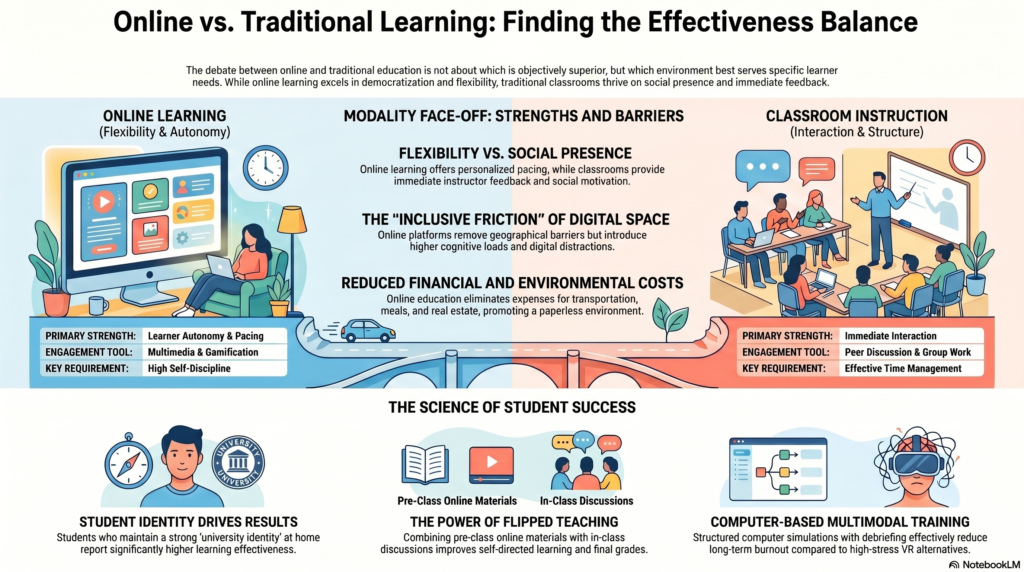
The effectiveness of online learning versus classroom instruction varies greatly across several metrics. Online education promotes flexibility and personalized pacing, allowing students to learn at their own convenience. However, classroom instruction offers immediate feedback and fosters collaboration, enhancing motivation through direct interaction. Engagement levels and retention rates can differ, with online learners often struggling with distractions and cognitive load. Despite these challenges, digital tools and multimedia resources can enrich the online learning experience. Understanding these differences is essential for optimizing educational strategies, and further exploration reveals deeper insights into how these environments impact learning effectiveness.
KEY TAKEAWAYS
- Online learning offers flexibility and self-paced education, allowing students to progress according to their individual schedules and learning styles.
- Classroom instruction facilitates immediate feedback and direct interactions, enhancing student understanding and collaboration among peers.
- Engagement levels can differ significantly; traditional classrooms foster a sense of community, while online platforms require self-discipline for effective participation.
- Retention rates are influenced by engagement; higher interactivity in both environments correlates with improved memory recall and learning outcomes.
- Technological tools in online learning, such as multimedia resources and gamification, enhance engagement and cater to diverse learning preferences.
OVERVIEW OF ONLINE LEARNING
Online learning, which has rapidly expanded in recent years, now encompasses a significant portion of educational delivery across various levels. The rise of virtual classrooms has transformed traditional educational paradigms, facilitating access to diverse learning opportunities. These platforms utilize online assessments to gauge student understanding, ensuring that learners can track their progress in real time.
Interactive platforms serve as the backbone of online education, providing engaging environments where students can interact with both peers and instructors. The integration of digital resources enhances the learning experience, allowing for a rich tapestry of content that appeals to various learning styles.
Self-paced learning is a hallmark of online education, granting learners the autonomy to navigate their education according to individual schedules and preferences. Course design plays an essential role in the effectiveness of online learning, necessitating innovative instructional strategies that cater to the unique dynamics of virtual environments.
Educators must employ collaborative tools to foster communication and teamwork, significant components often lacking in traditional settings. By implementing diverse teaching methodologies, instructors can create a more inclusive and engaging experience.
Ultimately, learner autonomy is a key aspect of successful online education. Empowering students to take control of their learning paths not only enhances motivation but also cultivates lifelong learning skills.
Overview of Classroom Instruction
Classroom instruction remains a fundamental approach to education, characterized by direct interaction between teachers and students within a physical environment. This traditional method of teaching facilitates various instructional strategies, allowing educators to implement diverse teaching styles tailored to the unique needs of their students.
Classroom dynamics play an essential role in fostering an effective learning atmosphere, where peer interaction can enhance understanding and engagement. Most online courses, however, particularly those serving K-12 students, have a format much more similar to in-person courses. The teacher helps to run virtual discussion among the students, assigns homework, and follows up with individual students. Sometimes these courses are synchronous (teachers and students all meet at the same time) and sometimes they are asynchronous (non-concurrent). In both cases, the teacher is supposed to provide opportunities for students to engage thoughtfully with subject matter, and students, in most cases, are required to interact with each other virtually.
One significant advantage of classroom instruction is the immediate access to instructor feedback. This real-time interaction allows teachers to address misconceptions and provide guidance, thereby supporting students in their learning journeys. The structured learning environment encourages participation in group activities, which not only promotes collaboration but also enhances social skills.
Time management is another key aspect of classroom instruction, as educators can design lessons that effectively allocate time for different activities and assessments. The availability of resources, such as textbooks and technology, is often more straightforward in a physical classroom, enabling students to access materials that reinforce their learning.
Assessment techniques within this context are varied and can be employed to evaluate student progress continuously. Formative assessments, such as quizzes and class discussions, provide insights into student comprehension, allowing for timely interventions.
To conclude, classroom instruction offers a multifaceted approach to education, integrating traditional methods with contemporary teaching practices to create a supportive and engaging learning environment.
Student Engagement Comparisons
How do student engagement levels differ between online and traditional classroom settings? Research indicates that engagement is multifaceted, influenced by various factors including peer interaction dynamics and motivation factors. Discussions surrounding online education vs traditional education often focus on how engagement levels differ between digital learning environments and physical classrooms.
In traditional classroom environments, face-to-face interactions often foster immediate feedback and collaborative learning. This social presence can enhance emotional connections among students, potentially leading to higher engagement levels. According to studies, a strong sense of community in the classroom notably contributes to students’ motivation to participate actively in discussions and group activities.
Conversely, online learning platforms present unique challenges and opportunities regarding student engagement. While they offer flexibility and accessibility, research suggests that the lack of physical presence can hinder peer interaction dynamics. Students may feel isolated, which can detract from their overall motivation to engage with course material.
However, when designed effectively, online environments can facilitate engagement through interactive tools such as discussion boards and group projects, creating virtual communities that replicate some aspects of traditional peer interactions.
Moreover, motivation factors play a vital role in both settings. In-person instruction often benefits from immediate instructor feedback and support, which can enhance motivation. Conversely, online learners may require more self-discipline and intrinsic motivation to stay engaged.
Ultimately, understanding these differences in engagement levels is essential for educators seeking to enhance learning experiences and outcomes, ensuring that both online and traditional methods effectively serve diverse student needs.
Learning Retention Rates
One of the most fascinating aspects of my work in the Learning Sciences is observing how student engagement levels shift when you move from a physical desk to a digital interface. While classroom instruction provides that irreplaceable “social presence” and immediate feedback that can spark instant motivation, the online world offers a different kind of intensity. I’ve often noted that online learners face a significantly higher cognitive load. Without the physical cues of a lecture hall, digital distractions can easily fragment attention. Yet, this is where multimedia tools and gamified experiences become so much more than just “fun” additions, they are essential scaffolding that helps manage that mental weight and keep a student anchored to the material.
In my own research, I’ve seen how interactive quizzes and virtual simulations can actually bridge the retention gap, sometimes even outperforming traditional methods by allowing for “safe failure” and real-time assessment. We also have to consider the “external” ecosystem: a student’s digital literacy and their physical learning environment.
Success in a virtual space isn’t just about the software; it’s about the university student identity the learner maintains at home and their ability to separate study time from personal time. Whether it’s through a SPOC-based flipped teaching model or a computer-based multimodal approach, the goal is to create a sense of community and belonging that transcends the medium.
Learning retention rates are critical indicators of the effectiveness of online education, as they reflect how well learners can recall information over time.
Research indicates that memory recall can vary considerably based on the level of engagement during the learning process; higher engagement often correlates with improved retention.
Analyzing these dynamics provides insights into optimizing online learning strategies for better educational outcomes.
Memory Recall Differences
Memory recall differences between online and traditional learning environments have garnered considerable attention in educational research, particularly concerning their impact on retention rates. Studies indicate that cognitive load, digital distractions, and varied study habits considerably affect information retention across learning modalities.
Key factors influencing memory recall include:
- Cognitive Load Management: Online learners often face higher cognitive loads due to multitasking and digital distractions, which can impede effective learning.
- Note Taking Techniques: Traditional classroom settings allow for immediate feedback on note-taking strategies, while online platforms may lack this direct interaction, potentially affecting retention.
- Recall Strategies: The effectiveness of memory techniques, such as spaced repetition and retrieval practice, can vary based on learning styles and assessment methods used in each environment.
Research suggests that attention span is generally shorter in online settings, which may hinder the application of effective recall strategies.
As a result, educators must adapt their approaches to cater to the unique challenges presented by online learning. By understanding these memory recall differences and implementing tailored techniques, educators can enhance learning retention and better serve their students’ needs.
Engagement and Retention
Engagement is a vital factor influencing retention rates in both online and traditional learning environments. Research indicates that learners who actively participate in interactive platforms exhibit higher retention levels compared to those who are passive recipients of information.
Online learning environments that facilitate peer collaboration foster a sense of community, enhancing motivation strategies and ultimately improving retention. The Virtual Classroom is accessible 24 hours a day, seven days a week. Time efficiency is another strength brought by the online learning format. Asynchronous communication through online conferencing programs allows the professional juggling work, family, and study schedules to participate in class discussions. There is no question about doing the work; just do it at the times that are more convenient. Students can access their courses at any time of day or night. Further, they have continuous access to lectures, course materials, and class discussions. This is particularly convenient for those who may need to reread a lecture or take more time to reflect on some material before moving on.
Self-paced learning allows students to engage with content at their own speed, accommodating diverse learning styles and preferences. This personalized approach, coupled with personalized feedback from instructors, can greatly boost retention rates, as learners feel more directly supported in their educational journey.
In addition, incorporating gamified experiences into online courses can enhance engagement, making the learning process more enjoyable and memorable.
Instructor presence, facilitated through video conferencing or discussion forums, is essential in establishing a connection with students, which promotes social interaction and encourages ongoing participation.
Studies have shown that when students feel a sense of belonging, they are more likely to remain engaged and committed to their studies.
As a result, integrating these elements in online learning environments is vital for maximizing engagement and retention, ultimately leading to more effective educational outcomes.

FLEXIBILITY AND ACCESSIBILITY
The rise of online learning has fundamentally transformed educational landscapes by enhancing flexibility and accessibility for diverse student populations. By leveraging remote learning, students can engage in their educational journeys with varying degrees of personalization, accommodating individual needs and circumstances. This evolution fosters learner autonomy and promotes self-directed study, essential for effective time management. These features highlight several advantages of online learning, particularly for students who require adaptable schedules and personalized pacing in their educational journey.
Several key features of online learning highlight its flexibility and accessibility:
- Personalized Pacing: Students can tailor their learning experiences, progressing at their own speed. This approach caters to different learning styles and allows for deeper engagement with materials.
- Asynchronous Options: Unlike traditional classroom settings, online courses often provide asynchronous learning opportunities. This enables learners to access course materials and participate in discussions at times that suit their schedules, accommodating work and personal commitments.
- Global Reach and Diverse Resources: Online education breaks geographical barriers, allowing individuals from various backgrounds to access a wealth of resources. This broadens learning opportunities and fosters collaboration among a diverse student body, enriching the overall educational experience.
Moreover, effective online learning environments incorporate robust support systems, ensuring that students have access to guidance and assistance throughout their studies.
Varied assessments further enhance the learning experience, allowing students to demonstrate their understanding through multiple formats.
As a result, the flexibility and accessibility of online learning not only empower students but also create an inclusive atmosphere that promotes lifelong learning.
Technological Impact on Learning
The technological impact on learning is significant, particularly in enhancing accessibility and flexibility for diverse learners. By integrating structured digital learning materials and activity-based resources, including those similar to those offered by the engineering teacher shop, educators can create more interactive and engaging online learning environments.
By utilizing multimedia tools, online learning environments can foster greater engagement and cater to various learning styles, thereby improving educational outcomes.
This integration of technology not only broadens the reach of educational resources but also optimizes the learning experience through interactive elements.
Accessibility and Flexibility
One of the most significant benefits of online learning is its inherent accessibility and flexibility, which have fundamentally transformed the educational landscape. This modality allows learners to navigate their educational journeys with greater autonomy, effectively addressing various accessibility challenges while promoting diverse resources and personalized learning experiences.
Key aspects of this transformation include:
- Self-Paced Education: Online learning accommodates individual time management needs, allowing learners to progress at their own speed, which can enhance retention and understanding.
- Remote Collaboration: Students can connect with peers and educators from around the globe, leveraging digital literacy to foster collaborative learning environments that are rich in diverse perspectives.
- Instructional Design: Well-structured online courses incorporate engagement strategies that cater to different learning styles, ensuring that all learners can access the material effectively.
These factors not only enhance the learning experience but also empower individuals to take control of their education, thereby fostering a culture of lifelong learning.
The flexibility inherent in online education encourages a more inclusive approach, ultimately serving the diverse needs of learners in a rapidly evolving world.
Engagement Through Multimedia Tools
Multimedia tools have emerged as pivotal components in online learning environments, greatly enhancing student engagement and interaction. By integrating diverse formats such as video lectures and multimedia presentations, educators can cater to various learning styles, thereby fostering a more inclusive atmosphere.
Research indicates that interactive quizzes markedly improve retention rates by allowing learners to assess their understanding in real-time. Gamified learning elements, such as leaderboards and rewards, incentivize participation and drive motivation, transforming the educational experience into an engaging journey.
Additionally, virtual simulations provide practical applications of theoretical concepts, enabling students to explore complex scenarios in a controlled environment. Collaborative projects, facilitated through digital platforms, encourage teamwork and communication among peers, essential skills in today’s interconnected world.
Digital storytelling offers students a creative outlet to express their understanding, while audio-visual aids enhance comprehension, making abstract ideas more tangible.
Student Satisfaction Insights
Amid the rapid expansion of online learning platforms, understanding student satisfaction has emerged as a key factor influencing the effectiveness of these educational modalities. Research indicates that student preferences greatly shape their learning experiences and outcomes, making it essential to analyze their satisfaction levels.
Feedback mechanisms serve as crucial tools in this process, allowing educators to gauge student sentiments and adapt instructional strategies accordingly. Another advantage of online learning is reduced financial costs. Online education is far more affordable as compared to physical learning. This is because online learning eliminates the cost points of student transportation, student meals, and most importantly, real estate. Additionally, all the course or study materials are available online, thus creating a paperless learning environment which is more affordable, while also being beneficial to the environment.
Key insights into student satisfaction in online learning can be summarized as follows:
- Flexibility and Convenience: Students often express appreciation for the ability to access course materials at their own pace and on their own schedule, which is a distinct advantage of online learning compared to traditional classroom settings. This flexibility can lead to increased engagement and a better alignment with individual learning styles.
- Quality of Interaction: The level of interaction with instructors and peers plays a key role in student satisfaction. While some students thrive in online environments, others may miss the face-to-face interactions that foster collaboration and community. Effective online platforms often incorporate discussion forums and live sessions to bridge this gap.
- Perceived Value of Learning: Students are more likely to report higher satisfaction when they perceive the content as relevant and applicable to their personal or professional goals. Ensuring that course material aligns with real-world applications can enhance this perception.

RELATED STUDIES ABOUT EFFECTIVENESS OF ONLINE LEARNING
To summarize, the effectiveness of online learning versus traditional classroom instruction reveals a complex interplay of factors influencing educational outcomes. While online learning offers unparalleled flexibility and accessibility, it often struggles to match the engagement and personal interaction found in classroom settings. Evidence shows that learning retention rates can vary greatly between modalities, suggesting a need for a nuanced approach to education. Ultimately, the choice between these two formats may hinge on individual learning preferences and circumstances, underscoring the diversity of educational experiences.
Looking For Student Success Factors Outside Of The Educators’ Scope: The Effect Of Digital Literacy, Personal Skills, And Learning Habits And Conditions On Self-Evaluated Online Learning Effectiveness In Management Education
- Purpose and Research Questions
The rapid shift to online and hybrid learning has fundamentally changed higher education. While institutions focus on improving course design, many critical factors influencing student success lie outside the direct control of educators. This study investigates these “external” factors—specifically students’ digital literacy, personal skills, and learning habits—to understand what drives student-perceived effectiveness in online learning. The research addresses two main questions: (1) what personal factors impact online learning effectiveness, and (2) how do these factors influence effectiveness? The goal is to provide actionable insights for students to improve their own learning and for institutions to better support them.
- Methodology
The study employed a sequential mixed-methods design. First, focus groups were conducted with students during the COVID-19 lockdown (2021) and again in 2024 to identify key factors affecting their online learning experience. Based on these insights and a comprehensive literature review, a survey instrument was developed. The quantitative phase involved 1,447 bachelor students from four management programs at a leading Hungarian university. Students self-evaluated their online learning effectiveness (SOLE) and rated themselves across three categories of independent variables: digital literacy (based on the DIGCOMP framework), personal skills (including cognitive skills like problem-solving and “attitude” skills like time management), and learning habits and conditions (student identity, quality of the learning space, social support). Data were analyzed using correlation, ANOVA, and linear regression.
- Key Findings
- All Three Factors Matter, but Differently: Digital literacy, personal skills, and learning habits and conditions all have a significant, positive effect on self-evaluated online learning effectiveness.
- Learning Habits and Conditions are the Strongest Predictor: This category had the highest explanatory power, far exceeding the others. The most critical elements were:
- University Student Identity: Students who maintained a sense of being a university student even in a virtual environment reported significantly higher effectiveness.
- Time and Task Management: The ability to organize tasks and manage time effectively was crucial.
- Social Environment: Support from family and the ability to separate personal space from learning space were important. Conversely, social isolation and a lack of non-verbal communication damaged effectiveness.
- Digital Literacy Has a Positive, but Weak, Correlation: While higher digital literacy leads to higher perceived effectiveness, the relationship is not as strong as expected. This suggests that being a “digital native” (using phones/social media) does not automatically translate into strong digital learning skills, and that online education can provide relatively equal opportunities even for those less confident with technology.
- Personal Skills: Cognitive vs. Attitude: Cognitive skills (problem-solving, critical thinking) showed a positive correlation. However, “attitude” skills (like time management) were more closely related to the powerful learning habits factor, highlighting their intertwined nature.
- Conclusion and Implications
This study demonstrates that a student’s success in online learning is shaped by a combination of factors, with their personal learning habits and conditions playing the most critical role. The concept of “student identity” emerged as a particularly novel and important finding.
Recommendations for Practice:
- For Students:
- Protect Your Student Identity: Consciously create routines and structures that separate study time from personal time, even when learning from home.
- Design Your Learning Space: Intentionally create a dedicated, organized physical space for studying.
- Cultivate Social Connections: Actively seek peer interaction, as social support is key to motivation.
- Develop Self-Management Skills: Focus on improving time management and task organization.
- For Educators and Institutions:
- Adopt Hybrid Models: Combine the flexibility of online learning with the motivational and social benefits of structured offline classes.
- Provide Structure and Feedback: Offer clear deadlines, frequent quizzes, and regular feedback to help students stay on track.
- Rethink Online Group Work: Recognize that online group work can be ineffective without the benefits of in-person collaboration.
- Support the Whole Student: Acknowledge that factors like students’ home environment significantly impact their learning and provide resources or guidance where possible.
The findings highlight that improving online education requires looking beyond the curriculum to understand and support the student’s entire learning ecosystem.
| REFERENCE: Balázs Vaszkun, Katalin Mihalkov Szakács, Looking for student success factors outside of the educators’ scope: The effect of digital literacy, personal skills, and learning habits and conditions on self-evaluated online learning effectiveness in management education, The International Journal of Management Education, Volume 23, Issue 2, 2025, 101188, ISSN 1472-8117, https://doi.org/10.1016/j.ijme.2025.101188. (https://www.sciencedirect.com/science/article/pii/S1472811725000588) |
Effectiveness Of The Small Private Online Course-Based Flipped Teaching Program For Enhancing Nursing Students’ Self-Directed Learning Ability In The Surgical Nursing Course: A Practical Study
- Purpose and Background
Nursing students face increasing demands for complex decision-making and adaptability in modern healthcare. Self-directed learning ability (SDLA)—the capacity to identify learning needs, manage time, and integrate knowledge independently—is critical for their professional development. This study evaluates the effectiveness of a Small Private Online Course (SPOC)-based flipped teaching model in enhancing the SDLA of undergraduate nursing students enrolled in a Surgical Nursing course. The SPOC-based flipped approach combines online pre-class learning with in-class interactive activities, offering a student-centered alternative to traditional lecture-based instruction.
- Methodology
A quasi-experimental design was employed with 264 junior nursing students from Huzhou University, China. Participants were randomly assigned to either:
- Experimental Group (n = 131): Received instruction through a SPOC-based flipped teaching model, which included pre-class online learning (videos, PPTs, exercises), in-class group discussions and presentations, and post-class online consolidation.
- Control Group (n = 133): Received traditional lecture-based instruction.
The intervention spanned two semesters (128 class hours). SDLA was measured using a validated scale across four dimensions: Learning Motivation (LM), Self-Management Skills (SMS), Cooperative Learning Skills (CLS), and Information Literacy (IL) . Assessments were conducted before and after the intervention, and final comprehensive scores were compared between groups.
- Key Findings
- No Baseline Differences: Pre-test scores showed no significant differences between the experimental and control groups across all SDLA dimensions, confirming group comparability.
- Significant Improvement in SDLA: After the intervention, the experimental group demonstrated significantly higher scores than the control group across all four SDLA dimensions and in final scores (p < 0.05 for all). The experimental group showed substantial mean increases in each dimension, while the control group showed minimal or negative changes.
- Enhanced Academic Performance: Final comprehensive scores for the experimental group were significantly higher than those for the control group in both the fifth semester (74.17 vs. 70.64, p = 0.034) and sixth semester (78.58 vs. 72.95, p = 0.007).
- Discussion
The SPOC-based flipped teaching model proved effective for multiple reasons:
- Learning Motivation: The interactive, student-centered environment increased engagement, participation, and interest in learning.
- Self-Management Skills: Students controlled their learning pace and schedule, with the SPOC platform enabling self-monitoring and reflection.
- Cooperative Learning Skills: In-class group work and discussions fostered teamwork, mutual support, and deeper thinking.
- Information Literacy: Access to online resources and the need to independently gather information strengthened students’ ability to locate, evaluate, and utilize information effectively.
- Conclusion and Implications
This study provides strong evidence that the SPOC-based flipped teaching model significantly enhances nursing students’ self-directed learning abilities and academic performance in a Surgical Nursing course. By shifting the focus from teacher-centered instruction to student-centered active learning, the model cultivates essential skills for lifelong learning and professional practice.
Recommendations:
- The SPOC-based flipped teaching approach should be introduced and promoted across other nursing courses to foster SDLA more broadly.
- Future research should explore longer implementation periods to assess sustained effects and investigate whether impacts remain consistent or evolve over time.
Limitations: The relatively short duration of the study may have limited the full realization of the program’s potential. Extended implementation and follow-up are recommended for future research.
| REFERENCE: Juling Xu, Sanxiong Huang, Chengliang Wu, Yujie Ren, Qiannan Li, Jiali Cai, Chunsheng Wang, Peiyu Jiang, Effectiveness of the small private online course‐based flipped teaching program for enhancing nursing students’ self-directed learning ability in the Surgical Nursing course: A practical study, Heliyon, Volume 10, Issue 17, 2024, e36698, ISSN 2405-8440, https://doi.org/10.1016/j.heliyon.2024.e36698. (https://www.sciencedirect.com/science/article/pii/S2405844024127296) |
Comparing the Effectiveness of Multimodal Learning Using Computer-Based and Immersive Virtual Reality Simulation-Based Interprofessional Education With Co-Debriefing, Medical Movies, and Massive Online Open Courses for Mitigating Stress and Long-Term Burnout in Medical Training: Quasi-Experimental Study
- Purpose and Background
Burnout among healthcare workers, particularly in emergency medicine, has reached critical levels, with significant consequences for workforce stability, provider well-being, and patient safety. Each unit increase in emotional exhaustion is associated with increased risks of poor care quality, patient falls, medication errors, and healthcare-associated infections. This study evaluates the effectiveness of a novel multimodal learning approach—Emergency Room Virtual Simulation Interprofessional Education (ER-VIPE) —in reducing stress and burnout among future healthcare professionals. The intervention integrates medical movies, massive open online courses (MOOCs), and either computer-based or virtual reality (VR)-based simulation with structured co-debriefing, grounded in interprofessional education (IPE) principles.
- Methodology
A single-blind, quasi-experimental study was conducted at a university hospital in Thailand from August 2022 to September 2023. Eighty-seven undergraduate students from medicine, nursing, pharmacy, medical technology, and radiological technology were randomly assigned to three groups:
- Group A (Control, n=29): Participated in 3D computer-based simulation without debriefing.
- Group B (ER-VIPE Computer, n=29): Received medical movies, MOOCs, 3D computer-based simulation, and co-debriefing.
- Group C (ER-VIPE VR, n=29): Received medical movies, MOOCs, 3D VR-based simulation, and co-debriefing.
Stress was measured using the Dundee Stress State Questionnaire (DSSQ) across three dimensions (engagement, distress, worry) at multiple time points. Burnout was measured using the Copenhagen Burnout Inventory (CBI) at baseline, post-intervention, and one-month follow-up. Generalized estimating equations (GEE) were used for analysis, controlling for trait anxiety.
- Key Findings
- Engagement: After the movie/MOOC phase, Group B showed significantly higher engagement than Group A (mean difference 3.93, p < .001). After simulation, all groups showed positive engagement trends, with no significant between-group differences.
- Distress and Worry: Both distress and worry scores decreased across all groups, but differences were not statistically significant.
- Burnout: At one-month follow-up, Group B (computer-based ER-VIPE) had significantly lower burnout scores than Group A (mean difference -2.02, p = .02). Group B also showed significantly lower burnout than Group C (mean difference 1.59, p = .04). No significant difference was found between Group C and Group A.
Effect Sizes:
- ER-VIPE Computer-based (Group B): Small-to-moderate reduction in burnout (d = -0.31)
- Medical Movies + MOOCs alone: Small-to-moderate reduction (d = -0.30)
- ER-VIPE VR-based (Group C): Moderate-to-large increase in burnout (d = 0.45)
- VR-based SIMBIE with co-debriefing: Large increase in burnout (d = 0.83)
- Discussion
The computer-based ER-VIPE intervention proved most effective, likely due to its accessibility, user-friendly technology, and optimal stress induction within the Yerkes-Dodson law’s optimal arousal zone. VR-based simulation may have induced excessive stress (technostress, cybersickness) that hindered learning and well-being outcomes. The combination of preparatory tools (movies, MOOCs) with hands-on simulation and structured co-debriefing created a comprehensive learning cycle grounded in experiential learning theory, stress inoculation training, and the Job Demands-Resources model.
- Conclusion and Implications
This study provides evidence that a multimodal, computer-based interprofessional education approach combining medical movies, MOOCs, simulation, and co-debriefing can effectively reduce burnout and improve engagement among future healthcare professionals. The ER-VIPE computer-based model offers a scalable, accessible framework for enhancing well-being and resilience in high-pressure clinical environments.
Recommendations:
- Institutions should consider adopting computer-based ER-VIPE models for interprofessional training, as they demonstrated superior outcomes compared to VR-based alternatives.
- The integration of cinemeducation, MOOCs, and structured debriefing creates synergistic benefits for stress management and burnout prevention.
- VR-based simulation may require further refinement to reduce technological barriers and optimize stress levels before widespread implementation.
Limitations: Single-site study during COVID-19 pandemic, potential unmeasured confounders, and differential dropout rates between groups suggest cautious interpretation and need for replication in larger, randomized trials.
| REFERENCE: Sirikanyawan Srikasem, Sunisa Seephom, Atthaphon Viriyopase, Phanupong Phutrakool, Sirhavich Khowinthaseth, Khuansiri Narajeenron, Comparing the Effectiveness of Multimodal Learning Using Computer-Based and Immersive Virtual Reality Simulation–Based Interprofessional Education With Co-Debriefing, Medical Movies, and Massive Online Open Courses for Mitigating Stress and Long-Term Burnout in Medical Training: Quasi-Experimental Study, JMIR Medical Education, Volume 11, 2025,, ISSN 2369-3762, https://doi.org/10.2196/70726. (https://www.sciencedirect.com/science/article/pii/S2369376225001266) |
CONCLUSION
Reflecting on the various studies and perspectives, it becomes clear that the future of education isn’t a zero-sum game between the physical and the digital. My work always returns to the idea of flexibility, making learning inclusive for the professional juggling a career and the student who thrives in a self-paced, asynchronous environment. While we can’t ignore that online platforms sometimes struggle to replicate the spontaneous face-to-face interactions of a traditional room, the advantages of online learning, from its global reach to its significantly reduced financial costs, make it a powerhouse for accessibility.
Ultimately, an effective educational strategy recognizes that retention rates and student satisfaction are deeply tied to individual learning preferences. We are moving toward a world where hybrid models and online education vs traditional education strategies will blend to support the “whole student”. As an educator and researcher, I find this evolution incredibly exciting.
It challenges us to rethink instructional design and to prioritize the learner’s experience over the delivery method. Whether you are a student or a mentor, the key is to stay curious, remain adaptable, and leverage the technological tools available to create an environment where curiosity truly knows no bounds.