
When I worked in industry as a practicing structural engineer, no project ever arrived neatly categorized like the end-of-chapter problems in a textbook. On a real job site, dynamic wind loads, material fatigue, and soil foundation issues hit your desk simultaneously. You don’t get thirty consecutive shear stress calculations followed by thirty beam deflection problems; you get an unscripted puzzle where your first and most critical job is simply deciding which engineering principles apply to the scenario in front of you.
When I transitioned into mentoring STEM students, I quickly realized that our conventional study habits actively work against this reality. Most students spend hours grinding through twenty identical problems in a row—a practice known as blocked learning. It feels wonderfully productive because the repetitive pattern creates a soothing illusion of fluency. But that temporary confidence evaporates the moment an unannounced exam or an engineering design task scrambles the order.
That is why I advocate so heavily for interleaved practice. Treating your study sessions as an authentic simulation of professional practice requires you to juggle related concepts within the same block of time. It introduces productive friction, forcing your brain to identify situational cues, discriminate between subtle formulas, and build durable mental models rather than relying on autopilot.
Interleaved practice is an effective learning strategy that mixes various topics and problem types within a single study session. This approach enhances problem-solving skills and boosts knowledge retention by promoting cognitive flexibility and encouraging deeper understanding. By engaging with material in diverse contexts, learners strengthen neural pathways and improve memory consolidation. The effectiveness of interleaved practice over traditional study methods is well-documented, suggesting a compelling reason to contemplate its integration into educational routines for peak learning outcomes.
KEY TAKEAWAYS
- Interleaved practice enhances problem-solving skills by promoting cognitive flexibility through the integration of diverse topics within study sessions.
- Alternating between different problems encourages adaptable thinking, improving creativity and efficacy in tackling various challenges.
- Frequent retrieval of information in varied contexts strengthens memory consolidation and solidifies neural pathways for long-term retention.
- Mixing subjects during study sessions fosters deeper understanding and connections between concepts, reducing rote memorization.
- Reflection and self-assessment after interleaved practice bolster knowledge retention and empower learners to identify areas for improvement.
UNDERSTANDING INTERLEAVED PRACTICE: A KEY TO EFFECTIVE LEARNING
How can interleaved practice enhance learning outcomes? Interleaved practice, a method where different subjects or skills are mixed during study sessions, stands out in cognitive science for its effectiveness in improving retention and understanding.
Research indicates that this approach aligns well with various learning styles, allowing learners to adapt their strategies based on personal preferences while still benefiting from the cognitive advantages of interleaving. By presenting information in a non-linear fashion, it encourages deeper processing and enhances the ability to differentiate between concepts.
This method fosters connections between ideas, aiding in long-term retention and recall. Additionally, interleaved practice challenges learners to apply knowledge flexibly, rather than in isolation.
As a result, individuals are better equipped to serve others, utilizing their enhanced understanding to address diverse needs effectively. Emphasizing interleaved practice can therefore be an essential strategy for educators and learners aiming to improve educational outcomes.
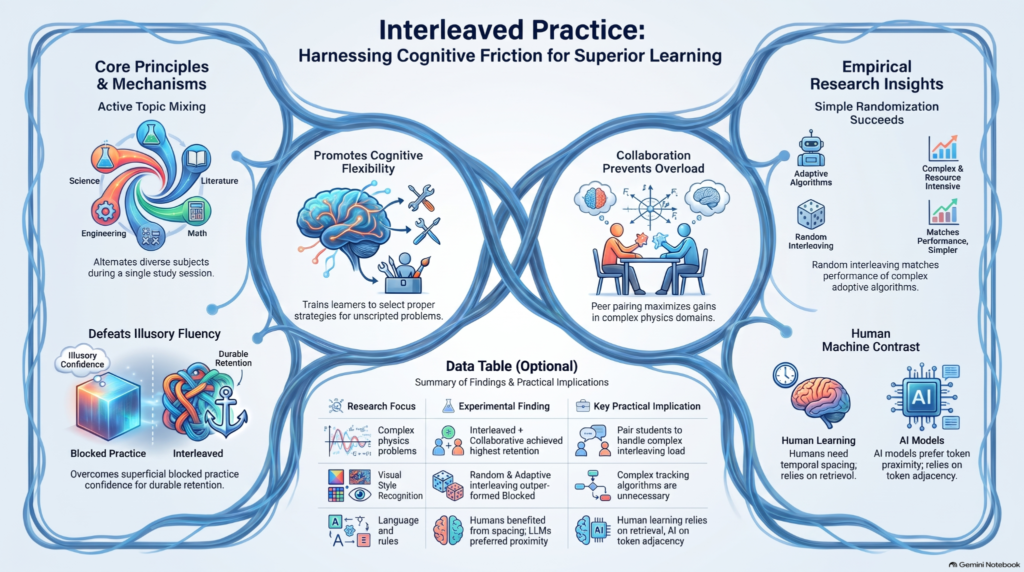
Why Interleaved Practice Enhances Problem-Solving Skills
Interleaved learning, an approach where different subjects or skills are mixed during training sessions, has been gaining attention in the realm of professional development. Unlike traditional blocked learning, where a single topic is focused on until mastery before moving on to the next, interleaved learning encourages the mixing of various topics and skills. This method, supported by insights from neuroscience and psychology, can significantly enhance problem-solving abilities and adaptability among professionals.
Interleaved practice not only enhances retention and understanding but also considerably improves problem-solving skills. This method promotes cognitive flexibility, allowing individuals to adapt and apply various problem-solving strategies across different contexts. By alternating between diverse problems, learners develop a more robust mental framework, enabling them to tackle challenges with greater creativity and efficacy.
| Problem Type | Strategy Used | Outcome |
| Algebraic Equations | Substitution | Increased accuracy |
| Geometry Problems | Visual Representation | Enhanced understanding |
| Word Problems | Logical Deduction | Improved reasoning |
| Data Analysis | Comparative Analysis | Broader insights |
The table illustrates how varying problem types paired with interleaved practice can lead to improved outcomes. Ultimately, interleaved practice fosters an environment where learners can refine their problem-solving abilities, equipping them with the tools necessary to serve others effectively.
How Interleaved Practice Boosts Knowledge Retention
When learners engage in interleaved practice, they often experience significant improvements in knowledge retention due to the way this method forces the brain to retrieve information in varied contexts.
This retrieval process enhances memory consolidation and fosters cognitive flexibility, allowing individuals to make connections between concepts. Understanding why testing improves long-term memory highlights how regularly retrieving information through quizzes and practice questions strengthens memory, reinforces learning, and helps students retain knowledge over time.
The following factors contribute to enhanced knowledge retention through interleaved practice:
- Varied Contexts: Engaging with material in diverse scenarios promotes deeper understanding.
- Increased Retrieval Attempts: Frequent recall strengthens neural pathways, solidifying memories.
- Enhanced Problem-Solving: Exposure to different types of problems encourages adaptable thinking.
- Reduced Overconfidence: Interleaving creates a challenge that enhances long-term retention rather than cramming.
Interleaved Practice vs. Traditional Methods: Key Differences
Interleaved practice requires the learner to evaluate each task and make a decision how to solve it because each task will be different to the one solved previously. Particularly when working on problems that look similar at the surface, but which require different operators to solve them, interleaved practice comes with additional cognitive demands compared to blocked practice.
The differences between interleaved practice and traditional methods of learning highlight the advantages of varied study techniques over more conventional, block-based approaches. Traditional methods typically involve studying one topic intensely before moving to the next, fostering a sense of familiarity but often leading to superficial understanding.
In contrast, interleaved practice integrates multiple topics within a single study session, prompting learners to continuously retrieve and apply knowledge in different contexts. Research indicates that interleaved practice enhances problem-solving skills and long-term retention more effectively than traditional methods.
This approach encourages learners to make connections between concepts, ultimately leading to deeper understanding. Additionally, interleaved practice often increases engagement, as the variation can combat monotony and stimulate curiosity.
Simple Ways to Use Interleaved Practice in Your Study Routine
Incorporating interleaved practice into a study routine can markedly enhance learning outcomes, as it encourages a dynamic approach to content mastery. This method contrasts with traditional study techniques by mixing different subjects or types of problems in a single study session. Combining interleaved practice with insights from memory consolidation spaced learning studies can help students organize their review sessions, revisit challenging topics, and strengthen their ability to recall information over time.
Below are simple ways to integrate interleaved practice into one’s learning strategies:
- Mix Subjects: Alternate between different subjects or topics within the same study session to promote cognitive flexibility.
- Varied Problem Types: Solve various types of problems related to the same concept, which helps deepen understanding.
- Scheduled Intervals: Set specific time blocks for each topic, ensuring a regular shift to maintain engagement and retention.
- Self-Testing: Incorporate quizzes that cover multiple subjects, reinforcing knowledge through retrieval practice.
Students can also use supplementary worksheets, practice exercises, and educational materials from the engineering teacher shop to reinforce key concepts, explore different problem types, and make interleaved practice more effective.

REAL-WORLD APPLICATIONS OF INTERLEAVED PRACTICE
Whenever I recommend interleaving to my students who are balancing intense technical courses with co-ops or internships, their initial reaction is almost always hesitation. Switching between fluid mechanics, statics, and differential equations in an afternoon feels disjointed and mentally taxing compared to knocking out an entire homework chapter in one sitting. But that feeling of cognitive strain is not an indicator of failure; in learning science, it is what Robert Bjork famously coined a “desirable difficulty.”
To make interleaving sustainable without burning out your working memory, I encourage my mentees to borrow a framework from lean engineering and agile workflows: keep your systems modular and collaborative. You do not need an elaborate, perfectly timed algorithm to make this work. Simply assemble a mixed “problem set sprint” containing three to four distinct types of tasks, set a clean timer, and rotate through them deliberately.
Furthermore, when the material reaches high abstract complexity—such as multi-variable vector fields or electromagnetics—pair up with a study partner. Recent cognitive research highlights that working through interleaved problem sets collaboratively offloads intrinsic mental fatigue while sharpening your conceptual debate. By vocalizing why you select a specific governing equation, you transform an isolated calculation into an active diagnostic workout.
Interleaved practice extends beyond theoretical frameworks and academic settings, finding applications in various real-world scenarios that enhance skill acquisition and retention. In education, instructors can implement interleaved practice by mixing different subjects or topics during lessons, fostering deeper understanding and improving retention among students. Similarly, in fields like healthcare, medical training can benefit from interleaved practice by combining various clinical skills and knowledge areas, thereby preparing practitioners for real-life complexities.
| Application Area | Interleaved Practice Strategy | Outcome |
| Education | Mixing subjects in lesson plans | Enhanced retention and understanding |
| Healthcare | Combining clinical skills in training | Improved readiness for real-life scenarios |
| Sports Coaching | Varying practice drills | Better adaptation to game situations |
| Music Education | Alternating practice of pieces | Improved versatility and performance |
| Language Learning | Mixing vocabulary with grammar | Enhanced fluency and comprehension |
Tips for Maximizing the Benefits of Interleaved Practice
While many learning designers are familiar with the benefits of spaced repetition to encourage practice, over time, that facilitates mastery and retention of new knowledge and skills, the idea of interleaved learning might be a tougher sell. That’s because many people assume or “know” that you have to practice one skill at a time to get good at it, a practice called “blocking.”
To maximize the benefits of interleaved practice, it is essential to implement specific strategies that enhance learning effectiveness.
Regularly varying practice sessions and incorporating diverse problem types can foster deeper understanding and retention of material.
Additionally, scheduling time for reflection allows learners to consolidate their knowledge and assess their progress, further reinforcing the advantages of this approach.
Vary Practice Sessions Regularly
Regularly varying practice sessions is essential for maximizing the benefits of interleaved practice.
Implementing practice variety not only enhances engagement but also strengthens retention and problem-solving skills.
To optimize learning, consider the following strategies:
- Alter Session Duration: Shorter, focused sessions can improve concentration and retention.
- Mix Topics: Rotate through different subjects or problem types within each session to promote cognitive flexibility.
- Adjust Frequency: Increase the frequency of practice sessions to reinforce knowledge and skills over time.
- Incorporate Review: Regularly revisit previously learned material to strengthen connections and deepen understanding.
Incorporate Diverse Problem Types
Incorporating diverse problem types into practice sessions considerably enhances the effectiveness of interleaved practice. Research indicates that problem variety fosters deeper cognitive engagement, as learners must adapt their strategies to tackle different challenges.
This variability compels individuals to integrate skills across different contexts, leading to improved problem-solving capabilities. For instance, when students encounter various mathematical problems—ranging from algebra to geometry—they develop a more versatile understanding of mathematical concepts.
Moreover, exposure to a spectrum of problem types reduces the likelihood of rote memorization, promoting long-term retention of knowledge. By prioritizing skill integration through diverse problem types, educators can cultivate a more robust learning environment that equips learners with the tools necessary for real-world applications and future challenges.
Schedule Time for Reflection
How can scheduling time for reflection enhance the effectiveness of interleaved practice? Incorporating reflection techniques into learning sessions can greatly improve problem-solving skills and knowledge retention.
Scheduled evaluations allow learners to process their experiences systematically. To maximize these benefits, consider the following strategies:
- Set Regular Reflection Intervals: Designate specific times for reflection after practice sessions to reinforce learning.
- Encourage Self-Assessment: Prompt learners to evaluate their performance and identify areas for improvement.
- Facilitate Group Discussions: Create opportunities for collaborative reflection, enabling shared insights and diverse perspectives.
- Document Reflections: Encourage learners to write down their thoughts, fostering deeper understanding and retention.
These approaches guarantee that reflection becomes integral to the learning process, enhancing the overall effectiveness of interleaved practice.

RELATED STUDIES ABOUT INTERLEAVED PRACTICE LEARNING BENEFITS
In summation, interleaved practice stands out as a powerful strategy for enhancing problem-solving abilities and knowledge retention. By breaking away from the traditional methods of study, learners can truly have their cake and eat it too—achieving deeper understanding and improved performance. The evidence supporting its effectiveness is compelling, suggesting that incorporating interleaved practice into educational routines can yield significant benefits. Embracing this approach may well be the key to releasing one’s full learning potential.
Interleaved practice in physics benefits from collaboration
Conceptual Framework and Research Rationale
- Desirable Difficulties and Adaptive Expertise: Educational instruction aims to foster lasting, flexible knowledge (adaptive expertise) rather than superficial procedural fluency (routine proficiency). The concept of “desirable difficulties” posits that introducing manageable cognitive challenges during learning deliberately increases mental effort, thereby supporting deeper conceptual integration and long-term retention.
- Interleaved Practice and Its Cognitive Mechanisms: Interleaved practice alternates tasks across different concepts within a domain rather than grouping identical problems together (blocked practice). Theoretical accounts attribute the benefits of interleaving to:
- Discriminative Contrast: Actively comparing superficially similar but conceptually distinct problems helps students identify subtle contextual cues and develop situational knowledge (knowing when to apply a specific strategy).
- Distributed Retrieval: Continually displacing information in working memory forces repeated, effortful retrieval from long-term memory, strengthening neural memory traces.
- Boundary Conditions and Cognitive Load: Interleaving is not universally beneficial. Under conditions of high intrinsic task complexity, the combined burden of domain difficulty and high contextual interference can overwhelm working memory capacity (Cognitive Load Theory), impairing learning and rendering the difficulty “undesirable”.
- Collaborative Learning as Cognitive Relief: Collaborative learning via transactive communication (where learners elaborate, critique, and negotiate conflicting ideas) provides a “shared working memory”. This distributed cognitive processing can offload extraneous demands while preserving the reflective cognitive conflict essential for conceptual restructuring.
- Core Research Objective: Investigate whether combining collaborative learning with interleaved practice mitigates cognitive overload and enhances immediate and long-term (8-week) conceptual understanding in a complex physics domain: the motion of charged particles in electric and magnetic fields (Lorentz force).
Methodology and Experimental Design
- Field Experiment Design: A preregistered 22 between-subjects factorial field experiment:
- Factor 1 (Practice Type): Interleaved Practice vs. Blocked Practice.
- Factor 2 (Social Format): Collaborative Learning (in pairs) vs. Individual Learning.
- Participants and Educational Context:
- 376 upper secondary German physics students (grades 12 and 13) across 30 classrooms in Kassel and Osnabrück.
- Condition Breakdown: Blocked-Individual (n=95), Blocked-Collaborative (n=94), Interleaved-Individual (n=92), and Interleaved-Collaborative (n=95).
- Classrooms were randomly assigned to social format (stratified across basic and advanced courses), while students within classes were randomly assigned to practice type. Baseline measures confirmed group equivalence in prior knowledge, physics interest, academic self-concept, and prior collaborative experience.
- Learning Environment (E-RASER):
- A validated, gamified simulation where learners destroyed meteorites using charged bullets deflected within electric or magnetic fields.
- Both conditions completed 36 practice tasks over 40 minutes:
- Blocked: Completed 18 magnetic field tasks followed by 18 electric field tasks.
- Interleaved: Alternated continuously between electric and magnetic field tasks.
- Collaborative pairs shared one laptop, alternated interface control every two tasks, and were prompted to explain and agree on solutions.
- Outcome Measures:
- Learning Success: Paper-based conceptual knowledge tests administered before practice (pretest; 15 items), immediately post-practice (immediate posttest; 20 items, including integrated superposition tasks), and at an 8-week follow-up (delayed posttest; 20 items).
- Cognitive Load: Shortened Leppink et al. scale assessing intrinsic and germane cognitive load.
- In-Game Log Analytics: Tracked practice task accuracy (dichotomous 0/1 scoring) and help-seeking clicks on the “Physics Info” tool.
- Statistical Modeling: Multilevel linear regression models with random intercepts for classes and teams, controlling for prior knowledge. Learning curves across practice were analyzed using generalized least squares with autoregressive error structures.
Key Empirical Findings
- Significant Practice Type Social Format Interaction:
- Multilevel models confirmed a statistically significant interaction between practice type and social format on both the immediate knowledge test (=0.35,p=.048,partial2=.018) and the 8-week delayed posttest (=0.36,p=.019,partial2=.015).
- The Interleaved-Collaborative condition achieved the highest conceptual learning gains of all groups, both immediately (M=12.12/20) and after 8 weeks (M=9.53/20).
- Main Effects and Isolated Interventions:
- Neither interleaved practice nor collaborative learning produced positive main effects on learning outcomes.
- Collaboration showed no overall main effect immediately (p=.590) or at 8 weeks (p=.913).
- Interleaved practice yielded no main effect on the immediate posttest (p=.313) and exerted a statistically significant negative main effect at the 8-week delay (=-0.22,p=.040,partial2<.001). When attempted individually, interleaving complex physics tasks impaired long-term retention relative to blocked practice.
- Simple main effect analyses confirmed that collaborative learning was a significant positive predictor of learning success only within the interleaved condition (immediate: =0.42,p=.019; delayed: =0.51,p=.006), whereas collaboration had no effect in the blocked condition (immediate: p=.447; delayed: p=.834).
- Cognitive Load Dynamics:
- Germane Load: No significant main or interaction effects emerged across groups (p>.20), indicating that all cohorts invested comparable effort into understanding the principles.
- Intrinsic Load: A significant interaction emerged (=-0.60,p=.005,partial2=.035). Students in the interleaved-collaborative condition reported significantly lower perceived intrinsic task complexity (M=3.18/8) than the other three conditions (M=3.72–3.88/8). Shared cognitive processing enabled pairs to master initial task complexity, making subsequent problems feel substantially more manageable.
- In-Game Log Data and Help-Seeking Behavior:
- Practice Accuracy Trajectories: Pairwise comparisons of practice curves revealed that collaborative groups significantly outperformed individual learners during practice (both interleaved-collaborative and blocked-collaborative teams achieved higher scores than individual counterparts, p<.001).
- Help-Seeking Clicks: A significant main effect of practice type emerged for accessing “Physics Info” (=0.46,p<.001,partial2=.047). Interleaved learners accessed reference aids significantly more frequently, confirming that interleaving provoked active uncertainty and cognitive conflict regarding which rules to apply.
Theoretical and Pedagogical Interpretations
- Resolving the “Desirable Difficulty” Paradox: Desirable difficulties cease to be desirable when intrinsic task complexity exceeds individual working memory thresholds. In individual learning, interleaving complex 3D electromagnetic concepts overloaded students, leading to negative delayed outcomes.
- Collaborative Cognitive Scaffolding: Peer collaboration acted as an instructional scaffold, distributing the cognitive burden of spatial orientation, right-hand-rule execution, and strategy selection across two minds. This enabled learners to productively channel the cognitive conflict provoked by interleaving without succumbing to cognitive overload.
- The Inefficacy of Collaboration in Routine Tasks: In the blocked practice condition, collaboration improved in-game accuracy during practice but did not enhance individual learning outcomes on subsequent tests. Because blocked practice does not demand conceptual discrimination or strategy selection, group discussion centered on routine execution rather than deep conceptual negotiation. Collaboration is therefore most impactful when the task structure actively necessitates conceptual reflection and differentiation.
Study Limitations and Future Directions
- Unobserved Dialogue Processes: The study inferred cognitive mechanisms from quantitative performance, cognitive load self-reports, and clickstream logs without qualitative coding of student verbal interactions (e.g., think-aloud protocols or transactive discourse analysis). Future analyses are required to confirm how specific verbal exchange patterns drive conceptual gains.
- Granularity of Knowledge Assessment: The knowledge posttest evaluated overall conceptual understanding and superposition, but did not separately isolate procedural execution accuracy (e.g., manual finger positioning errors) from situational or factual deficits.
- Practical Implications for Science Education: Instructional designers and STEM educators should avoid viewing interleaved practice as a standalone, “one-size-fits-all” intervention. When curriculum content is highly abstract or cognitively demanding, pairing interleaved task sequences with collaborative group work offers an effective, scalable strategy to build durable, transferable conceptual understanding.
| REFERENCE: Maria Danzglock, Roland Berger, Martin Hänze, Interleaved practice in physics benefits from collaboration, Learning and Instruction, Volume 102, 2026, 102307, ISSN 0959-4752, https://doi.org/10.1016/j.learninstruc.2025.102307. (https://www.sciencedirect.com/science/article/pii/S0959475225002312) |
Tailoring interleaved practice: Does adaptive sequencing boost the interleaving effect?
Conceptual Framework and Research Rationale
- Interleaved Practice as a Desirable Difficulty: Interleaved practice—alternating exemplars from different categories rather than studying them in blocked sequences (e.g., ABCBCACAB vs. AAABBBCCC)—consistently enhances inductive category learning, long-term retention, and transfer. According to the discriminative-contrast hypothesis and Sequential Attention Theory (SAT), interleaving juxtaposes different categories in close temporal proximity, directing attention toward subtle distinguishing features. This benefit is particularly pronounced when between-category similarity is high.
- The Promise of Adaptive Sequencing: Standard interleaved schedules sequence exemplars randomly. However, learners often exhibit idiosyncratic confusion patterns, struggling to differentiate specific pairs of categories. Adaptive interleaving tailors the study sequence to individual real-time classification performance by presenting mistaken categories immediately in succession, theoretically concentrating discriminative effort where it is most needed and reducing unnecessary cognitive load.
- Individual Differences in Working Memory Capacity (WMC): Interleaved learning requires learners to maintain distinguishing features in active memory, retrieve previous representations, and inhibit interference. Past research on whether WMC moderates the interleaving effect has produced conflicting findings. The authors hypothesized that adaptive interleaving might provide targeted support for individuals with lower WMC by reducing the temporal gap between confusable exemplars.
- Metacognitive Monitoring via Category Learning Judgments (CLJs): Learners routinely suffer from an “illusion of mastery” during blocked practice due to high immediate retrieval fluency, leading to higher study-phase CLJs despite inferior long-term learning. The study investigates whether adaptive interleaving lowers study-phase CLJs due to targeted difficulty or elevates them by prompting insight (“lightbulb moments”) when resolving confusion.
- Core Research Objectives:
- Test whether adaptive interleaved practice outperforms random interleaved practice and blocked practice in an inductive visual category learning task (classifying artists’ painting styles).
- Evaluate whether working memory capacity moderates the effectiveness of blocked, random interleaved, or adaptive interleaved practice schedules.
- Track metacognitive monitoring across learning and testing phases via Category Learning Judgments (CLJs).
Methodology and Experimental Design
- Experimental Design: A one-factorial between-subjects design with three study schedules: Blocked practice, Random interleaved practice, and Adaptive interleaved practice. Learning was assessed across two time points: an immediate posttest and a 1-week delayed posttest.
- Participants and Sampling:
- Recruited online via Prolific (native English speakers, approval rate $\ge 95\%$).
- Time 1 (T1; Study Phase, Immediate Posttest, WMC): 259 participants completed T1 after passing three attention checks (Blocked: n=87; Random: n=84; Adaptive: n=88; mean age 38.48 years, 62% female).
- Time 2 (T2; 1-Week Delayed Posttest): 192 participants returned within a 36-hour window and passed attention checks (Blocked: n=65; Random: n=64; Adaptive: n=63).
- Baseline Equivalence: Groups showed no significant differences in age, gender distribution, WMC, or pre-study artist name learning.
- Learning Stimuli and Pre-Training:
- 36 landscape paintings by six artists (Bruno Pessani, Henri-Edmond Cross, Judy Hawkins, Ron Schlorff, George Seurat, George Wexler; 6 paintings per artist), sourced from Kornell and Bjork (2008). Pairwise stylistic similarity was independently calibrated by five raters (ICC = 0.845).
- Name-Training: Prior to studying paintings, participants completed three cycles of two-letter-stem cued recall on artist surnames with feedback to ensure subsequent errors reflected stylistic confusion rather than name retrieval failures (mean final accuracy: 92.86%).
- Study Phase Implementations (Active Classification with Feedback):
- Across all conditions, each trial presented an unlabeled painting for 3 seconds, followed by six response buttons. After clicking an artist name, the painting reappeared for 3 seconds with corrective feedback.
- Blocked Schedule: All 6 paintings of an artist were completed sequentially before moving to the next randomized artist block.
- Random Interleaved Schedule: 36 paintings were randomized with the constraint that no two consecutive paintings shared the same artist.
- Adaptive Interleaved Schedule: If a participant classified a painting correctly, the next painting was chosen randomly from another artist (prioritizing artists with the most remaining paintings). If a participant made an error (e.g., misidentifying a Cross painting as Seurat), the immediate next painting presented was by the erroneously selected artist (Seurat), creating a targeted, performance-contingent discriminative contrast.
- Measures:
- Category Learning Judgments (CLJs): Assessed on a 0%–100% scale at four intervals: during study after 3 and 6 paintings per artist, immediately post-study (viewing one new labeled exemplar per artist), and at the 1-week delayed posttest.
- Classification Posttests: Evaluated accuracy across 18 novel transfer paintings (3 new paintings per artist) in randomized, self-paced sequences without feedback.
- Working Memory Capacity: Assessed after the immediate posttest via a shortened automated Operation Span task (OSPAN; score range 0–44; Cronbach’s =0.76).
- Statistical Analysis: One-way ANOVAs, repeated-measures mixed ANOVAs, Bayesian analyses (BF10 and BF01), multiple linear regressions with centered OSPAN interaction terms, and exploratory Latent Profile Analysis (LPA) modeling confusion error patterns.
Key Empirical Findings
- Study Phase Performance vs. Posttest Learning Outcomes:
- Study Phase Performance (H1 Supported): Blocked practice achieved significantly higher classification accuracy during learning (M=0.85) than random interleaving (M=0.50) and adaptive interleaving (M=0.51; F(2,256)=185.72,p<.001,p2=0.59). No difference emerged between random and adaptive interleaving (p=1.00,d=0.02,BF10=0.17).
- Immediate Posttest (H2a Supported, H2b Not Supported): The performance advantage reversed on novel transfer paintings (F(2,256)=6.29,p=.002,p2=0.05). Both random interleaving (M=0.71,d=0.49,p=.004) and adaptive interleaving (M=0.69,d=0.42,p=.015) significantly outperformed blocked practice (M=0.60). However, adaptive interleaving showed no advantage over random interleaving (d=0.07,p=1.00,BF10=0.11, providing strong Bayesian evidence for the null).
- 1-Week Delayed Posttest: A significant main effect of condition persisted (F(2,189)=4.01,p=.020,p2=0.04). Adaptive interleaving maintained a significant advantage over blocked practice (M=0.63 vs. M=0.54;p=.034,d=0.42). Random interleaving was descriptively higher than blocked practice (M=0.62 vs. M=0.54;d=0.37,p=.065,BF10=2.17). Crucially, adaptive and random interleaving remained statistically indistinguishable (d=0.05,p=1.00,BF10=0.20).
- Working Memory Capacity as an Independent Predictor (No Moderation):
- WMC (OSPAN) significantly and positively predicted classification accuracy across posttests (=0.323,p=.005 immediately; =0.395,p=.003 at delay).
- However, regression models revealed no significant interaction between WMC and study schedule at the immediate posttest (p=.647 for random vs. blocked; p=.964 for adaptive vs. blocked) or the delayed posttest (p=.202 and p=.835, respectively).
- The benefits of interleaved practice over blocked practice occurred independently of learners’ working memory capacity, and adaptive interleaving provided no differential benefit for individuals with low WMC.
- Category Learning Judgments (Metacognitive Illusions):
- During Study (H3a Supported): Blocked learners reported significantly higher confidence in their learning ($M = 66.09\%$) than random ($M = 56.34\%$) and adaptive interleaved learners ($M = 59.39\%; F(2, 189) = 6.42, p = .002, \eta_p^2 = 0.06$).
- Post-Study Dissipation (H3b Not Supported): Contrary to expectations, CLJs did not reverse in favor of interleaving after study. At the immediate and 1-week delayed posttests, CLJ ratings converged across all three conditions with no statistically significant differences (p=1.00).
- Process and Error Analysis of the Adaptive Mechanism:
- Manipulation Check: In the adaptive condition, 42% of transitions were explicitly error-contingent (presenting the confused artist next), compared to only 11% coincidental transitions in the random schedule (t(170)=20.83,p<.001,d=3.18).
- Selective Transitional Impact: The adaptive algorithm significantly increased consecutive transitions for the two most stylistically similar artist pairs: Seurat–Cross (transitional probability 8.83% vs. 6.29%, p<.001) and Schlorff–Wexler (7.63% vs. 6.33%, p=.009).
- Failure to Reduce Target Confusions: Despite increased exposure to confusable pairs, MANOVA models revealed no significant reduction in actual confusion errors between Seurat–Cross or Schlorff–Wexler in adaptive compared to random interleaving at immediate (p=.059) or delayed (p=.097) testing.
- Latent Profile Analysis (LPA): Identified four distinct confusion profiles ranging from low-error learners (n=105) to high-confusion learners (n=23). However, non-parametric MANOVAs indicated that adaptive interleaving failed to produce differential advantages over random interleaving within any specific confusion profile.
Theoretical, Practical, and Educational Implications
- Robustness of Standard Random Interleaving: The finding that adaptive sequencing provided no measurable learning benefit beyond random interleaving indicates that random presentation already provides sufficient discriminative contrast. In homogeneous categories where all exemplars share moderate stylistic overlap, almost any cross-category transition stimulates effective discriminative processing.
- Active Classification Mitigates WMC Bottlenecks: Unlike passive observational learning where higher WMC facilitates interleaving, requiring active classification with immediate feedback prompts learners to attend to diagnostic features directly. This overt engagement scaffolds attention and compensates for lower working memory capacity.
- Instructional Practicality: For educational software developers and teachers, standard random interleaving represents a robust, evidence-based strategy that is straightforward to implement without requiring complex adaptive tracking algorithms.
- Metacognitive Scaffolding Requirements: Because learners misinterpret the cognitive friction of interleaving as a sign of poor mastery (reporting lower study-phase CLJs despite achieving higher delayed transfer), educators must provide explicit metacognitive interventions—such as refutation texts or utility-value framing—to sustain learner motivation and prevent premature abandonment of effortful strategies.
Study Limitations and Future Directions
- Category Homogeneity: The six Impressionist/landscape artists shared similar stylistic features, which restricted the adaptive algorithm’s ability to isolate a wide range of distinct contrasts. Future research should test adaptive sequencing using heterogeneous domains with clear hierarchical or structural confusions (e.g., distinguishing addition vs. multiplication rules in fraction arithmetic).
- Exemplar Pool Constraints: Using only six exemplars per artist meant early classification errors were often driven by initial guessing rather than systematic misconceptions, potentially misdirecting early adaptive transitions. Larger exemplar sets or multi-stage designs (e.g., initial blocked introduction followed by adaptive interleaving) should be examined.
- Interleaved Posttest Confound: Administering the immediate posttest without feedback exposed all participants (including blocked learners) to 18 interleaved items, which may have acted as secondary interleaved retrieval practice and slightly attenuated between-condition effect sizes at the delayed posttest.
| REFERENCE: Lea Nemeth, Johannes Osterberg, Frank Lipowsky, Tailoring interleaved practice: Does adaptive sequencing boost the interleaving effect?, Learning and Individual Differences, Volume 124, 2025, 102804, ISSN 1041-6080, https://doi.org/10.1016/j.lindif.2025.102804. (https://www.sciencedirect.com/science/article/pii/S1041608025001803) |
Do large language models learn like humans: Interleaved and spaced practice in morphological learning
Conceptual Framework and Research Rationale
- Input Organization in Inductive Learning: In human cognition, the temporal organization of learning material strongly influences category induction. Interleaving exemplars from different categories typically enhances inductive learning compared to massing/blocking exemplars by category (the interleaving effect). Theoretical accounts attribute this advantage either to the discriminative contrast hypothesis (close temporal proximity allows direct comparison of distinguishing category features) or the retrieval effort / spacing hypothesis (intervening items force effortful retrieval from long-term memory, strengthening memory consolidation).
- Large Language Models (LLMs) as Machine Learners: The emergence of few-shot learning capabilities in advanced LLMs has prompted researchers in “machine psychology” to evaluate whether transformer-based architectures process and acquire structured information using mechanisms analogous to human cognition.
- Second Language Morphology as a Test Domain: Second-language inflectional morphology requires abstracting systematic form-meaning-function mappings across diverse stem structures. Because morphology represents a well-documented cognitive bottleneck—particularly for native speakers of non-inflectional languages like Chinese—it serves as an ideal domain to compare inductive rule abstraction across biological and artificial neural networks.
- Metacognitive Illusions: Human learners frequently succumb to metacognitive illusions, judging blocked schedules as more effective than interleaved practice due to immediate processing fluency, despite objective posttest results favoring interleaving. Evaluating whether LLMs mirror this bias provides insight into whether such illusions reflect fundamental statistical regularities or human-specific cognitive heuristics.
- Core Research Objectives:
- Systematically compare human learners and three state-of-the-art LLMs (GPT-4o mini, DeepSeek-V3, and Llama 3.1) on their capacity to acquire an artificial morphological grammar.
- Disentangle discriminative contrast from temporal spacing mechanisms by testing input sequencing (blocked vs. interleaved) across three spacing conditions (juxtaposed, partially-spaced, fully-spaced).
- Evaluate whether LLMs demonstrate metacognitive evaluation biases similar to human learners.
Methodology and Experimental Design
- Experimental Design: A 23 mixed factorial design evaluated across four learner cohorts:
- Within-Subjects Factor: Learning Sequence (Blocked vs. Interleaved).
- Between-Subjects Factor: Presentation Spacing (Juxtaposed [no fillers], Partially-Spaced [arithmetic fillers between learning blocks], and Fully-Spaced [arithmetic fillers between individual exemplars]). The partially-spaced condition matched total cognitive task load with the spaced condition while preserving local category juxtaposition.
- Participant Cohorts (N=94 per group):
- Human Learners: 94 native Mandarin-speaking Chinese university students (Mage=19.87 years; 40 male, 54 female).
- GPT-4o mini (OpenAI; proprietary compact model).
- DeepSeek-V3 (DeepSeek; proprietary flagship model).
- Llama 3.1 8B Instruct (Meta; open-source model).
- The “Taluna” Artificial Language Material:
- Modeled on Romance language verbal inflection groups (e.g., Latin, French).
- Designed around eight verb classes, each defined by a discontinuous, non-natural phonotactic feature: the vowel in the initial syllable paired with the final consonant (e.g., Alpha class: a-k stems like tanok, maluk, sarik).
- Progressive tense inflection rules mirrored the stem-defining elements plus an arbitrary terminal vowel suffix (e.g., Alpha class: suffix -ako, yielding tanokako, malukako).
- 32 base verbs and their inflected forms were used for training (4 exemplars per class); an independent set of 32 novel verbs was created for testing generalization.
- Protocol and LLM Automation:
- Human Protocol: Completed a 4-cycle training phase (8 seconds per exemplar), a 32-item arithmetic distraction task, an immediate posttest (64-item verb classification and 64-item verb inflection production), and a forced-choice metacognitive questionnaire.
- LLM Simulation Pipeline: Executed via the MacBehaviour R package using a multiple-trials-per-run architecture. For each human subject, an identical session preserving exact randomized stimulus orders, filler tasks, distractors, and response histories was administered to each LLM with fixed low-temperature sampling (T=0.2). Context windows comfortably accommodated total token consumption (12,700–20,000 tokens per run).
- Statistical Modeling: Generalized Linear Mixed-Effects Models (GLMMs) with a logistic link function (glmer in lme4), including fixed effects for Learner Identity (ID), Spacing Group, Learning Order, and their two-way and three-way interactions, with by-subject and by-item random intercepts and slopes.
Key Empirical Findings
- Overall Accuracy and the LLM Performance Advantage:
- Across both classification and inflection tasks, all three LLMs substantially and significantly outperformed human learners (p<.0001).
- Model Hierarchy: DeepSeek-V3 achieved near-ceiling performance across all tasks (M=0.65–0.69 classification accuracy; M=0.63–0.66 inflection accuracy), closely followed by GPT-4o mini (M=0.58–0.73), both outperforming Llama 3.1 (M=0.45–0.58), while human learners struggled (M=0.17–0.31 classification; M=0.18–0.42 inflection).
- LLMs demonstrated rapid few-shot inductive abstraction, whereas human learners faced severe processing bottlenecks when extracting discontinuous non-adjacent features within compressed timeframes.
- Dissociation of the Interleaving Effect (Sequence Spacing Learner ID):
- In the verb inflection task, a statistically significant three-way interaction emerged among Learner ID, Spacing Group, and Order (2(6)=32.69,p<.001).
- Human Learners: Strongly supported the discriminative contrast hypothesis. A robust interleaving benefit emerged under the juxtaposed condition (=-0.97,p<.0001) and partially-spaced condition (=-0.84,p<.0001). However, this interleaving advantage completely vanished when items were fully spaced by filler tasks (=0.16,p=.985).
- Large Language Models:
- GPT-4o mini: Exhibited a significant interleaving benefit in the partially-spaced condition (=-0.87,p=.0001).
- Llama 3.1: Showed an interleaving benefit in the fully-spaced condition (=-0.53,p=.044).
- DeepSeek-V3: Was largely indifferent to input sequencing, showing no significant performance difference between blocked and interleaved presentation across any spacing condition (p>.849).
- Opposing Sensitivities to Temporal Spacing:
- Human Learners: Replicated the classic spacing effect. Inflection accuracy was significantly lower in the massed juxtaposed condition (M=0.18) compared to the partially-spaced (M=0.42) and fully-spaced conditions (M=0.28;p=.017). Temporal spacing mitigated working memory overload and engaged beneficial retrieval effort.
- Large Language Models: Displayed the reverse pattern. GPT-4o mini achieved significantly higher accuracy in the juxtaposed condition relative to the partially-spaced (p=.019) and fully-spaced (p<.0001) conditions. Llama 3.1 and DeepSeek-V3 also trended toward superior accuracy under juxtaposed presentations. LLMs thrived on local token adjacency, where related exemplars were tightly clustered within the context window.
- Metacognitive Evaluation Biases:
- Human Learners: Demonstrated a pronounced metacognitive illusion. Despite achieving superior performance under interleaved schedules, the vast majority of human participants judged blocked learning as subjectively more effective on the post-test questionnaire (classification: 65% in juxtaposed, 83% in partially-spaced, 80% in spaced; inflection: 62% in juxtaposed, 70% in partially-spaced, 77% in spaced).
- LLMs:
- Llama 3.1 and DeepSeek-V3 consistently selected the interleaved option (100% of runs), aligning their choice with objective interleaving efficacy.
- GPT-4o mini statistically mirrored human metacognitive misjudgments, outputting “Blocking” across 100% of juxtaposed and 83%–87% of partially-spaced runs (p<.0001), demonstrating an emergent emulation of human preference biases.
Cognitive and Theoretical Implications
- Divergent Generalization Mechanisms: Human learners rely on biologically constrained working memory and attentional gating, where interleaving aids contrastive comparison (juxtaposition) and spacing promotes memory consolidation through effortful retrieval. LLMs process tokens via transformer self-attention over high-dimensional vector spaces, optimizing predictions based on statistical dependencies and local token proximity, rendering temporal spacing unproductive.
- “Impossible Languages” and Inductive Constraints: The discontinuous morphological grammar of Taluna (class identity based on vowel-1 + consonant-last) presented a severe learning barrier for humans due to natural language architectural constraints (Chomsky/Moro “impossible language” hypothesis). Conversely, LLMs rapidly generalized these discontinuous patterns without difficulty, confirming that artificial models are unconstrained by human bio-linguistic boundaries.
- Architectural Shifts with Model Scale: The insensitivity of DeepSeek-V3 to both spacing and interleaving suggests that frontier LLMs operate via higher-order, invariant internal representations stored in intermediate attention layers, making their reasoning relatively immune to local input sequencing variations.
- Simulated Metacognition vs. Emergent Regularities: GPT-4o mini’s preference for blocked learning does not reflect introspective metacognitive monitoring, but rather the statistical reflection of training corpora where human educators and students frequently describe blocked study as subjectively preferable.
Study Limitations and Future Directions
- Artificial Linguistic System: Taluna’s discontinuous morphological mapping, while theoretically informative, is typologically rare in natural human languages, potentially exaggerating the human-LLM performance gap. Future research should evaluate naturalistic morphological systems.
- LLM Scope: The study evaluated three specific models; expanding investigations to diverse open-source model scales (e.g., 7B to 70B parameters) and frontier reasoning architectures (e.g., o1/R1) will clarify scaling dynamics.
- Monolingual Protocol: Experiments were conducted exclusively with native Mandarin speakers using Mandarin prompts, warranting cross-linguistic validation across diverse language typologies.
| REFERENCE: Ying Xiong, Shiyu Wu, Do large language models learn like humans: Interleaved and spaced practice in morphological learning, Acta Psychologica, Volume 260, 2025, 105518, ISSN 0001-6918, https://doi.org/10.1016/j.actpsy.2025.105518. (https://www.sciencedirect.com/science/article/pii/S0001691825008315) |
CONCLUSION
Looking back at both my engineering career and my years in academic mentoring, the most reliable differentiator of long-term professional success has never been sheer study hours—it has always been the structural efficiency of the learning framework. We have to stop viewing studying as a tedious chore to survive before graduation and start treating it as your very first engineering design project, where your mental focus, time constraints, and cognitive energy are the primary resources you must optimize.
Interleaved practice is not the easiest path through a technical syllabus. It strips away the comforting, low-effort momentum of repetitive drilling, and on any given Tuesday evening, it might make you feel like your problem-solving process is slower. But that slight discomfort is the exact mechanism that cements retrieval pathways and deepens situational awareness.
When you step into a high-stakes exam, a technical interview, or a multi-million-dollar project review, the problems in front of you will not be labeled by chapter or formula. Embracing interleaving now conditions your brain to adapt, categorize, and execute under real-world ambiguity—and that adaptability is what transforms a stressed test-taker into an agile, highly capable engineer.
