

Whenever I sit down with students who are feeling completely burnt out before midterm season, I almost always notice the same habit: their desks are piled high with neon highlighters, and their textbooks are worn thin from repeated reading. They tell me, with genuine exhaustion in their eyes, “Elena, I spent eight hours going over these chapters, but on the exam, my mind went totally blank.” My heart aches for them because they truly put in the effort, but they fell straight into what cognitive researchers call the illusion of fluency.
Re-reading feels soothing and frictionless; as our eyes pass over familiar sentences, our brain tricks us into whispering, “Oh, I know this.” But recognition is worlds apart from true cognitive mastery. Over my years developing instructional design and curriculum strategies, I have watched brilliant engineering and STEM students stumble simply because their preparation focused entirely on passive input rather than deliberate output.
Studying cannot just be a passive reception of information; it must be an active, muscular act of construction. True retention takes root only when we challenge our brains to rebuild ideas without a safety net, shifting our focus from merely looking at the material to actually pulling it out of thin air.
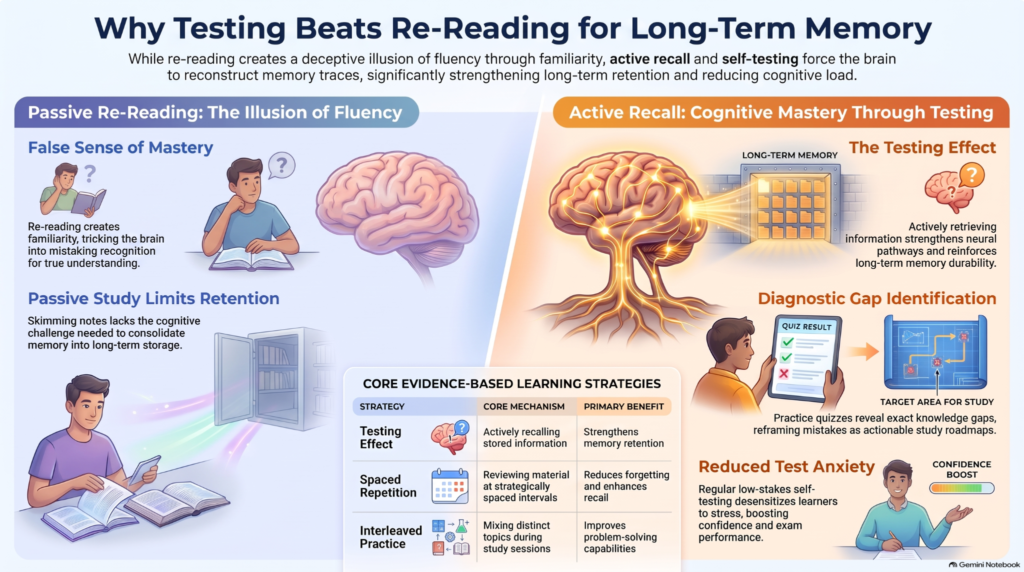
Research indicates that testing outperforms re-reading notes in enhancing long-term memory retention due to the active recall process. This method encourages deeper cognitive engagement, reinforcing learned material and identifying gaps in knowledge. Additionally, testing fosters neural connections that improve critical thinking and application skills. In contrast, re-reading creates a false sense of mastery with limited retention. Further exploration reveals effective self-testing techniques that can be implemented for improved learning outcomes and retention strategies.
KEY TAKEAWAYS
- Testing enhances long-term memory retention through active recall, which strengthens cognitive engagement and neural connections.
- Re-reading creates a false sense of mastery, limiting effective retention and engagement with the material.
- Self-testing identifies knowledge gaps, allowing learners to monitor their understanding and improve performance.
- Active engagement during testing fosters deeper cognitive connections, leading to improved memory consolidation and understanding.
- Regular testing reduces anxiety and boosts motivation, enhancing overall learning effectiveness compared to passive review methods like re-reading.
ARE YOU WASTING TIME RE-READING NOTES?
How effective is the practice of re-reading notes for enhancing long-term memory? Research indicates that while re-reading can initially seem beneficial, its re-reading efficiency is often overstated. This method may foster a false sense of mastery, leading individuals to believe they have grasped the material when, in fact, retention is limited.
Effective note-taking strategies, such as summarization and organization, facilitate deeper processing but are underutilized when relying solely on re-reading.
Moreover, studies suggest that active engagement with the material—such as self-testing and elaboration—proves more beneficial for long-term retention. Re-reading notes lacks the cognitive challenge that enhances memory consolidation, suggesting that individuals devoted to serving others might consider alternative methods.
Understanding the Testing Effect
The testing effect is a psychological phenomenon where taking a test on learned material enhances long-term retention of that information. This concept challenges traditional views of learning, which often regarded information retrieval as separate from the learning process.
The testing effect underscores the cognitive advantages that arise from retrieval practice, enhancing memory retention over time.
Research indicates that engaging in testing not only reinforces learned material but also aids in the consolidation of knowledge.
Cognitive Benefits of Testing
Testing serves as a powerful cognitive tool that enhances long-term memory retention, a phenomenon known as the testing effect. Research indicates that engaging in retrieval practice during testing reduces cognitive load by streamlining the mental processes involved in information recall. This reduction allows for greater focus on essential details, promoting deeper understanding.
Additionally, testing facilitates memory consolidation, wherein information shifts from short-term to long-term memory, solidifying knowledge retention. Understanding the psychology of effective learning strategies helps explain why active recall and regular testing strengthen memory, improve comprehension, and support better long-term learning outcomes. This process not only aids individual learners but also serves communities by fostering informed and knowledgeable participants.
Retrieval Practice Explained
Retrieval practice actively engages learners in recalling information, thereby enhancing their understanding and retention of material. This method leverages retrieval cues, which are stimuli that facilitate the recollection of previously learned information.
The effectiveness of retrieval practice is amplified through spaced repetition, a technique that involves revisiting material at strategically spaced intervals. Research indicates that this combination not only strengthens memory pathways but also fosters deeper cognitive processing.
As learners actively engage with the content, they are more likely to consolidate their knowledge for long-term retention. Consequently, incorporating retrieval practice into study routines can greatly improve academic outcomes, ultimately benefiting individuals seeking to serve others through enhanced knowledge and skill sets.
Memory Retention Strategies
Research consistently demonstrates that employing memory retention strategies, particularly through the testing effect, substantially enhances long-term memory. Effective memory techniques, such as spaced repetition, allow individuals to reinforce knowledge over time, making information retrieval more efficient.
| Strategy | Description | Benefits |
| Testing Effect | Actively recalling information | Strengthens memory retention |
| Spaced Repetition | Reviewing material at intervals | Reduces forgetting, enhances recall |
| Interleaved Practice | Mixing different topics during study | Improves problem-solving skills |
| Elaborative Rehearsal | Connecting new information to prior knowledge | Deepens understanding |
Utilizing these strategies can substantially improve one’s ability to retain and recall information, ultimately benefiting those who seek to serve and educate others effectively.
How Testing Enhances Memory Retention
Engaging in retrieval practices markedly bolsters long-term memory retention. Research demonstrates that testing not only facilitates memory reinforcement but also reduces cognitive load. When individuals are prompted to recall information, they engage in a process that strengthens neural connections, making the information more accessible in the future. This act of retrieval challenges learners to organize their knowledge, thereby enhancing understanding and retention.
Moreover, testing encourages active engagement with the material, which contrasts with passive review methods like re-reading notes. Active retrieval serves as a diagnostic tool, revealing gaps in knowledge and prompting further study.
The iterative nature of testing allows for spaced repetition, a technique proven to enhance memory durability over time. As a result, individuals who incorporate testing into their study routines are more likely to retain information, ultimately serving their communities with a deeper and more reliable understanding of the subject matter.

WHY GETTING ENGAGED HELPS YOU LEARN
In the classroom, I often explain study habits using the analogy of learning to paint with watercolors. You can spend dozens of hours observing a master artist blend rich pigments on paper, and while watching, every brushstroke makes complete intuitive sense. Yet the moment you pick up the brush yourself, you realize you have no real feel for the water-to-pigment ratio until you risk making a mess on a blank canvas. That is precisely what testing does for engineering and STEM coursework.
When you close your notes and attempt an open-ended quiz or derive a complex circuit equation from memory, you are forcing your synapses to forge resilient neural pathways through real mental friction. In my instructional design work, I consistently see that practice testing reframes errors not as personal failures, but as diagnostic roadmaps. A practice quiz tells you without ego or pretense exactly where your mental framework is robust and where the structural joints are weak.
Rather than treating practice assessments as intimidating evaluative hurdles, I encourage learners to treat them as low-stakes cognitive sandboxes. That shift removes academic panic and replaces it with quiet competence, ensuring that when high-stakes finals arrive, retrieval feels as natural and grounded as muscle memory.
The testing effect (also known as retrieval practice, active recall, practice testing, or test-enhanced learning) suggests long-term memory is increased when part of the learning period is devoted to retrieving information from memory. It is different from the more general practice effect, defined in the APA Dictionary of Psychology as “any change or improvement that results from practice or repetition of task items or activities.”
Engagement in the learning process greatly enhances retention by fostering active participation.
Research indicates that when learners actively involve themselves, they create stronger cognitive connections, leading to improved memory outcomes.
Additionally, emotional connections to the material further boost learning effectiveness, making the content more memorable and impactful.
Active Participation Enhances Retention
When individuals actively participate in the learning process, they are more likely to enhance their retention of information. Engaging in activities such as active recall and spaced repetition fosters deeper cognitive involvement, leading to improved memory consolidation.
Active recall, which involves retrieving information from memory, strengthens neural pathways, creating a more robust memory trace. Meanwhile, spaced repetition effectively times review sessions, allowing learners to revisit material at intervals that maximize retention.
Research indicates that these strategies not only facilitate learning but also promote long-term retention, making the information more accessible for future use. By incorporating active participation techniques, individuals can better serve others through effective knowledge transfer and application in various contexts.
Emotional Connection Boosts Learning
Active participation not only enhances retention through techniques like active recall and spaced repetition but also fosters emotional connections that greatly boost learning outcomes.
Emotional engagement and personal relevance markedly improve the retention of information, as emotions create stronger neural connections in the brain. Using images, diagrams, and color-coded materials can make lessons more engaging, while applying study tips for visual learners can help students connect new information with meaningful visual representations and improve long-term recall.
- Real-Life Applications: Linking new information to personal experiences makes learning memorable.
- Increased Motivation: Emotional connections drive a desire to learn, facilitating deeper engagement.
- Enhanced Critical Thinking: Engaged learners are more likely to analyze and synthesize information effectively.
Research indicates that when learners feel emotionally connected to the material, they are more likely to internalize and recall the information, consequently serving both themselves and others more effectively.
Top Self-Testing Techniques for Better Retention
How can self-testing enhance memory retention effectively? Self-assessment techniques, such as practice quizzes and flashcards, serve as powerful tools for reinforcing knowledge. Engaging in self-testing not only facilitates active recall but also promotes deeper cognitive processing, which greatly aids retention.
Employing spaced repetition alongside these techniques further optimizes learning. Testing can become more effective when learners use structured practice materials, such as worksheets, review exercises, and subject-based activities. Resources from the engineering teacher shop can support this process by giving students additional opportunities to test their knowledge, identify learning gaps, and strengthen their understanding of challenging concepts. This approach involves revisiting material at increasing intervals, allowing individuals to strengthen neural connections over time. Research indicates that this combination of self-testing and spaced repetition leads to long-term memory improvements compared to passive review methods like re-reading notes.
Additionally, incorporating varied question formats—such as multiple-choice, short answer, and essay prompts—can enhance critical thinking and application skills. Ultimately, these self-assessment techniques empower learners to monitor their understanding and identify gaps in knowledge, fostering a more effective and lasting educational experience.
Research on Testing vs. Re-Reading
Although re-reading has long been a popular study method, extensive research highlights that self-testing considerably outperforms it in enhancing long-term memory retention. Key findings indicate that active recall through testing fosters deeper cognitive engagement compared to passive re-reading.
- Retention Improvement: Studies show that students who engage in self-testing retain information more effectively over time.
- Reduced Test Anxiety**: Regular testing can desensitize individuals to the stress associated with assessment situations, ultimately leading to improved performance.
- Optimized Study Environment**: Creating a testing-friendly atmosphere encourages focused learning, reinforcing material through active participation rather than passive review.
Practical Tips to Make Testing a Habit
Taking a memory test not only assesses what one knows, but also enhances later retention, a phenomenon known as the testing effect. We studied this effect with educationally relevant materials and investigated whether testing facilitates learning only because tests offer an opportunity to restudy material. In two experiments, students studied prose passages and took one or three immediate free-recall tests, without feedback, or restudied the material the same number of times as the students who received tests. Students then took a final retention test 5 min, 2 days, or 1 week later. When the final test was given after 5 min, repeated studying improved recall relative to repeated testing. However, on the delayed tests, prior testing produced substantially greater retention than studying, even though repeated studying increased students’ confidence in their ability to remember the material. Testing is a powerful means of improving learning, not just assessing it.
What strategies can individuals employ to integrate testing into their study routines?
To foster habit formation, individuals should establish a consistent testing frequency, such as weekly quizzes or flashcard reviews. This regularity enhances retention by creating a structured learning environment.
In addition, implementing varied testing formats—such as multiple-choice, short answer, or oral recitations—can prevent monotony, keeping the process engaging and effective.
Setting specific goals, such as mastering a certain number of topics each week, can also contribute to sustained motivation.
Moreover, utilizing technology, like apps designed for self-testing, can facilitate easy access to testing materials and track progress.
Encouraging collaboration in study groups can enhance accountability, as peers can motivate each other and share resources.
Ultimately, integrating testing into study habits not only strengthens memory retention but also cultivates a disciplined approach to learning, benefiting both the individual and those they aim to serve.

RELATED STUDIES ABOUT WHY TESTING IMPROVES LONG-TERM MEMORY
To sum up, the evidence clearly supports that testing greatly enhances long-term memory retention compared to mere re-reading of notes. This phenomenon, known as the testing effect, underscores the importance of active engagement in the learning process. By incorporating self-testing techniques into study habits, learners can improve their retention and understanding. Isn’t it time to reconsider the effectiveness of our study strategies and prioritize methods that truly reinforce knowledge?
Longer-term skin-roasted peanut consumption improves brain vascular function and memory: A randomized, single-blind, controlled crossover trial in healthy older adults
Conceptual Framework and Clinical Rationale
- Aging, Cerebrovascular Decline, and Dementia Risk: Advanced age is associated with impaired brain vascular function, characterized by microvascular rarefaction, arterial stiffening, and reductions in cerebral blood flow (CBF). These hemodynamic deficits accelerate cognitive decline and elevate the risk of neurodegenerative disorders and dementia.
- Nutritional Interventions and Nut Consumption: Dietary patterns associated with neurocognitive preservation—such as the Mediterranean, DASH, and MIND diets—emphasize the regular intake of nuts. While peanuts are botanically legumes, their nutritional profile closely mirrors tree nuts, featuring high concentrations of unsaturated fatty acids, dietary fiber, and polyphenolic compounds.
- Mechanistic Potential of Peanuts: Peanuts are rich in L-arginine, the physiological precursor for endothelial nitric oxide (NO) synthesis, which regulates vasodilation and tissue perfusion. Furthermore, peanut skins contain dense concentrations of bioactives, including proanthocyanidins, flavonoids, and resveratrol, which exert antioxidant, anti-inflammatory, and vasoactive properties.
- Research Gap and Objectives: Prior studies using transcranial Doppler (TCD) ultrasound noted improved cerebrovascular reactivity to hypercapnic challenges following peanut intake, but TCD provides an indirect estimate reliant on large vessel flow velocity without capturing tissue-level perfusion. This trial used quantitative pseudo-continuous arterial spin labeling (pCASL) magnetic resonance imaging (MRI) to evaluate the impact of 16 weeks of daily skin-roasted peanut consumption on resting global and regional CBF, cognitive performance, peripheral blood pressure, and microvascular caliber in healthy older adults.
Methodology and Study Architecture
- Trial Design and Setting: A randomized, single-blind, controlled crossover trial conducted at the Metabolic Research Unit Maastricht (MRUM), Maastricht University, the Netherlands (ClinicalTrials.gov: NCT05724654).
- Intervention Protocol:
- Treatment Arms: Participants underwent two 16-week experimental periods separated by an 8-week washout phase.
- Active Intervention: Daily consumption of 60 g of unsalted, skin-roasted runner-type peanuts provided in pre-packaged sachets (yielding 340 kcal/1.4 MJ, 15.5 g protein, 29.5 g fat [predominantly cis-monounsaturated fatty acids], 5.1 g fiber, and 9.7 g carbohydrates). Participants were instructed to consume peanuts with the skin intact and avoid crushing or heating them.
- Control Period: Habitual diet without peanuts, tree nuts, nut spreads, seeds, or nut-containing baked goods.
- Participant Cohort:
- 36 randomized; 31 participants completed both arms and were included in the final analysis (15 women, 16 men).
- Baseline Profile: Mean age 674 years; mean BMI 26.73.3kg/m2; normotensive or mildly pre-hypertensive (12812mmHg systolic, 809mmHg diastolic); non-smokers without diabetes or active cardiovascular disease.
- Compliance: Median compliance was 100% (interquartile range 99%–100%), verified via empty sachet counts and participant diaries.
- Primary and Secondary Outcome Measures:
- Brain Vascular Function (Primary Outcome): Global and regional CBF measured via 3.0 T pCASL-MRI using background-suppressed 3D gradient and spin echo readouts. Predefined regions of interest included whole brain, gray matter, cortices, subcortices, cerebral lobes (frontal, temporal, parietal, occipital), hemispheres, and the hippocampus.
- Cognitive Performance (Secondary Outcome): Assessed using the Cambridge Neuropsychological Test Automated Battery (CANTAB), testing memory (Delayed Matching to Sample [DMS], Paired Associates Learning [PAL], Verbal Recognition Memory [VRM]), psychomotor speed (Reaction Time [RTI]), and executive function (Multitasking Test [MTT], Spatial Working Memory [SWM]).
- Cerebral Perfusion & Microvasculature: Resting middle cerebral artery velocity (MCAv), pulsatility index (PI), and resistance index (RI) via 2-MHz pulsed TCD ultrasound; retinal microvascular diameters (CRAE, CRVE, AVR) via digital retinal imaging.
- Cardiovascular & Anthropometric Indices: Office blood pressure (SBP, DBP, pulse pressure [PP], heart rate) using semi-continuous oscillometric monitors; body weight, waist-to-hip ratio (WHR), skinfold-derived body fat percentage; and validated food frequency questionnaires (FFQs).
- Statistical Modeling: Linear mixed models with random intercepts for participants, adjusting for period, sex, time, and baseline values as fixed factors. Statistical significance was set at p0.05.
Key Empirical Findings
- 1. Significant Enhancements in Cerebral Blood Flow (pCASL-MRI):
- Global and Tissue CBF: Peanut consumption significantly increased global CBF by 3.6% (+1.5 mL/100 g/min; 95% CI [0.3, 2.6], p=0.014) and gray matter CBF by 4.5% (+2.2 mL/100 g/min; 95% CI [0.9, 3.6], p=0.002) compared to the control period.
- Regional Perfusion: Significant increases occurred in the frontal lobe (+6.6%, +3.6 mL/100 g/min, p<0.001), temporal lobe (+4.9%, +2.5 mL/100 g/min, p=0.001), total cortical areas (+4.3%, +2.3 mL/100 g/min, p=0.004), subcortical areas (+3.1%, +1.0 mL/100 g/min, p=0.049), left hemisphere (+4.8%, p=0.003), and right hemisphere (+4.9%, p=0.002).
- Non-Significant Regions: CBF changes in the parietal lobe (+2.7%, p=0.065), occipital lobe (+1.0%, p=0.368), left hippocampus (+3.6%, p=0.070), and right hippocampus (+1.7%, p=0.362) did not reach significance.
- Volumetric Independence: All observed CBF increases were independent of brain tissue volume.
- 2. Cognitive Performance (CANTAB):
- Verbal Memory Improvement: In the VRM task, delayed recall memory significantly improved by 5.8% (+1.4 correct words after a 20-minute delay; 95% CI [0.0, 2.7], p=0.043). VRM immediate recall (+0.5 words, p=0.388) and free recall (+0.1 words, p=0.846) showed no significant differences.
- Executive Function and Psychomotor Speed: No improvements were observed in spatial working memory, visual paired learning, or multitasking accuracy. A small increase in reaction latency was noted during the multitasking test (+29 ms; 95% CI [1, 57], p=0.045), which likely reflected a speed-accuracy trade-off or an incidental finding.
- 3. Hemodynamics and Blood Pressure:
- Systemic Reductions: Brachial systolic blood pressure decreased significantly by 5 mmHg (95% CI [–8, –2], p=0.004) and pulse pressure decreased by 4 mmHg (95% CI [–7, –1], p=0.006).
- Unchanged Measures: Diastolic blood pressure remained stable (–1 mmHg, p=0.396), while resting heart rate increased slightly (+3 beats/min; 95% CI [1, 6], p=0.007).
- 4. Cerebral Perfusion (TCD) and Retinal Microvasculature:
- Resting middle cerebral artery velocity (MCAv), pulsatility index (PI), and resistance index (RI) did not differ significantly between intervention and control periods.
- Central retinal arteriolar equivalent (CRAE), central retinal venular equivalent (CRVE), and arteriolar-to-venular ratio (AVR) remained unchanged.
- 5. Nutritional and Anthropometric Profile:
- Peanut consumption increased daily energy intake (+0.9 MJ/day), total fat (+5.6 En%), cis-MUFA (+4.0 En%), cis-PUFA (+2.5 En%), and dietary fiber (+4.5 g/day), while reducing carbohydrate intake (–4.6 En%), saturated fatty acids (–1.0 En%), and cholesterol (–3.5 mg/MJ).
- Body fat percentage, waist circumference, and waist-to-hip ratio remained unchanged throughout the trial, while body weight fluctuated marginally (maximum change ~0.7 kg), demonstrating minimal clinical relevance. Physical performance (6-MWT, TUG, grip strength) and sleep quality (PSQI) were unaltered.
Biological and Clinical Interpretations
- Counteracting Age-Related Hemodynamic Decline: Given that global CBF naturally declines at approximately 0.37% per year in older adults, the observed 3.6% to 4.5% perfusion gain represents a clinically meaningful reversal of age-associated vascular slowing.
- The Neurovascular Coupling and Memory Mechanism: The concurrent perfusion increases in the frontal (+6.6%) and temporal (+4.9%) lobes provide a direct neurovascular explanation for the 5.8% gain in delayed verbal memory. These anatomical regions form the core of the phonological loop and language processing circuits necessary for the rehearsal, consolidation, and delayed retrieval of verbal information.
- Underlying Bioactive Mediators:
- Endothelial Nitric Oxide: High L-arginine intake promotes endothelial NO synthase activity, facilitating basal microvascular vasodilation and reducing arterial stiffness (reflected in reduced pulse pressure).
- Polyphenolic Synergies: Skin-derived flavonoids and resveratrol enhance microvascular endothelial function via antioxidant mechanisms and local NO bioavailability. The preservation of the peanut skin during roasting was likely critical to these outcomes.
- Methodological Discrepancy (pCASL vs. TCD): The absence of change in resting MCAv measured by TCD ultrasound—despite marked increases in CBF on MRI—illustrates that TCD measures flow velocity in major conduit vessels without accounting for changes in downstream microvascular caliber. Increased cerebral blood flow can occur through microvascular dilation without altering velocity in the proximal middle cerebral artery.
Study Strengths, Limitations, and Future Research
- Strengths: Gold-standard quantitative pCASL-MRI imaging; comprehensive neuropsychological evaluation using CANTAB; blinded outcome assessors; high trial retention (31/36 participants); and 100% median participant compliance.
- Limitations: Double-blinding was impossible due to the whole-food dietary nature of the intervention; dietary compliance was tracked through sachet counts and self-reports rather than objective biological biomarkers in blood or urine; and the study did not include a dose-response design.
- Future Research: Longitudinal studies are warranted to determine whether CBF improvements are maintained over multi-year periods, to evaluate dose-response relationships, and to examine whether processed peanut forms (e.g., blanched, boiled, or commercial peanut butters) deliver equivalent vascular benefits.
| REFERENCE: Lucia Kerkhof, Ronald P. Mensink, Jogchum Plat, Kevin M.R. Nijssen, Peter J. Joris, Longer-term skin-roasted peanut consumption improves brain vascular function and memory: A randomized, single-blind, controlled crossover trial in healthy older adults, Clinical Nutrition, Volume 55, 2025, Pages 170-179, ISSN 0261-5614, https://doi.org/10.1016/j.clnu.2025.10.020. (https://www.sciencedirect.com/science/article/pii/S0261561425002924) |
Sabinene improves memory in naive and scopolamine-induced amnesic mice by inhibiting neurotransmitter metabolic enzymes and attenuating oxidative stress
Conceptual Framework and Research Rationale
Alzheimer’s disease (AD) and related dementias represent escalating global public health challenges driven by progressive synaptic failure, cognitive decline, and memory deterioration. Central to AD pathophysiology is the cholinergic hypothesis, wherein the loss of basal forebrain cholinergic neurons and excessive hydrolytic activity of acetylcholinesterase (AChE) lead to acetylcholine (ACh) depletion and memory impairment. Concurrently, oxidative and nitrergic stress play critical roles; the brain’s high oxygen consumption and high lipid content make it exceptionally vulnerable to reactive oxygen species (ROS). This induces lipid peroxidation, depletes endogenous antioxidant defenses (GSH, CAT, SOD, GPx), and exacerbates neuroinflammation.
While standard cholinesterase inhibitors such as donepezil (DPZ) provide symptomatic relief, their clinical utility is limited by gastrointestinal side effects, potential hepatotoxicity, and an inability to arrest disease progression. Consequently, multi-target natural compounds with dual cholinergic and antioxidant activities have attracted interest.
Sabinene (SAB) is a natural bicyclic monoterpene found in essential oils of plants such as Juniperus and Laurus species, known for antimicrobial, anti-inflammatory, and neuroprotective properties. However, its cognitive-enhancing potential had remained unexplored.
Core Research Objectives:
- Evaluate the nootropic and memory-enhancing effects of SAB in both naive mice and mice with scopolamine (Scopo)-induced amnesia.
- Assess spatial working memory, non-spatial recognition memory, and exploratory locomotion.
- Quantify biochemical alterations in neurotransmitter-metabolizing enzymes (AChE, MAO-B), markers of oxidative and nitrergic stress (MDA, nitrite, GSH, GPx, CAT, SOD), and molybdenum-containing enzymes (aldehyde oxidase, xanthine oxidase, sulphite oxidase) across the prefrontal cortex (PFC) and hippocampus (HC).
Methodology and Experimental Design
- Animal Model and Dosing: Male Swiss mice (20–25 g, 6–8 weeks old; n=10 per group) were maintained under standardized laboratory conditions.
- Two-Phase Study Architecture:
- Phase 1 (Naive Cohort): Five groups received daily oral treatments for 14 days: normal saline control (10 mL/kg), SAB at 5, 10, or 20 mg/kg, or reference donepezil (DPZ, 1 mg/kg).
- Phase 2 (Scopolamine Amnesia Cohort): Six groups evaluated protection against muscarinic blockade. Groups 1 and 2 received saline vehicle; Groups 3–5 were pretreated with oral SAB (5, 10, or 20 mg/kg); Group 6 received oral DPZ (1 mg/kg). Thirty minutes after daily pretreatment, Groups 2–6 received scopolamine hydrobromide (3 mg/kg, i.p.) daily for 14 consecutive days.
- Behavioral Testing Battery:
- Y-Maze Test (YMT): Measured spontaneous alternation behavior as an index of spatial working memory.
- Novel Object Recognition Test (NORT): Calculated the discrimination index (DI) reflecting non-spatial episodic recognition memory.
- Open Field Test (OFT): Quantified horizontal beam breaks over 5 minutes to evaluate general locomotor activity.
- Biochemical Assays (PFC and HC Homogenates):
- Enzymatic Assays: Ellman’s colorimetric method for AChE, benzylamine spectrophotometry for MAO-B, and UV-VIS assays for molybdenum enzymes (aldehyde oxidase, xanthine oxidase, sulphite oxidase).
- Oxidative and Nitrergic Markers: Griess reaction for nitrites, thiobarbituric acid reactive substances (TBARS) for malondialdehyde (MDA), Ellman’s reagent for reduced glutathione (GSH), NADPH oxidation for glutathione peroxidase (GPx), H2O2 decomposition for catalase (CAT), and superoxide dismutase (SOD) activity.
- Organ Safety Screening: Gravimetric weight profiling of brain, liver, and kidneys.
- Statistical Analysis: One-way and two-way ANOVA with Tukey’s post hoc tests (p<0.05).
Key Empirical Findings
- Behavioral Performance and Memory Restoration:
- Naive Mice: SAB (5 and 10 mg/kg) significantly enhanced spatial working memory, increasing percentage correct alternations in the Y-maze (p<0.05). In the NORT, all SAB doses (5, 10, and 20 mg/kg) produced increases in the discrimination index relative to saline controls. In the OFT, SAB at 5 and 10 mg/kg reduced line crossings (p<0.01), indicating mild sedation or reduced exploratory reactivity, whereas DPZ did not alter locomotion.
- Scopolamine-Treated Mice: Scopolamine induced hyperlocomotion and marked memory deficits (reduced Y-maze alternations and lower NORT DI). SAB pretreatment (5, 10, and 20 mg/kg) significantly reversed spatial and non-spatial memory impairments while normalizing motor hyperactivity (p<0.001). In contrast, while DPZ restored cognitive scores, it failed to normalize scopolamine-induced motor hyperactivity.
- Cholinergic and Monoaminergic Modulation:
- Scopolamine administration resulted in marked upregulation of AChE and MAO activities in both the PFC and HC.
- SAB administration (5, 10, and 20 mg/kg) and DPZ significantly suppressed AChE activity in the PFC and HC relative to scopolamine controls (p<0.0001).
- Similarly, SAB and DPZ significantly reduced elevated MAO-B activity in both brain regions (p<0.0001).
- Attenuation of Oxidative and Nitrergic Stress:
- Lipid Peroxidation: Scopolamine elevated MDA levels across the PFC and HC (p<0.05). High-dose SAB (20 mg/kg) and DPZ significantly reduced cortical and hippocampal MDA levels.
- Nitrergic Stress: Scopolamine-induced increases in brain nitrite were mitigated by SAB (10 and 20 mg/kg), which lowered nitrite concentrations in the PFC and HC.
- Antioxidant Armory Restoration: Scopolamine severely depleted endogenous GSH, GPx, CAT, and SOD (p<0.0001). SAB restored hippocampal GSH levels, improved GPx activity, and increased hippocampal CAT levels (p<0.05). Furthermore, SAB (10 and 20 mg/kg) significantly upregulated SOD activity in both the PFC and HC.
- Molybdenum-Containing Enzyme Regulation:
- Scopolamine elevated cortical and hippocampal levels of aldehyde oxidase, xanthine oxidase, and sulphite oxidase.
- SAB at 20 mg/kg significantly decreased elevated xanthine oxidase in the PFC (p<0.05), directly suppressing an enzymatic source of superoxide free radicals. DPZ selectively reduced aldehyde oxidase in the HC.
- Organ Tolerability and Safety Indicators:
- SAB treatments had no significant effect on relative brain weight or liver weight.
- However, the highest dose of SAB (20 mg/kg) caused a statistically significant reduction in relative kidney weight (p<0.05), highlighting a potential renal vulnerability at elevated doses.
Pharmacological and Mechanistic Interpretations
- Multi-Target Nootropic Profile: Unlike conventional mono-targeted therapies, SAB acts via dual pathways: enhancing cholinergic signaling via AChE inhibition and reducing neuro-oxidative injury by restoring GSH/SOD/CAT and suppressing xanthine oxidase.
- Normalization of Scopolamine-Induced Hyperactivity: Muscarinic receptor blockade by scopolamine induces psychomotor agitation and heightened exploratory crossing. While DPZ restored memory without modifying locomotion, SAB normalized hyperactivity, indicating potential sedative or mood-stabilizing properties that could address neuropsychiatric agitation in neurodegenerative disorders.
- Molybdenum Enzyme Regulation: Elevated xanthine oxidase activity generates superoxide anions during purine catabolism, driving secondary neurotoxicity. The suppression of xanthine oxidase by SAB highlights a specific mechanism by which it reduces oxidative burden in cortical circuits.
Study Limitations and Future Research Directions
- Subacute Duration and Toxicity Considerations: The 14-day protocol leaves chronic efficacy and safety unassessed. The observed reduction in kidney weight at 20 mg/kg requires dedicated renal clearance assays (serum creatinine, blood urea nitrogen) and histopathological evaluation to identify nephrotoxicity thresholds.
- Absence of Histological and Molecular Corroboration: The study relied on behavioral and spectrophotometric homogenate assays without complementary immunohistochemistry (e.g., NeuN neuronal density, GFAP astrogliosis, Iba-1 microglial activation) or receptor-binding kinetics.
- Chemically Induced Amnesia Model: While scopolamine serves as a standard model for acute cholinergic hypofunction, it does not fully replicate the complex, chronic neuropathology of AD (such as amyloid-beta plaques and neurofibrillary tau tangles). Future evaluations in transgenic AD mouse models (e.g., 5xFAD or APP/PS1) are warranted.
| REFERENCE: Benneth Ben-Azu, Akhator J. Amenotie, Daniel T. Esuku, Bienose S. Chijioke, Olusegun G. Adebayo, Jackson E. Onuelu, Miracle K. Nekabari, Ewhre O. Lawrence, Obukohwo M. Oyovwi, Sabinene improves memory in naive and scopolamine-induced amnesic mice by inhibiting neurotransmitter metabolic enzymes and attenuating oxidative stress, Brain Disorders, Volume 22, 2026, 100320, ISSN 2666-4593, https://doi.org/10.1016/j.dscb.2026.100320. (https://www.sciencedirect.com/science/article/pii/S2666459326000156) |
Intrahippocampal glutamate improves spatial memory in offspring of prenatally alcohol-exposed rats
Conceptual Framework and Research Rationale
Intrauterine alcohol exposure is a major cause of preventable neurodevelopmental disabilities and behavioral disorders collectively characterized under Fetal Alcohol Spectrum Disorders (FASD). Maternal alcohol consumption disrupts fetal neurogenesis, compromises neural circuit wiring, and causes long-term structural and neurochemical deficits in the offspring brain.
Among brain regions, the hippocampus is particularly vulnerable to ethanol teratogenicity, resulting in marked hippocampal neuronal loss and persistent spatial learning and memory deficits in adulthood. At the neurochemical level, alcohol disrupts the glutamatergic system—the principal excitatory neurotransmitter network in the central nervous system essential for long-term potentiation (LTP), synaptic stabilization, and memory consolidation. Ethanol interferes with NMDA receptor density and function, alters glutamate release kinetics, and impairs synaptic transmission.
Because memories remain labile immediately following learning acquisition, post-training neuromodulation of hippocampal circuits can influence consolidation strength. While intracerebral glutamate administration has previously been shown to modulate memory retention in rodent models, whether targeted post-training glutamate replenishment into the dorsal hippocampus can rescue spatial cognitive deficits and reverse neuronal loss in prenatally alcohol-exposed offspring remained unaddressed.
Core Research Objectives:
- Evaluate the therapeutic impact of post-training intrahippocampal L-glutamate microinfusion on spatial memory acquisition and retention in adult rat offspring exposed to prenatal ethanol.
- Determine the effects of targeted glutamate infusion on hippocampal neuronal survival within the Dentate Gyrus (DG) and Cornu Ammonis (CA) subfields.
- Assess whether local microinfusion normalizes endogenous hippocampal glutamate tissue concentrations without eliciting excitotoxic neuropathology.
Methodology and Experimental Design
- Animal Model and Prenatal Ethanol Administration:
- Adult female Wistar albino rats (150–200 g) were mated with proven fertile males. Successful mating was confirmed via vaginal smear for sperm and copulatory plug presence, designating gestational day (GD) 0.
- Pregnant dams were randomized to receive either tap water (control dams, n = 6) or absolute alcohol by oral gavage at a dose of 5 g/kg/day throughout gestation (alcohol-exposed dams, n = 6). Pups were reared by biological mothers until weaning at postnatal day (PND) 21.
- Offspring Cohort and Group Allocation:
- A total of 24 offspring (PND 85) were randomly allocated into three experimental cohorts (n=8 per group; 4 males and 4 females pooled per group):
- Control Group (C1): Offspring from normal dams receiving vehicle.
- Untreated Group (E1): Offspring from alcohol-exposed dams receiving vehicle infusion (sterile normal saline).
- Glutamate-Infused Group (E2): Offspring from alcohol-exposed dams receiving L-glutamate microinfusion.
- A total of 24 offspring (PND 85) were randomly allocated into three experimental cohorts (n=8 per group; 4 males and 4 females pooled per group):
- Behavioral Protocol (Morris Water Maze):
- On PND 85, rats underwent Morris Water Maze (MWM) spatial acquisition training across 6 consecutive days (4 trials per day).
- On day 6, immediately following the completion of the final training trial, animals underwent stereotaxic cannulation and microinfusion.
- Stereotaxic Cannula Implantation and Glutamate Microinfusion:
- Under ketamine (60 mg/kg) and xylazine (6 mg/kg) anesthesia, rats were positioned in a stereotaxic frame. Bilateral coordinates targeting the dorsal hippocampus were set using the Paxinos and Watson rat brain atlas (AP=4.0mm, L=3.6mm, V=4.2mm).
- Group E2 received bilateral microinfusions of L-glutamic acid (2.0 µg in 0.5 µL sterile normal saline per hemisphere) via a 30-gauge internal needle connected to a Hamilton micro-syringe on a Harvard Pico Plus infusion pump. The cannula was maintained in situ for 10 seconds post-infusion to facilitate passive diffusion and prevent backflow.
- After a 48-hour recovery period, spatial memory retention was assessed in a probe trial (evaluating Time Taken to reach the Platform Quadrant [TTPQ] and Time spent in the Platform Quadrant [TPQ]).
- Tissue Analysis and Quantitative Histology:
- Animals were sacrificed immediately following the probe trial.
- Biochemical Glutamate Quantitation: Hippocampal tissue was dissected on ice, homogenized in 10% (w/v) PBS, and assayed for glutamate concentration using an EnzyChrom Glutamate Assay Kit (dehydrogenase-catalyzed oxidation yielding formazan/MTT at 565 nm).
- Quantitative Histology: Perfusion-fixed brains were cut into 5-µm coronal sections through the dorsal hippocampus and stained with 0.1% Cresyl violet. Viable neuronal cell density was quantified at 20× magnification in predefined regions of interest: Cornu Ammonis (CA, 300 µm linear length) and Dentate Gyrus (DG, 200 µm² field) across 4 sections per rat using NIS Elements software.
- Statistical Analysis: Conducted in Jamovi (v2.3.28). Data were evaluated via one-way ANOVA with Bonferroni corrections and independent samples t-tests. Effect sizes for neuronal counts were calculated as Cohen’s d.
Key Empirical Findings
- Spatial Memory Performance (Morris Water Maze):
- Latency to Platform Quadrant (TTPQ): Untreated alcohol-exposed offspring (E1) exhibited profound retention deficits, requiring an average of 13.0 minutes to locate the target platform quadrant. Post-training glutamate infusion (E2) significantly shortened this latency to 7.12 minutes (p<0.001), approaching the 5.87-minute latency recorded in the unexposed control group (C1).
- Duration in Platform Quadrant (TPQ): Untreated offspring (E1) spent significantly less time in the platform quadrant compared to controls (p<0.001). In contrast, glutamate-infused offspring (E2) demonstrated robust target quadrant preference, spending significantly longer exploring the target area than the untreated group (16.12 minutes vs. untreated baseline; p<0.001), reflecting successful consolidation of the spatial memory trace.
- Hippocampal Neuronal Preservation (DG and CA Subfields):
- Dentate Gyrus (DG):
- Untreated alcohol-exposed rats displayed a massive reduction in DG viable neurons relative to controls (13.02.56 vs. 47.811.4 cells; p<0.001, Cohen’s d=4.1).
- Post-training glutamate infusion substantially increased viable neuronal density to 31.52.45 cells (p<0.001 vs. E1; large negative effect size, Cohen’s d=-7.38).
- Cornu Ammonis (CA):
- Untreated alcohol offspring exhibited marked cell loss in CA compared to controls (6.881.13 vs. 15.33.2 cells; p<0.001, Cohen’s d=3.5).
- Glutamate infusion elevated CA neuronal survival to 12.63.85 cells (p=0.001 vs. E1; Cohen’s d=-2.03). Notably, CA counts in the glutamate-infused group were no longer statistically different from unexposed controls (p=0.160, Cohen’s d=0.742), reflecting marked cellular recovery.
- Endogenous Hippocampal Glutamate Concentrations:
- Biochemical quantification revealed total glutamate levels of 51.70.29mg/dL in controls (C1), 50.660.25mg/dL in untreated alcohol offspring (E1), and 51.950.27mg/dL in glutamate-infused offspring (E2).
- Although one-way ANOVA indicated that total baseline tissue glutamate levels did not significantly differ across groups at adult PND 85, the descriptive upward shift in the E2 group indicated that targeted microinfusion helped restore glutamate concentrations to control-level values.
- Excitotoxicity and Histological Safety:
- Microscopic evaluation of Cresyl violet-stained sections confirmed 0% incidence of excitotoxic lesions, tissue necrosis, inflammatory infiltration, or gross architectural disruption attributable to the infused glutamate dose (2.0 µg/0.5 µL).
Neurobiological and Translational Interpretations
- Memory Consolidation via Synaptic Strengthening: The selective administration of glutamate during the critical post-training consolidation window provided the necessary synaptic excitation to activate NMDA receptors and drive downstream intracellular cascades required for long-term memory stabilization. This bypassed the developmental receptor hypo-functioning induced by fetal alcohol exposure.
- Trophic Preservation vs. Excitotoxicity: High-dose glutamate can induce excitotoxic neuronal death through intracellular calcium overload. In this study, the low-dose regimen (2.0 µg) fell well within the physiological neuroprotective window, promoting neuronal survival and structural stabilization in the CA and DG regions without inducing pathological lesions.
- Resolution of Developmental Neurochemical Deficits: While baseline adult glutamate tissue concentrations may appear largely normalized across groups through compensatory adult homeostatic mechanisms, dynamic synaptic release and receptor responsiveness remain impaired in FASD models. Localized exogenous glutamate delivery compensates for these functional deficits during heightened cognitive tasks.
Study Limitations and Future Directions
- Lack of Mechanistic and Electrophysiological Corroboration: The study did not measure downstream molecular markers of synaptic plasticity (e.g., BDNF, phosphorylated CaMKII, CREB) or apoptotic signaling proteins (Bax, Bcl-2, cleaved caspase-3). Direct electrophysiological assessments of hippocampal LTP were also omitted.
- Sample Size and Sex Stratification: The trial was not statistically powered to evaluate sexually dimorphic responses; male and female data were pooled (n=4 per sex per group) despite documented sex differences in fetal alcohol vulnerability and NMDA receptor expression.
- Clinical Translation Boundaries: Direct stereotaxic intrahippocampal microinfusion is invasive and clinically impractical for human patients. Future investigations must explore non-invasive pharmacological modalities—such as positive allosteric modulators (PAMs) of AMPA/NMDA receptors, metabotropic glutamate receptor agonists, or systemic glutamate transport enhancers—to evaluate translatable therapeutic strategies for FASD.
| REFERENCE: Mitha K V, Saraswati Jaiswal Yadav, Ganaraja, Rashmi KS, Aradhana Marathe, Intrahippocampal glutamate improves spatial memory in offspring of prenatally alcohol-exposed rats, Translational Research in Anatomy, Volume 43, 2026, 100486, ISSN 2214-854X, https://doi.org/10.1016/j.tria.2026.100486. (https://www.sciencedirect.com/science/article/pii/S2214854X26000269) |
CONCLUSION
Ultimately, shifting our study habits toward active retrieval isn’t just about boosting exam scores—it is about restoring balance and humanity to the entire learning journey. For too long, our academic culture has worn exhaustive, late-night cram sessions like a badge of honor, mistaking hours spent staring passively at open binders for deep comprehension. When we embrace low-stakes self-testing and spaced recall, we actually give ourselves permission to study with intention and step away.
Instead of spending endless, anxiety-ridden evenings drowning in re-read pages, focused testing allows you to achieve deeper retention in a fraction of the time, carving out space for genuine rest, a quiet walk, or an evening curled up in a cozy reading corner. As an educator, my ultimate goal is never to see students become mechanical calculators who merely recite textbook formulas under pressure.
I want them to step into their exams feeling calm, confident, and grounded in authentic understanding. When you trade the comfort of re-reading for the honest effort of active recall, you cultivate more than just a sharper memory—you build true academic resilience and an enduring curiosity that outlasts any single test day.
