
When I left the engineering lecture hall to complete my doctoral research in educational psychology, one stark reality immediately stood out: we frequently confuse self-directed learning with simply leaving students on their own. In rigorous STEM environments, faculty often hand undergraduates complex design briefs or open-ended problem sets and assume that genuine intellectual agency will naturally take over. In practice, stripping away instructional structure without preparing students’ internal self-regulation rarely sparks autonomy; instead, it floods working memory with extraneous cognitive load. When learners lack clear benchmarks or domain competence, attempting to navigate unstructured information induces decision paralysis, acute anxiety, and mental exhaustion.
From a cognitive science standpoint, true learning autonomy is not the total absence of guidance—it is the systematic internalization of instructional scaffolding. Students become genuinely self-directed only when their foundational knowledge is robust enough to let them monitor, evaluate, and adapt their own problem-solving steps under pressure. Handing someone a digital tool or open access to course materials does not make them an autonomous learner any more than sitting at a chessboard makes someone a grandmaster.
Real autonomy requires explicit metacognitive habits, deliberate self-reflection routines, and the psychological safety to make calculated mistakes. If we want modern classrooms to cultivate independent thinkers rather than overwhelmed observers, we must shift our pedagogical aim from unguided discovery to structured, cognitive empowerment.
Educational research highlights that autonomous learning psychology boosts student engagement and motivation in modern classrooms. It fosters critical thinking and problem-solving skills, enabling learners to take ownership of their education. The principles of self-determination theory support the importance of autonomy in enhancing intrinsic motivation. Despite various challenges, such as resistance from educators and resource limitations, the shift towards self-directed learning is evident. Further insights into strategies for implementing autonomy can lead to transformative educational experiences.
KEY TAKEAWAYS
- Autonomous learning fosters intrinsic motivation, enhancing student engagement and ownership of their educational experiences in modern classrooms.
- Research shows that self-directed learning improves critical thinking and problem-solving skills, essential for navigating today’s complex world.
- Collaborative environments, supported by autonomous learning, promote mutual respect and accountability among students, enhancing their social skills and teamwork abilities.
- Personalized learning experiences, bolstered by technology, allow students to progress at their own pace, increasing motivation and fostering lifelong learning habits.
- Effective integration of self-assessment and reflection practices in classrooms encourages ongoing personal growth and deeper understanding of content among learners.
THE CONCEPT OF AUTONOMOUS LEARNING: AN OVERVIEW
Self-determination theory (SDT) is a macro theory of human motivation and personality regarding individuals’ innate tendencies toward growth and innate psychological needs. It pertains to the motivation behind individuals’ choices in the absence of external influences and distractions. SDT focuses on the degree to which human behavior is self-motivated and self-determined.
Autonomous learning represents a paradigm shift in educational methodologies, emphasizing learner independence and self-direction. This concept is rooted in various educational theories that advocate for a departure from traditional, teacher-centered approaches. Theories such as constructivism and self-determination theory underscore the importance of fostering an environment where learners actively engage in their educational journeys.
Such an environment promotes critical thinking and problem-solving skills, as students take ownership of their learning processes. Research indicates that when learners are encouraged to set their own goals and pursue knowledge autonomously, they exhibit higher levels of motivation and achievement.
Furthermore, facilitating learner independence enhances the ability to adapt to diverse situations, preparing individuals for lifelong learning. As educational stakeholders aim to serve others effectively, understanding and implementing autonomous learning principles can lead to more meaningful and impactful educational experiences, ultimately benefiting both learners and the broader community.
Understanding the Psychology Behind Self-Directed Learning
The psychology of self-directed learning reveals critical insights into the nature of autonomy, motivation, and engagement. Applying building knowledge constructivism in learning encourages students to actively connect new information with their prior experiences, develop their own understanding, and take greater responsibility for their learning.
Research indicates that autonomy enhances learners’ intrinsic motivation, leading to greater engagement and persistence in their educational pursuits.
Understanding these psychological factors is essential for educators aiming to foster an environment conducive to autonomous learning.
Nature of Autonomy
In today’s world, it is of great importance to raise qualified learners whose creative thinking skills and self-efficacy are developed and who can make various choices and take responsibility for their choices as well as implementing them by making their own decisions. In this regard, the study examined the role of gifted students’ self-efficacy (SE) as a mediator on the relationship between autonomous learning (AL) and creative cognition (CC).
While many educational frameworks emphasize structured guidance, the nature of autonomy in learning reveals the significant role of self-directed engagement. Autonomy, defined as the capacity to make informed choices about one’s learning process, empowers learners to take ownership of their educational journeys.
Research indicates that autonomy benefits not only the individual learner but also enhances collaborative environments by fostering mutual respect and shared responsibility. This self-directed approach encourages critical thinking and adaptability, essential skills in today’s fast-paced world.
Moreover, when educators facilitate opportunities for autonomy, they cultivate an atmosphere where learners feel valued and motivated, leading to deeper understanding and retention of knowledge. Emphasizing autonomy in educational settings ultimately promotes lifelong learning and personal growth.
Motivation and Engagement
Self-directed learning is greatly influenced by motivation and engagement, which are rooted in psychological principles. Research indicates that intrinsic motivation plays a pivotal role in fostering autonomous learning, as learners who are internally driven often exhibit higher levels of persistence and creativity.
Moreover, collaborative engagement enhances this process by promoting social interaction and mutual support among peers. When students collaborate, they are more likely to share diverse perspectives, which can deepen understanding and sustain motivation.
The interplay between intrinsic motivation and collaborative engagement creates an environment conducive to self-directed learning, where individuals feel empowered to pursue their interests and take ownership of their educational journeys.
Understanding these dynamics can help educators design strategies that support and nurture autonomous learners.
Benefits of Autonomous Learning for Students and Educators
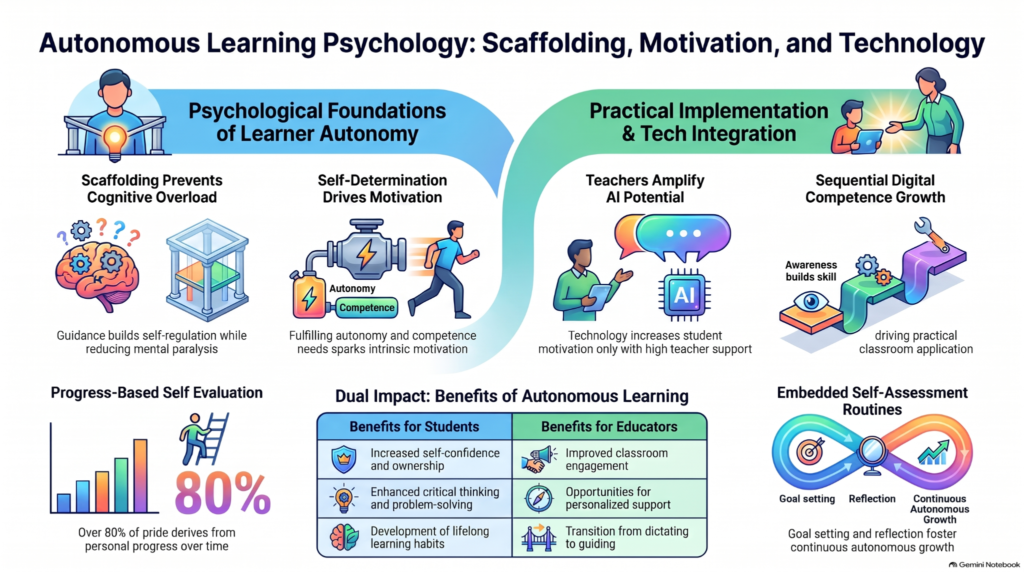
Numerous studies highlight the significant advantages of autonomous learning for both students and educators. This approach fosters student empowerment, enabling learners to take ownership of their educational journeys. As students engage more deeply with content, they develop critical thinking skills and intrinsic motivation. Educators can apply insights from forgetting curve educational psychology to help students retain what they learn by incorporating spaced reviews, retrieval activities, and regular opportunities to revisit important concepts. Educators benefit as well, as autonomous learning allows for a more supportive role, guiding students rather than dictating their learning experiences.
| Benefits for Students | Benefits for Educators |
| Enhanced critical thinking | Improved student engagement |
| Increased motivation | More effective classroom management |
| Greater self-confidence | Opportunities for personalized support |
| Development of lifelong learning skills | Professional growth through mentorship |
| Strengthened problem-solving abilities | Improved assessment strategies |

KEY PSYCHOLOGICAL THEORIES THAT SUPPORT AUTONOMOUS LEARNING
Throughout my years designing instructional workflows and observing how students tackle engineering mechanics, I have witnessed the common misconception that digital learning platforms and AI assistants automatically make students autonomous. Recent empirical research reminds us of an essential boundary condition: advanced learning technologies amplify self-directed ability only when active teacher scaffolding is present to ground the process. When a student uses an interactive AI platform or adaptive module in isolation, they are vulnerable to superficial tool dependency, frequently mistaking fluency in generating answers for deep conceptual understanding.
This is precisely where the psychology of cognitive load becomes central. Self-regulated learning requires considerable executive functioning. A student must parse information, diagnose their misconceptions, select problem-solving heuristics, and evaluate their own outcomes. If we overwhelm their limited working memory with clunky digital workflows or leave them to compare themselves anxiously against high-performing peers, their intrinsic motivation deteriorates.
As educators, our role is not to stand aside, but to provide targeted cognitive, instrumental, and emotional scaffolding. We must coach students on how to formulate rigorous questions, critically audit automated feedback, and ground their progress against their own past performance rather than normative social standards. Autonomy is an earned psychological capability built through deliberate feedback loops, not an innate personality trait that emerges by default in digital environments.
Understanding the psychological foundations of autonomous learning is essential for educators aiming to enhance student engagement and ownership. Several key psychological theories provide a framework to support autonomous learning, particularly through constructivist theories and self-regulated learning.
- Constructivist Theories: Emphasize the active role of learners in constructing knowledge, promoting critical thinking and problem-solving skills.
- Self-Regulated Learning: Focuses on learners’ ability to set goals, monitor their progress, and reflect on their learning processes, fostering independence.
- Social Learning Theory: Highlights the importance of observational learning and social interaction in the acquisition of knowledge, reinforcing collaborative learning environments.
- Motivation Theory: Examines intrinsic and extrinsic motivators that drive students to take initiative in their learning, vital for developing a sense of agency.
These theories collectively underscore the importance of fostering an educational environment that encourages autonomy and self-direction among students.
How to Foster Student Agency in Autonomous Learning
It is crucial for language learners to have a strong grasp of vocabulary as with sufficient vocabulary, learners can develop proficiency in language skills (Aton et al., 2024; Qian & Lin, 2019). To succeed in language learning, learners need to employ effective learning strategies, particularly when it comes to vocabulary (Wen & Naim, 2023). Consistent with this insight, vocabulary learning strategies (VLS) play a major role in improving vocabulary knowledge. However, vocabulary learning strategies cannot be implemented effectively if the learners rely solely on the teacher for vocabulary learning. Therefore, learners need to be autonomous, so they are conscious of their important role in taking control of the learning process and employing effective vocabulary learning strategies.
Fostering student agency in autonomous learning requires a dual approach that emphasizes self-directed learning and the creation of collaborative environments.
Research indicates that encouraging students to take initiative in their educational journey enhances their motivation and engagement.
Additionally, collaborative settings promote peer interaction, allowing students to share their insights and strategies, which can further empower their individual learning processes.
Encouraging Self-Directed Learning
While traditional teaching methods often emphasize direct instruction, creating an environment that encourages self-directed learning can greatly enhance student agency.
Fostering learner autonomy involves implementing strategies that empower students to take charge of their learning experiences. Teachers can explore additional educational resources and practical classroom materials through the engineering teacher shop to support independent learning, encourage student participation, and create more engaging learning experiences. Effective approaches include:
- Goal Setting: Encourage students to define their own academic objectives, fostering ownership over their learning journey.
- Self-Assessment: Facilitate opportunities for students to evaluate their progress, promoting the use of self-regulated strategies.
- Choice in Learning Activities: Allow students to select projects or subjects that interest them, increasing motivation and engagement.
- Reflection Practices: Incorporate regular reflection sessions to help students identify strengths, weaknesses, and areas for improvement, reinforcing a mindset of continuous growth.
These practices collectively nurture an environment conducive to self-directed learning.
Building Collaborative Environments
Creating collaborative environments is essential for enhancing student agency within autonomous learning frameworks. Research emphasizes that implementing effective collaborative strategies fosters a sense of belonging and accountability among students.
By engaging in structured group dynamics, learners develop critical skills such as communication, problem-solving, and leadership. These interactions not only promote deeper understanding of content but also empower students to take initiative in their learning processes.
Educators can facilitate this by designing tasks that require teamwork and collective goal-setting, thereby ensuring that each student’s voice is valued. Additionally, regular reflection on group experiences helps students recognize their contributions and areas for improvement, ultimately cultivating a more autonomous and engaged learner.
Such environments serve as a foundation for lifelong learning and community involvement.
Common Challenges in Autonomous Learning?
What obstacles impede the effectiveness of autonomous learning in modern classrooms? Various barriers to autonomy can hinder students’ ability to engage fully in self-directed learning. Recognizing these challenges is essential for fostering an environment conducive to autonomy.
Key issues include:
- Lack of Student Motivation**: Students may struggle to take initiative without intrinsic motivation or clear relevance to their learning goals.
- Assessment Challenges: Traditional assessment methods often do not align with autonomous learning practices, making it difficult to evaluate student progress effectively.
- Insufficient Resources: Limited access to educational resources can restrict opportunities for independent exploration and learning.
- Teacher Resistance: Some educators may be hesitant to relinquish control, fearing it could compromise curricular objectives or classroom management.
Addressing these challenges is vital for enhancing the effectiveness of autonomous learning and ultimately benefiting student outcomes in modern educational settings.
Future Trends: The Evolution of Autonomous Learning in Education
As educational paradigms continue to shift towards more personalized learning experiences, the evolution of autonomous learning in education is becoming increasingly prominent.
Future technologies, including artificial intelligence and adaptive learning systems, are poised to play a critical role in facilitating this evolution. These innovations enable tailored educational experiences, allowing learners to engage at their own pace and according to their individual interests.
Moreover, educational policies are increasingly recognizing the importance of autonomy in learning, promoting frameworks that support self-directed educational practices. Initiatives that encourage project-based learning and self-assessment are being integrated into curricula, fostering environments where students can take ownership of their education.
The combination of future technologies and supportive educational policies positions autonomous learning as a cornerstone of modern education, equipping students with the skills necessary to thrive in an increasingly complex world.
This evolution not only enhances individual learning outcomes but also prepares students to contribute meaningfully to society.

RELATED STUDIES ABOUT AUTONOMOUS LEARNING PSYCHOLOGY
In the garden of education, autonomous learning emerges as a resilient tree, nurtured by the waters of self-direction and psychological insight. Its roots, grounded in key theories, draw sustenance from the benefits it offers both students and educators. Yet, like any thriving organism, it faces challenges that can hinder its growth. As the landscape of modern classrooms evolves, cultivating this tree will require ongoing attention and adaptation, promising a fruitful harvest for future generations of learners.
Application of artificial intelligence in English learning: The interactive effects of teacher support, learning motivation, and autonomous learning ability
Conceptual Framework and Research Rationale
- Digital Transformation and AI Integration in Language Learning: The rapid development of artificial intelligence applications (AIA)—such as ChatGPT, Grammarly, and Copilot—is transforming higher education by offering personalized learning pathways, interactive exercises, and instantaneous feedback. English language learning, marked by structural openness and communicative variability, is particularly well suited to AI integration.
- The Necessity of Autonomous Learning Ability (ALA): While AI tools expand opportunities for individualized pacing, they require learners to self-monitor, self-evaluate, and adapt their study strategies. Without well-developed autonomous learning abilities, students risk superficial tool use or overdependence, which can impair long-term skill acquisition.
- Theoretical Integration of SDT and SRL: The study integrates Self-Determination Theory (SDT) and Self-Regulated Learning (SRL) Theory into a unified conceptual framework. SDT posits that technological environments that satisfy psychological needs for autonomy, competence, and relatedness foster intrinsic learning motivation (LM). SRL explains how motivated learners translate cognitive strategies into goal-directed, self-monitored study behaviors.
- The Missing Moderating Mechanism of Teacher Support (TS): Despite the autonomous nature of AI tools, external educational environments remain influential. Teacher support—comprising cognitive, emotional, and instrumental assistance—serves as an external scaffolding resource. However, prior empirical research has rarely examined whether teacher support moderates the relationship between AI application usage and student learning motivation.
- Core Hypotheses:
- Hypothesis 1 (H1): Artificial intelligence applications are significantly and positively associated with university students’ autonomous learning ability.
- Hypothesis 2 (H2): Learning motivation mediates the positive relationship between AI applications and autonomous learning ability.
- Hypothesis 3 (H3): Teacher support moderates the relationship between AI applications and learning motivation.
Methodology and Empirical Data Architecture
- Sampling and Participant Demographics:
- Cross-sectional survey data collected via the online platform Questionnaire Star from undergraduate students attending multiple comprehensive universities across academic tiers in China.
- Target sample size was set at 648 based on a 10:1 subject-to-item ratio for 54 total questionnaire items with an anticipated 20% attrition rate. Out of 680 distributed surveys, 650 were collected, and 142 invalid cases (non-AI users, >20% missing values, or >80% straight-lining) were excluded.
- Final Analytic Sample: 508 undergraduates. Demographics included 52.17% male (n=265) and 47.83% female (n=243); 54.72% aged 18–22 (n=278), 30.32% aged 23 (n=154), and 14.96% aged 17 (n=76).
- Disciplinary Distribution: Natural Sciences (64.77%, n=329), Humanities and Social Sciences (29.72%, n=151), and Engineering (5.51%, n=28).
- Academic Standing: Juniors (50.00%, n=254), Sophomores (25.39%, n=129), Seniors (19.10%, n=97), and Freshmen (5.51%, n=28).
- AI Usage Frequency: 64.96% (n=330) reported using AI learning tools for 3 hours per week. One-way tests showed no significant differences in ALA across gender, age, discipline, grade, or usage frequency (p>0.05).
- Instrumentation and Measurement Scales:
- Artificial Intelligence Applications (AIA): Developed from the Survey on Non-experts AI Literacy (SNAIL) and the Meta AI Literacy Scale (MAILS) in alignment with DigComp 2.2. 12 items (5-point Likert scale) spanning four dimensions: Cognition (=0.774), Attitude (=0.797), Skills (=0.725), and Application & Reflection (=0.710). Total scale reliability was =0.922, with confirmatory factor analysis (CFA) fit indices of CMIN/DF=3.918, CFI=0.966, TLI=0.956, SRMR=0.048, and RMSEA=0.076. Discriminant validity was supported via the Fornell-Larcker criterion.
- Learning Motivation (LM): Adapted from Ryan & Deci’s SDT motivation scale validated in China. 5 items (5-point Likert scale; =0.872; CMIN/DF=4.000, CFI=0.989, TLI=0.963, SRMR=0.033, RMSEA=0.077).
- Teacher Support (TS): Adapted from Ouyang & Song’s scale validated in Chinese education. 19 items (5-point Likert scale) measuring learning, emotional, and instrumental support (=0.954; CMIN/DF=3.654, CFI=0.907, TLI=0.893, SRMR=0.062, RMSEA=0.072).
- Autonomous Learning Ability (ALA): Measured using Pintrich’s Motivated Strategies for Learning Questionnaire (MSLQ). 10 items (7-point Likert scale; =0.918; CMIN/DF=4.038, CFI=0.966, TLI=0.950, SRMR=0.076, RMSEA=0.077).
- Statistical Modeling Strategy:
- Common method bias (CMB) was assessed via Harman’s single-factor test and the unmeasured latent method construct (ULMC) technique in AMOS 26.0.
- Collinearity was evaluated via Tolerance (>0.20) and Variance Inflation Factor (VIF < 5.0).
- Pearson correlation analysis evaluated linear associations. A sensitivity analysis re-tested correlations across all 633 returned cases (including 125 non-AI users) to ensure sample screening did not introduce selection bias.
- Mediation and moderated mediation analyses were executed using the SPSS PROCESS macro (Model 7) with 5,000 bias-corrected bootstrap resamples and heteroscedasticity-consistent standard errors (HC3 method), controlling for gender, grade level, and academic discipline. Variables were mean-centered prior to testing interaction terms. Johnson-Neyman conditional effect techniques were applied to probe floodlight interaction boundaries.
Key Empirical Findings
- Preliminary Tests, Bias Diagnostics, and Correlations:
- Harman’s single-factor test indicated that the first factor explained 32.26% of the variance, below the 40% threshold. CFA model comparisons incorporating a common method factor yielded fit index shifts (CFI,TLI,GFI) under 0.01 and RMSEA<0.05, confirming the absence of severe common method bias.
- Collinearity diagnostics confirmed acceptable independence: AIA (Tolerance=0.734,VIF=1.362), LM (Tolerance=0.485,VIF=2.062), and TS (Tolerance=0.584,VIF=1.713).
- Bivariate Pearson correlations revealed significant positive relationships across all primary constructs (p<0.001):
- AIA and LM: r=0.515.
- AIA and ALA: r=0.519.
- AIA and TS: r=0.340.
- LM and ALA: r=0.538.
- LM and TS: r=0.645.
- TS and ALA: r=0.438.
- Sensitivity analysis on the full sample of 633 cases confirmed stable relationships (AIA-LM r=0.496; AIA-ALA r=0.519; p<0.001).
- Direct Effect on Autonomous Learning Ability (H1 Supported):
- In regression modeling adjusting for demographic covariates, AI applications were significantly and positively associated with students’ autonomous learning ability ($\beta = 0.326, t = 7.880, p < 0.001, 95\%\text{ CI } [0.245, 0.407]$), supporting H1.
- Mediating Role of Learning Motivation (H2 Supported):
- AIA significantly predicted learning motivation ($\beta = 0.514, t = 13.480, p < 0.001, 95\%\text{ CI } [0.439, 0.589], R^2 = 0.274$).
- Learning motivation significantly predicted autonomous learning ability ($\beta = 0.375, t = 9.027, p < 0.001, 95\%\text{ CI } [0.293, 0.456]$).
- Bootstrapping analysis (5,000 resamples) revealed a total effect of AIA on ALA of 0.519 ($95\%\text{ CI } [0.444, 0.594]$):
- Direct effect =0.326 ($95\%\text{ CI } [0.245, 0.407]$), accounting for 62.81% of the total effect.
- Indirect mediating effect through LM =0.193 ($95\%\text{ CI } [0.129, 0.260]$), accounting for 37.19% of the total effect.
- Because the 95% bootstrap confidence interval excluded zero, learning motivation was confirmed as a partial mediator, supporting H2.
- Moderating Role of Teacher Support (H3 Supported):
- In PROCESS Model 7, the overall moderated mediation model explained 54.4% of the variance in learning motivation (R2=0.544,F=85.132,p<0.001).
- The interaction term (AIATS) was positive and statistically significant ($\beta = 0.125, t = 4.467, p < 0.001, 95\%\text{ CI } [0.069, 0.179]$), confirming that teacher support moderates the link between AI usage and learning motivation.
- Simple Slopes Probing:
- At low teacher support (–1 SD), the predictive effect of AIA on LM remained significant but modest ($\beta = 0.206, t = 4.079, p < 0.001, 95\%\text{ CI } [0.107, 0.305]$).
- At high teacher support (+1 SD), the effect of AIA on LM more than doubled ($\beta = 0.455, t = 7.979, p < 0.001, 95\%\text{ CI } [0.343, 0.567]$).
- Johnson-Neyman Floodlight Analysis:
- Identified a significance transition threshold at -1.687SD of teacher support.
- When standardized TS fell below -1.687SD, AI usage had no statistically significant association with learning motivation (p>0.05). When TS exceeded -1.687SD, the positive relationship between AIA and LM became significant and steadily strengthened.
Theoretical and Pedagogical Interpretations
- Motivational Activation as an Internal Mechanism: Grounded in Self-Determination Theory, AI language tools provide self-directed pacing, immediate feedback, and low-stakes error correction, fulfilling psychological needs for autonomy and competence. This psychological fulfillment stimulates intrinsic learning motivation, which in turn energizes self-regulated learning behaviors.
- The Essential Complementarity of Teacher Scaffolding: The moderating role of teacher support demonstrates that autonomous AI technology does not replace the educator. Instead, AI and teacher support function synergistically. When students encounter technological complexities, prompt formulation difficulties, or inaccurate AI outputs, high teacher support prevents frustration and cognitive disengagement. Without teacher guidance (below -1.687SD), the motivational benefit of AI tools disappears entirely.
- Mitigating Risks of Passive Overdependence: While AI applications enhance autonomous learning capabilities, unguided usage risks reducing students to passive consumers of automated answers. Teachers provide the metacognitive scaffolding necessary to ensure students use AI for reflective problem-solving rather than rote assignment completion.
Practical Implications and Study Limitations
- Implications for University Instruction and Educational Administration:
- Embed AI Literacy Training: Higher education institutions should incorporate structured AI literacy modules into language courses, training students in prompt engineering, critical verification of AI outputs, and learning planning.
- Strengthen Teacher Competencies in AI Scaffolding: Faculty development programs should train language instructors to provide differentiated instrumental, emotional, and cognitive support tailored to students navigating AI learning platforms.
- Promote Process-Oriented Learning Analytics: Universities can integrate AI tools within learning management systems to allow students and teachers to monitor study progress and goal attainment in real time.
- Methodological Boundaries:
- Cross-Sectional Architecture: The cross-sectional survey design precludes definitive claims of causality; longitudinal panel designs are required to verify developmental trajectories over time.
- Self-Report Measurement: Variables were assessed through self-report questionnaires, which remain subject to social desirability bias and subjective recall errors.
- Sample Composition: Participants were convenience-sampled from comprehensive universities in China, with an overrepresentation of Natural Science majors (64.8%) and a small proportion of Engineering students (5.5%).
- Lack of Objective Invariance and Performance Testing: The study did not test multi-group measurement invariance across disciplines or link self-reported autonomous learning ability to objective standardized English proficiency examination scores.
| REFERENCE: Xiaofei Zhen, Application of artificial intelligence in English learning: The interactive effects of teacher support, learning motivation, and autonomous learning ability, Acta Psychologica, Volume 261, 2025, 105960, ISSN 0001-6918, https://doi.org/10.1016/j.actpsy.2025.105960. (https://www.sciencedirect.com/science/article/pii/S0001691825012739) |
In search of a “big idea”: A critical review of the function of comparison processes in language learning psychology
Conceptual Framework and Research Rationale
- The Problem of Conceptual Accessibility in Language Learning Psychology: While research into the psychology of language learning (PLL) aims to support classroom teaching, its practical impact is hindered by conceptual fragmentation, dense technical terminology, and the proliferation of siloed subfields and constructs. Teachers and educational stakeholders often encounter research as disconnected units of knowledge, creating a persistent gap between research and classroom practice.
- The Function of a “Big Idea”: Borrowed from educational pragmatism (Dewey) and curriculum design (Wiggins and McTighe), a “big idea” represents a parsimoniously formulated, core organizing principle that links disparate subfields, explains underlying commonalities, and makes complex domains conceptually accessible to non-specialists.
- Comparison Processes as a Candidate “Big Idea”: Comparison is a fundamental human cognitive process through which individuals evaluate personal actions to answer “How am I doing?”. Across social psychological scholarship, comparisons operate through three primary mechanisms:
- Social Comparisons: Appraising one’s attributes relative to other people (upward toward superior models or downward toward inferior ones).
- Temporal Comparisons: Evaluating one’s current state relative to past autobiographical performance or envisioned future selves.
- Dimensional Comparisons: Contrasting performance across different domains (e.g., comparing language proficiency to mathematics, or speaking skills to writing skills).
- Core Research Objective: To conduct a critical conceptual review evaluating whether comparison processes satisfy the threshold criteria for a disciplinary “big idea” in PLL by (a) spanning across core subfields, and (b) linking disciplinary understandings into a coherent metatheoretical framework.
Critical Review Across Core Subfields of PLL
- Motivation:
- Seminal models in second language (L2) motivation inherently rely on social and temporal comparison standards.
- Socio-Educational Model: Gardner’s concept of integrativeness involves identity adjustments where learners evaluate their L2 self against target language communities (social comparison) and previous personal identities (temporal comparison).
- Process and Attribution Models: Dörnyei and Ottó’s process model and Weiner’s attribution theory (as applied by Ushioda) rely on temporal retrospection, where learners contrast past outcomes against present efforts and future goals.
- Self-Determination Theory (SDT): Fulfilling basic psychological needs requires comparative appraisals. Perceived competence involves social comparisons against peers, while autonomy and relatedness are judged through temporal comparisons across school transitions (e.g., moving across grades) and dimensional comparisons across subjects (e.g., contrasting autonomy experienced in French versus English classrooms).
- Self-Regulation:
- Self-regulation encompasses cyclical self-generated thoughts and actions aimed at goal attainment, governed by standards and reference points.
- Implicit Mindsets: Dweck’s growth versus fixed mindsets (Lou and Noels) dictate how learners process upward social comparisons with proficient speakers; fixed mindset learners often view upward comparisons as self-esteem threats rather than motivating benchmarks.
- Regulatory Focus and Regulatory Reference: While regulatory focus concerns strategic orientation (promotion vs. prevention), Higgins’s concept of regulatory reference concerns the benchmarks against which current performance is judged.
- Expanded Standards Architecture: Henry and Liu extended this to L2 learning, demonstrating that self-regulation relies on an ecology of comparison standards, including normative social guides, category factuals, prospective future possibilities, and biographical factuals from the learner’s personal history.
- Willingness to Communicate (WTC):
- MacIntyre et al.’s classic pyramid model explains the situational emergence of communication through six hierarchical layers.
- The Role of Box 9 (Social Situation): Situated within Layer V (Affective-Cognitive Context), the social situation has historically received little analytical attention compared to immediate Layer III situational variables.
- Person-by-Situation Standards: Box 9 represents cognitive structures of norms, expectations, and behavioral standards appropriate to a given setting. When deciding whether to initiate speech, learners do not make absolute self-evaluations; rather, they engage in relative evaluations against internalized comparison standards representing both present interlocutors and imagined, generalized social audiences (e.g., “other learners in my class”, “speakers on social media”). Experiences from previous communicative episodes (temporal) and other communicative settings (dimensional) further condition willingness to speak.
- Emotions:
- Plonsky, Sudina, and Teimouri’s framework highlights cognitive appraisal as the primary antecedent that triggers and guides affective episodes.
- Beyond Academic Achievement Emotions: While Pekrun’s Control-Value Theory (CVT) explains academic achievement emotions via control and value appraisals, language learning is an inherently social enterprise eliciting complex relational emotions.
- Social Comparison Emotion Matrix: Adapting Smith’s model, emotions are structured along two axes: comparison direction (upward vs. downward) and self-effect (assimilative vs. contrastive):
- Assimilative Downward (Anxiety, Worry, Fear): Foreign Language Classroom Anxiety (FLCA) stems from an upward-downward appraisal where learners compare their limited L2 communicative persona against their full native-language identity, while fearing negative appraisals from observers.
- Assimilative Upward (Optimism, Inspiration): Triggered when observing successful models, enhancing perceived capabilities for the future.
- Contrastive Upward (Shame, Envy): Shame arises when the self is diminished relative to an internalized, judging audience.
- Contrastive Downward (Pride, Scorn): Pride can stem from downward social comparison (outperforming others), though empirical findings (Khajavy and Lüftenegger) demonstrate that in L2 contexts, over 80% of pride experiences derive from temporal comparisons (recognizing personal progress over time).
Disciplinary and Metatheoretical Synthesis
- Fulfillment of “Big Idea” Criteria:
- Spans Across Subfields: Comparison processes are not isolated to a single construct; they are embedded within core formulations of motivation, regulation, willingness to communicate, and classroom emotions.
- Links Disciplinary Understandings: Comparisons serve a metatheoretical function, revealing that seemingly distinct psychological phenomena share a common root in how learners evaluate current functioning relative to social, temporal, and dimensional standards.
- Benefits for Educators and Non-Specialist End-Users: A “big idea” provides language teachers with a coherent heuristic framework. Rather than managing dozens of isolated theories and technical labels, teachers can understand learner behavior through the unifying lens of self-appraisal and comparison. Instructional practices can be designed to deliberately shift student focus away from anxiety-inducing upward social comparisons and toward progress-oriented temporal comparisons.
- Benefits for Educational Researchers: Framing comparison processes as a core idea encourages scholars to move beyond siloed research territories, resist the uncritical pursuit of novel labels, and investigate the foundational causes and processes underpinning language learner psychology.
Critical Limitations and Future Research Directions
- Scope Boundaries: The review focused primarily on four selected subfields (motivation, regulation, WTC, emotions) and prioritized constructs where comparison processes were historically less explicit (WTC Box 9 and social-comparison emotions); other psychological domains were not examined.
- Subjective Synthesis Approach: The critical review methodology emphasizes theoretical critique, synthesis, and conceptual innovation rather than exhaustive systematic mapping or quantitative meta-analysis.
- Need for Disciplinary Cultural Shift: Introducing metatheoretical “big ideas” is insufficient on its own. Enhancing the practical impact of research requires structural changes in how scholars, reviewers, and journal editors communicate findings—moving beyond dense reporting toward accessible, user-aligned dissemination.
- Future Inquiries: Subsequent research should employ empirical and systematic review methodologies to examine how comparison standards operate dynamically across digital environments, out-of-class informal learning contexts, and diverse cultural classroom ecologies.
| REFERENCE: Alastair Henry, Meng Liu, In search of a “big idea”: A critical review of the function of comparison processes in language learning psychology, System, Volume 137, 2026, 103923, ISSN 0346-251X, https://doi.org/10.1016/j.system.2025.103923. (https://www.sciencedirect.com/science/article/pii/S0346251X25003331) |
Construction of a Dynamic Improvement Model of English Autonomous Learning Ability:: Digital Literacy Oriented
Conceptual Framework and Research Rationale
- Digital Transformation in Vocational Education: The rapid adoption of mobile and blended learning models, powered by 5G, artificial intelligence, and cloud-based didactic systems, has redefined the delivery of modern instruction. In vocational colleges, teachers are the critical link in translating these technologies into hands-on workforce training.
- The “Digital Application Gap”: While international policy frameworks (e.g., the European Union’s DigCompEdu, ISTE standards) emphasize digital competence, more than 65% of vocational educators feel inadequately prepared to integrate digital tools into practical, laboratory, or workshop training. Existing literature predominantly centers on general basic education or pre-service teachers, leaving in-service vocational educators under-researched.
- Limitations of Top-Down Frameworks: Standard digital literacy models often suffer from a “tool-oriented” bias or assume uniform classroom contexts, failing to address the specific pedagogical realities of vocational education (such as using digital simulations to replicate authentic auto-repair, manufacturing, or healthcare workflows). Furthermore, prior investigations have largely relied on isolated descriptive statistics rather than testing the internal structural pathways linking competence dimensions.
- Core Research Objectives and Theoretical Hypotheses:
- Grounded in competence development theory, the Technological Pedagogical Content Knowledge (TPACK) framework, and China’s Teacher Digital Literacy standards issued by the Ministry of Education, this study investigates the interrelationships among five core digital literacy dimensions:
- Digital Awareness
- Digital Knowledge and Skills
- Digital Application
- Digital Social Responsibility
- Professional Development
- Hypothesis 1 (H1): Digital awareness significantly and positively predicts the acquisition of digital knowledge and skills.
- Hypothesis 2 (H2): Digital knowledge and skills significantly and positively predict digital application competence.
- Hypothesis 3 (H3): Digital application competence significantly and positively drives ongoing teacher professional development.
- Grounded in competence development theory, the Technological Pedagogical Content Knowledge (TPACK) framework, and China’s Teacher Digital Literacy standards issued by the Ministry of Education, this study investigates the interrelationships among five core digital literacy dimensions:
Methodology and Structural Equation Modeling Design
- Target Population and Context:
- The empirical study investigates in-service vocational college teachers in China (specifically situated within higher vocational institutions, such as Henan Vocational College of Tuina).
- The sampling specifically targeted frontline educators actively engaged in vocational skills training, addressing the specific challenges of low-resource environments and practical curriculum delivery.
- Instrument Development and Psychometrics:
- The survey instrument was adapted from the Teacher Digital Literacy standard of the Ministry of Education of China and supplemented by contemporary literature.
- Content validity was verified through a panel review by three domain experts, followed by a pilot study involving three vocational college instructors to refine question clarity and eliminate ambiguities.
- The final survey instrument retained 29 items organized across three primary sections:
- Basic personal information.
- Demographic variables (including gender, age, educational background, teaching experience, and discipline).
- Dimension-level measurement indicators mapping the five digital literacy domains on Likert-type response scales.
- Analytical Modeling Strategy:
- Structural Equation Modeling (SEM) was used to move beyond descriptive analysis and deconstruct the direct, indirect, and sequential regression paths among the latent constructs.
- Competing and alternative structural configurations (e.g., direct pathways from awareness to practical application that bypass knowledge and skills) were evaluated against the hypothesized sequential competence model.
Key Empirical Findings
- Validation of the Sequential Competence Pathway:
- The SEM path analysis confirmed all three core hypothesized pathways, demonstrating a clear, sequential chain of digital competence development:
- Digital Awareness Digital Knowledge and Skills (H1 Supported): A teacher’s cognitive recognition and perceptual awareness of digital transformation act as an essential prerequisite that fosters the active acquisition of digital knowledge and technical skills.
- Digital Knowledge and Skills Digital Application (H2 Supported): Possessing foundational technical literacy and digital skills robustly enhances teachers’ capacity to implement digital tools within their instructional design.
- Digital Application Professional Development (H3 Supported): Practical classroom application directly feeds into ongoing, self-directed professional growth, pedagogical reflection, and career development.
- The Central Mediating Role of Digital Application:
- Digital application operates as the critical structural mediator in the model. Digital awareness and technical skills do not translate directly into meaningful professional development unless they are actively enacted through classroom teaching practices.
- Awareness and theoretical skills function merely as enabling conditions; actual teaching reform and teacher capacity building are achieved only through the experiential application of digital technologies.
- Empirical Confirmation of the Implementation Deficit:
- Consistent with broader national and international trends, descriptive and latent scoring identified an asymmetric proficiency profile:
- Vocational teachers scored highest in Digital Social Responsibility and Digital Awareness, reflecting strong ethical consciousness, digital citizenship, and institutional compliance.
- In contrast, Digital Application was the lowest-rated dimension across the entire framework.
- This confirms that while vocational educators recognize the importance of technology and possess basic operating skills, they face substantial hurdles when attempting to integrate virtual simulations, digital assessments, and interactive mobile platforms into complex vocational curricula.
Theoretical and Contextual Interpretations
- Challenging “Tool-Oriented” Digitalization: Merely training teachers to use individual software programs or operating platforms does not lead to educational innovation. In vocational domains, digital literacy must be conceptualized as an adaptive, problem-solving capacity that bridges technical tools with subject-specific vocational pedagogy.
- Discipline-Specific Pedagogical Requirements: The study underscores that vocational education cannot utilize a generic, cross-disciplinary digital training curriculum. Technical and engineering instructors require specialized training in virtual simulation environments and digital twin workflows, whereas health and service-oriented instructors require tools centered on case evaluation, diagnostic simulation, and interactive digital communication.
- Protecting Professional Autonomy in Policy Reform: Rigid, top-down bureaucratic mandates and tracking systems that measure performance solely through platform login frequency risk undermining vocational teachers’ professional agency and practical adaptability. Policy must incentivize teacher-directed classroom experimentation rather than enforce superficial compliance.
Practical Strategies and Policy Recommendations
- Develop Discipline-Specific Training Programs: Institutional faculty development should replace generic computer software classes with modular, subject-tailored training programs (e.g., integrating virtual simulation software for technical labs or interactive clinical apps for health disciplines).
- Adopt Blended Professional Development: Colleges should implement blended teacher training models that combine asynchronous online instructional modules with collaborative, hands-on offline workshops to facilitate peer exchange and real-time troubleshooting.
- Establish Targeted Incentive and Evaluation Mechanisms: Vocational institutions must reform faculty evaluation criteria, moving away from tracking simple click-through rates and resource downloads to rewarding authentic digital instructional design, pedagogical innovation, and digital curriculum development.
- Build Cloud-Based Resource Sharing Platforms: Educational authorities should expand access to open-source, industry-aligned digital repositories and virtual simulation libraries to reduce preparation burdens on individual vocational instructors.
Study Limitations and Future Research Directions
- Geographical and Institutional Scope: The study focuses primarily on in-service vocational teachers within a specific regional context in China, which may limit the direct transferability of the structural coefficients to vocational institutions operating under different governance or funding models.
- Cross-Sectional Architecture: The model evaluates cross-sectional survey data, which cannot capture the dynamic, multi-year developmental trajectory of digital literacy as institutional technologies evolve.
- Reliance on Self-Report Instrumentation: Data collection relied on questionnaire self-assessments, which may introduce subjective perception biases regarding actual technical proficiency.
- Future Inquiries: Subsequent research should implement longitudinal tracking, incorporate objective platform usage analytics and classroom observation rubrics, and conduct multi-group SEM analyses to explore variations across teacher age cohorts, institutional tiers, and vocational discipline clusters.
| REFERENCE: Ji Dang, Construction of a Dynamic Improvement Model of English Autonomous Learning Ability:: Digital Literacy Oriented, International Journal of Mobile and Blended Learning, Volume 18, Issue 1, 2026,, ISSN 1941-8647, https://doi.org/10.4018/IJMBL.408165. (https://www.sciencedirect.com/science/article/pii/S1941864726000028) |
CONCLUSION
Reflecting on the evolving landscape of modern education, the call to build autonomous learners must not be treated as a trendy administrative mandate or an excuse to automate the teaching profession. True autonomous learning psychology operates on an intentional balance between learner agency and thoughtful pedagogical design. In my own work bridging engineering education with cognitive science, I have come to view instructional architecture much like building a responsive physical system: every degree of freedom given to the learner must be balanced by structural stability in the learning environment.
Moving forward, educators and curriculum designers must reject the false choice between direct instruction and independent exploration. Technology, whether artificial intelligence or blended simulation platforms, offers exceptional tools to personalize learning trajectories and lower the cognitive barrier to complex problem spaces. Yet, tools remain inert without the human element of mentorship that guides learners to set realistic goals, manage productive failure, and develop self-efficacy.
If we truly want to prepare students to tackle ill-defined, complex challenges in our rapidly shifting world, we must intentionally cultivate their reflective, self-regulatory habits. By aligning our classroom strategies with how the human mind actually processes and retains knowledge, we transform autonomy from an abstract educational ideal into a practical, lifelong intellectual competency.