

In my fifteen years standing at the front of lecture halls and running mechanical engineering labs, I have watched hundreds of bright students make the exact same fundamental mistake every semester: treating their minds like high-pressure boilers. They assume that if they just pour in twelve consecutive hours of brute force the night before a thermodynamics midterm, the pressure alone will hold everything together. Inevitably, they blow a gasket.
I often tell my classes that acquiring technical knowledge is less like pouring quick-set concrete and more like fermenting a loaf of sourdough. You cannot rush the rise by simply cranking up the ambient heat; if you do, the exterior scorches while the core remains raw dough. Real comprehension demands slow, intentional rest periods where the biochemical heavy lifting actually takes place behind the scenes. In engineering terms, your cognitive architecture needs structural settling time.
Whenever a panicked student comes to my office hours buried under reams of highlighted formula sheets, I ask them to close the binder and walk me through their rest schedule. Nine times out of ten, their study plan contains zero margin for sleep or reflection. Learning how your brain consolidates memory is not some optional study tip—it is the governing mechanical law of human performance. Understanding this principle changes studying from an exhausting sprint into a durable, repeatable craft.
Students can learn that memory consolidation is essential for transforming new information into long-term memories, primarily occurring during sleep. Research supports the effectiveness of spaced learning techniques, which distribute study sessions over time, enhancing retention. This method takes advantage of neural processing capabilities, fostering deeper understanding and application of knowledge. By implementing strategies like active recall and tracking progress, students can optimize their learning experiences and improve recall efficiency. More effective insights on this topic await exploration.
KEY TAKEAWAYS
- Memory consolidation enhances long-term retention, making spaced learning an effective strategy for mastering new information.
- Distributing study sessions over time leverages the spacing effect, improving recall and understanding.
- Active recall through self-testing during spaced intervals reinforces neural pathways and boosts memory retention.
- Regular review sessions are crucial for reinforcing knowledge and preventing cognitive overload.
- Tracking progress with tools and visual aids motivates students and highlights areas needing improvement.
WHAT IS MEMORY CONSOLIDATION AND WHY IS IT IMPORTANT?
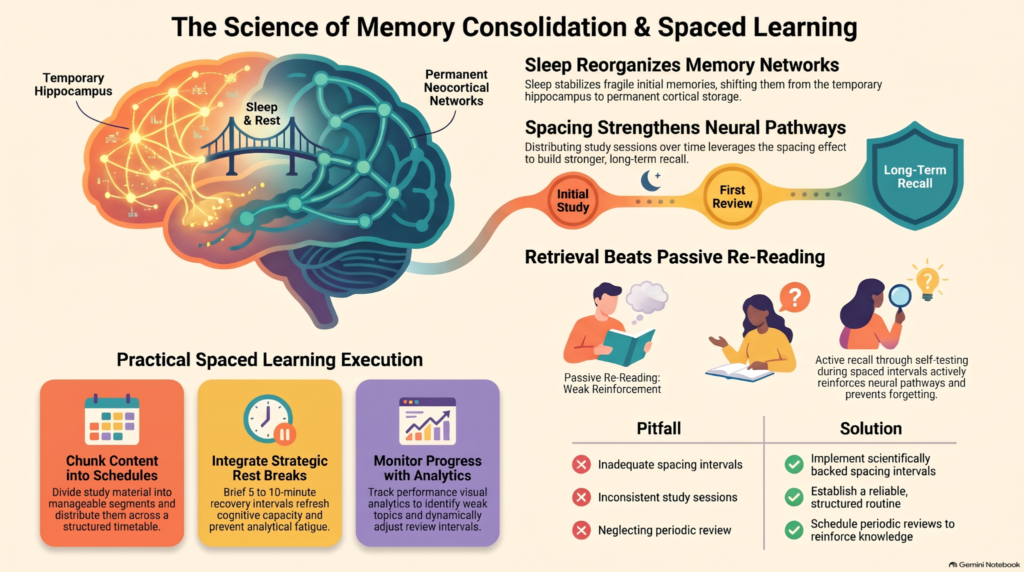
Memory consolidation is the remarkable neurobiological process that transforms fragile, newly acquired information into stable, long-term memories your brain can retrieve years later. This intricate mechanism occurs when neural pathways strengthen and reorganise, shifting memories from temporary storage in the hippocampus to permanent networks distributed across the cortex. Without consolidation, every lesson learnt, skill practised, and experience gained would fade within hours or days. Understanding how your brain accomplishes this transformation holds the key to making any learning truly stick.
Memory consolidation is a critical cognitive process that transforms newly acquired information into stable, long-term memories. This intricate mechanism involves the stabilization and integration of memories, allowing individuals to retain knowledge over extended periods. It occurs primarily during sleep and involves the reorganization of neural connections, thereby enhancing memory retention.
Research indicates that effective memory consolidation is essential for learning and skill acquisition, as it enables individuals to apply knowledge in real-world scenarios.
Understanding memory consolidation is crucial for educators and those seeking to support others in their learning journeys. By recognizing how cognitive processes function, they can implement strategies that optimize memory retention.
For instance, reinforcing material through various methods can facilitate this consolidation, ensuring that learners not only absorb information but also retain it effectively. This awareness empowers educators to create supportive environments that enhance learning outcomes and foster lifelong knowledge retention in their students.
The Science Behind Spaced Learning Techniques
While traditional learning methods often emphasize cramming information in short periods, research supports the effectiveness of spaced learning techniques for enhancing long-term retention. This approach aligns with key neuroscience principles, highlighting how the brain processes and consolidates information.
Spaced learning involves distributing study sessions over time, which allows for the gradual strengthening of neural connections. Cognitive psychology further explains that this method leverages the spacing effect, where information is more easily recalled when study sessions are spaced apart. Understanding the psychology of effective learning strategies helps educators recognize how spaced learning supports memory consolidation, strengthens knowledge retention, and promotes deeper understanding among students.
By incorporating intervals of rest, learners benefit from sleep, which is essential for memory consolidation. These techniques not only enhance retention but also promote deeper understanding, enabling learners to apply knowledge more effectively.
Consequently, spaced learning stands as an important strategy in educational practices, fostering a more profound and lasting mastery of content, ultimately serving the broader goal of empowering others through education.
How Spaced Learning Improves Retention
Research indicates that spaced learning markedly enhances retention by strategically timing study sessions to optimize memory formation. This approach leverages spaced repetition, a technique that involves intervals between learning sessions, allowing the brain to consolidate information more effectively.
Studies demonstrate that when learners revisit material at spaced intervals, they reinforce neural pathways, leading to stronger long-term memory retention.
Furthermore, spaced learning aligns with cognitive principles such as the testing effect, where retrieval practice enhances recall. Understanding why testing improves long-term memory helps educators see how regular retrieval practice strengthens neural pathways, reinforces learned information, and improves students’ ability to retain knowledge over time. By utilizing effective retention techniques, educators can foster deeper understanding and memorization in students.
The implementation of spaced repetition not only aids in information retention but also encourages a more engaged and active learning environment. Consequently, educators committed to serving their students’ needs should consider integrating spaced learning strategies to enhance educational outcomes and support lifelong learning.
Practical Strategies for Implementing Spaced Learning
Integrating spaced learning into educational practices requires a systematic approach that prioritizes effective scheduling and resource allocation. Educators can employ several practical strategies to enhance learning outcomes through this method.
- Chunk Information: Break content into manageable segments and distribute them across sessions. This aligns with memory techniques that facilitate better retention.
- Create a Revision Schedule: Develop a structured timetable that integrates regular intervals for revisiting material. This promotes long-term retention and reinforces key concepts, employing effective revision strategies.
- Utilize Active Recall: Encourage students to actively engage with the material by testing themselves at spaced intervals. This approach not only enhances memory consolidation but also fosters deeper understanding.
To make spaced learning more engaging and organized, students can use additional worksheets, practice activities, and educational resources from the engineering teacher shop to review key concepts, reinforce their understanding, and strengthen long-term memory retention.
Top Pitfalls in Spaced Learning and How to Avoid Them
Memory systems select from the thousands of stimuli in the environment those to encode permanently. Scientists have tried to understand long-term memory (LTM) processes through a variety of approaches including using repeated, spaced stimuli (Ebbinghaus, 1913; Pavlov, 2010). Pavlov and his associates focused on memory encoding of demonstrably new associations (a link between the sound of a bell and food), and Ebbinghaus on memory retrieval, testing himself with word-like sequences of nonsense syllables. For almost a century after these first studies there remained two intractable issues: first, what was the physical basis of LTM encoding, and second, how could it be triggered most effectively? (Fields, 2005, 2011).
Although spaced learning has proven to be an effective method for enhancing retention and understanding, several common pitfalls can undermine its effectiveness. Pitfall identification is essential for maximizing this learning strategy. Common issues include inadequate spacing intervals, which can lead to cognitive overload, and inconsistent scheduling that disrupts the learning process.
To avoid these pitfalls, educators and learners should prioritize effective scheduling and adhere to a structured approach.
| Pitfall | Solution |
| Inadequate spacing | Implement scientifically backed intervals |
| Inconsistent practice | Develop a consistent study routine |
| Lack of focus | Minimize distractions during sessions |
| Ignoring feedback | Regularly assess understanding |
| Neglecting review sessions | Schedule periodic reviews to reinforce knowledge |

CRAFTING YOUR IDEAL STUDY SCHEDULE
Whenever we talk about spaced learning and breaks, students often mistake the idea for simple procrastination. But there is a massive operational difference between slacking off and deliberate, scheduled recovery. Outside the classroom, I spend my weekends at the woodworking bench, shaping timber with hand planes and chisels. If you take a piece of raw green wood and immediately try to carve a precision mortise-and-tenon joint, the wood will twist, warp, and crack as its internal moisture shifts unevenly. You have to let the timber season over time, adjusting to ambient conditions between cuts, or the joint will never hold structural load.
The human brain handles technical problems in precisely the same way. When my engineering students sit down and spend three solid, uninterrupted hours banging their heads against fluid dynamics problem sets, their analytical precision begins to degrade rapidly. They start making elementary sign errors and misapplying boundary conditions because their working memory is saturated. Taking a ten-minute walk away from the screen or stepping outside to breathe isn’t lost time; it is the vital seasoning period that allows neural circuits to reset.
When you return to the desk, you suddenly spot the governing equilibrium equation that seemed invisible forty minutes earlier. By spacing your reps and stepping back before fatigue compromises your baseline reasoning, you give your mind the necessary clearance to assemble complex pieces into a clean, enduring framework.
Crafting an effective study schedule requires prioritizing study topics to guarantee that focus is directed towards the most critical material first.
Research indicates that incorporating regular breaks enhances cognitive processing and retention, ultimately supporting memory consolidation.
Prioritize Your Study Topics
Effective study schedules are essential for maximizing learning outcomes, as they enable students to allocate their time and resources efficiently.
Prioritizing study topics through careful topic selection is vital for fostering deeper understanding and retention. Students can enhance their learning by following these steps:
- Assess Importance: Identify subjects that carry more weight in exams or future applications.
- Evaluate Difficulty: Recognize topics that challenge understanding and require additional focus.
- Set Goals: Establish clear objectives for each study session to enhance motivation and direction.
Schedule Regular Breaks
Maximizing study effectiveness not only involves prioritizing topics but also requires attention to the structure of study sessions themselves.
Scheduling regular breaks is essential for enhancing cognitive performance and retention. Research indicates that incorporating brief intervals, typically lasting five to ten minutes, provides considerable cognitive refreshment. During these breaks, students can engage in physical activities or mindfulness exercises to rejuvenate their mental state.
This practice prevents cognitive fatigue, allowing for improved focus during subsequent study periods. Furthermore, strategically timed breaks encourage better memory consolidation, as information is more effectively retained when spaced over time.
Ultimately, a well-structured study schedule that includes appropriate break durations can greatly aid students in achieving their academic goals while promoting overall well-being.
How to Track Your Progress With Spaced Learning?
Spaced repetition is an evidence-based learning technique that is usually performed with flashcards. Newly introduced and more difficult flashcards are shown more frequently, while older and less difficult flashcards are shown less frequently in order to exploit the psychological spacing effect. The use of spaced repetition has been proven to increase the rate of learning.
Tracking progress in spaced learning requires setting clear goals that align with desired learning outcomes.
Additionally, the use of progress tracking tools can provide quantitative data to evaluate retention and understanding over time.
Set Clear Goals
As learners engage in spaced learning, establishing clear goals becomes essential for measuring progress and enhancing retention.
Goal setting not only provides direction but also aids in outcome visualization, allowing learners to picture their success.
To effectively track progress in spaced learning, individuals can consider the following strategies:
- Define Specific Objectives: Clearly articulate what knowledge or skills one aims to achieve during each spaced learning session.
- Set Timelines: Establish a realistic timeframe for accomplishing each goal, ensuring accountability and motivation.
- Evaluate Progress Regularly: Periodically assess one’s understanding and retention to identify areas needing improvement.
Utilize Progress Tracking Tools
While learners often recognize the importance of progress tracking in spaced learning, the effective use of various tools can greatly enhance their ability to monitor advancement and retention.
Progress tracking tools, such as digital learning platforms and mobile applications, offer valuable learning analytics that aid in evaluating individual growth. These tools provide insights into study habits, identify areas needing improvement, and optimize learning schedules based on performance data.
By systematically documenting their progress, learners can make informed adjustments to their study techniques. Additionally, visual representations of progress, such as graphs and charts, foster motivation and accountability.
Ultimately, utilizing progress tracking tools empowers learners to take charge of their educational journey, facilitating a deeper understanding of the material through spaced learning methodologies.

RELATED STUDIES ABOUT MEMORY CONSOLIDATION SPACED LEARNING STUDIES
To sum up, while some may argue that cramming is more efficient for short-term results, the evidence supports spaced learning as a superior method for long-term retention and understanding. By integrating memory consolidation principles into study habits, students can enhance their academic performance and deepen their mastery of subjects. Embracing structured spaced learning techniques can transform the educational experience, fostering a more profound engagement with material that extends well beyond the classroom.
Memory consolidation during sleep: a facilitator of new learning?
Conceptual Framework and Theoretical Rationale
- Active Systems Consolidation (ASC) Model: Sleep plays an established role in stabilizing newly formed memories and preparing the brain to acquire new information. The dominant ASC framework posits that episodic memories initially rely on the hippocampus to bind distributed neocortical representations. During non-rapid eye movement (NREM) sleep, coordinated dialogues between neocortical slow oscillations (<1 Hz), thalamocortical sleep spindles (12–15 Hz), and hippocampal sharp-wave ripples (100–300 Hz) drive the repeated reactivation of these memory traces. Over time, this dialogue strengthens cortico-cortical connectivity, integrating memory into semantic networks until retrieval becomes independent of the hippocampus.
- The Resource Reallocation Hypothesis: A prominent theoretical assumption derived from the ASC framework is that overnight consolidation directly clears finite hippocampal encoding capacity. By offloading old memory traces to neocortical circuits, sleep is assumed to reduce hippocampal burden during retrieval, thereby freeing up neural resources to facilitate next-day hippocampus-dependent learning.
- Core Review Objective: The authors critically evaluate the empirical viability of the resource reallocation hypothesis, reviewing evidence for its two primary tenets, examining direct behavioral and neuroimaging tests, proposing alternative mechanistic models, and outlining an experimental roadmap to resolve current inconsistencies.
Evaluation of the Core Tenets of Resource Reallocation
- Tenet 1: Sleep-Associated Consolidation Reduces Hippocampal Burden:
- Evidence Supporting Reallocation: Several functional magnetic resonance imaging (fMRI) investigations show that episodic retrieval elicited less hippocampal activation following a 24-hour delay containing sleep, or following a 90-minute nap rich in slow-wave sleep (SWS), relative to immediate retrieval or post-wake conditions. SWS duration and the magnitude of slow-wave activity (<1 Hz) correlate with decreased hippocampal activation during post-sleep retrieval. Furthermore, prior schemas (pre-existing knowledge) accelerate this transfer, with higher spindle density predicting accelerated reductions in hippocampal retrieval demands.
- Contradictory and Nuanced Evidence: Other studies indicate that a single night or two of sleep is insufficient to render episodic memories hippocampal-independent. Gais et al. (2007) found stronger hippocampal activation and enhanced hippocampal-neocortical functional connectivity two days post-encoding in sleeping versus sleep-deprived subjects, with hippocampal independence emerging only at a six-month follow-up. Additionally, Joensen et al. (2024) demonstrated that hippocampal pattern completion persists alongside emergent neocortical reinstatement after a 24-hour delay, showing that hippocampal and neocortical systems often operate additively rather than via mutually exclusive handoffs.
- Tenet 2: Sleep Restores Hippocampal Capacity for New Learning:
- Established Sleep Facilitation: Numerous human behavioral studies and meta-analyses confirm that post-sleep episodic encoding is significantly superior to encoding following total sleep deprivation or extended wakefulness.
- Functional Evidence: fMRI studies demonstrate that sleep deprivation disrupts hippocampal recruitment during learning, leading to memory deficits that persist even after subsequent recovery sleep.
- Oscillatory Manipulation: Acoustic disruption of slow waves during SWS impairs subsequent hippocampal encoding without altering total sleep time. Conversely, enhancing slow oscillations via non-invasive electrical transcranial stimulation or closed-loop auditory stimulation during NREM sleep enhances next-day learning capacity and encoding-related hippocampal activation in younger adults.
Direct Empirical Tests of the Resource Reallocation Hypothesis
Despite indirect evidence supporting both individual tenets, direct tests examining whether the amount of memory consolidated during sleep correlates with the capacity for next-day learning have yielded inconsistent results:
- Initial Cross-Domain Testing (Guttesen et al., 2022): Healthy young adults encoded a visuospatial memory task before sleep (or sleep deprivation) and completed a paired-associates learning task the following morning. While sleep enhanced both overnight retention and next-day encoding compared to sleep deprivation, there was no significant correlation between overnight memory consolidation and next-day learning capacity in the sleep group. Furthermore, slow oscillatory activity was not linked to a relationship between the two processes.
- Task-Homogeneous Testing (Guttesen et al., 2025): To rule out task-modality mismatches, participants encoded word pairs before sleep and learned a new set of word pairs the following morning. Preregistered analyses again showed no significant correlation between overnight consolidation and subsequent learning. However, exploratory analyses controlling for individual baseline learning differences revealed a significant positive correlation between overnight retention and next-day learning that was absent in wake control participants.
- Synthesis: Current empirical data offer only weak, preliminary support for an intrinsic, causal dependency between overnight consolidation and next-day learning capacity.
Alternative Mechanistic Accounts
In the absence of clear causal coupling between consolidation and next-day encoding, the authors outline two alternative neurobiological frameworks:
- 1. Synaptic Homeostasis Hypothesis (SHY) – A Shared Underlying Mechanism:
- Rather than active systems reorganization freeing space, wakefulness causes progressive, widespread synaptic potentiation, saturating neural circuits.
- During SWS, slow oscillations mediate a global downscaling and renormalisation of synaptic weights.
- This downscaling prunes weaker synaptic connections while preserving stronger ones, simultaneously boosting signal-to-noise ratios for recently consolidated memories and desaturating global synaptic weights to restore the brain’s baseline capacity for new encoding. Under SHY, memory consolidation and refreshed learning capacity occur concurrently as parallel byproducts of synaptic renormalisation rather than through a sequential causal chain.
- 2. Discrete Oscillatory Rhythms – Independent Opposing Mechanisms:
- Slow-wave sleep comprises distinct rhythmic components: slow oscillations (<1 Hz) and delta waves (1–4 Hz).
- Optogenetic evidence in rodents (Kim et al., 2019) reveals functional dissociation: disrupting slow oscillations (<1 Hz) impairs memory consolidation, whereas disrupting delta waves (1–4 Hz) enhances memory retention by preventing forgetting.
- Under this model, slow oscillations drive memory reactivation and systems redistribution, while delta waves independently prune synaptic connections to restore next-day learning capacity. Consolidation and encoding restoration are therefore driven by distinct, non-contingent mechanisms.
Methodological Roadmap and Future Research Directions
The authors outline specific experimental strategies required to rigorously validate or refute the resource reallocation hypothesis:
- Direct Neuroimaging of the Encoding-Retrieval Shift: Conduct longitudinal fMRI studies examining whether the degree of reduced hippocampal engagement during retrieval of old memories directly predicts the magnitude of hippocampal activation during the encoding of new memories across multi-night intervals (1, 2, and 7+ nights).
- Controlling for Baseline Encoding Variance: Future protocols must train participants to a fixed criterion (e.g., 80% accuracy) at initial encoding to eliminate baseline learning differences that obscure correlations between overnight consolidation and next-day learning.
- Causal Modulation via Closed-Loop Stimulation: Deploy closed-loop auditory stimulation or transcranial electrical stimulation during NREM sleep to selectively boost or disrupt memory reactivation, using mediation analyses to test whether changes in post-sleep learning are directly mediated by consolidation efficacy.
- Optogenetic and Oscillatory Dissociation: In animal models, optogenetically disrupt global slow oscillation-spindle coupling. If disruption impairs consolidation while leaving post-sleep encoding intact, it would provide definitive evidence that sleep-dependent learning restoration operates independently of systems consolidation.
| REFERENCE: Anna á V. Guttesen, Marcus O. Harrington, Melanie K. Fleming, M. Gareth Gaskell, Scott A. Cairney, Memory consolidation during sleep: a facilitator of new learning?, Neuropsychologia, Volume 221, 2026, 109320, ISSN 0028-3932, https://doi.org/10.1016/j.neuropsychologia.2025.109320. (https://www.sciencedirect.com/science/article/pii/S0028393225002556) |
Latent persistence in fMRI dynamics during human memory consolidation
Conceptual Framework and Research Rationale
- Systems Memory Consolidation: Long-term memory consolidation involves the progressive reorganization and stabilization of fragile, newly acquired memory traces into persistent representations. While diverse empirical theories—such as the Standard Model, Multiple Trace Theory (MTT), the Transformation Hypothesis, and Reconsolidation Theory—and mathematical models emphasize different aspects of this process, validating competing frameworks against human empirical neuroimaging data remains challenging.
- Limitations of Conventional Approaches: Standard blood-oxygen-level-dependent (BOLD) functional magnetic resonance imaging (fMRI) analyses typically rely on General Linear Models (GLMs) that focus on regional activation magnitudes or static functional connectivity. These methods often miss the latent, time-evolving, nonlinear dynamics that govern how neural circuits reorganize across consolidation stages.
- The Koopman Operator Framework: Originating in dynamical systems theory, the Koopman operator lifts nonlinear state dynamics into an infinite-dimensional function space where the system evolves linearly. By approximating this operator using Dynamic Mode Decomposition (DMD), nonlinear fMRI signals can be spectrally decomposed into eigenvalues, eigenfunctions, and spatial modes. In this spectral representation, eigenvalue magnitudes quantify temporal persistence: eigenvalues approaching unity ($\vert{}\lambda\vert{} \approx 1$) indicate slowly decaying, persistent latent modes (invariant representations), whereas smaller magnitudes indicate transient, rapidly dissipating dynamics.
- Core Research Objectives:
- Formalize dominant consolidation theories into three distinct functional clusters based on their predicted latent stability profiles.
- Formulate an observability-aware, data-driven Koopman learning framework tailored to multivariate fMRI time series.
- Empirically test hypothesis-driven spectral predictions against three open-access fMRI datasets.
Conceptual Clustering and Theoretical Predictions
The authors categorized empirical and computational accounts of memory consolidation into three functional clusters based on their expected dynamical stability fingerprints:
- Cluster 1: Standard Consolidation Model (H1):
- Theoretical Premise: Newly formed traces initially depend heavily on the hippocampus and gradually transition toward neocortical autonomy over time.
- Predicted Spectral Signature: Remote memory retrieval will exhibit greater latent stability than recent retrieval, marked by higher mean eigenvalue magnitudes and a higher count of near-unit eigenmodes ($0.95 < \vert{}\lambda\vert{} < 1.0$).
- Cluster 2: Episodic Replay During Rest (H2):
- Theoretical Premise: Post-encoding rest intervals serve as critical windows where memory patterns undergo transient, stochastic reactivations and cycles of destabilization/restabilization.
- Predicted Spectral Signature: Post-encoding resting and reactivation intervals will display labile, transient modes with broader eigenvalue dispersion across retrieval-rest cycles compared to encoding states.
- Cluster 3: Distributed Long-Term Storage and Transformation (H3):
- Theoretical Premise: Grounded in MTT, the Transformation Hypothesis, and Complementary Learning Systems (CLS), memory traces transition from context-rich, episodic representations into semanticized, abstracted schemas supported by persistent, distributed hippocampal-neocortical networks.
- Predicted Spectral Signature: Semanticized, abstracted autobiographical content will demonstrate greater latent persistence and near-unit modes than event-specific episodic recall.
Methodology and Mathematical Formulation
- Hypothesis-Driven Dataset Selection:
- Cluster 1 (Standard Consolidation): Dataset ds005581 (N=20), contrasting encoding versus remote (24-hour delay) and recent similarity judgment retrieval tasks.
- Cluster 2 (Episodic Replay): Dataset ds003721 (N=35), involving encoding of distressing film clips interleaved with 5-minute post-encoding rest periods (with button indication [BI] of spontaneous intrusions) and 24-hour delayed cued reactivation (React).
- Cluster 3 (Distributed Storage): Dataset ds003511 (N=39), evaluating overt autobiographical recall categorized into Internal (event-specific episodic details) versus External (semantic, generalized, or non-event-specific details).
- Standardized Preprocessing and ROI Extraction:
- Executed in SPM12 using minimally processed, unresliced functional volumes normalized directly to MNI space via unified segmentation deformation fields. Spatial smoothing, slice timing correction, and temporal filtering were omitted during image processing to preserve native high-frequency dynamics and cross-regional covariance.
- Regions of Interest (ROIs): Extracted from memory-related hubs—hippocampus (HPC), medial prefrontal cortex (mPFC), angular gyrus (AG), and lateral temporal cortex (LTC)—using the BASC Cambridge atlas. Signals were detrended, high-pass filtered at 0.01 Hz, and z-scored.
- Observability-Aware Koopman Learning:
- Lifting Map: A trainable nonlinear mapping (yt) lifts ROI signals ytRp into latent coordinates ztRd, where dynamics evolve approximately linearly: zt+1Kzt, with linear output reconstruction yt=Czt.
- Observability Regularization: To prevent trivial or unidentifiable latent spaces, an observability Gramian Wo,=i=0-1(Ki)CCKi was integrated into the loss function via an observability penalty: Lobs=-(Wo,+I). This term maximizes output-level distinguishability and latent state conditioning.
- Stability Enforcement: Real Schur decomposition (K=QUQ) was applied with spectral shrinkage/retraction to strictly bound the spectral radius within the unit disk ((K)1-), ensuring well-conditioned, stable discrete-time operators.
- Statistical Inference: Subject-level within-subject permutation testing (shuffling condition labels across runs) generated empirical null distributions, reported alongside paired-sample effect sizes (Cohen’s dz).
Key Empirical Findings
- Cluster 3: Distributed Long-Term Storage (Robust Subject-Level Validation):
- Dataset ds003511 yielded the clearest and most statistically reliable subject-level contrast across all evaluations.
- External (semanticized/abstracted) autobiographical details exhibited significantly higher mean eigenvalue magnitudes than Internal (episodic) details (EXT=0.9852 vs. INT=0.9839; mean difference =+0.0013; p=0.017,dz=0.39).
- External details also demonstrated a significantly higher count of near-unit modes (EXT=56.87 vs. INT=55.64; mean difference =+1.23; p=0.008,dz=0.45).
- This confirms that abstracted, semantic memory representations recruit slower-decaying, more persistent latent dynamical modes across the hippocampal-neocortical network than context-rich episodic memories. However, because this contrast evaluated detail types rather than a direct longitudinal interval, it indexes representational transformation rather than a direct temporal consolidation effect.
- Cluster 2: Episodic Replay During Rest (Task-State Differentiation):
- Dataset ds003721 exhibited marked, statistically significant condition separation across all pairwise comparisons at the subject level (p=0.0001,N=35).
- Spectral persistence followed a consistent hierarchical ordering: Post-encoding rest (BI; mean $\vert{}\lambda\vert{} = 0.9795$, near-unit count =45.86) > Delayed cued reactivation (React; mean $\vert{}\lambda\vert{} = 0.9685$, near-unit count =39.69) > Active film encoding (Film; mean $\vert{}\lambda\vert{} = 0.9570$, near-unit count =35.71).
- While lower persistence during film viewing supports the premise that encoding dynamics are more transient and heterogeneous than post-encoding rest, the resulting within-subject effect sizes were exceptionally large (dz ranging from 1.50 to 12.73). This magnitude indicates that the separation was heavily driven by broad task structure (e.g., passive continuous film watching vs. unconstrained rest) alongside consolidation-related replay.
- Cluster 1: Standard Consolidation (Subtle, Non-Significant Trends):
- Dataset ds005581 revealed that remote retrieval (24-hour delay) showed a slightly higher mean eigenvalue magnitude than recent retrieval ($\text{Remote } \vert{}\bar{\lambda}\vert{} = 0.9836$ vs. $\text{Recent } \vert{}\bar{\lambda}\vert{} = 0.9834$).
- Although directionally consistent with standard consolidation theory, this subject-level difference was small and statistically non-significant (p=0.599,dz=-0.12,N=20).
- Across all conditions in this dataset, eigenvalues were concentrated near unity ($\mathbb{E}[\vert{}\lambda\vert{}] \approx 0.985$), suggesting potential ceiling effects at standard BOLD fMRI temporal resolution (TR2s) that may mask subtle short-term (24-hour) systems transfers.
- Network-Level vs. Regional Dynamics:
- Because operators were trained on multivariate snapshot pairs spanning all four ROIs simultaneously, the resulting eigenvalues reflect global network stability.
- The findings demonstrate network-wide persistence but emphasize that attributing stability to individual nodes (e.g., confirming a specific shift from hippocampus to mPFC) requires dedicated spatial mode projection.
Theoretical, Systems, and Methodological Implications
- Consolidation as Latent Dynamical Stability: The study formalizes memory consolidation from static regional activation changes into an operator-theoretic stability problem: persistent memory traces correspond to near-unit Koopman eigenmodes ($\vert{}\lambda\vert{} \approx 1$) that evolve slowly in latent space.
- Support for Representational Transformation: The robust distinction between semantic/external and episodic/internal details provides quantitative support for the Transformation Hypothesis and Multiple Trace Theory. Semanticized memory structures exhibit greater dynamical resilience and slower decay within distributed cortical networks.
- Observability-Aware Formulation: Integrating the finite-horizon observability Gramian into DMD objective functions resolves ill-conditioning and ensures that latent dynamical coordinates remain mathematically identifiable from fMRI readouts.
- Subject-Level vs. Pooled Inference: The authors demonstrate that pooled operators (aggregated across participants) can diverge from subject-level averages due to inter-individual variance. Valid scientific inference requires subject-level estimation combined with non-parametric permutation testing.
Study Limitations and Future Directions
- Hemodynamic and Temporal Resolution Constraints: BOLD signals represent an indirect, sluggish hemodynamic proxy of underlying neural firing, which limits the resolution of rapid, millisecond-scale synaptic replay events.
- Linearity of Lifted Dynamics: Finite-dimensional Koopman approximations assume that lifted coordinates evolve approximately linearly, which remains a numerical surrogate for complex, nonlinear biological networks.
- Confounding Task Architecture: In replay paradigms (Cluster 2), differentiating endogenous memory consolidation from differences in sensory input, run length, and cognitive task constraints remains difficult without specialized baseline controls.
- Recommended Extensions: Future work should deploy this operator-theoretic framework on high-temporal-resolution modalities (e.g., magnetoencephalography [MEG], intracranial EEG), apply hierarchical mixed-effects models to capture participant-specific variances, and track longitudinal memory transformations across multi-week and multi-month delays.
| REFERENCE: Maria Bartzioka, Mohammad Khosravi, Latent persistence in fMRI dynamics during human memory consolidation, NeuroImage: Reports, Volume 6, Issue 3, 2026, 100398, ISSN 2666-9560, https://doi.org/10.1016/j.ynirp.2026.100398. (https://www.sciencedirect.com/science/article/pii/S2666956026000814) |
Does overnight memory consolidation support next-day learning?
Conceptual Framework and Research Rationale
The Active Systems Consolidation (ASC) model posits that newly encoded declarative memories initially rely on the hippocampus, which binds disparate neocortical representations. During slow-wave sleep (SWS), repeated, coordinated reactivations between slow oscillations, sleep spindles, and sharp-wave ripples drive a systems-level reorganization, gradually transferring memory representations to the neocortex for long-term storage.
A foundational, theoretical implication of the ASC framework is the “resource reallocation” or “encoding capacity” hypothesis: by disengaging the hippocampus from maintaining older memories, sleep-dependent consolidation is assumed to free up finite hippocampal resources, directly refreshing the brain’s capacity for next-day learning. While prior studies have established that sleep deprivation impairs subsequent encoding and daytime naps restore learning capacity, these paradigms evaluate total sleep loss rather than normal physiological variation.
Furthermore, a prior laboratory investigation (Guttesen et al., 2022) found no correlation between overnight retention of visuospatial memories and next-day encoding of word-image pairs, though this null result may have stemmed from using qualitatively divergent memory modalities. The present study directly tests whether overnight memory consolidation correlates with next-day learning when evaluated within the same declarative memory domain (semantically related word pairs) across typical 12-hour sleep/wake cycles.
Core Research Hypotheses:
- Declarative memory retention will be significantly superior across a 12-hour delay containing overnight sleep compared to a 12-hour delay of daytime wakefulness.
- Next-day encoding of new word pairs will be significantly enhanced following sleep compared to wakefulness.
- Overnight memory retention will correlate positively with next-day learning performance in individuals who sleep, but not in those who remain awake.
Methodology and Experimental Design
- Study Architecture and Preregistration: Two preregistered online behavioral experiments (OSF: khwzm and jywwz) using a 12-hour/12-hour day-night delay design.
- Participant Cohorts:
- Experiment 1: 115 native English-speaking adults aged 18–30 (Sleep Group: N=57; Wake Group: N=58) recruited via Prolific.
- Experiment 2: 123 independent adults aged 18–30 (Sleep Group: N=58; Wake Group: N=65).
- Exclusion Controls: Preregistered exclusions removed participants failing attention checks, falling below a 20% immediate recall learning threshold, submitting $\ge 20\%$ blank or nonsense words, or reporting daytime naps in the wake group.
- Behavioral Memory Tasks:
- Word Pair Cued-Recall Task: 90 semantically related word pairs divided into three counterbalanced lists of 30 pairs. Participants learned 60 pairs in the pre-delay session. Immediate recall was tested on 30 pairs; delayed recall was tested on the remaining 30 un-tested pairs following the 12-hour interval. Word Pair Retention Index was quantified as: [delayed recall % – immediate recall %].
- New Learning Assessment: Immediately following the delayed test, participants encoded and were tested on a completely new set of 30 word pairs. Percentage correct on this novel set defined the Learning Index.
- Visuospatial Task (Experiment 1 only): Included 20 object locations on a grid trained to a criterion zone. Retention was quantified as the distance error difference: [immediate recall error – delayed recall error]. It was omitted in Experiment 2 to eliminate cross-task cognitive interference.
- Alertness and Vigilance Controls:
- Objective vigilance measured via a 3-minute Psychomotor Vigilance Task (PVT; tracking attention lapses >500ms) in Experiment 1.
- Subjective alertness tracked using the Stanford Sleepiness Scale (SSS) across both experiments.
- Statistical Modeling: Independent sample t-tests and Bayesian factors (BF10 for alternative, BF01 for null) evaluating group differences. Robust skipped Pearson correlations (with 95% bootstrapped confidence intervals and Zou’s test for comparing independent correlations) to detect and exclude bivariate outliers. Semi-partial correlations were conducted to evaluate retention-learning associations while holding initial baseline encoding performance constant.
Key Empirical Findings
- Sleep Supports Declarative Memory Consolidation:
- In Experiment 1, overnight sleep significantly improved memory retention relative to daytime wakefulness for both visuospatial locations (t(113)=2.54,p=.012,d=0.47,BF10=3.47) and word pairs (t(113)=3.19,p=.002,d=0.60,BF10=17.29).
- In Experiment 2, sleep-dependent consolidation of word pairs was replicated with an even larger effect size (t(121)=4.26,p<.001,d=0.77,BF10=484.93), likely due to reduced task interference and lower cognitive load from omitting the visuospatial task.
- Absence of a Sleep Benefit for Next-Day New Learning:
- In Experiment 1, post-delay word pair learning did not differ between the Sleep and Wake Groups (t(113)=0.97,p=.34,d=0.18), with Bayesian analysis providing substantial support for the null hypothesis (BF01=3.32).
- In Experiment 2, new learning was significantly higher in the Wake Group compared to the Sleep Group (t(121)=2.87,p=.005,d=0.52,BF10=7.36).
- In an integrated analysis combining both experiments (N=238), there was no significant difference in new learning between the Sleep and Wake Groups once baseline learning was accounted for (p=.089).
- Preregistered Tests of the Consolidation–Learning Link:
- Across both experiments, preregistered analyses revealed no significant correlation between overnight memory retention and subsequent new learning in the Sleep Group:
- Experiment 1: rskipped=0.13 (95% CI [–0.10, 0.33], BF01=2.14).
- Experiment 2: rskipped=-0.07 (95% CI [–0.31, 0.20], BF01=2.95).
- Integrated Dataset (N=115): rskipped=-0.01 (95% CI [–0.15, 0.14], BF01=4.57, indicating substantial evidence for the null).
- Unexpected Wake Correlation: In the Wake Group, preregistered analyses identified a significant negative correlation between retention and new learning (rskipped=-0.37 in Exp 1; rskipped=-0.22,p<.05 in the integrated cohort).
- Exploratory Analysis: The Masking Role of Baseline Encoding Capacity:
- Significant individual differences in baseline learning capacity were observed: immediate recall on initial word pairs strongly correlated with new learning of subsequent word pairs across all participants (rskipped=0.65,p<.001).
- Furthermore, immediate recall negatively correlated with the Retention Index (rskipped=-0.34 in Sleep, -0.59 in Wake), demonstrating that high baseline learners had more items available to forget, artificially driving negative retention scores.
- Controlling for Initial Encoding Performance: When a semi-partial correlation was conducted controlling for initial recall performance, the spurious negative relationship in the Wake Group disappeared (r=0.13,p=.16).
- In contrast, in the integrated Sleep Group, a statistically significant positive correlation emerged between overnight delayed recall and subsequent new learning (r=0.22,p=.020). This indicates that when baseline encoding ability is held constant, individuals who retain more over sleep exhibit superior next-day learning capacity.
- Alertness, Circadian, and Time-of-Day Controls:
- Objective PVT attention lapses did not differ between the Sleep and Wake Groups.
- Subjective sleepiness (SSS) was higher in the morning post-delay session for the Sleep Group, but correlation analyses confirmed that subjective sleepiness did not predict memory retention or new learning performance. Time-of-day testing showed no significant differences between morning and evening baseline performance.
Theoretical and Cognitive Interpretations
- Nuancing the Active Systems Resource Reallocation Account: The lack of a direct, raw correlation between overnight consolidation and subsequent learning challenges the simplified assumption that sleep automatically clears hippocampal space in a 1-to-1 manner. Systems consolidation is a protracted biological process requiring weeks or months; a single night of sleep may only initiate the hippocampal-to-neocortical transfer.
- The Interplay of Individual Differences: The emergence of a significant positive correlation (r=0.22) only after controlling for pre-sleep performance demonstrates that stable trait-level learning differences mask consolidation dynamics. High-performing individuals encode more, forget more items in absolute terms, and learn more subsequent items, introducing statistical artifacts unless baseline capacity is controlled.
- Alternative Explanations (Passive Protection and Synaptic Downscaling):
- The retention benefit of sleep may partially reflect passive protection against waking contextual interference (Contextual Binding Theory), as waking participants encounter continuous interference while sleeping participants do not.
- Under the Synaptic Homeostasis Hypothesis (SHY), memory stabilization and refreshed learning capacity may operate as parallel byproducts of global slow-wave synaptic downscaling rather than as a strict sequential requirement where consolidation must precede new encoding.
Study Limitations and Methodological Recommendations
- Online Testing Limitations: The study utilized an online testing framework (Prolific/Pavlovia/Gorilla). Although rigorous attention checks and response-latency criteria were enforced, polysomnographic sleep staging (e.g., EEG quantification of slow oscillations and sleep spindles) was not collected.
- Circadian and Diurnal Asymmetry: The 12-hour/12-hour paradigm inherently confounds sleep and wake with time of day (morning vs. evening testing), which may explain why wake participants slightly outperformed sleep participants in raw post-delay learning in Experiment 2.
- Future Experimental Directions:
- Confirmatory trials must employ fixed-criterion learning protocols (training all participants to a specific threshold, such as 80% accuracy) at initial encoding to eliminate baseline learning variability.
- Implement 24-hour designs or multi-day intervals (e.g., testing at 24 hours, 48 hours, or 7 days at identical times of day) to track systems-level redistribution over extended delays.
- Integrate simultaneous EEG and closed-loop auditory stimulation during slow-wave sleep to manipulate slow oscillations and examine whether selective enhancement of consolidation directly mediates next-day encoding capacity.
| REFERENCE: Anna á V. Guttesen, Marcus O. Harrington, M. Gareth Gaskell, Scott A. Cairney, Does overnight memory consolidation support next-day learning?, Cognition, Volume 264, 2025, 106241, ISSN 0010-0277, https://doi.org/10.1016/j.cognition.2025.106241. (https://www.sciencedirect.com/science/article/pii/S0010027725001817) |
CONCLUSION
At the end of every academic term, the grade distributions tell the exact same story with striking consistency. The students who earn top marks and walk away with genuine mastery are rarely the ones who pulled heroic, caffeine-fueled all-nighters in the campus library. Instead, they are the quiet, methodical planners who treated their calendar like an engineering drawing. They blocked out sixty to ninety minutes for focused problem derivation, scheduled periodic reviews days in advance, and, most critically, protected their eight hours of sleep like an unbreakable design constraint.
Exam season will always test your endurance, but treating your brain like an engine run continuously past its redline is simply poor stewardship of your tools. As engineers, we design mechanisms to withstand fatigue through balanced load cycles, proper lubrication, and planned maintenance—we would never expect a turbine to survive constant peak stress without failure. Hold your own learning process to that exact same engineering standard.
Give your concepts the space they need to ferment, allow your neural pathways the overnight rest required to permanently consolidate the day’s work, and step into every exam confident that your mental foundation has been built to bear real weight. Structure your routine deliberately, respect the recovery intervals, and let the science do the heavy lifting.
