

Over my twelve years in engineering lecture halls and board review programs, I have watched countless capable students grind themselves down to sheer exhaustion. They sit through twelve-hour cramming sessions armed with energy drinks and fluorescent highlighters, operating under the assumption that academic triumph is strictly an endurance sport. As an engineer, whenever a machine overheats and operates with declining efficiency despite higher energy consumption, I do not demand more wattage—I look at the underlying architecture. Human cognitive architecture operates on identical constraints.
Learning is not about forcing raw hours into an unwilling system; it is about respecting how our neural circuitry processes, stores, and accesses data. Early in my academic career, I fell victim to that same brute-force trap until I began examining learning through cognitive psychology. The human brain simply was not engineered to absorb walls of static text through brute repetition.
Our memory pathways decay predictably when deprived of active retrieval and timely reinforcement. When you understand how working memory bridges into long-term storage, you stop treating study sessions as a test of willpower. Instead, you begin calibrating your study habits like an optimized control loop—one where efficiency, timing, and mental recovery yield superior retention with a fraction of the friction.
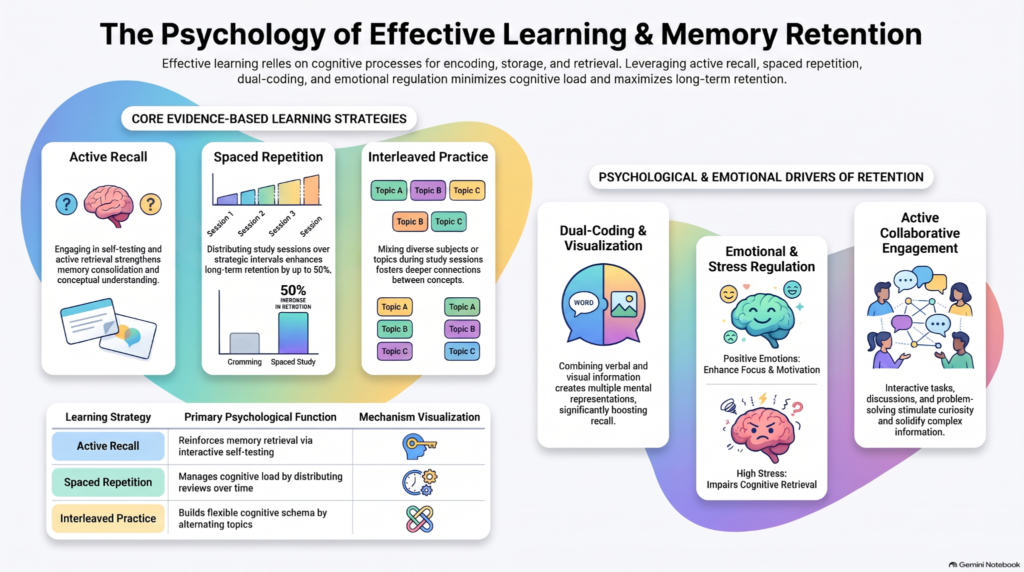
The psychology of effective learning strategies emphasizes cognitive processes that enhance memory retention. Techniques such as active recall, spaced repetition, and elaboration are rooted in sound psychological principles, promoting deeper understanding and better retention. Active engagement through interactive activities and collaboration stimulates curiosity and solidifies information. Additionally, managing cognitive load and utilizing dual-coding theory can greatly bolster recall. Further exploration reveals more about how to tailor these strategies for ideal academic success.
KEY TAKEAWAYS
- Active recall and self-testing reinforce memory retention by actively engaging students in the learning process.
- Spaced repetition enhances long-term retention by revisiting material at strategic intervals, reducing cognitive load.
- Interleaved practice improves comprehension by mixing different subjects, promoting deeper connections between concepts.
- Emotional engagement through interactive activities fosters stronger memory retention by creating positive associations with the material.
- Personalized learning strategies, including varied methods and collaborative study, cater to individual preferences and enhance understanding.
FOUNDATIONAL PRINCIPLES OF LEARNING AND MEMORY: WHAT YOU NEED TO KNOW
The intricate relationship between learning and memory forms the cornerstone of effective educational strategies. Contemporary learning theories emphasize the significance of cognitive processes in acquiring knowledge, while memory models elucidate how information is stored and retrieved.
For instance, the dual-coding theory posits that integrating verbal and visual information enhances retention, supporting the notion that diverse instructional methods can foster deeper understanding. Furthermore, the multi-store model of memory outlines how information shifts from sensory memory to short-term and eventually long-term storage, highlighting the importance of rehearsal and meaningful engagement.
Research indicates that effective learning environments are those that acknowledge the interplay between these theories and models, enabling educators to design curricula that promote active learning. By understanding these foundational principles, educators can better facilitate knowledge retention and transfer, ultimately serving the diverse needs of their students and fostering a culture of lifelong learning.
Top Learning Strategies for Effective Study Habits
While numerous study habits exist, certain learning strategies have consistently demonstrated effectiveness in enhancing academic performance. Among these, active recall has emerged as a powerful tool for reinforcing memory retention. Research indicates that actively retrieving information aids in deeper cognitive processing. Students can strengthen their understanding of complex subjects by using visual aids, hands-on activities, and interactive resources. Educational materials from the engineering teacher shop can complement these approaches by providing practical learning tools that make challenging concepts easier to understand and remember. Additionally, optimizing the study environment—characterized by minimal distractions and a conducive atmosphere—can greatly impact learning outcomes.
| Learning Strategy | Description |
| Active Recall | Engaging in self-testing to enhance memory retention. |
| Spaced Repetition | Distributing study sessions over time for better retention. |
| Interleaved Practice | Mixing different subjects or topics during study sessions. |
| Study Environment | Creating a distraction-free and comfortable space for studying. |
| Elaboration | Connecting new information to existing knowledge for deeper understanding. |
These strategies not only facilitate effective study habits but also cultivate a learning culture that benefits both individuals and communities.
The Role of Active Engagement in Retention
Active engagement considerably enhances information retention by fostering deeper cognitive involvement. Research indicates that active participation in the learning process, such as through interactive learning activities, considerably bolsters memory retention and comprehension. When students engage with material through discussions, problem-solving, or collaborative projects, they are more likely to assimilate and recall information effectively. This method encourages learners to connect new knowledge with prior experiences, facilitating a richer understanding.
Moreover, studies highlight that interactive learning environments stimulate curiosity and motivation, essential factors for sustained engagement. By actively participating, students can clarify misunderstandings and reinforce concepts, ultimately leading to improved academic performance.
Implementing strategies that promote active engagement not only supports individual learning but also cultivates a dynamic educational atmosphere. Consequently, educators and facilitators are encouraged to design curricula that prioritize active participation, thereby enhancing the overall learning experience and promoting lasting retention of information.
The Influence of Emotions on Learning Retention
Take behaviourism, for instance. It zeroes in on those observable actions and how we can influence them with things like rewards or punishments. It emphasises how external factors shape our learning journey. This perspective has led to some practical, real-world tools for managing classrooms and designing lessons.
Research indicates that emotional engagement greatly enhances memory retention, as emotions can create stronger associations with the material learned.
Conversely, high levels of stress have been shown to negatively impact retention rates, highlighting the importance of emotional regulation in educational settings.
Additionally, positive emotions are linked to improved learning outcomes, suggesting that fostering a supportive and encouraging environment can facilitate effective learning.
Emotional Engagement Enhances Memory
How do emotions shape the process of learning and retention?
Emotional engagement greatly enhances memory consolidation, facilitating deeper understanding and recall. Research indicates that emotional resonance can transform mundane information into memorable experiences.
Key factors include:
- Connection: Emotions foster stronger connections to the material.
- Motivation: Engaged learners exhibit higher motivation levels, leading to sustained effort.
- Attention: Emotional stimuli capture attention, enhancing focus on relevant information.
- Context: Emotional experiences create contextual cues that aid retrieval.
These elements collectively underscore the importance of emotional engagement in educational settings, suggesting that educators should leverage emotional resonance to optimize learning outcomes.
Stress Impacts Retention Rates
At its core, educational psychology seeks to understand how individuals learn and retain information and how teachers can facilitate this process. The field encompasses various factors—cognitive development, motivation, memory, and learning environments—that influence student success. Here are some key research findings from educational psychology that inform best practices in teaching and instructional design.
Stress greatly influences retention rates, often undermining the learning process. Research indicates that heightened stress levels can impair cognitive functions, particularly memory consolidation and retrieval.
In educational contexts, students experiencing significant stress may find it challenging to absorb and retain information, leading to decreased academic performance. Effective stress management strategies are essential for enhancing learning outcomes.
Implementing relaxation techniques, such as mindfulness meditation or deep breathing exercises, can alleviate stress and foster a conducive learning environment. Studies have shown that students who practice these techniques demonstrate improved focus and retention capabilities.
Positive Emotions Facilitate Learning
Emotional states considerably shape the learning process, with positive emotions playing a pivotal role in enhancing retention. Research indicates that fostering positive emotions can greatly improve learning outcomes through various mechanisms, including:
- Increased engagement: Positive emotions foster a deeper connection with the material.
- Enhanced memory encoding: Emotional intelligence enables better integration of information.
- Motivation boost: Positive reinforcement encourages sustained effort and interest in learning.
- Stress reduction: Positive emotions counteract anxiety, creating a conducive learning environment.
These findings underscore the importance of integrating emotional strategies in educational settings, as they not only improve retention but also cultivate a more supportive atmosphere for learners.

WHY SPACED REPETITION WORKS FOR BETTER LEARNING
Whenever I mentor engineering candidates preparing for licensing exams, their initial reaction to evidence-based techniques like active recall and spaced intervals is genuine resistance. They often ask me why rereading a chapter feels smooth and comforting, while closing the textbook and forcing themselves to write out a derivation from scratch feels agonizing. My answer is straightforward: ease is frequently an illusion of competence. In cognitive psychology, this mental friction is precisely where retrieval pathways strengthen. When you passively re-read, your eyes glide over familiar syntax, tricking your brain into thinking it owns concepts it merely recognizes.
Understanding the psychology of learning is essential for educators, students, and institutions aiming to improve academic outcomes. Learning is not just about memorizing facts, it is a complex cognitive, emotional, and social process influenced by multiple factors.
Real comprehension requires systematic feedback. Just as an electrical engineer relies on closed-loop feedback to stabilize voltage, a student needs continuous retrieval practice to identify signal distortion and gaps in memory. I always advise my students to ditch passive re-reading in favor of structured elaboration and visual mapping—breaking complex principles down into functional blocks and explaining the mechanism aloud.
Spacing these retrieval sessions across days rather than hours stops working memory overload and gives neural synaptic networks time to consolidate. When you embrace the cognitive strain of recalling facts unassisted, retention stops being a gamble and turns into an engineered certainty.
Research indicates that spaced repetition effectively manages cognitive load by distributing learning over time, which reduces the overwhelming pressure of cramming.
This method enhances long-term memory retention by reinforcing neural connections at strategically timed intervals, allowing for better consolidation of information.
Consequently, spaced repetition serves as a powerful tool in optimizing the learning process.
Cognitive Load Management
Cognitive load management is a critical factor in enhancing learning outcomes, particularly through the technique of spaced repetition. This approach promotes cognitive efficiency by strategically spacing study sessions, allowing for ideal load reduction.
Research indicates that effective cognitive load management can lead to improved retention and understanding. Key principles include:
- Chunking Information: Breaking down complex information into manageable pieces.
- Timing of Repetitions: Distributing learning sessions over time to enhance recall.
- Active Engagement: Incorporating activities that require learners to interact with the material.
- Minimizing Extraneous Load: Reducing distractions to focus on essential content.
Long-Term Memory Retention
Spaced repetition has emerged as a powerful strategy for enhancing long-term memory retention, effectively leveraging the principles of cognitive load management previously discussed.
Research indicates that this technique aligns with memory consolidation techniques, allowing learners to revisit information at ideal intervals, thereby reinforcing neural pathways.
By integrating retrieval practice methods, spaced repetition encourages active engagement with material, which greatly boosts retention rates compared to massed practice.
Studies show that spacing learning sessions helps to combat forgetting and promotes deeper understanding of the subject matter.
This method not only aids in retaining knowledge but also fosters a lifelong learning mindset, ultimately equipping individuals to better serve others through informed decision-making and expertise in their respective fields.
Boosting Recall With Visualization and Mnemonics
While many learners struggle to retain information effectively, employing visualization and mnemonic techniques can greatly enhance memory recall. Research indicates that these strategies facilitate deeper cognitive processing, leading to improved retention. Using diagrams, charts, and color-coded notes, along with practical study tips for visual learners, can help students organize complex information and improve memory recall.
Key methods include:
- Mind Mapping: Creating visual representations of information to show relationships and hierarchies.
- Acronyms: Formulating memorable words from the initial letters of a list, aiding in recall.
- Imagery: Associating concepts with vivid mental images, which can enhance memory pathways.
- Chunking: Breaking down large amounts of information into smaller, manageable units for easier retention.
How to Design Your Personalized Learning Strategy for Success
Designing a personalized learning strategy is essential for achieving academic and professional success. Effective strategies must align with personalized goals and utilize adaptive techniques tailored to individual learning preferences. Research indicates that personalized approaches enhance engagement and retention, fostering a deeper understanding of material. These personalized approaches can help students identify the best way to study for a test by considering their individual learning preferences, academic goals, and areas that need improvement.
| Personalized Goals | Adaptive Techniques | Examples of Implementation |
| Define academic objectives | Utilize spaced repetition | Schedule review sessions |
| Identify strengths and weaknesses | Incorporate varied learning methods | Use videos, podcasts, and reading |
| Set realistic timelines | Monitor progress and adapt | Use analytics tools for feedback |
| Engage in collaborative learning | Join study groups | Participate in peer teaching sessions |

RELATED STUDIES ABOUT PSYCHOLOGY OF EFFECTIVE LEARNING STRATEGIES
To summarize, effective learning strategies are underpinned by a nuanced understanding of cognitive psychology and memory retention. Research indicates that spaced repetition can enhance retention rates by up to 50% compared to traditional study methods. By incorporating active engagement, emotional connections, and techniques such as visualization and mnemonics, students can greatly improve their ability to recall information. Ultimately, tailoring personalized learning strategies based on these principles can lead to more successful educational outcomes and deeper mastery of content.
User regret psychology-driven electric vehicle charging navigation strategy based on deep reinforcement learning and transfer learning
Conceptual Framework and Research Rationale
The rapid adoption of electric vehicles (EVs) and the expansion of public charging stations (CSs) create complex interdependencies between urban transportation networks (TNs) and power distribution networks (PDNs). Uncoordinated EV charging behavior exacerbates traffic congestion, unevenly distributes charging station queues, and stresses local electrical infrastructure.
Existing electric vehicle charging navigation (EVCN) algorithms typically optimize system performance by minimizing total travel time, driving distance, or financial expenditure under the assumption of complete traveler rationality. However, real-world driver behavior deviates from perfect rationality; human drivers make decisions based on bounded rationality and user regret psychology. Traditional Regret Theory (RT) models in EVCN suffer from three fundamental limitations:
- Static and Single-Shot Formulations: They evaluate choices at the moment of request generation, failing to capture dynamic uncertainties that unfold across the journey, such as evolving traffic speeds, fluctuating waiting times, and changing battery state-of-charge (SOC).
- Predefined Choice Set Restrictions: They limit decisions to selecting the minimum-regret option from a fixed list of conventional paths, missing novel or dynamic routing options.
- Attribute Estimation Inaccuracies: Complex, stochastic traffic conditions make it difficult to estimate the unchosen alternatives’ attributes accurately, leading to erroneous regret values and suboptimal navigation.
Core Research Objectives:
- Construct a dynamic EVCN model grounded in regret theory that incorporates multiple operational uncertainties (traffic speeds, queue waiting times, initial SOC, electricity tariffs).
- Formulate a transfer learning (TL) mechanism driven by an improved Jaccard similarity metric to accurately estimate the attributes of comparison strategies from historical trajectory replay buffers.
- Deploy a Double Deep Q-Network (DDQN) reinforcement learning algorithm to optimize navigation decisions dynamically, concurrently determining the optimal CS destination and real-time charging routes to minimize cumulative regret.
Methodological Architecture and Mathematical Modeling
- Regret-Theory-Based EVCN Optimization Model:
- Strategy Costs: Evaluates total cost as a combination of time cost (Cs=wTTs) and electricity cost (Ms=pk(1-Es)Ecap). Total time (Ts) encompasses driving time (Tsdri), charging waiting time (Tswai), and charging time (Tscha). Time is monetized using the traveler’s unit time value (wT).
- Comparison Strategies Set (Socom): Rather than comparing solely against the single shortest path, the top r shortest paths to each of the k charging stations from initial origin node o are established as the comparison baseline (kr comparison strategies).
- Semi-Compensatory Regret Formulation: If an unchosen comparison strategy b outperforms the selected strategy s in either time cost or electricity cost, a regret penalty is incurred proportional to the difference; if strategy s is superior, zero regret is assigned for that attribute. The overall regret of strategy s relative to comparison strategy b is:Rs,b={0,Cs-Cb}+{0,Ms-Mb}. The global regret of strategy s is governed by the maximum regret across all comparison options: $R_s = \max\{R_{s,1}, R_{s,2}, \dots, R_{s,b}\}$.
- Objective Function: Formulated as a stochastic optimization problem minimizing global strategy regret subject to routing continuity, flow conservation, battery capacity, and queuing constraints: Rs.
- Transfer Learning (TL) Attribute Estimation with Improved Jaccard Similarity:
- Experience Replay Buffer 1 (D1): Stores historical trajectories of EVs traveling between origin-destination pairs to form a source domain.
- Improved Jaccard Similarity: Standard Jaccard set similarity considers only unique element presence, failing when navigation routes contain repeated nodes. The authors integrate element occurrence frequency:JY,Z=zYZ(countY(z),countZ(z))zYZ(countY(z),countZ(z)).
- Weighted Attribute Transfer: The top H historical strategies with the highest similarity to the target comparison strategy are normalized and weighted to predict driving times (Tbdri). This estimate is blended with static environmental observations to provide robust attribute values under dynamic traffic conditions.
- Double Deep Q-Network (DDQN) Decision Engine:
- Markov Decision Process (MDP) Formulation:
- State Space (st): Encodes current time t, previous node nt-1 (to prevent backtracking loops), current node nt, current SOC Et, real-time CS electricity prices PC,t, and real-time CS waiting times TC,twai.
- Action Space (at): Selecting the next adjacent node uOi to traverse.
- Reward Function (rt): Terminal reward upon charging completion based on normalized strategy regret: rt=(Rmax-Rs)/(Rmax-Rmin), providing dense feedback for gradient optimization.
- Decoupled Network Architecture: Employs an evaluation network (t) to select actions and a separate target network (t’) to evaluate Q-values, mitigating overestimation bias inherent in conventional DQN. An -greedy exploration schedule balances exploratory routing against policy exploitation.
Experimental Configuration and Case Study Setup
- Transportation Network Topology:
- Baseline Network: 34-node, 55-line urban network partitioned into inner-ring (red, mean speed 36 km/h), middle-ring (yellow, mean speed 56 km/h), and outer-ring (green, mean speed 108 km/h) zones following truncated normal speed distributions.
- Fast Charging Stations: Three fast CSs located at nodes 5, 17, and 24, each equipped with 10 charging piles delivering 180 kW at 90% charging efficiency.
- Time-of-Use (TOU) Pricing: Peak (0.987 ¥/kWh), flat (0.610 ¥/kWh), and valley (0.320 ¥/kWh) tariffs.
- Fleet Specifications: Battery capacity of 64 kWh, consumption rate of 0.21 kWh/km, initial SOC uniformly distributed U(0.4,0.6), and unit time value wT=8.7903¥/h. Fifty EVs participated simultaneously in 24-hour simulations with 3-minute discrete time steps.
- Large-Scale Network (Scalability Test): 108 nodes, 170 road segments, 4 fast CSs (nodes 105, 106, 107, 108 with 20 piles each), and 300 concurrent EVs.
Key Empirical Findings and Performance Benchmarks
- Transfer Learning Attribute Estimation Accuracy:
- The proposed TL-based estimation method was benchmarked against the traditional static prediction method (calculating travel times solely based on traffic conditions at the moment of request generation).
- Relative to static predictions, the TL method reduced Mean Squared Error (MSE) by 49% (from 2153.29 to 1102.25), Root Mean Squared Error (RMSE) by 28% (from 46.40 to 33.20), Mean Absolute Error (MAE) by 21% (from 27.08 to 21.40), and Mean Absolute Percentage Error (MAPE) from 6.55% to 5.85%.
- The coefficient of determination (R2) increased from 0.90 to 0.95, confirming that transferring historical route experiences accurately estimates unchosen comparison strategy attributes under stochastic conditions.
- Convergence and Regret Reduction:
- During training, DDQN rewards stabilized around 0.94–0.95 after 800 episodes.
- Strategy regret exhibited a continuous decline from initial exploration (~10) to a converged level of 0.34, matching or slightly outperforming the theoretical minimum regret achievable among the fixed comparison strategies.
- Benchmark Comparisons Against Conventional Navigation Strategies:
- Compared against Shortest Distance (SD) and Shortest Driving Time (SDT) algorithms:
- Shortest Distance (SD): Minimizes driving distance (4.96 km) and electricity cost (19.69 ¥), but overlooks traffic congestion and CS queue buildup. This led to severe congestion at central CS 17, driving average charging waiting time to 747.50 s and yielding the highest total cost (24.19 ¥) and highest regret (1.65).
- Shortest Driving Time (SDT): Achieves the lowest driving time (326.35 s), but fails to prevent queue accumulation at popular stations (average waiting time 338.70 s), resulting in an average cost of 23.24 ¥ and regret of 0.62.
- Proposed TL-DDQN Method: Achieved an average driving distance of 5.74 km, driving time of 340.32 s, and cut charging waiting time down to 175.36 s. It delivered the lowest overall travel-charging cost (22.84 ¥) and lowest strategy regret (0.34)—representing a 45% reduction in regret relative to SDT and 79% reduction relative to SD.
- Sensitivity to Operational Factors (Price vs. Time Value):
- Electricity Price Sensitivity: Applying incremental price surcharges (+0.1 and +0.2 ¥/kWh) to CS 17 caused the regret associated with electricity cost to outweigh time cost regret. As a result, EVs dynamically shifted to CS 5 and CS 24, with EV selection ratio at CS 17 dropping from ~97% to near 0%, balancing regional grid utilization.
- Unit Time Value Sensitivity: When user time value was increased to 6× and 11× baseline, time cost regret dominated decision-making. Despite elevated charging prices at CS 17, EVs resumed selecting CS 17 due to its shorter transit and waiting times, confirming that the model reflects bounded human trade-offs between expenditure and time.
- System Adaptability and Scalability:
- Environmental Adaptability: The trained agent was subjected to abrupt disruptions every 1,000 episodes:
- Scenario 2 (CS 17 price hike of +0.4 ¥/kWh).
- Scenario 3 (CS 5 capacity halved to 5 piles, simulating hardware outage).
- Scenario 4 (15% of road links disabled, simulating physical network failure).
- Across all disturbance scenarios, the model adjusted its policy parameters and restored convergence approximately 5 times faster than baseline training, consistently lowering regret by >50% and total costs by ~10% compared to SD and SDT.
- Scalability Validation (108-Node Network): In the expanded 108-node, 300-EV environment, the algorithm converged within 1,200 episodes. The proposed method achieved a strategy regret of 0.62 and total cost of 26.15 ¥, outperforming SD (regret 6.56, cost 28.70 ¥) and SDT (regret 4.55, cost 27.38 ¥), confirming that the framework scales to large metropolitan traffic networks.
Practical Implications and Engineering Insights
- User-Centric Charging Infrastructure Coordination: Incorporating regret psychology produces navigation policies that align with actual human decision-making, increasing driver adherence to automated guidance systems.
- Alleviating Grid and Traffic Congestion: By continuously penalizing excessive waiting times within the regret calculation, the system autonomously diverts charging demand away from congested urban core stations toward underutilized peripheral stations, smoothing spatial charging loads without requiring centralized mandatory dispatch.
- Computational Feasibility for Real-Time Deployment: Offloading heavy computation to offline DDQN training and using transfer learning for rapid attribute estimation allows sub-second inference, meeting the real-time operational demands of vehicle onboard units and mobile navigation applications.
Study Limitations and Future Directions
- Single Vehicle Agent Perspective: While 50 to 300 EVs operate in the environment, the algorithm models individual agent decision-making against a background environment rather than deploying multi-agent reinforcement learning (MARL) with explicit inter-agent communication.
- Station Queuing Assumptions: The model assumes first-come, first-served (FCFS) queuing and continuous full-charge departures (charging to 100% SOC), omitting partial fast-charging behaviors common in commercial ride-hailing fleets.
- Future Research Extensions: The authors outline future extensions to examine tighter physical coupling between PDN power-flow constraints (voltage stability, transformer loading), dynamic carbon emission factors, and bidirectional vehicle-to-grid (V2G) interaction mechanisms.
| REFERENCE: Pengwei Zhuang, Changxu Jiang, Hao Xu, Junjie Lin, User regret psychology-driven electric vehicle charging navigation strategy based on deep reinforcement learning and transfer learning, International Journal of Electrical Power & Energy Systems, Volume 172, 2025, 111075, ISSN 0142-0615, https://doi.org/10.1016/j.ijepes.2025.111075. (https://www.sciencedirect.com/science/article/pii/S0142061525006234) |
Explainable artificial intelligence in cognitive learning psychology: A psychometric meta-analysis
Conceptual Framework and Research Rationale
- Measurement Challenges in Cognitive Learning Psychology: In cognitive psychology, defining and measuring constructs such as attention, working memory, executive function, learning transfer, and metacognition often suffers from indistinct boundaries and variable psychometric precision. The deployment of artificial intelligence (AI) models in educational contexts has largely relied on “black-box” systems, limiting transparency, interpretability, and pedagogical trust.
- The Role of Explainable AI (XAI): Explainability techniques (such as SHAP, LIME, Grad-CAM, Layer-wise Relevance Propagation [LRP], and attention rollout) have primarily been treated as algorithmic visualization safeguards rather than psychometrically validated measurement instruments. Furthermore, data-driven XAI models frequently reduce dynamic, contextual human learning into static feature-outcome mappings, risking misalignment with established cognitive learning theories (e.g., Cognitive Load Theory, Constructivism).
- Core Research Objectives:
- Conduct a systematic psychometric meta-analysis synthesizing empirical research on XAI applications in cognitive learning psychology across higher education.
- Deploy science mapping and network clustering to delineate the intellectual and thematic architecture of XAI within cognitive psychology.
- Empirically validate whether XAI explainability metrics correspond to established psychometric reliability and validity standards, supporting their transition from post hoc descriptive tools into theoretically grounded, valid measurement models.
Methodology and Review Architecture
- Search Strategy and PRISMA Protocol: A systematic literature search was executed following PRISMA 2020 guidelines across PsycINFO, PubMed, Scopus, Web of Science, and IEEE Xplore covering studies published between January 1, 2015, and October 30, 2025.
- Screening and Final Corpus: From an initial pool of 3,426 records, 874 duplicates and 1,936 ineligible titles/abstracts were removed. Of 616 articles assessed via full-text review, 428 were excluded due to incomplete psychometric indices (n=176), limited transparency in XAI analyses (n=142), or insufficient cognitive alignment (n=110). The final synthesis comprised 188 empirical studies representing over 62,000 higher education participants worldwide.
- Study Typologies:
- Experimental studies: 78 studies (41.5%; testing model interpretability against behavioral and neurocognitive responses using CNNs, LSTMs, and hybrid transformer encoders).
- Simulation-based studies: 65 studies (34.6%; simulating latent cognitive constructs and error patterns via deep belief networks, autoencoders, and GNNs).
- Hybrid studies: 45 studies (23.9%; evaluating AI outputs and human behavioral indicators simultaneously via dual-layer validation).
- Bibliometric and Network Analyses: Bibliographic coupling, co-citation, and keyword co-occurrence mapping were implemented via VOSviewer and R Bibliometrix. Evaluated through Lotka’s law of author productivity (R2=0.962), Bradford’s law of journal dispersion (core zone = 18 journals), and Zipfian rank-frequency distribution (=1.08,R2=0.954).
- Psychometric Meta-Analytic Modeling:
- Effect sizes were modeled using Fisher’s z-transformation, disattenuated true-score correlation adjustments, and random-effects Bayesian Markov Chain Monte Carlo (MCMC) sampling (4 chains, 5,000 iterations; convergence criteria R1.01 and effective sample size >1,500).
- Model interpretability mechanisms were integrated into meta-regressions using surrogate models: SHAP values evaluated study-level moderator importance, LIME approximated local prediction surfaces, and permutation importance ranked feature weights.
- Quality Appraisal and Diagnostics: Assessed using the JBI Critical Appraisal Framework and an adapted Newcastle-Ottawa Scale with XAI credibility weighting. Robustness was verified through jackknife sensitivity resampling, Cook’s distance influence diagnostics, and Bayesian Egger’s regression for publication bias.
Key Empirical Findings
- Meta-Analytic Effect Estimates and Psychometric Soundness:
- Global Association: The Bayesian psychometric model revealed a stable, positive global hypermean effect linking XAI models to cognitive learning measures: =0.33 (back-transformed pooled correlation r=0.32, 95% Credible Interval [0.27, 0.38]; =0.05; =0.11).
- Heterogeneity: Between-study heterogeneity was moderate ($I^2 \approx 58\%; \tau^2 = 0.011\text{ to } 0.012$), reflecting consistent effects across diverse higher education populations and instructional settings.
- Measurement Model Fit: The second-order latent construct model demonstrated strong structural fit: CFI=0.95, TLI=0.93, RMSEA=0.045, SRMR=0.041, and 2/df=1.92.
- Reliability Metrics: Composite reliability (c=0.91), Cronbach’s alpha (=0.88), Average Variance Extracted (AVE=0.72), and test-retest stability (ICC=0.86) all met or exceeded established psychometric benchmarks. Discriminant validity was supported by a Heterotrait-Monotrait ratio (HTMT=0.43) well below the conservative 0.85 threshold.
- Cognitive Construct Representation and Domain Correlations:
- Corpus Distribution: Attention and visual cognition (29.3%), working memory representation (23.9%), and learning transfer/generalization (18.1%) represented over 70% of the synthesized studies.
- Positive Domain Correlations:
- Working memory representation: r=0.36 (95% CI [0.31, 0.40]; =0.90).
- Attention and visual cognition: r=0.33 (95% CI [0.29, 0.37]; =0.91).
- Metacognition and reflective learning: r=0.32 (95% CI [0.27, 0.36]; =0.88).
- Learning transfer and knowledge generalization: r=0.30 (95% CI [0.25, 0.34]; AVE=0.71).
- Reasoning and problem solving: r=0.29 (95% CI [0.24, 0.34]; =0.86).
- Affective-cognitive interaction: r=0.28 (95% CI [0.22, 0.33]; =0.89).
- Language and conceptual processing: r=0.27 (95% CI [0.21, 0.32]; =0.88).
- Theoretical Inverse Effect: Cognitive load and neural efficiency demonstrated a statistically significant negative association (r=-0.26, 95% CrI [-0.33,-0.18]). This aligns with Cognitive Load Theory regarding processing interference and mental resource depletion.
- Alignment Between XAI Techniques and Psychometric Validity:
- Cross-tabulation demonstrated that higher explainability interpretability correlated with stronger psychometric validity indices (r0.78,p<0.001; R2=0.79).
- SHAP: Strongest convergence with working memory and sequential attention models (ICC=0.88, stability index = 0.91, temporal fidelity = 0.83).
- Grad-CAM: Highest visual attribution integrity (0.86) and strong correlation with attention and visual cognition (r=0.78,p<0.001).
- Attention Rollout: Demonstrated high structural validity (CFI=0.95) and reflective reliability (0.85) in capturing metacognitive monitoring.
- LIME: Effectively modeled local approximations for learning transfer and problem-solving (=0.64, model fidelity = 0.81, cross-task transfer = 0.78).
- Strategic Thematic Mapping:
- Network co-word analysis identified a small-world modular structure (Q=0.392,S=1.22,p<0.001, mean centrality C=0.72, mean density D=0.64):
- Motor Themes (Q1; High Centrality, High Density): Cognitive load, neural efficiency, and attention/working memory frameworks (C=0.81,D=0.74) represent the core, well-developed backbone of the field.
- Niche Themes (Q2; Low Centrality, High Density): Metacognition and reflective learning (C=0.63,D=0.68) operate as highly specialized, internally coherent research areas.
- Basic Themes (Q3; High Centrality, Low Density): Psychometric validation and measurement fidelity (C=0.77,D=0.56) function as foundational methodological requirements.
- Emerging Themes (Q4; Low Centrality, Low Density): Affective-cognitive interaction and learning transfer generalizability (C=0.57,D=0.49) represent newer frontiers with high novelty (0.71).
- Sensitivity and Influence Diagnostics:
- Study quality appraisal yielded a weighted mean of 0.780.10, exceeding the 0.65 threshold.
- Jackknife leave-one-out analyses and domain-level exclusions produced minimal parameter variation (r=0.31to0.33,2=0.009to0.017). Cook’s distance values remained below critical levels (mean Cook’s D=0.041), confirming that no single study distorted the pooled conclusions.
Theoretical, Practical, and Policy Implications
- Theoretical Integration: The findings demonstrate that explainability features correlate with established cognitive construct variance. Rather than treating XAI merely as post-modeling interpretation, XAI architectures can function as meta-level mechanisms that monitor and regulate cognitive information flow.
- Validating XAI as Measurement Instruments: The convergence of high reliability (=0.88,ICC=0.86) and model fit confirms that XAI systems (e.g., feature attribution matrices, attention maps) can serve as valid, quantifiable psychometric instruments within adaptive learning platforms.
- Educational System Design: In higher education, embedding transparent XAI models enables real-time cognitive monitoring. Educational software can dynamically tailor instructional complexity, optimize cognitive load, and provide interpretable formative feedback to both students and educators.
- Policy and Governance: Provides empirical justification for educational policymakers to mandate human-centered explainability standards in AI-driven tutoring systems, ensuring accountability, algorithmic fairness, and psychological validity.
Methodological Limitations
- Linguistic Restriction: Inclusion was limited to peer-reviewed English-language publications, potentially underrepresenting non-Anglophone higher education implementations.
- Approximation Bounds of XAI: Current explainability algorithms (e.g., LIME, SHAP) generate mathematical approximations of internal model parameters and do not fully capture human contextual reasoning or emotional nuance.
- Longitudinal Data Scarcity: The majority of analyzed datasets relied on cross-sectional implementations, leaving long-term cognitive adaptation, skill retention, and developmental trajectories under-examined.
- Publication Bias Potential: As with educational technology meta-analyses generally, preferential publication of statistically significant positive correlations remains a potential source of distortion.
| REFERENCE: Hanvedes Daovisan, Explainable artificial intelligence in cognitive learning psychology: A psychometric meta-analysis, Acta Psychologica, Volume 266, 2026, 106899, ISSN 0001-6918, https://doi.org/10.1016/j.actpsy.2026.106899. (https://www.sciencedirect.com/science/article/pii/S0001691826007006) |
Exploring positive psychology in robot-assisted language learning: A PERMA-based systematic review
Conceptual Framework and Research Rationale
Second and foreign language (L2) acquisition is an affective and psychological process heavily influenced by learners’ emotional and motivational states. Although earlier second language research primarily addressed negative emotions—notably foreign language anxiety and its inhibition of communicative performance—the field of applied linguistics has increasingly embraced Positive Psychology. Grounded in Seligman’s well-being theory, optimal human functioning relies on positive emotions, interest, curiosity, and psychological resources that support long-term learning motivation.
Advances in artificial intelligence and robotics have positioned Robot-Assisted Language Learning (RALL) as an intervention to address anxiety, motivation deficits, and limited communicative practice. Physically embodied robots provide a sense of social presence not achievable through flat, screen-based technologies. Crucially, learners perceive robots as patient, non-judgmental conversational partners, which helps lower the affective filter and creates a low-stakes environment for practice.
However, RALL implementations face major challenges, particularly the transient “novelty effect,” where initial excitement and engagement decline sharply over time once the unfamiliarity of the technology subsides. Prior reviews cataloged robot morphologies and target linguistic skills but lacked a comprehensive psychological framework to evaluate long-term flourishing. This review addresses that gap by systematically mapping empirical RALL literature onto the five dimensions of Seligman’s PERMA framework: Positive Emotion (P), Engagement (E), Relationships (R), Meaning (M), and Accomplishment (A).
Core Research Questions:
- RQ1: How do the affective outcomes reported in empirical RALL studies map onto the five dimensions of the PERMA model?
- RQ2: How do specific characteristics of educational robots (morphology, interactivity, expressiveness, adaptivity) relate to outcomes within each PERMA dimension, and what psychological mechanisms explain these relationships?
Methodology and Review Architecture
- Protocol and Eligibility Guidelines: Conducted in accordance with PRISMA 2020 standards. Inclusion criteria required English-language, peer-reviewed empirical studies (quantitative, qualitative, or mixed-methods) evaluating human learners interacting with physically embodied robots for language learning purposes. Studies relying solely on virtual agents, software applications, or purely cognitive performance metrics (e.g., vocabulary scores without affective measures) were excluded.
- Information Sources and Search Timeline: Systematic searches were executed on March 15, 2024, across five databases: Scopus, Web of Science, PsycINFO, ERIC, and Google Scholar, covering publications from 2004 (the inception of RALL) through early 2024.
- Screening and Selection Corpus: From 624 initially identified records, 88 duplicates were removed. Title and abstract screening excluded 441 irrelevant records, leaving 95 full-text articles. Sixty-four articles were excluded upon full-text review (due to lack of physical robots, non-empirical formats, or insufficient methodological detail to extract affective constructs), resulting in a final synthesis of 31 unique empirical studies.
- Analytical and Coding Protocol: Two independent reviewers extracted study metadata and mapped explicitly measured affective outcomes to PERMA dimensions. Crucially, dimensions were coded only when studies reported empirical data from dedicated scales, validated survey items, or direct behavioral metrics; implicit pedagogical intentions were excluded from coding. Due to pronounced heterogeneity in robot designs, target populations, and non-standardized outcome instruments, a narrative synthesis was conducted rather than a quantitative meta-analysis.
Key Empirical Findings Across PERMA Dimensions
- The Hedonic Clustering Pattern: The synthesis identified an uneven distribution across the PERMA model. Research heavily clustered around immediate, hedonic dimensions—Positive Emotion (26 studies) and Engagement (22 studies)—with 17 studies investigating them simultaneously. In contrast, deeper, eudaimonic dimensions were underexplored: Accomplishment appeared in 8 studies, Relationships in 6 studies, and Meaning in only 3 studies.
- Positive Emotion (P) – 26 Studies:
- RALL consistently increased learner motivation, enjoyment, satisfaction, and curiosity compared to conventional instructional methods or screen-based applications.
- Anxiety reduction emerged as a primary outcome: interacting with a non-judgmental robot significantly alleviated the fear of negative evaluation and making oral mistakes.
- Effect sizes were substantial in comparative trials; for instance, a study evaluating a robot vocabulary trainer versus traditional paper-and-pencil learning reported a high effect size (Cohen d = 0.97) for enhanced positive affect.
- Engagement (E) – 22 Studies:
- Physical embodiment and tangible interactivity captured and sustained learner attention more effectively than passive desktop computers.
- Multimodal social cues—including eye contact, synchronized gestures, and conversational turn-taking—promoted high behavioral and cognitive immersion.
- However, studies highlighted that while novelty elicits immediate engagement, motivation drops rapidly if the interaction relies merely on technological novelty without sound instructional design.
- Relationships (R) – 6 Studies:
- Human-Robot Bonding: Learners frequently formed parasocial bonds with robots, perceiving them as peers, friends, or supportive tutors rather than mechanical tools. This connection was reinforced by the robot’s inability to express anger or frustration.
- Social Mediation: Robots also acted as social catalysts in group learning, facilitating peer-to-peer collaboration, turn-taking, and joint problem-solving. However, these observed bonds were often context-dependent and superficial, lacking evidence of translation into broader interpersonal skills.
- Accomplishment (A) – 8 Studies:
- Providing immediate, non-threatening corrective feedback boosted learners’ perceived competence, self-efficacy, and willingness to communicate.
- Adaptive scaffolding based on learner performance (e.g., Bayesian Knowledge Tracing) generated notable gains; explaining adaptation decisions yielded significantly higher learning gains (Cohen d = 1.04).
- Methodological Shortcoming: Most studies inferred accomplishment indirectly from test scores or general participation rather than measuring self-efficacy or goal attainment through validated psychometric instruments.
- Meaning (M) – 3 Studies:
- Meaning was the least researched dimension. Existing evidence remained largely indirect, linked to Total Physical Response (TPR) tasks or situated role-play (e.g., ordering in a café, shopping simulations) that grounded language in real-world contexts.
- The literature lacked interventions exploring learners’ broader sense of purpose, cultural identity connection, or long-term personal aspirations related to language mastery.
The Role of Robot Characteristics and Psychological Mechanisms
- Robot Morphology and Typologies:
- Humanoid Robots (e.g., NAO, Pepper, Robovie): Most widely utilized (21 studies). Grounded in Social Presence Theory, their human-like form and gaze/head tracking elicit strong psychological responses of “being with a social other,” fostering positive emotions and engagement.
- Cartoon-like / Zoomorphic Robots (e.g., Tega, iCat, DragonBot): Emphasize expressive, non-threatening forms that build empathy, lower anxiety, and engage younger children.
- Mechanomorphic Robots (e.g., Scribbler): Highlight machine-like functionality, successfully supporting task-oriented learning and physical verb demonstrations.
- Expressiveness: Multi-degree-of-freedom joints, facial cues, tone modulation, and non-verbal reinforcement (e.g., celebratory eye-blinking, thumbs-up gestures) communicate empathy and social support, reinforcing self-efficacy and emotional valence.
- Adaptivity and Transparency: Systems that adjust instructional difficulty to individual learner states foster genuine accomplishment. Transparently explaining why an adaptation was made reduces cognitive load and confusion, particularly for struggling learners.
- Self-Determination Theory (SDT) Alignment: Non-judgmental robotic interactions fulfill learners’ needs for autonomy (practicing at one’s own pace) and competence (immediate, private feedback), enhancing intrinsic motivation.
Methodological Limitations of the Literature
- Small and Homogeneous Samples: Most studies evaluated small convenience samples (typically under 50 participants), limiting statistical power and demographic generalizability.
- Short-Term Interventions and Novelty Confounding: Research designs were overwhelmingly short-term—often single-session interventions lasting under an hour. This prevents disentangling genuine pedagogical and well-being gains from temporary novelty spikes.
- Lack of Methodological Control: Many trials lacked rigorous non-robot control groups (e.g., human-to-human tutoring or screen-based computer tasks), complicating causal attribution.
- Measurement Vulnerabilities: Affective outcomes relied predominantly on self-report surveys susceptible to social desirability bias, rather than objective physiological or behavioral measures.
- Technical Vulnerabilities: Automated speech recognition (ASR) errors, latency, and hardware malfunctions were documented across multiple studies, causing frustration, increasing learner anxiety, and disrupting perceived competence.
Theoretical Implications and Future Research Directions
- Shifting from Hedonic Boosters to Eudaimonic Flourishing: Future RALL design must move beyond novelty-driven entertainment toward eudaimonic development. The authors formulate three targeted research hypotheses:
- Targeting Meaning (M): Deploying robots as “L2 Cultural Informants” or social companions that guide discussions on cultural values, history, and real-world issues—rather than rote grammar drills—will foster deeper purpose and cultural identity.
- Targeting Accomplishment (A): Utilizing robots as “Goal-Setting Partners” equipped with transparent adaptive tutoring systems to track and celebrate long-term milestones will cultivate enduring self-efficacy.
- Targeting Relationships (R): Programming robots as “Social Mediators” in multi-party groups (managing turn-taking and supporting lower-proficiency peers) will foster genuine human-human collaboration rather than superficial human-robot attachments.
- Longitudinal and Experimental Dismantling Studies: Multi-week and semester-long implementations are required to observe whether well-being gains persist after novelty dissipates. Dismantling studies should systematically isolate specific robot capabilities (e.g., adaptive vs. non-adaptive feedback, presence vs. absence of physical gesture) to identify active causal mechanisms.
- Multimodal Objective Measurement: Supplement self-report questionnaires with objective biometrics, such as eye-tracking for sustained attention, facial expression analysis for positive valence, and acoustic voice analysis for communicative confidence.
- RALL as a Psychological Experimental Tool: Beyond applied pedagogy, socially embodied robots offer controllable, replicable testbeds for psychologists to manipulate specific non-verbal cues (e.g., gaze, prosody) and explore core mechanisms of anthropomorphism, social cognition, and human interaction.
| REFERENCE: Saman Ebadi, Amir Panahi Noor, Exploring positive psychology in robot-assisted language learning: A PERMA-based systematic review, Acta Psychologica, Volume 264, 2026, 106457, ISSN 0001-6918, https://doi.org/10.1016/j.actpsy.2026.106457. (https://www.sciencedirect.com/science/article/pii/S0001691826002581) |
CONCLUSION
When looking across academic cohorts and high-stakes licensure reviews, the dividing line between those who excel and those who plateau rarely comes down to raw talent. It almost always hinges on systematic habits and psychological sustainability. Cramming may occasionally push a student across the finish line of tomorrow’s quiz, but it leaves behind an empty cognitive shell—knowledge that evaporates within forty-eight hours, accompanied by chronic burnout and high stress. That is a catastrophic operational failure if your goal is long-term professional mastery.
Treat your brain as a finely tuned instrument rather than an infinite storage bin. When you integrate structured spacing, active retrieval, and clear visual organization, you create a workflow that protects both your retention rates and your mental equilibrium. Throughout my own work across research and curriculum design, my foundational rule has stayed constant: study systems must be designed for longevity.
Step back from the panic of marathon study sessions. Start treating your daily review as a series of intentional, micro-calibrated repetitions. Build a disciplined rhythm that leaves room for rest, reflection, and recovery. When you engineer your learning habits around sound cognitive science, enduring academic success will follow naturally.
