

As a learning support specialist working daily with engineering and technology undergraduates, I see a familiar cycle play out every semester. A student will spend eight hours preparing for a fluid dynamics or circuit analysis exam, perform reasonably well, and then feel genuine panic three weeks later when they cannot solve a fundamental prerequisite problem in design lab. They often walk into my office believing they simply lack natural aptitude or that their memory is fundamentally broken. I spend a lot of time reassuring them that their brains are actually functioning as biologically designed.
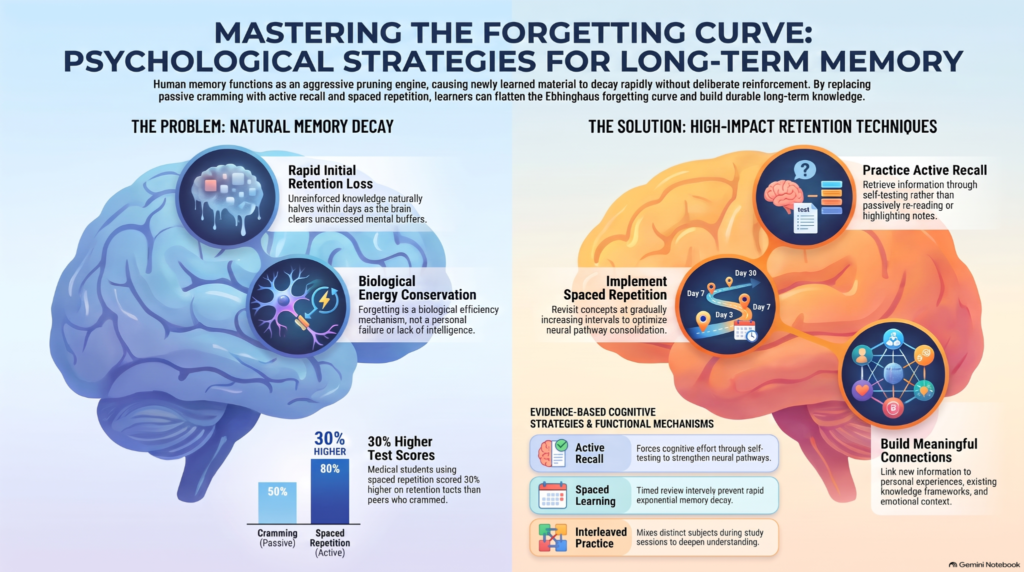
The human cognitive apparatus is an aggressive pruning engine. It does not treat information as valuable just because you looked at it for half the night while drinking an energy drink. Unless the brain receives deliberate signals that a piece of information is required for ongoing survival—or at least ongoing utility—it systematically clears the buffer to conserve metabolic energy.
Hermann Ebbinghaus mapped this predictable decay well over a century ago, yet modern education still often treats rapid forgetting as a personal failure rather than a baseline biological reality. When students understand the mathematical reality of the forgetting curve, the shame around memory lapses disappears. Instead of questioning their intelligence, they can begin treating memory retention like an engineering challenge that requires structured systems, intentional feedback loops, and sustainable review intervals.
The forgetting curve, formulated by Hermann Ebbinghaus, illustrates the decline of memory retention shortly after learning. This phenomenon emphasizes the impact of factors such as interference, decay, and cognitive load. Effective techniques, including spaced repetition and active recall, can combat rapid forgetting and enhance long-term memory. Additionally, emotional engagement and contextual learning serve to strengthen retention. Understanding these dynamics further illuminates the complexities of memory retention, encouraging deeper exploration of effective educational strategies.
KEY TAKEAWAYS
- The forgetting curve demonstrates rapid memory loss soon after learning, emphasizing the need for effective study strategies to retain information.
- Memory encoding and consolidation are crucial phases for long-term retention, requiring attention, emotional engagement, and techniques like spaced repetition.
- Regular review and spaced practice significantly enhance memory retention by preventing decay and reinforcing learned material over time.
- Active recall and interleaved practice promote deeper understanding and retention by involving retrieval and mixing different subjects during study sessions.
- Awareness of memory myths, such as overconfidence in recall, encourages the use of effective techniques like meaningful connections and self-testing for better retention.
UNDERSTANDING THE FORGETTING CURVE
The Ebbinghaus Forgetting Curve is a model showing how newly learnt information fades quickly without regular review. It shows how newly learned facts fade quickly without regular review. The curve reveals how fast this loss happens (Ebbinghaus, 1885). This idea is vital for helping learners remember.
Although many learners may not realize it, the Forgetting Curve, a concept developed by psychologist Hermann Ebbinghaus in the late 19th century, reveals critical insights into the retention of information over time. This phenomenon delineates how information is lost from memory, illustrating that forgetting occurs rapidly soon after learning.
Ebbinghaus identified various forgetting mechanisms, including interference and decay, which contribute to this decline. Understanding these mechanisms allows educators and learners to devise effective retention strategies.
For instance, spaced repetition promotes long-term retention by revisiting material at strategically timed intervals, counteracting the natural decline in memory. Additionally, active engagement with the material, such as summarization and self-testing, enhances retention.
How Memory Retention Changes Over Time
The forgetting curve is a psychological model that describes how information is lost over time when there is no attempt to retain it. Forgetting isn’t a linear process but a predictable decay shaped by several factors: the strength of the original encoding, the method of learning, emotional salience, and the frequency of review. The curve highlights the brain’s natural tendency to prioritize efficient storage, meaning information that isn’t used or recalled is quickly de-prioritized or pruned.
Memory retention is initially robust but experiences a noticeable decline over time, a phenomenon that can be quantitatively assessed through the forgetting curve.
Research indicates that the strongest memories typically fade within days or weeks if not reinforced, leading to significant long-term memory decay.
This relationship underscores the importance of retention strategies to mitigate the inevitable loss of information.
Initial Memory Retention
When individuals are exposed to new information, the initial phase of memory retention plays an essential role in determining how well that information will be recalled over time. This phase, known as initial encoding, involves the transformation of sensory input into a format suitable for storage in the brain.
The effectiveness of initial encoding is influenced by various factors, including attention and emotional engagement. Following this, memory consolidation takes place, whereby encoded information is stabilized and integrated into long-term memory. Encouraging building knowledge constructivism in learning allows students to connect new information with their existing understanding, actively develop meaningful concepts, and strengthen their ability to retain knowledge over time.
This process can be enhanced through techniques such as spaced repetition and active retrieval practices. Understanding the dynamics of initial memory retention is important for educators and practitioners aiming to improve learning outcomes and facilitate lasting knowledge retention in their students or clients.
Long-Term Memory Decay
The process of memory retention does not end with initial encoding and consolidation; it evolves over time, leading to long-term memory decay.
Research indicates that memory retention diminishes as cognitive load increases, making it increasingly challenging to retrieve information over extended periods. Factors such as interference, lack of rehearsal, and the passage of time contribute to this decay, highlighting the fragility of long-term memories. Applying principles of behaviorism in educational psychology can help educators reinforce learning through repetition, positive reinforcement, and consistent feedback, encouraging students to retain information and develop stronger study habits.
Educational strategies aimed at reinforcing memory retention, such as spaced repetition and active recall, can mitigate these effects.
Key Factors Affecting Memory Retention
The Ebbinghaus forgetting curve measures the decline of memory retention across time, showing how information is lost when there is no attempt to retain it. A related concept is the strength of memory that refers to the durability that memory traces in the brain. The stronger the memory, the longer period of time that a person is able to recall it. A typical graph of the forgetting curve purports to show that humans tend to halve their memory of newly learned knowledge in a matter of days or weeks unless they consciously review the learned material.
Memory retention is influenced by several key factors, particularly repetition and spaced practice, as well as emotional engagement and relevance.
Research indicates that repeated exposure to information, especially when spaced out over time, greatly enhances recall.
In addition, the emotional context and personal relevance of the material also play essential roles in solidifying memories, suggesting that engagement is as important as the frequency of review.
Repetition and Spaced Practice
Although learners often underestimate its significance, repetition and spaced practice serve as essential mechanisms for enhancing memory retention. Research indicates that these strategies facilitate active recall, a process where individuals retrieve information from memory, reinforcing neural connections.
Spaced practice, in particular, optimizes retention by introducing intervals between learning sessions, preventing cognitive overload and promoting deeper understanding. This method encourages retrieval practice, allowing learners to reinforce and test their knowledge over time.
As individuals revisit material in a structured manner, they enhance their ability to recall information in varied contexts. Ultimately, integrating repetition and spaced practice into educational strategies can greatly improve long-term memory retention and empower individuals to serve others effectively through knowledge dissemination.
Emotional Engagement and Relevance
When individuals encounter information that resonates emotionally or holds personal significance, their capacity for retention noticeably increases. Emotional resonance and personal relevance serve as critical catalysts in the learning process, enhancing memory retention through deeper cognitive engagement.
Research indicates that when learners connect emotionally with content, they are more likely to recall it later. Key factors influencing this relationship include:
- Personal Narrative: Stories that relate to an individual’s experiences can enhance memory.
- Motivation: Increased motivation linked to emotional engagement fosters greater retention.
- Contextual Learning: Situations that evoke strong emotions create memorable contexts.
- Social Connection: Learning in emotionally supportive environments strengthens memory pathways.
Incorporating these elements into educational practices can meaningfully improve long-term memory retention.

STUDY TECHNIQUES TO ENHANCE MEMORY
When we look at how students actually study, the gap between cognitive psychology and daily practice becomes obvious. In technical fields, learners tend to fall into the trap of passive re-reading, endless highlighting, and massed practice—cramming ten hours of differential equations into a single Sunday afternoon. From a cognitive perspective, this builds fluency, not durability. You recognize the steps on the page, mistake that recognition for mastery, and then hit an absolute wall when an exam requires unprompted retrieval. The research detailed in this guide underscores a crucial reality: memory trace stabilization demands cognitive effort. Without active recall and spaced intervals, the neural pathways responsible for retrieving that knowledge simply wither.
In my practice, I encourage engineering students to treat their study calendars like an automated cache-clearing prevention system. Instead of doing four hours of practice problems once before midterms, distribute that workload into twenty-minute retrieval sprints throughout the month. Modern knowledge-tracing research even demonstrates that different types of learning—such as procedural problem-solving versus conceptual definitions—decay along different mathematical functions.
You cannot treat solving a multi-step thermodynamic proof the exact same way you treat memorizing material properties. By pairing active self-testing with deliberately timed reviews, you force the brain to continually reconstruct neural pathways, fundamentally reshaping the forgetting trajectory from a steep cliff into a stable plateau.
Numerous study techniques have emerged as effective strategies for enhancing retention and recall, addressing the challenges posed by the forgetting curve. Among these, mnemonic devices and active recall stand out as particularly powerful methods. Mnemonic devices leverage associations to improve memory retrieval, while active recall emphasizes the importance of retrieving information from memory, thereby reinforcing neural connections.
| Technique | Description |
| Mnemonic Devices | Use of patterns, acronyms, or visual imagery to aid memory. |
| Active Recall | Testing oneself to reinforce memory retention and understanding. |
| Spaced Learning | Distributing study sessions over time to combat forgetting. |
| Interleaved Practice | Mixing different subjects or topics to enhance learning. |
These techniques not only facilitate deeper understanding but also empower learners to serve others by sharing knowledge more effectively. Employing such strategies can greatly diminish the effects of the forgetting curve, promoting long-term retention.
The Power of Spaced Repetition in Learning
The concept of spaced repetition has emerged as a cornerstone in cognitive science, particularly in its application to learning and memory retention. This method leverages the brain’s natural forgetting curve, optimizing the timing of review sessions to enhance long-term retention. Research suggests that spaced learning, when implemented effectively, can greatly improve retention strategies.
Key elements of spaced repetition include:
- Interval Timing: Gradually increasing intervals between reviews to align with forgetting patterns.
- Active Recall: Engaging with material actively during reviews, fostering deeper learning.
- Personalization: Tailoring the pace and content of repetition to fit individual learning needs.
- Technology Integration: Utilizing apps and tools that facilitate spaced learning, making retention more efficient.
Through the strategic application of spaced repetition, educators and learners can foster a more profound understanding of material, ultimately serving the broader goal of knowledge retention and application.
Common Misconceptions About Memory?
How accurately do individuals perceive their memory capabilities? Often, people hold various memory myths that can distort their understanding of memory accuracy. These misconceptions can hinder effective learning and retention strategies. For instance, many believe that memory functions as a video recorder, faithfully capturing every detail, while research indicates that memory is reconstructive and prone to errors.
| Memory Myth | Reality | Impact on Learning |
| Memory is perfect | Memory is fallible | Overconfidence in recall |
| More information equals better memory | Quality matters more than quantity | Ineffective learning strategies |
| Memorization is the key | Understanding enhances retention | Neglect of deeper learning methods |
Recognizing these myths allows individuals to adopt more effective learning techniques, ultimately improving long-term memory retention and facilitating better service to others in educational settings.
Practical Tips for Improving Long-Term Memory Retention
Understanding the misconceptions surrounding memory can greatly enhance the approach individuals take toward improving long-term retention.
Research indicates that effective strategies can considerably boost memory performance, particularly through techniques such as active recall and the use of mnemonic devices. Teachers can find useful classroom materials and instructional resources at the engineering teacher shop to create engaging learning activities that reinforce memory, encourage active participation, and support students’ understanding of key concepts.
To foster better long-term memory retention, individuals might consider the following strategies:
- Utilize mnemonic devices: These memory aids can help encode information more effectively.
- Practice active recall: Regularly testing oneself on the material enhances retention and understanding.
- Space out learning sessions: Distributing study sessions over time mitigates the forgetting curve.
- Engage in meaningful connections: Relating new information to existing knowledge fosters deeper understanding and recall.

RELATED STUDIES ABOUT FORGETTING CURVE EDUCATIONAL PSYCHOLOGY
In summary, understanding the forgetting curve is essential for enhancing long-term memory retention. Research indicates that spaced repetition greatly improves recall; for instance, a study involving medical students demonstrated that those who utilized spaced learning techniques scored 30% higher on retention tests compared to their peers who crammed. By recognizing the dynamics of memory decay and employing effective study strategies, learners can better retain information, ultimately leading to more successful educational outcomes and lifelong learning.
Is there a better way to forget? Modelling memory decay in deep knowledge tracing
Conceptual Framework and Research Rationale
- The Interplay of Acquisition and Decay in Deep Knowledge Tracing: Deep Knowledge Tracing (DKT) leverages neural architectures to track student skill mastery over time and predict future performance. In educational modeling, knowledge acquisition increases the likelihood of correct future responses, whereas forgetting decreases this probability over time.
- The “One-Size-Fits-All” Flaw in Current DKT Architectures: State-of-the-art DKT models predominantly model time-based memory decay by adopting Ebbinghaus’s classical exponential forgetting curve (F=(-d)). However, contemporary cognitive psychology demonstrates that human memory is not monolithic. Different memory systems exhibit distinct neurobiological decay trajectories:
- Semantic Memory: Factual knowledge and concepts that decay exponentially without rehearsal.
- Procedural Memory: Motor sequences and cognitive problem-solving routines that follow power-law or polynomial decay patterns.
- Episodic Memory: Specific, contextual learning events exhibiting sigmoid-like consolidation curves with initial retention plateaus before dropping.
- Working Memory: Dynamic active maintenance showing inverse decay characteristics under rapid cognitive turnover.
- Core Research Objective: To address the question “Is there a better way to forget?” by conducting systematic ablation studies and comparative benchmarks across six distinct decay formulations, six representative DKT model architectures, and five large-scale educational datasets.
Methodology and Empirical Design
- Three-Step Analytic Pipeline:
- Forgetting Component Identification and Removal: Isolating and ablating the mathematical forgetting component (F) within each model to test whether time-decay components actually improve predictive performance.
- Alternative Decay Mechanism Implementation: Substituting the default exponential decay with five theoretically grounded functions: Logarithmic, Sigmoid, Inverse, Step, and Polynomial decay.
- Model Training and Evaluation: Retraining all models under a unified framework and evaluating predictive accuracy (ACC), area under the receiver operating characteristic curve (AUC), root mean squared error (RMSE), analysis of variance (ANOVA), and training execution runtime.
- Evaluated Decay Functions:
- Exponential Decay (Benchmark): F(d)=(-d), derived from Ebbinghaus’s forgetting curve.
- Logarithmic Decay: F(d)=1/(d+e), reflecting Jost’s law of older memory stabilization.
- Sigmoid Decay: F(d)=1/(1+(d-)), derived from S-shaped learning/consolidation curves.
- Inverse Decay: F(d)=1/(d+1), derived from diminishing returns and working memory degradation.
- Step Decay: F(d)=1 if d< else 0, modeling threshold interference theory.
- Polynomial Decay: F(d)=1/(d+1)n, reflecting Crossman’s power-law of procedural practice.
- Model Architectures (6 Representative DKT Frameworks):
- Attention/Transformer Models: AKT (Context-Aware Attentive Knowledge Tracing) and SimpleKT.
- Point Process/Hawkes Models: HawkesKT and CT-NCM (Continuous Time-Aware Neural Network).
- Recurrent/Relation Models: RKT (Relation-Aware Self-Attention) and DKT-Forget.
- Benchmark Educational Datasets (5 Longitudinal Datasets):
- ASSISTments 2012 (AS12; 2.54M answers, 27,066 students).
- ASSISTments 2017 (AS17; 942K answers, 1,709 students).
- Bridge to Algebra 2006–2007 (BA06; 3.65M answers, 1,146 students).
- NeurIPS 2020 Education Challenge (NIPS34; 1.38M answers, 4,918 students).
- EdNet-KT1 (EN1; 95.29M answers, 784,309 students).
- All evaluations were standardized using the open-source PyTorch-based EduStudio library with 5-fold cross-validation and early stopping.
Key Empirical Findings
- Model-Specific Sensitivity to Forgetting Mechanisms (ANOVA Analysis):
- ANOVA testing revealed that different neural architectures respond heterogeneously to decay modifications:
- Decay choice exerted a statistically significant effect on AKT (F=10.10,p<0.05), HawkesKT (F=4.71,p<0.05), SimpleKT (F=7.94,p<0.05), and DKT-Forget (F=5.35,p<0.05).
- RKT (F=0.86,p>0.05) and CT-NCM (F=0.005,p>0.05) showed no statistically significant performance variance across decay functions, indicating that models with built-in relational regularization are largely insensitive to forgetting curve alterations.
- Impact of Complete Forgetting Removal (Ablation Analysis):
- AKT: Suffered severe performance degradation when its decay component was removed, with accuracy dropping by 17.13% and AUC falling by 16.87%. Because AKT directly modulates scaled dot-product attention scores by interaction recency, time-based decay is indispensable to its attention mechanism.
- HawkesKT: Removing the exponential decay kernel resulted in an unexpected performance increase of 10.33% in ACC and 22.43% in AUC. HawkesKT already incorporates logarithmic temporal scaling; combining this with exponential decay introduced redundant noise and caused severe overfitting.
- Performance Across Alternative Decay Functions:
- The widely adopted Ebbinghaus exponential curve was systematically outperformed by alternative functions across multiple architectures and datasets:
- HawkesKT Gains: Inverse and sigmoid decay significantly outperformed the original exponential implementation. On BA06, inverse decay produced an AUC gain of +38.84% (0.5453 to 0.7571) and an RMSE reduction of 31.29%. On NIPS34, inverse decay boosted AUC by +31.45% (0.5205 to 0.6742).
- AKT Gains: Sigmoid decay improved over exponential decay across all five datasets, achieving near-perfect AUC on NIPS34 (0.9996 vs. 0.9968) and reducing RMSE by 41.68% (0.1461 to 0.0852).
- SimpleKT & DKT-Forget: Introducing decay functions into models that previously had no time-decay mechanism yielded consistent performance improvements across datasets (e.g., up to +8.37% in AUC for CT-NCM on AS17).
- Computational Efficiency Profiling:
- Benchmarking on an NVIDIA DGX Station (4 Tesla V100 GPUs) revealed that replacing exponential decay frequently improves computational efficiency alongside accuracy:
- RKT: On ASSIST12, sigmoid decay reduced per-step training time from 252.83 ms to 133.63 ms—a 47% computational speedup—due to sigmoid’s bounded numerical stability during backpropagation.
- HawkesKT: Polynomial, sigmoid, and step decay achieved 25% to 30% execution time reductions compared to exponential decay by simplifying temporal cross-effect calculations.
- SimpleKT: Adding decay functions to attention scores constrained the attention search space, generating up to a 20-fold reduction in computation time on ASSIST17 (from 343.92 s to 15.28 s).
Theoretical, Methodological, and Practical Implications
- Abandoning Universal Exponential Decay: The widespread assumption that Ebbinghaus’s exponential forgetting curve is the default standard for deep knowledge tracing is empirically flawed. Different educational tasks activate different memory systems (semantic, procedural, episodic, working), each demanding aligned mathematical decay functions.
- Architectural Alignment Rules:
- Attention-Based Models (AKT, RKT): Benefit most from Sigmoid Decay, which mirrors episodic consolidation, stabilizes gradient computations, and enforces smooth attention down-weighting.
- Point-Process/Hawkes Models (HawkesKT): Benefit most from Inverse Decay, which captures working memory decay and the rapid diminishing returns of repetitive student interactions without triggering mathematical over-complexity.
- Efficiency–Accuracy Synergy: Replacing exponential decay with sigmoid or polynomial functions does not force a trade-off between speed and predictive power; it frequently enhances predictive accuracy while reducing GPU training latency.
Study Limitations and Future Research Directions
- Granularity of Benchmark Datasets: Existing educational data mining datasets track basic timestamps and correctness, but omit cognitive load metrics, problem difficulty ratings, and explicit learning content classifications needed to dynamically identify active memory types.
- Static vs. Adaptive Decay: The study implemented fixed mathematical curves across training sequences. Future architectures should develop dynamic, meta-learned decay functions that adaptively shift between exponential, sigmoid, and inverse regimes based on individual student learning trajectories and concept complexity.
- Interference Modeling: Memory decay represents only one facet of forgetting; future knowledge tracing models must integrate memory interference theory (how newly acquired concepts displace older, unreinforced skills) alongside time-based decay functions.
| REFERENCE: Alyssa Sha, Zhenhui Gu, Bernardo Pereira Nunes, Is there a better way to forget? Modelling memory decay in deep knowledge tracing, Knowledge-Based Systems, Volume 332, 2026, 114884, ISSN 0950-7051, https://doi.org/10.1016/j.knosys.2025.114884. (https://www.sciencedirect.com/science/article/pii/S0950705125019227) |
A student modeling method combining Deep Learning and forgetting models with Knowledge Tracing
Conceptual Framework and Research Rationale
- The Educational Data Mining (EDM) Imperative: EDM seeks to extract actionable pedagogical insights from large-scale learning repositories, focusing on modeling student mastery states and item difficulty parameters to personalize instruction.
- Knowledge Tracing (KT) Foundations and Deep Learning Limitations: Traditional KT relies on Hidden Markov Models (HMM) to represent unobservable student skill mastery as latent states and predict binary correctness on upcoming problems. While Deep Knowledge Tracing (DKT) architectures—such as bidirectional Recurrent Neural Networks (Bi-RNNs)—achieve high predictive accuracy, they operate as opaque “black-box” systems lacking interpretability and theoretical grounding in educational psychology.
- Psychometric Rigor Through Item Response Theory (IRT): In educational measurement, IRT (specifically the one-parameter logistic/Rasch model) offers an established, highly interpretable statistical foundation. It mathematically decouples student latent ability () from item difficulty (bj), providing standardized evaluation across varying test administrations.
- Bridging Dynamic Memory Decay: Human learning involves both skill acquisition and knowledge decay over time. While conventional DKT implementations assume static proficiency between practice sessions, integrating Hermann Ebbinghaus’s mathematical forgetting curve allows systems to model how retention drops exponentially as the time interval since prior engagement lengthens.
- Core Research Objective: To develop and evaluate a hybrid student modeling framework that integrates Ebbinghaus’s forgetting curve into an IRT-augmented Bidirectional Gated Recurrent Unit (Bi-GRU) architecture, simultaneously enhancing predictive performance and psychometric explainability.
Methodological Architecture and Technical Design
- Baseline Recurrent Architecture (Bi-GRU Backbone):
- Leverages a bidirectional GRU network that processes sequential learning data in both forward (past-to-future) and backward (future-to-past) temporal trajectories. GRUs utilize two gating mechanisms—a reset gate (rt) and an update gate (zt)—achieving long-range sequence modeling with lower parameter complexity (9 parameters) than standard LSTM cells (12 parameters).
- Input Layer: Ingests skill indicators (qt) and prior binary response histories ($r_{t-L}, \dots, r_{t-1}$) over an active sequence window of length L. Inputs pass through dense embedding layers, spatial dropout (rate = 0.2) to drop entire 1D feature maps, and 1D convolutional layers (100 filters, kernel size = 3, stride = 1, ReLU activation) with batch normalization to prevent overfitting.
- Concatentated representations pass through the Bi-GRU core and a Gaussian dropout layer into an intermediate dense feed-forward layer.
- IRT Integration and Dynamic Forgetting Mechanism:
- Unlike standard DKT models that feed only raw question-response tuples, the proposed architecture introduces a third input stream: the dynamic student latent ability parameter t.
- t is computed via the Rasch model formulation: pj()=1/(1+(-1.7(-bj))), where bj represents item difficulty.
- Dynamic Temporal Updating:
- Initial baseline ability parameters () are estimated from early interaction data.
- Across subsequent problem attempts, the elapsed time since the student last solved a problem involving that specific skill is recorded.
- Memory decay is modeled using Ebbinghaus’s logarithmic savings rate formulation: f=100[1.84/((10t)1.25+1.84)].
- Forgetting is applied by subtracting a parameter scaled by the savings rate from t. When the student re-engages and solves a new problem, review is assumed and t is incrementally updated upward.
- The updated t vector is concatenated with the Bi-GRU hidden representations at the post-dense stage and passed through a final dense classification layer to output the predicted response probability rt.
- Experimental Benchmarking Protocol:
- Evaluated across three comparative model variants:
- Model I: Baseline Bi-GRU model from prior literature without IRT or forgetting components.
- Model II: Hybrid Bi-GRU + IRT model utilizing static parameters estimated across all training data (excluding the forgetting mechanism).
- Model III (Proposed): Full hybrid Bi-GRU + IRT model incorporating dynamic Ebbinghaus forgetting decay.
- Data Configuration: Evaluated on a large-scale synthetic benchmark dataset generated via IRT and Ebbinghaus formulas to overcome the scarcity of real-world educational logs containing exact item-level timestamps. The dataset comprised 400,000 interaction records spanning 5,000 unique students, 400 questions, and 10 underlying knowledge components mapped via an expert Q-matrix. Training utilized 320,000 records (240,000 for initial IRT estimation; 80,000 for dynamic forgetting updates), evaluated against an 80,000-record test set over 5 training epochs using the Area Under the Receiver Operating Characteristic Curve (AUC).
- Evaluated across three comparative model variants:
Key Empirical Findings
- Predictive Performance Across Models:
- Incorporating psychometric parameters and forgetting dynamics produced superior predictive accuracy on unseen test data:
- Proposed Model III (Bi-GRU + IRT with Forgetting): Achieved the highest test performance with a final AUC of 0.6076.
- Model I (Baseline Bi-GRU without IRT): Achieved a final test AUC of 0.5931.
- Model II (Bi-GRU + IRT without Forgetting): Achieved a final test AUC of 0.5928.
- The model incorporating dynamic memory decay outperformed both the pure deep learning baseline and the static IRT hybrid, confirming that treating latent student ability as time-decaying rather than constant enhances predictive validity.
- Training Dynamics and Learning Speed:
- On the training set (320,000 records), the proposed model with forgetting demonstrated the steepest learning trajectory across all five epochs, climbing from an initial AUC of ~0.591 in Epoch 1 to over 0.652 in Epoch 5.
- In contrast, Model II reached a training AUC of ~0.638, and Model I reached ~0.627 at Epoch 5.
- On test data, Model III achieved its peak predictive capability rapidly by Epoch 3 (AUC ~0.606) and stabilized through Epoch 5 (AUC = 0.6076), whereas the models lacking forgetting required more epochs to converge and reached lower performance ceilings.
Pedagogical and Theoretical Interpretations
- Resolving the “Black Box” Problem: Standard recurrent neural networks lack pedagogical transparency. By integrating IRT-derived latent ability parameters (t) directly into the neural network’s decision layers, the model grounds its probabilistic predictions in established psychometric principles, providing educators with interpretable representations of student proficiency.
- Psychological Realism of Knowledge Atrophy: Static student models assume that a skill mastered in the past remains permanently intact. Incorporating Ebbinghaus’s savings rate models the reality that unexercised competencies decay as the retention interval widens, while active problem-solving functions as a cognitive review that restores proficiency.
Limitations and Future Research Directions
- Computational Overhead in Parameter Estimation: Calculating iterative IRT parameters dynamically across multiple problem-solving instances significantly increases computational runtime relative to standard deep neural networks.
- Sensitivity to Data Sparsity: The requirement for repeated student practice across identical knowledge components makes the current architecture computationally demanding and difficult to scale to highly sparse, real-world educational datasets where students rarely encounter the same skill repeatedly.
- Recurrent Architecture Bottlenecks: While Bi-GRUs effectively capture sequential dependencies, modern self-attentive Transformer models provide superior parallelization and longer-range context tracking. The authors propose extending the psychometric forgetting framework into self-attention and Transformer architectures.
- Evaluation Scope: Findings were validated on synthetic benchmarks designed to simulate forgetting distributions. Future work requires validation on real-world classroom logs, exploration of cognitive memory models beyond classical Ebbinghaus formulations, and expanding student modeling into AI-generated source code within programming education.
| REFERENCE: Shinichi Oeda, Shunichi Hasegawa, A student modeling method combining Deep Learning and forgetting models with Knowledge Tracing, Procedia Computer Science, Volume 225, 2023, Pages 1191-1200, ISSN 1877-0509, https://doi.org/10.1016/j.procs.2023.10.107. (https://www.sciencedirect.com/science/article/pii/S1877050923012656) |
Did H.M. exhibit accelerated long-term forgetting? Measuring forgetting in amnesia
Conceptual Framework and Historical Context
- The Historical Debate Over Accelerated Forgetting in Patient H.M.: Following bilateral medial temporal lobe resection in 1953, patient H.M. became the foundational case study for modern human memory research. In the late 1970s and 1980s, a critical controversy emerged regarding whether medial temporal lobe amnesia fundamentally accelerates the rate of long-term forgetting or primarily impairs initial memory acquisition.
- Contradictory Historical Findings:
- Huppert & Piercy (1979): Evaluated H.M.’s visual recognition memory across 10-minute, 1-day, and 7-day intervals using 120 magazine pictures (giving H.M. 10 seconds of exposure per slide versus 1 second for healthy controls). By contrasting H.M. with Korsakoff patients from their 1978 investigation, the authors concluded that medial temporal lobe damage produces rapid, accelerated forgetting, arguing for an etiology-based functional dissociation between temporal and diencephalic amnesia.
- Freed, Corkin, & Cohen (1987): Re-examined H.M. using the same picture recognition paradigm across four testing cycles over one year. To closely equate initial 10-minute acquisition to controls, H.M. was given two 10-second viewings per picture (20 seconds total). Finding no significant Group Delay interaction up to 7 days (and later extended to 6 months), Freed et al. concluded that H.M.’s forgetting rate was entirely normal once initial performance was matched.
- The Methodological Dilemma of Matching Baselines: The conclusion of Freed et al. implied that H.M.’s apparent rapid forgetting in Huppert and Piercy’s study was an artifact of lower initial acquisition. However, contemporary experimental psychology demonstrates that the slope of forgetting is independent of the initial degree of learning. Furthermore, artificially matching baseline performance through extended exposure introduces confounding variables: it alters encoding strategies, induces overlearning, and violates Jost’s second law of forgetting by comparing older memory traces in patients against younger memory traces in controls.
- Core Research Objective: Re-analyze the original empirical recognition datasets from Huppert & Piercy (1978, 1979) and Freed et al. (1987) using modern linear mixed-effects modeling and non-linear mathematical curve fitting to determine whether H.M. actually exhibited accelerated long-term forgetting relative to healthy controls.
Methodological Architecture and Re-Analysis Protocol
- Data Sourcing and Reconstruction:
- Extracted H.M.’s yes/no picture recognition scores from Huppert and Piercy (1979; Experiment 2) via digital plot digitizing tools.
- Extracted healthy control summary statistics (N=6; means and standard deviations) from Huppert and Piercy (1978) and simulated six individual data points per retention interval constrained to within 0.01 absolute tolerance of published metrics.
- Extracted trial-by-trial individual data for H.M. (four longitudinal testing schedules) and healthy controls (N=7) directly from Freed et al. (1987).
- Statistical Modeling Strategies:
- Linear Mixed-Effects Models: Applied using R lme4 following maximal random-effects specifications.
- For Huppert and Piercy: Modeled the performance difference between healthy controls and H.M. across 10-minute, 1-day, and 7-day delays with participant-level random intercepts.
- For Freed et al.: Evaluated percentage of correct recognition responses as a function of Group (H.M. vs. Controls), Retention Interval (10 min, 1 day, 3 days, 7 days), and their interaction.
- Non-Linear Retention Curve Fitting: Fitted group-level mean recognition trajectories to three widely established two-parameter forgetting equations:
- Exponential-power function: y=ae-bt
- Power function: y=at-b
- Logarithmic function: y=a-b(t)
- Evaluated goodness-of-fit via R2, Akaike Information Criterion (AIC), and Bayesian Information Criterion (BIC).
- Evaluated slope equality using incremental F-tests comparing unconstrained models (parameters a and b freely estimated for controls) against constrained models (where the slope parameter b of healthy controls was fixed to H.M.’s estimated slope). A non-significant F-test confirms equivalent forgetting rates.
- Linear Mixed-Effects Models: Applied using R lme4 following maximal random-effects specifications.
Key Empirical Findings
- Linear Mixed-Effects Model Outcomes:
- Re-Analysis of Huppert & Piercy (1978, 1979):
- Baseline recognition performance at 10 minutes was 73.31% for H.M. and 78.37 \pm 4.65% for healthy controls.
- At 1 day, performance was 60.90% for H.M. versus 69.75 pm 3.12% for controls; at 7 days, performance was 50.97% for H.M. versus 62.13 \pm 4.39% for controls.
- The performance gap between H.M. and healthy controls did not significantly widen across time (F(2,10)=3.83,p=.058).
- Pairwise Bonferroni-adjusted comparisons confirmed no significant change in the performance differential from 10 minutes to 1 day (t(10)=-1.70,p=.359), 1 day to 7 days (t(10)=-1.04,p=.970), or across the entire 10-minute to 7-day span (t(10)=-2.74,p=.063).
- Re-Analysis of Freed et al. (1987):
- Across matched baseline tests, only the main effect of retention interval was significant (F(3,21)=11.37,p<.001), reflecting normal memory decay over time.
- The main effect of Group was non-significant (F(1,3)=.24,p=.652).
- Crucially, the Group Interval interaction was non-significant (F(3,21)=2.41,p=.096).
- The statistical modeling demonstrates that the datasets from Huppert & Piercy and Freed et al. are compatible rather than contradictory: neither dataset provides statistical evidence of accelerated long-term forgetting in H.M..
- Mathematical Retention Function Fitting and Slope Comparisons:
- All fitted curves followed typical negatively accelerating profiles (steep initial drop followed by gradual stabilization).
- For Huppert & Piercy’s data (R2>.94 across all equations), incremental F-tests comparing unconstrained models to models constrained to H.M.’s slope yielded no statistically significant differences across any retention function:
- Exponential-power: F=10.91,p=.187
- Power function: F=5.48,p=.257
- Logarithmic function: F=3.20,p=.325
- For Freed et al.’s data, incremental F-tests likewise confirmed equivalent slopes across all functions:
- Exponential-power: F=.36,p=.555
- Power function: F=1.07,p=.313
- Logarithmic function: F=.45,p=.511
- Across all mathematical functions and experimental protocols, the rate of forgetting in H.M. was statistically indistinguishable from that of healthy controls.
Neuropsychological and Methodological Implications
- Resolving a 40-Year Discrepancy: The historical belief that H.M. exhibited accelerated forgetting stemmed from flawed statistical comparisons. Huppert and Piercy relied on one-tailed z-tests comparing H.M. to a cohort of Korsakoff patients, rather than directly evaluating the rate of change relative to healthy controls using factorial models. When evaluated directly against controls, H.M.’s visual recognition decay rate is normal.
- Invariance of Forgetting to Initial Learning: The findings support behavioral literature showing that forgetting rates operate independently of baseline acquisition levels. A patient with poor initial memory encoding does not automatically forget at an accelerated rate.
- Methodological Warnings for Amnesia Research:
- Researchers should reconsider the standard requirement to force equal baseline performance between patient and control cohorts.
- Artificially elevating patient scores by granting massive study time (e.g., 20–40 minutes vs. 2 minutes for controls) alters the cognitive nature of the task, prompting idiosyncratic mnemonic chunking, overlearning, and comparing memory traces of unequal chronological age.
- Cross-group studies of forgetting should prioritize identical, controlled encoding protocols, using appropriate non-linear and mixed-effects statistical tools to model forgetting trajectories rather than distorting experimental exposure.
Study Limitations
- Single-Case Archival Data: Analysis was restricted to historic published records of a single neurosurgical patient (H.M.) tested on visual picture recognition.
- Summary Statistic Simulation: Raw trial-level data from Huppert and Piercy (1978) were unavailable, necessitating the simulation of control data points matched to published means and standard deviations.
- Task Modality Scope: Findings reflect forced-choice and yes/no visual picture recognition and do not necessarily rule out accelerated long-term forgetting in free recall, narrative recall, or other sensory modalities.
| REFERENCE: Nan Peng, Umberto Noè, Sergio Della Sala, Did H.M. exhibit accelerated long-term forgetting? Measuring forgetting in amnesia, Cortex, Volume 180, 2024, Pages 35-41, ISSN 0010-9452, https://doi.org/10.1016/j.cortex.2024.09.003. (https://www.sciencedirect.com/science/article/pii/S0010945224002466) |
CONCLUSION
Reflecting on long-term retention, it becomes clear that education often confuses immediate performance with lasting learning. It is easy to cram, hit a benchmark on a Friday quiz, and completely empty your mental cache by Monday morning. That strategy might get a student past a single test, but in cumulative disciplines like engineering, computer science, and data analytics, that debt eventually comes due. Every complex concept rests entirely on the foundational schema built during prior terms. If those earlier memory traces have completely decayed due to neglect, advanced coursework quickly becomes an overwhelming, exhausting uphill climb.
The educational psychology behind the forgetting curve should not be viewed as an intimidating obstacle, but as a practical blueprint for cognitive efficiency. As emerging research in computational modeling and deep knowledge tracing proves, forgetting is a dynamic variable that can be predicted, managed, and systematically countered.
When learners abandon the myth of the photographic memory and embrace systematic tools—such as flashcard algorithms, spaced problem sets, and low-stakes self-quizzing—studying shifts from an anxious scramble into a predictable discipline. True academic stamina does not come from superhuman recall or brute-force willpower; it comes from aligning your daily habits with how human memory actually functions.