

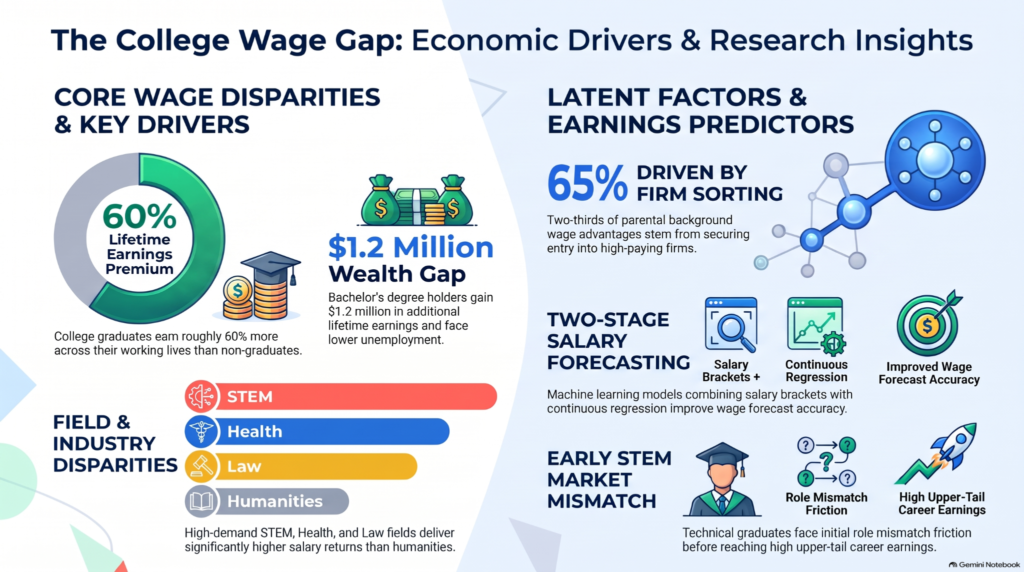
Whenever I sit down with my first-year engineering students during office hours, the conversation inevitably drifts toward the same underlying anxiety: is all this work actually going to pay off? These students are grinding through calculus problem sets, wrestling with introductory circuit design, and taking on substantial debt, all driven by the promise that a college degree is the golden ticket to financial security. On paper, broad macroeconomic statistics seem to back that up; we routinely hear that graduates out-earn non-graduates by around 60% across their working lives.
Yet, standing at the front of a college classroom for over ten years has shown me that this broad statistical average often glosses over how daunting and uneven that transition really feels from the ground level. Today’s incoming learners are stepping into a labor market where entry-level wages have felt the pinch of recent inflation, and the simple possession of a diploma no longer guarantees an automatic, comfortable entry into the middle class.
Viewing this wage gap solely through broad numbers misses the human reality of a shifting economy. As someone who mentors students through the steep learning curves of higher education, I believe we owe it to prospective graduates to examine what these wage statistics actually mean—unpacking not just the numbers on a degree, but the precise skills, disciplines, and economic factors that dictate career outcomes.
The wage gap between college graduates and non-graduates presents significant disparities in earnings and economic mobility. Graduates typically earn about 60% more over a lifetime compared to their non-graduate counterparts. Factors such as educational attainment, degree types, and regional differences contribute to these wage differences. Additionally, the long-term implications of the wage gap may exacerbate income inequality and limit economic opportunities. Continued exploration reveals deeper insights into the dynamics shaping these disparities.
KEY TAKEAWAYS
- College graduates earn approximately 60% more over their lifetime than non-graduates, highlighting the significant wage gap in earnings.
- Educational attainment is crucial, with degree type influencing salary outcomes, especially for graduates in high-demand fields like STEM.
- Networking and regional job demand contribute to disparities in employment opportunities between graduates and non-graduates.
- The wage gap exacerbates income inequality, limiting economic mobility for non-graduates in an increasingly knowledge-based economy.
- Addressing barriers to education is essential for closing the wage gap and fostering a skilled workforce that meets industry needs.
THE CURRENT STATE OF THE WAGE GAP BETWEEN GRADUATES AND NON-GRADUATES
For many college graduate workers, earnings are not keeping pace with inflation. In December 2019, the average college-educated worker earned the equivalent of $1,389 in today’s dollars. By December 2025, that figure had fallen to $1,311, a 5.6% decline in real wages. As the economy evolves, the wage gap between graduates and non-graduates remains a significant area of study, revealing stark disparities in earnings based on educational attainment.
Current statistics indicate that, on average, college graduates earn approximately 60% more than their non-graduate counterparts over a lifetime. This disparity is influenced by various demographic factors, including age, race, and geographic location.
For instance, younger graduates tend to benefit more from their degrees in urban areas where high-demand jobs are prevalent. Conversely, non-graduates often face challenges in securing stable, well-paying employment, particularly in regions with limited economic opportunities.
Additionally, racial and gender disparities compound the wage gap, as certain demographic groups experience even greater obstacles in achieving equitable earnings.
Understanding these dynamics is essential for policymakers and educators aiming to address the systemic issues contributing to income inequality and to foster a more inclusive workforce.
Top Factors Contributing to Wage Differences for Graduates and Non-Graduates
Educational attainment serves as a critical determinant in the wage differences observed between graduates and non-graduates. Graduates typically enjoy enhanced employment opportunities, primarily driven by industry demand for skilled labor. This demand often correlates with higher wages, as employers seek individuals with advanced skill acquisition and relevant job experience. Understanding the college application process allows students to explore academic programs that develop the specialized knowledge and skills employers seek in competitive industries.
In addition, graduates frequently benefit from robust networking influence, facilitating connections that can lead to lucrative positions. Regional disparities also play an important role; certain areas may offer more opportunities for graduates, while non-graduates face limited economic mobility.
This disparity is compounded by the varying levels of educational attainment within different communities, impacting local job markets. Ultimately, the interplay of these factors underscores the complexity of wage differences, highlighting how educational pathways can considerably influence an individual’s professional trajectory and earning potential in an increasingly competitive workforce.
Long-Term Earnings: Graduates vs. Non-Graduates
The evidence that a college degree significantly improves one’s employment prospects and earnings potential is overwhelming. Bachelor’s degree holders are half as likely to be unemployed as their peers whose highest degree is a high school diploma and they make $1.2 million in additional earnings over their lifetime.1,2 Analyzing outcomes data from over 30 million students, a group of economists also found public universities offer the greatest upward economic mobility.
The disparity in long-term earnings between graduates and non-graduates reflects a significant aspect of economic stratification in the labor market. Economic research consistently indicates that individuals with higher educational attainment tend to enjoy greater financial stability over their lifetime.
Graduates typically secure higher initial salaries and experience more substantial wage growth compared to their non-graduate counterparts. This trend is particularly pronounced in sectors that require specialized skills or advanced knowledge, where the demand for educated individuals often exceeds supply.
Over time, this gap in earnings can result in considerable differences in wealth accumulation, affecting not only the individuals but also their families and communities. Consequently, the implications of educational attainment extend beyond personal financial success, influencing broader societal factors such as economic mobility and access to resources.
Understanding these dynamics is essential for policymakers and educators focused on fostering equitable opportunities in the job market.
How Degree Types Affect Salary Outcomes
Degree type plays a critical role in determining salary outcomes for graduates, influencing both initial earnings and long-term financial trajectories. Various degree types, such as associate, bachelor’s, and advanced degrees, yield different financial returns. For instance, individuals holding a bachelor’s degree typically earn considerably more than those with only an associate degree.
Moreover, advanced degrees in specialized fields, such as medicine or law, can lead to even higher salary outcomes due to the demand for expertise. Students preparing to pursue higher education can also strengthen their applications by learning how to create an effective resume for college application that highlights their academic achievements, extracurricular activities, and relevant skills.
Additionally, degree types within the same field can also impact earnings. For example, graduates with degrees in STEM (science, technology, engineering, and mathematics) often experience higher salary outcomes compared to those in humanities or social sciences.
This disparity underscores the importance of understanding how degree types not only shape immediate financial prospects but also contribute to broader economic stability and career advancement.
Ultimately, informed choices regarding degree types can enhance both personal fulfillment and societal contributions.
How Where You Live Affects Your Pay
Geographic location greatly influences salary levels, creating disparities that can affect both graduates and non-graduates. Regional disparities manifest prominently in urban versus rural settings, where urban influence often results in higher wages due to concentrated industries and a dynamic labor market.
However, these benefits may be offset by higher costs of living, necessitating cost of living adjustments in salary negotiations.
Moreover, industry variations play an essential role; sectors like technology thrive in metropolitan areas, attracting talent and driving up pay scales. Economic conditions, including local demand for skilled labor, further compound these differences.
Geographic mobility, although beneficial, can also lead to challenges for individuals who must adapt to new environments and potentially negotiate salaries reflective of different regional contexts.
Understanding these factors is vital for both graduates and non-graduates seeking equitable compensation in an increasingly diverse economic landscape.

WAGE GAP TRENDS OVER TIME
In my introductory courses, I often tell students that earning an engineering degree is much like learning to play the classical guitar: possessing the instrument itself means very little if you haven’t mastered the specific technique, rhythm, and applied fundamentals needed to play real music. The economic research mirrors this exact reality. A college degree is not a uniform financial asset. As academic literature reveals, wage outcomes diverge dramatically based on field specialization, geographic markets, and employer placements.
In highly technical programs, early-career graduates frequently face a steep adjustment curve where market friction and role matching can create surprising wage penalties until they land in a role that genuinely utilizes their skills. Furthermore, studies tracking firm sorting demonstrate that who you work for—and the networking safety nets supporting your job hunt—often carries as much weight as your GPA.
I see this play out every semester. Students who develop strong technical foundations, engage deeply in practical coursework, and learn how to translate complex concepts into real-world applications navigate this transition far more effectively than those who assume the diploma will do the heavy lifting for them. Bridging this gap isn’t about passively collecting course credits; it requires deliberately building verifiable competencies that align directly with industry needs.
The current softening in the labor market is hitting recent college graduates especially hard, suggesting the traditional college premium may be weakening. At least for quickly landing a job. In this post, we take a longer view of the unemployment gap between college graduates (with a bachelor’s degree or higher) and high school graduates (with no college).
An analysis of historical wage gaps reveals a persistent disparity between graduates and non-graduates over time.
Current trends indicate a widening gap in certain sectors, suggesting that educational attainment increasingly influences earning potential.
Understanding these trends is essential for evaluating the long-term implications on the labor market and economic mobility.
Historical Wage Gap Analysis
While the wage gap between graduates and non-graduates has fluctuated over the decades, a consistent trend highlights the increasing financial advantage of obtaining a higher education.
Historical context reveals that, in the mid-20th century, the wage evolution for college graduates considerably outpaced that of non-graduates, establishing a foundation for future disparities.
By the 1980s, the gap had widened further, reflecting economic shifts and rising educational demands. Data indicate that graduates began earning, on average, nearly double the wages of their non-graduate counterparts.
This trend underscores the importance of higher education in enhancing earning potential and serves to inform policymakers and educators aiming to address socioeconomic inequalities within society, thereby aiding in the pursuit of a more equitable future for all individuals.
Current Trends Overview
As the labor market continues to evolve, recent data reveals a persistent and widening wage gap between college graduates and non-graduates. This trend is particularly pronounced in sectors experiencing high industry demand, such as technology and healthcare, where skilled labor is increasingly sought after.
Current employment statistics indicate that individuals with college degrees earn considerably more than their non-graduate counterparts, with the gap continuing to expand since the early 2000s. Moreover, graduates often enjoy greater job stability and benefits, reflecting the value placed on higher education in today’s economy.
This ongoing disparity underscores the importance of education in facilitating economic mobility and highlights the challenges non-graduates face in securing competitive wages and job opportunities in an evolving workforce.
Future Implications of the Wage Gap for the Workforce
The wage gap between graduates and non-graduates presents significant long-term economic implications for the workforce.
As the disparity in earnings persists, it may exacerbate skill gaps, limiting opportunities for non-graduates in an increasingly knowledge-based economy.
This trend could lead to a polarized labor market, where educational attainment becomes a critical determinant of economic mobility.
Long-Term Economic Impact
Although the wage gap between graduates and non-graduates is often discussed regarding immediate salary differences, its long-term economic implications for the workforce extend far beyond initial earnings.
This disparity can greatly hinder economic mobility, as non-graduates may find it increasingly challenging to ascend the socioeconomic ladder. Over time, this gap can lead to broader societal implications, including increased income inequality and reduced consumer spending power among a substantial segment of the population.
As the workforce evolves, the concentration of wealth among degree holders may further entrench existing disparities, limiting opportunities for non-graduates. Ultimately, addressing this wage gap is essential for fostering a more equitable economy that benefits all individuals and promotes inclusive growth within society.
Skill Gap Consequences
A significant consequence of the wage gap between graduates and non-graduates is the persistent skill gap that affects the workforce. This disparity hinders skill acquisition, limiting employment opportunities for non-graduates and subsequently constraining their economic mobility.
As job specialization increasingly demands advanced skill development, those without a college degree face diminished prospects for career advancement. Consequently, the labor market becomes less competitive, further widening income disparities. Access to practical learning materials, worksheets, and educational resources from the engineering teacher shop can help students strengthen their technical knowledge, develop relevant skills, and better prepare for changing workforce demands.
Education investment emerges as a vital factor in addressing these challenges, as it fosters a more skilled workforce capable of meeting evolving industry demands. Ultimately, bridging the skill gap is essential for enhancing workforce competitiveness and ensuring equitable access to opportunities that promote social and economic well-being for all individuals.

RELATED STUDIES ABOUT WAGE GAP BETWEEN COLLEGE GRADUATES AND NON GRADUATES
In summary, the wage gap between college graduates and non-graduates remains a significant economic divide, shaped by various factors including degree type and geographic location. As the labor market evolves, the disparity in earnings may widen further, casting a long shadow over the future workforce. Addressing this gap is not merely an academic exercise; it is an essential endeavor that holds the potential to elevate the economic landscape and foster equitable opportunities for all.
Wage differentials by fields of study among college graduates in Turkey: a decomposition analysis
Conceptual Framework and Research Rationale
- Higher Education Expansion and Field Heterogeneity: Across both developed and emerging economies, the expansion of tertiary education has shifted public and academic attention from the general returns to college towards the returns associated with specific college majors. Different fields of study endow graduates with distinct skill sets that the labor market rewards unevenly based on supply, industrial demand, and institutional regulations.
- Economic and Policy Importance of Major Choice: Quantifying wage differentials across academic fields serves critical socioeconomic purposes:
- Informs prospective university students and their families, assisting in major selection and career decision-making.
- Guides higher education administrators and policymakers in setting centralized admission quotas, entrance exam cut-off scores, and targeted tuition subsidies to mitigate skill shortages in critical technical and social sectors.
- Deepens understanding of the structural roots of wage inequality, occupational mismatch, and social mobility.
- The Context of Turkey: Turkey provides a compelling institutional setting as a major emerging economy characterized by a sustained expansion of higher education. Access to Turkish tertiary programs is strictly rationed through a centralized, high-stakes national university entrance examination that sorts candidates by academic discipline and university. Despite high demand, empirical evidence on wage gaps across college majors in Turkey and the broader Middle East and North Africa (MENA) region has remained virtually absent.
- Core Research Objectives:
- Estimate conditional wage differentials across 15 distinct college fields of study among tertiary-educated male wage earners in Turkey.
- Perform an Oaxaca-Blinder decomposition to separate average raw wage gaps into explained endowment differences (individual, family, and job characteristics) versus unexplained factors (market returns and unobserved selection).
- Apply Unconditional Quantile Regression (UQR) via Recentered Influence Function (RIF) decompositions to examine how explained and unexplained drivers of major-specific wage gaps vary across the entire wage distribution.
Methodology and Data Architecture
- Data Source and Sample Criteria:
- Utilizes pooled annual cross-sections from the Turkish Household Labor Force Survey (HLFS) collected by the Turkish Statistical Institute (TURKSTAT) from 2009 to 2015 (the first waves recording fields of study).
- Analytical Sample: 77,154 regularly employed male university graduates aged 23–65 working full-time (30–72 hours per week).
- Sample Restrictions: Restricted to males to minimize endogenous self-selection into employment (female labor force participation remains low in Turkey, even among university graduates). Excluded military/police graduates, post-graduation return emigrants, and those earning below the 2010 real minimum wage threshold (<600 TL/month).
- Dependent Variable:
- Log of real hourly wage in main employment, adjusted to 2010 baseline prices, derived by converting net monthly earnings (inclusive of regular bonuses) via reported typical weekly hours multiplied by 4.3.
- Fields of Study Classification:
- 15 standardized categories: Education, Arts, Humanities, Business and Management (the largest field, serving as the primary baseline/reference), Law, Personal Services, Social Sciences and Services (other), Hard Sciences, Mathematics and Statistics, Computing, Engineering, Manufacturing, Architecture, Agriculture and Veterinary, and Health.
- Econometric and Decomposition Modeling:
- Stepwise Ordinary Least Squares (OLS): Progressively incorporating (1) raw field dummies; (2) survey wave, quadratic job tenure, and quadratic potential experience; (3) family structure (marital status, number of children); (4) employment sector (10 categories) and quadratic firm size; (5) occupational categories; and (6) 26 NUTS-2 regional fixed effects.
- Average Decomposition: Twofold Oaxaca-Blinder decomposition using pooled model estimates with field dummies as the nondiscriminatory wage benchmark.
- Distributional Decomposition: RIF-regression decomposition (Firpo, Fortin, & Lemieux) across nine unconditional wage deciles (q1 to q9), evaluating how endowment advantages and return coefficients shift from lower to upper tails.
Key Empirical Findings
- Field-Specific Wage Premiums and Penalties (OLS Regressions):
- Unconditional Gaps (relative to Business and Management): Health (+64.6%) and Law (+55.0%) exhibited massive wage premiums. Significant positive advantages were also found for Hard Sciences (+13.7%), Social Sciences (+12.9%), Education (+12.9%), Mathematics and Statistics (+12.0%), and Agriculture/Veterinary (+11.0%).
- Conversely, graduates in Manufacturing (–14.1%), Computing (–12.1%), Personal Services (–8.8%), Arts (–7.9%), and Engineering (–5.2%) earned lower raw wages than Business graduates.
- Mediating Role of Covariates:
- Experience and Tenure: Controlling for potential experience mitigated penalties in Computing and Manufacturing, reflecting the younger demographic profile of technology cohorts.
- Family and Geography: Family structure and 26 NUTS-2 regional dummies exerted virtually no influence on major-related wage gaps.
- Occupation and Sector: Entering occupational dummies substantially compressed wage gaps across all fields. Nevertheless, Law (+30.9%) and Health (+41.0%) maintained massive, robust wage premiums even after full conditioning for sector, occupation, and region.
- The Turkish Education Anomaly: Unlike developed economies where Education degrees face wage penalties, Turkish Education graduates earn positive wage premiums, driven by their concentration in the public sector where regulated entry salaries exceed private sector alternatives.
- Oaxaca-Blinder Average Decompositions:
- Dominance of Endowments: Observable endowments (explained component)—primarily occupational placement and, secondary, employment sector—account for the majority of average wage differentials across fields.
- Fully Explained Penalties: The raw negative wage differentials observed in Computing (–20.5% total gap; –17.5% explained), Engineering (–15.5% total gap; –19.7% explained), and Manufacturing (–22.6% total gap; –17.4% explained) were almost entirely accounted for by observable characteristics. For Engineering and Manufacturing, early-career qualification and skills mismatch (holding jobs mismatched with their specific degree level) drove these wage penalties.
- Law and Health Premiums: For Law (+47.5% total gap) and Health (+59.5% total gap), the unexplained component (+27.6% and +38.4%, respectively) significantly exceeded the explained component. High returns to occupational licensing, institutional market protections, and unobserved positive ability sorting drive these exceptional premiums.
- Distributional Wage Gaps (RIF-Unconditional Quantile Decompositions):
- Public-Sector Floor Dynamics: For Education, Humanities, and Social Sciences, wage premiums were highest at the bottom deciles (e.g., Education was +48.3% at q1 and –28.6% at q9; Humanities was +39.8% at q1 and –20.4% at q9). The explained component accounts for this positive lower-tail advantage, capturing public-sector wage floors that protect lower-earning graduates but compress earnings at the top.
- STEM and Technical Fields Across Quantiles: Computing, Engineering, and Manufacturing exhibited severe negative wage gaps in the lower tail (q1 to q3; e.g., Computing suffered –48.4% at q3; Engineering –41.6% at q2). These lower-tail penalties were driven almost entirely by poor initial endowments. However, as graduates advanced to upper deciles (q8–q9), these penalties completely vanished or turned positive (Engineering reached +5.9% at q9), as high-performing technical workers secured matched, high-return professional roles.
- Elite Tail Trajectories in Law and Health: Both Law and Health maintained positive advantages across the entire wage distribution, expanding dramatically at the top. Law gaps rose from +32.2% at q3 to +66.5% at q9, while Health rose from +40.6% at q3 to +79.1% at q9. In both fields, the explained component dominated at the bottom deciles, but unexplained factors surged in the upper tail, driving the overwhelming majority of top-decile earnings.
Economic and Policy Interpretations
- Occupational Placement as the Primary Transmission Channel: Wage gaps across college disciplines are primarily realized through access to high-paying occupations rather than wide pay discrepancies within identical job titles. Where graduates land in the occupational hierarchy dictates their financial return.
- The Technical Graduate Mismatch Problem: The early-career wage penalties observed in technical fields (Computing, Engineering, Manufacturing) signal labor market friction and qualification mismatch in Turkey. Despite rapid higher education expansion, the economy struggles to absorb new technical cohorts into high-productivity, specialized roles immediately upon graduation.
- Institutional Selection and Sorting in Law and Health: Centralized university entrance exam cut-off scores are highest for Medical and Law faculties. Consequently, the substantial unexplained premiums in Health and Law reflect a compound effect: high positive selection on unobserved cognitive and non-cognitive ability, coupled with legally protected professional monopolies that prevent external competition.
Policy Implications and Study Limitations
- University Entrance Exam Quotas and Cut-Offs: Central planning authorities (such as the Turkish Higher Education Council) can use major-specific wage returns to recalibrate admission quotas and cut-off points, balancing candidate demand against labor market saturation.
- Mitigating Early STEM Underemployment: Because technical graduates suffer from early-career matching frictions, policymakers and universities should implement interdisciplinary programs, cooperative education, and structured industry internships to facilitate direct transition into matched professional occupations.
- Methodological Boundaries:
- Focuses exclusively on male wage earners, leaving female graduate dynamics and gender-specific occupational sorting unaddressed.
- Relies on cross-sectional survey data without individual longitudinal tracking.
- Because admission cut-off scores and unobserved student preferences could not be directly modeled through quasi-experimental instruments (such as regression discontinuity at exam cut-offs), the unexplained decomposition component remains a composite of true human capital returns and unobserved ability sorting.
| REFERENCE: Antonio Di Paolo, Aysit Tansel, Wage differentials by fields of study among college graduates in Turkey: a decomposition analysis, Journal of Economic Studies, Volume 52, Issue 9, 2025, Pages 48-68, ISSN 0144-3585, https://doi.org/10.1108/JES-03-2024-0124. (https://www.sciencedirect.com/science/article/pii/S0144358525000057) |
Background wage premia, beyond education: Firm sorting and unobserved abilities of graduates
Conceptual Framework and Research Rationale
- Intergenerational Inequality Beyond Formal Education: While extensive literature establishes that parental background strongly influences offspring wages through educational attainment, substantial wage premia linked to socioeconomic family origin persist even when comparing individuals with identical levels of formal education.
- Two Latent Transmission Channels: Beyond formal education, parental background confers labor market advantages through two primary mechanisms:
- Individual-Specific Abilities: Enhancing unobserved human capital, non-cognitive traits, and productive capacities nurtured by family environments that are equally rewarded across all employers.
- Firm Sorting and Employment Opportunities: Influencing the allocation of graduates into firms that operate superior, high-paying compensation policies via social networks, referrals, cultural affinity, or economic safety nets that permit prolonged job searches.
- The AKM Decomposition Perspective: To separate individual human capital from employer wage policies, the authors apply the two-way fixed effects framework developed by Abowd, Kramarz, and Margolis (AKM). While prior studies in Sweden and Israel found that firm effects play only a modest role in overall intergenerational mobility, those studies evaluated general populations across varied educational tiers. By holding formal education constant within a homogeneous graduate cohort, this study isolates the residual transmission mechanisms operating in the graduate labor market.
- Core Research Objectives:
- Disentangle the graduate background wage premium into worker fixed effects (unobserved individual productive abilities) and firm fixed effects (sorting into higher-paying firms).
- Track how the sorting channel evolves across career trajectories, comparing initial job market entry against voluntary transitions and involuntary displaced job searches following mass layoffs.
- Examine the relationship between parental background and worker-firm assortative matching, evaluating whether family background plays a compensatory role for lower-earning graduates.
Methodology and Data Architecture
- Matched Administrative Data:
- Employer-Employee Records (INPS): Social security records covering the Italian private non-agricultural sector from 2005 to 2021. The AKM estimation was conducted on the largest connected set comprising 23,388,179 workers, 3,486,907 firms, and 215,846,510 individual-year wage observations.
- University Administrative Records (UNIMORE): Detailed academic registries from the University of Modena and Reggio Emilia covering all graduation cohorts from 2005 to 2021. Restricting the analysis to graduates from a single public institution effectively controls for formal educational attainment, degree quality, and local institutional sorting.
- Matched Estimation Sample: 75,413 unique worker-firm employment contracts observed between ages 23 and 35 across 39,009 graduates and 24,547 private firms.
- Parental Economic Background Measure:
- Operationalized via means-tested exemption from university tuition fees based on the Equivalent Economic Situation Indicator (ISEE).
- Captures both annual family income and household asset wealth at enrollment, identifying students belonging to the bottom quintile (~20%–25%) of the socioeconomic distribution (coded as 0 for fee-exempt/low-income, and 1 for non-exempt/advantaged background).
- Two-Stage Econometric Strategy:
- Stage 1 (AKM Estimation): Log real weekly full-time equivalent wages were decomposed on the national connected set into worker fixed effects (i), firm fixed effects (j), time-varying observables (cubic experience interacted with occupational categories, normalized age polynomials, year dummies), and an idiosyncratic error term.
- Exogenous Mobility Validation: The additive separability assumption was confirmed via event-study profiles of job movers across coworker wage quartiles (ruling out match-specific rents and Ashenfelter-style earnings dips) and testing orthogonality of AKM residuals across deciles.
- Stage 2 (Second-Stage OLS Regressions): Regressed overall log wages, worker fixed effects, firm fixed effects, covariates, and residuals on the parental background indicator, controlling for cohort fixed effects, year fixed effects, gender, degree level (Master vs. Bachelor), STEM discipline, and relative GPA. Observations were weighted by the inverse number of individual spells to ensure balance.
- Identification Subsamples: Restricted to first jobs (n=39,009), subsequent jobs (n=31,025), and workers displaced through involuntary mass layoffs (defined as a firm downsizing by $>30\%$; n=5,621).
- Robustness Checks: Re-estimated Stage 1 models by restricting firms to 5,10,20, and 30 movers, implementing grouped fixed effects via k-means clustering à la Bonhomme, Lamadon, and Manresa (BLM, 2019), clustering standard errors at the firm level, and running 200 bootstrap replications.
Key Empirical Findings
- The Background Wage Premium and Decomposition:
- Baseline Premium: Holding degree type, major, grade, and institution constant, graduates from advantaged family backgrounds earned a statistically significant 5.35% higher real weekly wage across all observed contracts (p<.01).
- Two-Thirds Sorting Dominance: Decomposing this gap revealed that approximately two-thirds (65%) of the background premium operates through sorting into high-paying firms (j coefficient = +0.0347, p<.01), while only one-third operates through individual productive fixed effects (i coefficient = +0.0187, p<.01).
- First-stage covariates and residuals contributed virtually nothing to the gap (+0.0036 and –0.0035, respectively), demonstrating that the background wage advantage among graduates is primarily a matter of where individuals secure employment rather than disparities in unobserved individual ability.
- Career Progression and Displacement Dynamics:
- First Jobs vs. Career Trajectories: In initial post-graduation jobs, the total background premium was 4.07% (firm component = +0.0326; worker component = +0.0182). In subsequent jobs, the wage premium expanded to 6.88%, driven by an amplification of firm sorting (+0.0350) and rising returns to match-specific covariates (+0.0114).
- Involuntary Mass Layoffs: When individuals were forced into the labor market following sudden plant closures or mass layoffs, the background advantage surged dramatically to 10.60% (p<.01). Under acute re-employment pressure, advantaged graduates secured positions at significantly higher-paying firms (firm effect = +0.0539, p<.01), indicating that family safety nets prevent graduates from having to accept low-paying distress jobs.
- Qualitative Job Attributes and Upward Transitions:
- Contractual Stability: Graduates from advantaged backgrounds had a 6.22 percentage point higher probability of obtaining a permanent contract and a 5.54 percentage point higher probability of securing full-time employment (p<.01).
- Retention and Poaching: Advantaged graduates were 3.98 percentage points less likely to involuntarily exit their firm in any given year. When changing employers voluntarily, they were 2.51 percentage points more likely to transition into a “better firm” with a higher firm fixed effect (p<.01).
- Age Stratification: The firm-sorting background premium grew monotonically across age brackets, more than tripling from +0.0149 among workers aged 23–25 to +0.0558 among workers older than 28 (p<.01).
- Subgroup Heterogeneity:
- Academic Performance (GPA): The family background premium was significantly larger among graduates with below-average graduation marks (+0.060) than those with above-average marks (+0.046). This gap was driven entirely by firm sorting (+0.040 vs. +0.031), showing that family connections act as an employment buffer for academically weaker students.
- STEM Disciplines: Graduates with STEM degrees exhibited smaller background premia (+0.036) compared to non-STEM graduates (+0.058), confirming that technical, codified qualifications reduce reliance on family-mediated networks.
- Citizenship: Foreign-born graduates exhibited an enormous background premium (+0.125), where worker fixed effects and firm fixed effects contributed almost equally.
- Sectoral Controls: Controlling for firm size and province did not diminish the firm effect (+0.0347), but adding broad industry sector controls reduced the coefficient to +0.0262, demonstrating that a notable portion of firm sorting occurs through entry into high-paying industrial sectors.
- Weakening Positive Assortative Matching (Compensatory Role):
- While the baseline economy exhibited positive assortative matching (correlation between i and j of +0.147 nationally and +0.180 in the UNIMORE sample), parental background was negatively associated with the covariance of worker and firm fixed effects (=-0.0509,p<.01).
- Stratified regressions confirmed a compensatory dynamic:
- The background sorting effect into high-paying firms was larger for workers with lower individual fixed effects (+0.0326 below the median vs. +0.0298 above).
- The background effect on individual fixed effects was larger within lower-paying firms (+0.0188 below the median vs. +0.0139 above).
- Family background acts as an informal insurance mechanism, mitigating the penalties of lower personal productive capacity by facilitating placement into better-paying firms.
Economic and Theoretical Interpretations
- The Educational Mediation of Worker Ability: In general social mobility literature, worker fixed effects typically dominate firm effects. By evaluating a population where formal educational degree and institutional prestige are held constant, this study demonstrates that most background-transmitted individual ability operates through educational attainment itself. Once education is controlled, the residual background premium is overwhelmingly driven by firm-level wage rents.
- Rent-Seeking vs. Efficient Search: Rather than reflecting unmeasured technical productivity, firm wage premia represent institutional and market rents (e.g., product market power, collective bargaining surpluses, efficiency wages). Advantaged graduates leverage familial networks, social capital, and parental wealth to capture these firm-level rents, distorting pure meritocratic matching.
- Search Flexibility and Outside Options: Higher parental wealth insulates young graduates from credit constraints, enabling them to reject low-paying stepping-stone jobs and wait for high-rent vacancies—an advantage that becomes especially pronounced during unexpected displacements like mass layoffs.
Policy Implications and Study Limitations
- Beyond Educational Access: Public policies aimed at fostering equal opportunity cannot rely solely on equalizing access to higher education. Even when students graduate from the same university with identical degrees, socioeconomic inequalities re-emerge through unequal firm placement.
- Reforming Labor Market Intermediation: Governments and university career centers must professionalize post-graduation job placement, providing transparent internship matching, centralized recruitment channels, and universal career counseling to neutralize the advantage of informal family networks.
- Social Safety Nets for Job Seekers: Expanding targeted unemployment benefits and transitional basic income for recent graduates reduces the financial pressure on low-income youth to accept poor-paying entry contracts, leveling their search duration relative to wealthier peers.
- Study Limitations:
- Focuses on graduates from a single northern Italian public university, reflecting an institutional context with strong firm-level wage variance and moderate labor market mobility.
- The sample is restricted to male wage earners in the private non-agricultural sector to avoid female labor force participation selection biases, leaving gender-differentiated sorting and public-sector dynamics unobserved.
- Family background is measured via a binary income/wealth proxy at college entry rather than continuous lifetime parental earnings records.
| REFERENCE: Luca Bonacini, Fabrizio Patriarca, Edoardo Santoni, Background wage premia, beyond education: Firm sorting and unobserved abilities of graduates, Economics of Education Review, Volume 109, 2025, 102733, ISSN 0272-7757, https://doi.org/10.1016/j.econedurev.2025.102733. (https://www.sciencedirect.com/science/article/pii/S027277572500113X) |
Explainable salary forecasting for recent college graduates: A two-stage machine learning approach with uncertainty quantification
Conceptual Framework and Research Rationale
- The Challenge of Graduate Earnings Transparency: Rising tuition costs, compounding student loan burdens, and heightened competition in entry-level labor markets have increased scrutiny regarding the economic returns of university degrees. For recent college graduates—particularly Generation Z cohorts prioritizing baseline financial security—accurate, transparent salary forecasting is essential to guide major selection, career paths, and geographic mobility.
- Limitations of Existing Prediction Tools: Conventional salary estimators present several intersecting shortcomings:
- Over-reliance on small, institutional convenience samples or unverified, web-scraped data lacking national representativeness.
- Coarse or binary classification categories (e.g., high vs. low pay) that lack the granularity needed for financial planning.
- Failure to integrate classification and continuous regression into a unified architecture, losing the complementary benefit of structural wage tiers.
- “Black-box” predictive designs that offer high accuracy without interpretable feature attribution.
- Point-estimate forecasts that omit uncertainty quantification, giving users a false sense of precision in high-variance labor markets.
- Core Research Objectives:
- Develop and validate a novel two-stage machine learning pipeline combining coarse salary-bracket classification with continuous regression using a large-scale, multi-year national survey.
- Evaluate model explainability using SHapley Additive exPlanations (SHAP) to identify and interpret key structural drivers of early-career compensation.
- Quantify predictive uncertainty by generating finite-sample valid prediction intervals via conformal prediction with the Model-Agnostic Prediction Interval Estimator (MAPIE).
- Deploy the unified framework as an interactive, stakeholder-facing web application that translates algorithmic outputs into practical decision support.
Methodology and System Architecture
- Dataset and Population Scope:
- Drawn from the National Survey of College Graduates (NSCG, 2003–2019), sponsored by the National Center for Science and Engineering Statistics (NCSES) of the U.S. National Science Foundation.
- Merged across 17 annual survey files and filtered for early-career graduates: ages 18–30, within 3 years of first bachelor’s degree completion, residing in the United States, and earning within a standard range of $10,000 to $150,000.
- Final Sample: 25,614 individual survey records and 26 input features.
- Inflation Adjustment: All historical earnings were standardized to 2024 U.S. dollars using annual Consumer Price Index (CPI) deflators (OVCPI2024CPIbase), yielding a sample median salary of $58,150.
- Feature Engineering and Selection:
- Evaluated through a three-step filter ensuring conceptual relevance, empirical performance gains, and practical availability (retaining only variables known to a current student or prospective graduate).
- Captured 22 native survey fields (educational history, parental education, employer region, employer sector, hours worked, supervision status, race, gender) and 2 derived variables: time_since_degree and Degree_Group (aggregating raw degree fields into 21 broad disciplinary categories verified via an explicit crosswalk).
- Two-Stage Machine Learning Pipeline:
- Stage 1 (Salary-Bracket Classification): Classifies profiles into three distributional tiers based on natural density divisions: Low (10,000–40,000; 24.0% of sample), Medium (40,000–80,000; 53.7% of sample), and High (80,000–150,000; 22.3% of sample). Evaluated on a 90/10 split, with a reserved 10% calibration fold using Isotonic Regression to output calibrated posterior class probabilities.
- Stage 2 (Continuous Regression): Appends the predicted salary bracket and the three calibrated class probabilities (Plow,Pmed,Phigh) to the original 26 input features to constrain the continuous regression space, predicting exact 2024 dollar-denominated salary. Evaluated on a 70/30 partition.
- Algorithms Evaluated and Hyperparameter Tuning:
- Four algorithms tested across both stages: Decision Tree, Random Forest, AdaBoost, and XGBoost.
- Optimized via Grid Search Cross-Validation over tree depth, estimators, learning rate, and sample leaf constraints.
- Interpretability and Uncertainty Quantification:
- Explainability: Local and global feature importance analyzed via SHAP, decomposing predictions additively based on cooperative game-theoretic Shapley values.
- Conformal Prediction Intervals: Computed via MAPIE using minmax residual aggregation across calibration folds to construct distribution-free prediction bounds at 70%, 80%, and 90% nominal confidence levels.
- Software Deployment: Deployed via an interactive Streamlit web dashboard providing real-time point forecasts, confidence intervals, and local SHAP impact charts.
Key Empirical Findings
- Stage 1 Classification Performance:
- Random Forest achieved the highest classification performance, recording a test macro-F1 score of 71.27% (training F1 of 100%), followed closely by XGBoost (test F1 of 71.06%), AdaBoost (67.80%), and Decision Tree (61.80%).
- Class Breakdown: Performance was highest in the dominant Medium bracket (F1 = 74.82% for Random Forest), followed by the Low bracket (F1 = 66.61%), and lowest in the High bracket (F1 = 61.15%), reflecting greater variance and smaller sample representation in upper income tiers.
- Over 16,500 correct classifications made by the Random Forest model occurred with high prediction confidence (75%–100% probability band), outperforming alternatives in classification certainty.
- Stage 2 Continuous Regression Performance:
- Random Forest again emerged as the top-performing regression algorithm, achieving a test R2 of 74.35% and a test Root Mean Squared Error (RMSE) of $13,900 (training R^2 = 97.99\%, training RMSE = 3,840).
- Comparative Benchmark: XGBoost achieved a test R2 of 68.06% (RMSE = 15,502), Decision Tree reached a test R2 of 64.26% (RMSE = 16,398), and AdaBoost delivered the weakest performance with a test R2 of 50.63% (RMSE = 19,293).
- 5-Fold Cross-Validation: Evaluated across folds, Random Forest demonstrated stable generalizability with a mean cross-validation R2 of 82.07% \pm 6.40%. Regularization experiments (constraining min_samples_leaf = 10 and max_depth = 20) narrowed the train-test gap from 23.65 to 13.55 percentage points while maintaining strong predictive performance (test R^2 = 73.46%, RMSE = 14,132).
- Ablation Study Validating the Two-Stage Architecture:
- Evaluating a single-stage Random Forest model trained solely on the 26 raw features produced a test R2 of only 55.88% and an RMSE of $18,221.
- Appending Stage 1 classification outputs delivered an absolute gain of 18.47 percentage points in R2 and reduced prediction error by $4,327.
- Consistent improvements were observed across other algorithms: XGBoost gained 18.11 percentage points in R2 (54.95% to 73.06%) and Decision Tree gained 46.36 percentage points (12.60% to 58.96%), confirming that feeding coarse salary-tier probability structures into continuous regression models sharpens boundary precision.
- Uncertainty Quantification via Conformal Prediction (MAPIE):
- Conformal prediction intervals generated using minmax aggregation yielded empirical coverages slightly below nominal targets:
- 70% Nominal Level: 68.54% empirical coverage (mean interval width = $19,824).
- 80% Nominal Level: 76.86% empirical coverage (mean interval width = $24,807).
- 90% Nominal Level: 85.74% empirical coverage (mean interval width = $32,570).
- Under-coverage stems from mild violations of exchangeability across the multi-decade longitudinal survey (2003–2019), discretized random forest terminal leaves, and unobserved variables like individual salary negotiation skills and regional cost-of-living differences.
- Feature Importance and Interpretability (SHAP):
- Aggregated Random Forest feature importances ranked Employment Type, Employer Sector, and Degree Category (Field of Study) as the top three drivers of early-career compensation, followed by hours worked per week and technical skill requirements.
- Partial Dependence Plots (PDP) revealed clear directional trends:
- Sectoral Patterns: Government jobs (58,111median)andbusiness/industryroles(57,585) paid slightly higher than educational institutions (57,218),withfour-yearuniversitiespayingthelowestentry-levelaverages(56,729).
- Disciplinary Hierarchy: Business and Management, Computer Science and IT, and Health/Medical Sciences topped predicted earnings (above $57,600), while Psychology and Biological/Life Sciences clustered at the bottom (below $56,700).
- Continuous Curves: Predicted salaries remained relatively flat through age 25 before rising sharply from age 26 to 30; earnings increased steeply between 30 and 40 weekly hours, leveling off beyond 50 hours.
- Algorithmic Fairness and Disaggregated Errors:
- Disaggregated evaluations revealed moderate performance differences across demographic cohorts:
- Gender: Model error was higher for male graduates (RMSE = 14,679; MAE = 10,358) than female graduates (RMSE = 13,183; MAE = 9,431), reflecting greater dispersion in male starting salaries.
- Race: Highest errors occurred among Asian graduates (RMSE = 15,457) and Native Hawaiian/Pacific Islanders (RMSE = 16,009, n = 41), while Black graduates (RMSE = 12,740) exhibited lower error rates. Disparities reflect historical demographic variances in the survey rather than algorithmic amplification.
- Interactive Web Deployment:
- The application processes queries with a mean inference latency of 24.12 ms (median 23.09 ms, 95th percentile 34.04 ms), enabling real-time interactive performance.
- For a sample engineering master’s profile in California working 47 hours, the dashboard returns a point forecast of $101,391 alongside an 80% conformal interval of $87,924 to 112,816,accompaniedbylocalSHAPattributionbars(e.g.,++18,369 for California location; –$9,033 for master’s degree relative to doctoral/professional credentials).
Practical Implications and Decision Support
- Data-Driven Advising: Integrating continuous point forecasts, conformal ranges, and SHAP attribution provides high school and college advisors with a tool to ground career counseling in verifiable national data, helping students understand the trade-offs of major and sector choices.
- Mitigating Misleading Precision: Communicating prediction intervals (e.g., $24,800 wide at 80% confidence) alongside point estimates prevents students from placing unearned confidence in single-value predictions, acknowledging real-world labor market variance.
- Actionable Knowledge Artifacts: SHAP feature values function as reusable knowledge assets that demonstrate how specific credentials (e.g., degree level, sector) alter early-career earnings, supporting policy reviews of program outcomes and wage equity.
Study Limitations and Future Directions
- Historical Data Horizon: Survey data spans 2003 to 2019, omitting labor market disruptions resulting from the post-2020 COVID-19 pandemic, accelerated inflation, and remote work arrangements. Incorporating post-2020 NSCG waves is needed to calibrate models to contemporary wage realities.
- Partitioning Architecture: Stage 1 and Stage 2 models used independent train-test splits. While preventing true-label leakage, future implementations should employ an end-to-end nested cross-validation scheme with out-of-fold Stage 1 probability generation evaluated on a single untouched holdout test partition.
- Algorithmic Fairness and Mitigation: Differences in prediction error across gender and racial subgroups highlight the need to explore debiasing methods, such as adversarial debiasing or group-calibrated post-processing.
- Longitudinal Career Trajectories: The prediction window was restricted to graduates within three years of degree completion. Extending models over 5- to 10-year post-graduation windows would enable longitudinal tracking of career earnings trajectories.
| REFERENCE: Puneet Agarwal, Md. Salehin Seyam, Sam Chacon, Nafisa Mahbub, Explainable salary forecasting for recent college graduates: A two-stage machine learning approach with uncertainty quantification, Knowledge-Based Systems, Volume 351, Part C, 2026, 116810, ISSN 0950-7051, https://doi.org/10.1016/j.knosys.2026.116810. (https://www.sciencedirect.com/science/article/pii/S0950705126015364) |
CONCLUSION
After more than a decade of teaching, I remain a firm believer in the transformative potential of higher education, but I think our advice to college students needs an honest update. We can no longer present the college wage premium as a simple, guaranteed transaction where four years of tuition automatically yields lifetime prosperity. The data makes it overwhelmingly clear that educational pathways, disciplinary focus, and institutional placement shape real-world earnings in complex ways. When I host informal study sessions or chat with struggling sophomores, I remind them that their focus must extend beyond just passing exams to survive the semester.
The real value of an undergraduate education lies in cultivating durable problem-solving abilities, communication skills, and practical technical judgment that an evolving economy cannot easily automate or replace. If we truly want to close wage disparities and ensure equal economic mobility, both universities and students must take a more proactive approach.
Institutions must demystify career placement and offer robust, transparent preparation, while students must take ownership of their professional development early. A degree opens the initial door, but a graduate’s willingness to master actionable, high-demand skills ultimately builds sustainable, long-term financial stability.