

In my years advising engineering faculties and academic institutions on digital transformation, I have often witnessed a recurring misstep when adopting educational technology: mistaking automated pacing for genuine pedagogy. When institutional leadership first evaluates adaptive learning platforms, the presentation slides are almost always dazzling. Administrators see interactive dashboards, dynamic branching algorithms, and real-time mastery heatmaps, assuming that software can effortlessly optimize the learning trajectory for every student in the room. But technology without pedagogical scaffolding is simply automated compliance.
From an engineering curriculum perspective, learning is rarely a neat, linear ladder where a student simply needs more practice problems to achieve breakthrough comprehension. When an undergraduate struggles with circuit analysis or structural mechanics, it is seldom because they failed to drill enough repetitive equations; it is usually because their underlying conceptual mental model has broken down. An algorithm adjusting question difficulty based on whether a student clicked option A or B often ends up measuring compliance and pattern recognition rather than conceptual depth.
If an adaptive tool is merely used to sort students into static mastery buckets or fast-track those who already grasp the prerequisites, we haven’t revolutionized the digital classroom—we have merely automated the traditional textbook. For adaptive learning systems to truly serve our classrooms, they must be intentionally anchored in sound pedagogical design, transparent instructor intervention, and a clear architectural purpose that supports higher-order critical thinking.
Measuring the effectiveness of adaptive learning systems in modern digital classrooms relies on various performance metrics, including mastery levels and engagement scores. These metrics generate insights through data analytics, facilitating real-time adjustments to instructional approaches. Challenges such as data reliability and contextual variability can hinder accurate assessments. However, innovative strategies and continuous improvement practices can enhance effectiveness. Overall, understanding these areas can lead to more impactful learning experiences for diverse student populations and further insights await exploration.
KEY TAKEAWAYS
- Utilize performance indicators like mastery levels and retention rates to assess the effectiveness of adaptive learning systems in digital classrooms.
- Implement interactive feedback mechanisms to enhance student engagement and provide real-time insights into learning progress.
- Employ data analytics to transform educational data into actionable insights, enabling continuous refinement of teaching strategies and content delivery.
- Address challenges such as data reliability and measurement variability to ensure accurate evaluations of adaptive learning system effectiveness.
- Incorporate regular feedback loops to identify successful strategies and areas needing improvement, fostering a culture of continuous enhancement in learning environments.
HOW ADAPTIVE LEARNING SYSTEMS ADDRESS DIVERSE STUDENT NEEDS
As educational environments become increasingly diverse, adaptive learning systems have emerged as an essential solution for addressing the varied needs of students. These systems leverage technology to create personalized pathways tailored to individual learning styles, strengths, and weaknesses. By doing so, they foster learner autonomy, enabling students to take control of their educational journeys. By integrating instructional technology into digital classrooms, educators can provide more personalized learning experiences, respond to individual student needs, and make lessons more accessible and engaging.
Adaptive learning systems analyze real-time data, allowing them to adjust content and assessments dynamically. This responsiveness not only accommodates different paces of learning but also enhances motivation by providing relevant and engaging material.
As students navigate their unique pathways, they develop critical skills such as self-regulation and decision-making, essential for lifelong learning. Ultimately, adaptive learning systems bridge the gap between traditional instructional methods and the diverse requirements of modern classrooms, ensuring that every learner has the opportunity to succeed.
Through this innovative approach, the educational landscape can become more inclusive and effective.
The Role of Student Engagement in Adaptive Learning
While adaptive learning systems are designed to cater to individual learning needs, the effectiveness of these systems heavily relies on the level of student engagement. Engaged students exhibit higher motivation, facilitating deeper learning experiences. This motivation is vital, as it propels students to actively participate in the learning process, fostering an environment conducive to growth.
Interactive feedback serves as a pivotal component of this engagement, allowing students to understand their progress and areas for improvement in real-time. Effective use of technology in the classroom allows educators to provide interactive learning activities, monitor student progress, and create more engaging experiences that support individual learning needs. Such feedback not only reinforces learning but also encourages students to take ownership of their educational journey.
When students receive timely and relevant responses, they are more inclined to remain engaged, ultimately leading to better learning outcomes.
Thus, fostering student engagement through motivation and interactive feedback is essential for maximizing the effectiveness of adaptive learning systems, ensuring that each learner reaches their full potential in modern digital classrooms.
Essential Metrics for Assessing Adaptive Learning Effectiveness
Adaptive learning systems are designed to dynamically adjust to the level or type of course content based on an individual student’s abilities or skill attainment, in ways that accelerate a learner’s performance with both automated and instructor interventions. These adaptive systems achieve this by helping to address learning challenges such as varying student learning ability, diverse student backgrounds, and resource limitations.
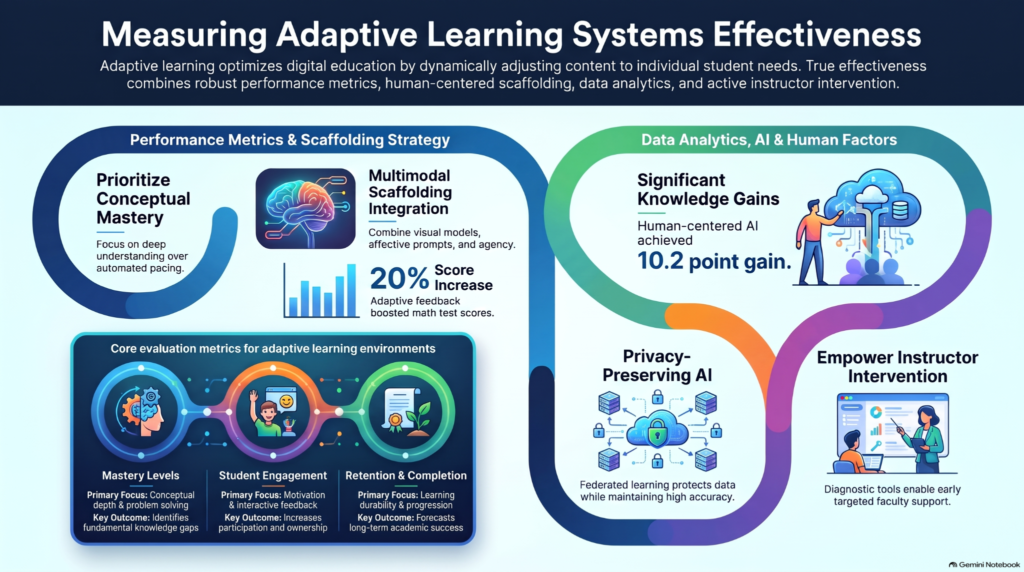
Measuring the effectiveness of adaptive learning systems necessitates a careful examination of specific metrics that reflect student progress and overall educational outcomes. Vital metrics include robust performance indicators such as mastery levels, retention rates, and engagement scores, which provide insights into learners’ understanding and application of concepts.
Assessment tools play a significant role in collecting data on these indicators, enabling educators to gauge the efficacy of adaptive learning environments. Additionally, metrics like personalized learning paths and completion rates can highlight the adaptability of the system to individual learners’ needs.
By analyzing these vital metrics, stakeholders can identify successful strategies and areas needing improvement. Ultimately, this focused approach not only enhances educational practices but also fosters an environment where students thrive, empowering them to reach their full potential in their learning journey.
Therefore, the careful selection and application of these metrics are paramount for evaluating the true impact of adaptive learning systems.
Using Data Analytics for Improvement
Data analytics serves as a powerful tool for enhancing adaptive learning systems by transforming raw educational data into actionable insights.
By employing data visualization techniques, educators can interpret complex data sets effectively, enabling them to identify patterns and trends in student performance. Educators can also explore instructional resources and practical teaching materials from the engineering teacher shop to support interactive lessons, reinforce key concepts, and create more engaging learning experiences. This visual representation not only simplifies comprehension but also fosters informed decision-making.
Predictive analytics further enhances these systems by forecasting student outcomes, allowing educators to tailor interventions proactively. By analyzing historical performance data, adaptive learning systems can adjust content delivery and instructional approaches to meet individual student needs, thereby fostering a more personalized learning experience.
Ultimately, the integration of data analytics into adaptive learning frameworks empowers educators to continuously refine their teaching strategies, ensuring that every learner receives the support necessary for success.
This commitment to data-driven improvement reflects a broader goal of enhancing educational accessibility and effectiveness for all students.

SUCCESSFUL CASE STUDIES OF ADAPTIVE LEARNING SYSTEMS
When evaluating adaptive tools in active technical classrooms—whether analyzing computer programming instruction or remote lab platforms—the central challenge invariably returns to human factors and learning ergonomics. Many commercial systems suffer from what I call “black-box optimization”: the software collects granular telemetry on hesitation times, keystrokes, and error rates, yet leaves both the student and the instructor completely blind to the rationale behind its branching decisions.
In demanding STEM environments, excessive automation without intuitive feedback actively undermines learner autonomy. If a student is wrestling with complex logic and suddenly finds themselves demoted to elementary tasks without conceptual explanation, frustration replaces curiosity. Cognitive load spikes not because the subject matter is rigorous, but because the interface and opaque logic create friction. What our empirical investigations and classroom implementations demonstrate is that adaptivity cannot just mean throttling task difficulty.
True instructional effectiveness requires multimodal scaffolding—integrating structured visual models, timely affective prompts, and shared agency where students can actively request contextual hints or deliberately choose to tackle harder challenges. Furthermore, we must bridge the loop back to the educator. The instructor cannot be relegated to an external bystander reviewing end-of-semester analytics. An adaptive system reaches its operational sweet spot when it functions as an intelligent diagnostic assistant, highlighting precisely where misconceptions lie and empowering faculty to conduct targeted, high-impact interventions before a student disengages entirely.
Adaptive learning is a methodology for teaching and learning that strives to personalize lessons, readings, practice activities, and assessments for individual students based on their current skills and performance.
Successful case studies of adaptive learning systems illustrate their potential to considerably enhance student engagement and improve learning outcomes.
By tailoring educational experiences to individual needs, these systems foster a more interactive and personalized learning environment.
Evidence from various implementations indicates that such innovations not only capture student interest but also lead to measurable academic advancements.
Improved Student Engagement
Numerous case studies illustrate how adaptive learning systems considerably enhance student engagement across diverse educational settings.
These systems effectively leverage interactive content to create personalized learning experiences that cater to individual student needs. By incorporating adaptive technologies, educators can foster heightened student motivation, as learners receive immediate feedback and tailored resources that resonate with their interests and abilities.
For instance, a study in a middle school setting demonstrated that students using adaptive platforms displayed a marked increase in participation and enthusiasm during lessons.
Such innovations not only keep students actively involved but also encourage a sense of ownership over their learning journey.
Ultimately, these successful case studies highlight the potential of adaptive learning systems to transform student engagement in modern classrooms.
Enhanced Learning Outcomes
The implementation of adaptive learning systems has not only improved student engagement but has also led to noteworthy enhancements in learning outcomes across various educational contexts.
Successful case studies reveal that these systems, by offering personalized feedback tailored to individual learning styles, considerably boost learning retention. For instance, in a recent study involving high school mathematics, students utilizing adaptive platforms demonstrated a 20% increase in test scores compared to traditional methods.
This personalized approach allows educators to identify knowledge gaps and provide targeted interventions, fostering a deeper understanding of the material.
Additionally, adaptive systems facilitate continuous assessment, ensuring that learning pathways remain relevant and effective, ultimately empowering students to achieve their academic goals and enhancing overall educational success.
What Challenges Should You Expect When Measuring Effectiveness?
How can the effectiveness of adaptive learning systems be accurately assessed amidst a landscape of evolving educational needs? One primary challenge lies in ensuring data reliability, as inconsistent data can skew results and misrepresent a system’s true impact.
Additionally, measurement variability poses significant hurdles; fluctuations in student engagement and performance can distort effectiveness evaluations. Factors such as differing educational contexts, learner demographics, and varying technological access further complicate assessments.
These challenges necessitate a robust framework that accounts for diverse educational environments and individual learning paths. Stakeholders must also consider the qualitative aspects of learning, which may not be easily quantifiable.
By addressing these complexities, educators can develop more thorough evaluation strategies that genuinely reflect the adaptive learning system’s effectiveness, ultimately leading to improved educational outcomes.
Therefore, understanding these challenges is essential for enhancing the measurement of adaptive learning systems in modern digital classrooms.
Best Practices for Continuous Improvement in Adaptive Learning Systems
Adaptive learning is an educational approach that uses technology to automatically adjust content, pacing, and instruction based on each learner’s individual needs, performance, and knowledge level.
Effective continuous improvement in adaptive learning systems relies on a systematic approach that incorporates regular feedback loops and data analysis. To enhance the effectiveness of these systems, educational institutions should implement adaptive strategies that respond dynamically to learner needs.
Regularly collecting and analyzing feedback from both students and instructors is vital, as it provides insights into the functionality and impact of the learning environment.
Moreover, iterative assessments should be conducted to evaluate the effectiveness of instructional materials and delivery methods. Utilizing data-driven decision-making enables educators to refine adaptive strategies, ensuring they remain aligned with individual learner goals.
Additionally, fostering a culture of collaboration among educators can lead to shared best practices and innovative solutions, further enhancing the adaptability of learning systems.
Ultimately, an ongoing commitment to improvement, grounded in robust feedback loops, is essential for optimizing the learning experience in digital classrooms.

RELATED STUDIES ABOUT ADAPTIVE LEARNING SYSTEMS EFFECTIVENESS
Ultimately, measuring the effectiveness of adaptive learning systems reveals a tapestry woven from diverse student needs, engagement, and data analytics. Each metric serves as a thread, illustrating the intricate patterns of success and challenges faced in modern digital classrooms. As educators navigate this evolving landscape, they must embrace continuous improvement, much like tending to a garden where growth thrives amid the occasional storm. Ultimately, the journey towards optimized learning experiences mirrors the complexity of each student’s unique educational path.
Effectiveness of adaptive versus non-adaptive intelligent tutoring systems in early primary mathematics
Conceptual Framework and Research Rationale
- Student Heterogeneity in Early Primary Education: Classrooms are characterized by high variance in students’ cognitive prerequisites, prior knowledge, working memory capacity, and motivational traits. When left unaddressed during early schooling, these foundational disparities can widen long-term academic achievement gaps.
- Intelligent Tutoring Systems (ITS) as an Adaptive Solution: ITS platforms use dynamic learner modeling, adaptive task sequencing, and immediate formative feedback to provide autonomous, individualized instruction. While meta-analyses document positive overall effects of ITS across secondary and higher education, findings in early primary contexts remain scarce and show smaller effect sizes.
- Confounding Bundles in Adaptivity Research: Prior ITS studies frequently bundle multiple adaptive features simultaneously (e.g., dynamic task difficulty, adaptive hints, customized scaffolding, and conversational dialogue) or compare adaptive digital systems against non-digital control conditions (such as paper workbooks or lectures). These designs conflate the medium effect with adaptivity, making it impossible to isolate the unique contribution of dynamic task difficulty adjustment.
- Core Research Objectives:
- Isolate the specific effect of dynamic task difficulty adaptation by comparing an adaptive ITS directly against a structurally equivalent non-adaptive ITS in second-grade mathematics.
- Keep learning content, user interface, hints, and immediate feedback identical across conditions, varying solely the progression logic.
- Evaluate primary outcomes: mathematics learning gains, cognitive load (mental effort and subjective difficulty), and task enjoyment.
- Exploratorily assess whether learner characteristics (prior knowledge, conscientiousness, interest, academic self-concept) or multidimensional latent learner profiles moderate system effectiveness.
Methodology and Experimental Design
- Field Experiment Architecture and Participants:
- Randomized two-group pretest-posttest field experiment conducted in Switzerland across 11 regular primary school classes in 7 public schools.
- Pilot Cohort: 29 second-grade students (Mage=7.48 years) confirmed technical usability, timing feasibility, and test psychometrics.
- Main Experimental Sample: 132 second-grade students (Mage=7.660.55 years; 57.58% female, 40.15% male, 2.27% unreported).
- Experimental Condition (Adaptive ITS, n=65): Implemented task difficulty adaptivity based on Bayesian Knowledge Tracing (BKT) and CTAT’s “Sequential Mastery Learning Easier First” algorithm. Students skipped mastered skills and remained at unmastered difficulty levels until demonstrating conceptual mastery.
- Control Condition (Non-Adaptive ITS, n=67): Received the exact same interface and problems in a static, predefined linear order resembling a conventional textbook chapter, progressing regardless of mastery.
- Instructional System and Mathematical Content:
- Built using the CTAT+TutorShop platform and deployed on school tablets.
- Focused on 13 standardized arithmetic skills spanning addition and subtraction of single-, double-, and triple-digit numbers with and without place-value transitions (carrying and borrowing).
- Problems used a pyramid number format with three sub-tasks per problem. Both systems offered identical multi-level audio-spoken hints (unlocked sequentially via lightbulb icons) and immediate visual color feedback (green for correct, red for incorrect).
- Experimental Procedure and Duration:
- Phase 1: Paper-and-pencil pretest (10 minutes) assessing demographics, non-cognitive characteristics, and baseline mathematical knowledge.
- Phase 2: Independent learning session with the assigned tablet ITS version (30 minutes).
- Phase 3: Immediate paper-and-pencil posttest (10 minutes) measuring cognitive load, enjoyment, and mathematics learning outcomes.
- Instrumentation and Assessment Scales:
- Mathematical Knowledge Tests: Pretest and parallel posttest containing 5 multi-step problems (15 scored items total, 0–15 points; pretest reliability =.88, posttest =.91).
- Learner Characteristics: 4-point Likert scales measuring Conscientiousness (3 items, =.59), Interest in Mathematics (3 items, =.83), and Academic Self-Concept (3 items, =.79).
- Cognitive Load & Affect: Single 4-point Likert items assessing Mental Effort, Subjective Difficulty, and Enjoyment.
Key Empirical Findings
- Learning Outcomes:
- Baseline MANOVA showed no significant differences between the two conditions across prior knowledge, conscientiousness, interest, or academic self-concept (Wilks’ =0.96,p=.255).
- ANCOVA evaluating posttest scores (controlling for prior knowledge) revealed a strong main effect of prior knowledge (F(1,124)=206.99,p<.001,p2=.63), but no significant effect of condition (F(1,124)=0.32,p=.574,p2=.00).
- Posttest performance was nearly identical: Non-Adaptive condition (M=9.983.99) versus Adaptive condition (M=10.303.86). Prior knowledge did not moderate the condition effect (p=.802).
- Cognitive Load and Enjoyment:
- Linear regression models revealed no statistically significant differences between the adaptive and non-adaptive conditions across:
- Mental Effort: F(1,127)=0.01,p=.938,p2=.00 (M=1.59 vs. 1.58).
- Subjective Difficulty: F(1,127)=1.59,p=.210,p2=.01 (M=1.51 vs. 1.68).
- Enjoyment: F(1,126)=0.41,p=.525,p2=.00 (M=3.68 vs. 3.76).
- Both groups reported high overall enjoyment (close to the ceiling of the 4-point scale) and low perceived mental effort.
- Moderation by Individual Learner Characteristics:
- Prior knowledge, academic interest, and academic self-concept did not moderate the effects of adaptivity on posttest performance or mental effort (p>.05).
- Conscientiousness emerged as a statistically significant moderator for:
- Subjective Difficulty: F(1,115)=4.39,p=.038,p2=.04.
- Enjoyment: F(1,114)=5.63,p=.019,p2=.05.
- Students with low conscientiousness reported higher subjective difficulty and higher enjoyment when using the adaptive tutor compared to the non-adaptive tutor, whereas these differences diminished among students with high conscientiousness.
- Latent Profile Analysis (LPA):
- A 5-profile model was identified based on statistical fit (BIC = 1254, SABIC = 1166) and theoretical interpretability:
- Profile 1: Balanced Performers: Average scores across all indicators.
- Profile 2: Disengaged Performers: Low scores across all metrics, particularly interest.
- Profile 3: Confident High-Performers: High scores across motivation, self-concept, and prior knowledge.
- Profile 4: Motivated Low-Performers: High interest but low self-concept and prior knowledge.
- Profile 5: Overstraining Performers: High self-concept and effort, but low actual prior knowledge.
- In regression modeling, learner profiles significantly predicted posttest scores (F(9,108)=4.58,p<.001,R2=.28), but profile membership did not moderate the condition effect (p.198,p2=.02).
- System Progression and Log-Data Insights:
- Log-data analysis showed that students in the non-adaptive condition reached significantly higher average mastery probabilities than those in the adaptive condition (M=0.67 vs. 0.58;F(1,128)=7.85,p=.006,2=.06).
- In the non-adaptive system, students were moved forward regardless of accuracy, exposing them to advanced problem types. In the adaptive system, students who struggled with prerequisite skills remained at lower difficulty tiers.
- An exploratory ANCOVA incorporating mastery probability alongside pretest scores showed a positive conditional effect for the adaptive system on posttest performance (t(122)=2.33,p=.022,d=0.46). However, the authors caution that because mastery probability is derived during the intervention, this reflects internal progression dynamics rather than an unconfounded treatment effect.
Theoretical and Pedagogical Interpretations
- Isolated Task Difficulty vs. Bundled Adaptivity: Dynamic difficulty adaptation in isolation does not produce the large learning advantages often attributed to ITS. The pronounced gains reported in broader literature likely stem from bundled features (such as adaptive scaffolding, explanatory feedback, and conversational dialogue) or contrasts with non-digital learning formats.
- Developmental Constraints in Early Primary Learners: Second graders possess developing metacognitive monitoring and self-regulation skills. Without adaptive instructional scaffolding (adjusting explanations rather than just problem difficulty), younger students may struggle to translate diagnostic task adjustments into learning gains.
- The Progression Dilemma: Mastery-based algorithms hold struggling students at basic levels until proficiency is established. Within brief practice sessions, this may restrict their exposure to advanced problem types compared to linear curricula that advance automatically.
Study Limitations and Future Directions
- Intervention Exposure Time: The 30-minute training session provided limited time for the Bayesian Knowledge Tracing algorithm to accumulate interaction data and adapt to each student. Longitudinal studies across multiple weeks are needed to examine cumulative effects.
- Auditory Support Modality: Hints were delivered exclusively via spoken audio. While accessible for early readers, purely auditory explanations can be abstract; integrating multimodal scaffolds (such as visual diagrams and concrete representations) may better support struggling novices.
- Absence of Delayed Assessments: The study assessed immediate posttest outcomes without a delayed retention posttest, leaving long-term consolidation and transfer unobserved.
- Implications for Primary ITS Design: Future adaptive systems for young learners should focus on adapting instructional support (varying guidance and visual scaffolding) rather than adjusting task difficulty alone.
| REFERENCE: Leonie Sibley, Tobias Berner, Thomas Schmalfeldt, Effectiveness of adaptive versus non-adaptive intelligent tutoring systems in early primary mathematics Computers and Education Open, Volume 11, 2026, 100420, ISSN 2666-5573, https://doi.org/10.1016/j.caeo.2026.100420. (https://www.sciencedirect.com/science/article/pii/S2666557326000911) |
Adaptive learning with human factors and Artificial Intelligence: associations with training effectiveness in programming education
Conceptual Framework and Research Rationale
- Limitations of Conventional Digital Learning Platforms: Traditional digital learning systems often rely on static content delivery and uniform task sequencing, failing to accommodate students’ cognitive diversity and psychological states. In high-cognitive-load subjects such as introductory computer programming, rigid instructional flows frequently induce frustration, cognitive overload, and disengagement, driving high student attrition.
- Integrating Human Factors Engineering (HFE) with Artificial Intelligence (AI): While AI algorithms can predict student behavior and recommend content, they frequently function as opaque “black-box” systems disconnected from cognitive ergonomics and affective needs. Human Factors Engineering introduces user-centered design, mental workload regulation, intuitive navigation, and perceptual feedback loops. Combining HFE principles with AI-driven adaptivity ensures that technological personalization directly supports learners’ cognitive capabilities, emotional resilience, and sense of autonomy.
- Core Psychological Constructs:
- Motivation: The internal drive to engage in programming tasks, spanning intrinsic curiosity and extrinsic utility.
- Interest: Affective orientation reflecting task enjoyment, curiosity, and sustained attention.
- Confidence: Perceived self-efficacy in overcoming coding obstacles and mastering concepts.
- Learning Effectiveness: Quantified objectively through standardized pre- and post-intervention knowledge tests covering programming fundamentals.
- Core Research Objectives and Hypotheses:
- Design and deploy a human-centered adaptive learning system integrating behavioral metrics and psychometric profiling.
- Evaluate whether adaptive system users achieve higher motivation, interest, and post-test scores than non-adaptive users (Hypothesis 1).
- Test whether motivation and interest independently predict objective learning gains (Hypothesis 2).
- Test whether the interaction of motivation and interest generates a synergistic effect on learning outcomes (Hypothesis 3).
System Architecture and Technical Implementation
The platform was engineered around a four-module architecture built in Python 3.9 using a Django REST API backend, a PostgreSQL 13 relational database, a ReactJS web interface, and Docker containerization hosted on AWS EC2:
- Behavioral Data Collection and Analysis Module:
- Tracks fine-grained user actions (clickstream events, time-on-task, code attempts, hesitation times, idle intervals at 0.5-second resolution) alongside psychometric surveys.
- Learner Modeling Module:
- Applies a Random Forest classifier (n_estimators=200,max_depth=12) to predict learner engagement and confidence (achieving 87.2% classification accuracy).
- Employs K-means clustering (k=3; average silhouette score =0.64) to group students into low-, moderate-, and high-engagement profiles, updating profiles dynamically after every three completed tasks.
- Personalized Learning Strategy Generation Module:
- Uses a reinforcement learning engine (Q-learning algorithm: =0.1,=0.9, decaying from 0.30 to 0.05) to optimize instructional pathways across beginner, intermediate, and advanced content tiers.
- System adaptations primarily comprised task difficulty adjustments (62%), feedback prompts (23%), and pacing modifications (15%).
- Real-Time Feedback and Support Module:
- Integrates rule-based triggers and predictive alerts delivered via real-time web sockets:
- Motivational Prompts: Triggered if self-reported motivation dropped >1 point or if idle time exceeded 45 seconds twice within 10 minutes.
- Scaffolding & Time Extensions: Triggered if cognitive overload occurred (three consecutive incorrect attempts paired with task durations exceeding peer 75th percentiles).
- Step-Level Pacing: Shortened sub-tasks provided if confidence ratings fell below 2.5 on a 5-point scale.
Methodology and Experimental Design
- Participants and Demographics:
- Sample of 100 undergraduate students recruited from introductory programming courses in Taiwan (selected from 105 recruits after removing 5 incomplete/straight-lined submissions).
- 55% male, 45% female; mean age 21.42.3 years (range 18–27).
- Prior programming experience: 38% had no prior formal coursework, 42% had one course, and 20% had two or more courses.
- Experimental Procedure (75-minute total protocol):
- Baseline testing: Briefing/consent (3 min), 10-item pre-test on programming fundamentals (10 min), and a 29-item baseline psychometric survey (5 min).
- System onboarding and tutorial (5 min).
- Core training session (40 min): Participants solved 12 micro-activities covering variables, conditional logic, iterative loops, and debugging.
- Post-intervention testing: 10-item parallel post-test (10 min), usability/satisfaction survey (5 min), and debriefing (2 min).
- Between-Subjects Experimental Group Assignment:
- Adaptive Condition (n=50): Received dynamic task difficulty adjustment, pacing changes, and real-time scaffolding.
- Non-Adaptive Condition (n=50): Completed identical programming micro-activities presented in a fixed, linear textbook sequence without adaptive intervention.
- Groups were confirmed equivalent at baseline across gender, age, pre-test scores, and initial motivation/interest (p>.10).
- Psychometric Validation:
- Exploratory Factor Analysis (EFA; Principal Component Analysis with Varimax rotation; KMO=0.911, Bartlett’s test p<.001) retained four factors accounting for 72.4% of total variance after dropping two low-communality items: Motivation (8 items, =.91), Interest (7 items, =.88), Confidence (6 items, =.87), and Perceived Learning Effectiveness (6 items, =.90).
Key Empirical Findings
- Learning Gains and Between-Group Comparisons (Supporting Hypothesis 1):
- Both groups showed significant pre-to-post knowledge gains, but improvements were significantly larger in the adaptive learning condition:
- Adaptive Group (n=50): Pre-test M=68.29.1 Post-test M=78.48.7 (Mean Gain = +10.2 points; paired t(49)=9.12,p<.001,Cohen’sd=0.83, large effect).
- Non-Adaptive Group (n=50): Pre-test M=69.58.8 Post-test M=72.19.2 (Mean Gain = +2.6 points; paired t(49)=2.01,p=.049,Cohen’sd=0.28, small effect).
- Between-Group ANCOVA (controlling for pre-test baseline, age, gender, and weekly study hours): Confirmed significantly higher post-test performance in the adaptive condition (F(1,96)=8.21,p=.005,partial2=0.079, medium effect).
- High-motivation learners also demonstrated significantly higher programming confidence (F(1,97)=6.71,p=.011,partial2=0.065) and higher engagement scores (F(1,97)=8.23,p=.005,partial2=0.078) than low-motivation peers.
- Direct Predictors of Learning Effectiveness (Supporting Hypothesis 2):
- In multiple regression models (N=100,R2=0.42,AdjustedR2=0.40,F(3,96)=24.1,p<.001), both psychological constructs independently predicted post-test performance:
- Motivation: $\beta = 0.41, t = 3.12, p = .001, 95\%\text{ CI } [0.23, 0.59], f^2 = 0.18$ (medium-to-large effect). A one standard deviation increase in motivation predicted an average 4.1-point increase in post-test score.
- Interest: $\beta = 0.32, t = 2.85, p = .004, 95\%\text{ CI } [0.10, 0.54], f^2 = 0.11$ (medium effect).
- Confidence approached significance as a positive predictor (=0.19,p=.054,f2=0.08).
- Demographic control variables (gender =0.06,p=.42; age =-0.07,p=.37; weekly study hours =0.08,p=.31) were non-significant and did not alter primary predictor relationships.
- Synergistic Interaction Effect (Supporting Hypothesis 3):
- The mean-centered interaction term (MotivationInterest) was positive and statistically significant ($\beta = 0.21, t = 2.10, p = .032, 95\%\text{ CI } [0.02, 0.40], f^2 = 0.06$), accounting for unique variance beyond main effects (R2=0.04,p=.032).
- Simple slopes analysis confirmed a synergistic dynamic: the positive predictive relationship of motivation on post-test performance was markedly steeper among students with high interest (+1 SD) compared to those with low interest (–1 SD). Students with simultaneously high motivation and high interest achieved the highest learning outcomes.
- Qualitative Usability and Subjective Feedback:
- Thematic analysis of 186 open-ended responses (inter-rater agreement Cohen’s =0.82) identified four primary themes: interface clarity, motivational support through timely prompts, task pacing control, and desires for deeper code explanations.
- Students with lower initial programming experience reported that adaptive pacing reduced anxiety and cognitive overload, making self-directed coding feel less intimidating.
Theoretical and Ergonomic Interpretations
- Human Factors Engineering as a Learning Scaffolding Mechanism: Technological adaptivity achieves pedagogical value only when integrated with human cognitive and emotional ergonomics. Clear visual layouts, progressive disclosure of interface features, and intuitive dashboards reduce extraneous cognitive load, freeing mental bandwidth for complex computational problem-solving.
- Dynamic Alignment with Adaptive Learning Theory: Rather than treating learning as linear, the system confirms that matching task difficulty to real-time performance and affective signals maintains learners in their “optimal learning zone” (preventing boredom from under-challenge and anxiety from excessive difficulty).
- Shared Control and Preserving Autonomy: Preventing student disengagement requires balancing automation with learner agency. Incorporating shared-control mechanisms—where learners can override system suggestions or request hints—protects learner autonomy while delivering structured scaffolding.
Practical Implications and Study Limitations
- Instructional and System Design Recommendations:
- Adaptive learning platforms should incorporate dual-layer monitoring that pairs behavioral performance logs (error rates, idle times) with subjective affective check-ins.
- Institutional training centers and universities should implement modular software architectures that allow adaptive engines to be repurposed across diverse STEM disciplines without rebuilding frontend interfaces.
- Methodological Boundaries:
- Sample Scope: The study evaluated 100 undergraduate students from a single institutional context in Taiwan over a short 40-minute intervention window, limiting conclusions regarding long-term knowledge retention.
- Periodic vs. Continuous Sensing: Adaptation relied on periodic behavioral logs and discrete self-report prompts rather than continuous physiological tracking (e.g., eye-tracking, EEG, facial emotion detection).
- Domain Specificity: The empirical evaluation was restricted to introductory programming fundamentals; transferability to abstract, less structured domains (e.g., humanities, complex design) requires further testing.
| REFERENCE: Kuo-Yi Lin, Meng-Hua Li, Fang-ying Lo, Hsiao-Chun Huang, Kotomichi Matsuno, Ruriko Watanabe, Adaptive learning with human factors and Artificial Intelligence: associations with training effectiveness in programming education, International Journal of Industrial Ergonomics, Volume 110, 2025, 103834, ISSN 0169-8141, https://doi.org/10.1016/j.ergon.2025.103834. (https://www.sciencedirect.com/science/article/pii/S0169814125001404) |
A federated learning-based Emotion-Aware Autonomous AI tutoring system with adaptive curriculum and multilingual interaction
Conceptual Framework and Research Rationale
- Shift Toward Emotion-Aware Educational Systems: Conventional intelligent tutoring systems (ITS) focus almost exclusively on cognitive evaluation and knowledge delivery, neglecting learners’ real-time emotional and psychological states. Unaddressed learner frustration, confusion, or boredom often leads to cognitive fatigue, decreased knowledge retention, and course dropout.
- The Privacy Challenge in Affective Computing: Creating robust emotion-recognition engines requires training on sensitive biometric and behavioral data—specifically student speech recordings and natural language text. Centralizing these heterogeneous datasets on third-party servers presents severe student data privacy risks and regulatory compliance hurdles.
- The Proposed FAT-FedNet Solution: The authors introduce the Fused Audio-Text Federated Network (FAT-FedNet), a decentralized, multi-domain framework that simultaneously analyzes speech emotion recognition (SER) and text emotion analysis (TEA). By leveraging federated learning, institutions collaborate to train global emotional representation models across distributed, non-IID client nodes while keeping raw audio and text strictly local.
- Core Research Objectives:
- Develop parallel, multi-modal neural architectures combining self-supervised acoustic embeddings (Wav2Vec 2.0) and contextual language embeddings (DistilBERT) with CNN-BiLSTM-Attention encoders.
- Implement federated learning optimization (FedAvg and FedProx) across heterogeneous multi-lingual speech corpora (English, Bengali, Persian) and diverse text corpora.
- Couple the emotion-recognition engine to an autonomous AI tutoring architecture featuring dual operating modes: a Subject Learning Mode powered by Retrieval-Augmented Generation (RAG) and a multilingual Language Learning Mode (supporting English, Tamil, and Hindi).
Technical Architecture and Methodological Design
- Dual-Domain Neural Pipelines:
- Text Emotion Pipeline: Raw text is tokenized (maximum length 128–192 tokens) and processed through a two-branch architecture:
- Text Semantic Fusion Encoder (Branch A): Extracts contextual sentence representations via DistilBERT’s [CLS] token.
- Cross-Modal Temporal Fusion Encoder (Branch B): Passes DistilBERT token embeddings through three 1D convolutional layers (128256256 filters), a Bidirectional LSTM (256 hidden units per direction), and an 8-head self-attention layer to weight emotionally salient terms.
- Features are concatenated into a 256-dimensional fused vector and classified via a dense softmax layer.
- Speech Emotion Pipeline: Raw audio waveforms are normalized to 16 kHz and fixed to 3-second segments. Feature extraction feeds two parallel branches:
- Speech Semantic Fusion Encoder (Branch A): Time-averages 768-dimensional contextual acoustic embeddings from a pretrained Wav2Vec 2.0-base model.
- Cross-Modal Temporal Fusion Encoder (Branch B): Extracts log-mel spectrograms (128bands188frames), passed through three 2D-CNN blocks (64, 128, 256 filters), a 256-unit BiLSTM, and an 8-head self-attention layer (R512) to model temporal and prosodic dependencies.
- Global and temporal vectors concatenate into a 1,024-dimensional fused representation passed through Layer Normalization, ReLU activation, and softmax classification.
- Text Emotion Pipeline: Raw text is tokenized (maximum length 128–192 tokens) and processed through a two-branch architecture:
- Data Harmonization Across Multi-Domain Corpora:
- Text Datasets (6 Unified Emotion Classes: anger, fear, joy, sadness, love, surprise): Evaluated across DAIR-AI (N=15,996), Boltuix (N=16,046), MTEB Emotion (N=15,956), and GoEmotions (N=6,283).
- Speech Datasets (7 Unified Emotion Classes: anger, disgust, fear, happy, neutral, sad, surprise): Evaluated across five multilingual corpora: CREMA-D (N=7,442, English acted), RAVDESS (N=2,880, English acted), TESS (N=2,880, English balanced), ShEMO (N=3,000, Persian imbalanced), and SUBESCO (N=6,000, Bengali balanced).
- Cross-Silo Federated Learning Framework:
- Simulates a decentralized institutional ecosystem where each distinct speech or text dataset functions as an independent local client node.
- Local Training: Speech clients train for 3 local epochs per round; text clients train for 5 local epochs per round using AdamW optimization with progressive layer unfreezing.
- Global Aggregation: Central server updates are coordinated over 15–25 global communication rounds via Federated Averaging (FedAvg), weighted by client sample volume. FedProx regularization (prox=1.510-3) was incorporated to penalize local client drift under severe non-IID conditions.
- Data Leakage Safeguards: Split into 80% training and 20% validation partitions strictly under speaker-independent criteria for audio and source-independent splits for text.
Key Empirical Findings
- Text Emotion Recognition Performance:
- In multi-class text emotion benchmarks, FAT-FedNet significantly outperformed all centralized and traditional baselines:
- DAIR-AI Dataset: Achieved 98.1% accuracy and 0.972 F1-score (outperforming standalone DistilBERT at 88.2%, CNN-BiLSTM-Attention at 86.7%, and SVM at 73.3%).
- MTEB Dataset: Achieved 98.1% accuracy and 0.970 F1-score (vs. DistilBERT at 85.0% and CNN-Transformer at 69.8%).
- Highly Granular/Challenging Corpora: Achieved 76.0% accuracy on Boltuix (a 19.9 percentage-point gain over DistilBERT) and 72.8% accuracy on GoEmotions (a 21.6 percentage-point gain over DistilBERT).
- Global Federated Model Evaluation: The global FedAvg model reached 82.95% accuracy and a macro-F1 of 0.797 across all pooled validation samples, demonstrating fast convergence within 8 to 10 communication rounds.
- Unseen Generalization Test: Evaluated on the independent JeffNyman/emotions test set (N=2,000), the global FedAvg model sustained 92.25% accuracy and an 0.872 macro-F1 score.
- Speech Emotion Recognition (SER) Performance:
- Across five multilingual speech corpora, FAT-FedNet demonstrated consistent cross-dataset and cross-lingual advantages:
- TESS (English): Achieved 96.43% accuracy and 0.964 F1-score (outperforming standalone Wav2Vec at 34.8% and SVM at 83.6%).
- SUBESCO (Bengali): Achieved 88.15% accuracy and 0.881 F1-score (a 36.3 percentage-point improvement over centralized baselines despite language-specific acoustic variance).
- RAVDESS (English): Achieved 83.59% accuracy and 0.834 F1-score (vs. Wav2Vec at 64.6% and CNN-BiLSTM-Attention at 41.0%).
- ShEMO (Persian): Achieved 69.63% accuracy and 0.737 F1-score despite severe 28x class imbalance (outperforming standalone Wav2Vec at 60.9%).
- CREMA-D (English): Achieved 68.93% accuracy and 0.698 F1-score.
- Global Model Convergence: Global speech validation accuracy climbed from 23% at round 1 to 84% at round 25, exhibiting a smooth, monotonic decline in global loss.
- Unseen Audio Generalization: Evaluated on the external Surrey Audio-Visual Expressed Emotion (SAVEE) dataset (N=480), the global model achieved 62% accuracy under FedAvg and 64% under FedProx, confirming transferability to unseen speakers and recording environments.
- Ablation Analyses:
- Text Modality: The semantic branch (DistilBERT [CLS]) consistently outperformed the temporal branch (CNN-BiLSTM) by 0.5% to 6.5%, indicating that contextual semantics dominate text emotion decoding. The centralized hybrid integration of both branches yielded modest gains (0.7% to 3%), while federated learning aggregation added an average gain of ~20% across corpora.
- Speech Modality: Combining acoustic embeddings (Wav2Vec 2.0) with spectro-temporal features (Mel-spectrogram CNN-BiLSTM) generated large complementary gains in the centralized hybrid model (up to +38.3% on TESS). Incorporating federated learning boosted speech accuracy by an average of 28.1% over centralized models, demonstrating that cross-institutional data diversity mitigates single-dataset acoustic overfitting.
Autonomous Tutoring Integration and Instructional Workflow
The study grounds the FAT-FedNet recognition engine within an interactive AI tutoring workflow operating across two distinct modules:
- Subject Learning Mode:
- Focuses on STEM subjects, including computer science, mathematics, and physics.
- Ingests instructor-provided curriculum roadmaps, textbooks, and lecture notes through a Retrieval-Augmented Generation (RAG) pipeline.
- Continuously monitors acoustic tone and text input; if student frustration or confusion is detected, the tutor automatically slows instructional pacing, decomposes abstract concepts, and retrieves foundational review materials. When confidence or enthusiasm is detected, the tutor accelerates pacing and introduces challenging extension exercises.
- Language Learning Mode:
- Supports oral fluency, pronunciation correction, and grammatical proficiency across English, Tamil, and Hindi.
- Utilizes speech recognition to detect phonetic mispronunciations in real time, delivering localized speech feedback and empathetic text corrections powered by the Google Gemini API.
Practical Implications and Study Limitations
- Privacy-Preserving Educational Deployments: The decentralized architecture enables universities and EdTech platforms to deploy emotion-aware tutoring systems that comply with strict student data protection regulations (such as FERPA and GDPR), eliminating the liability of centralized audio/text repositories.
- Mitigating Cultural and Linguistic Bias: Incorporating multilingual corpora (English, Bengali, Persian, Hindi, Tamil) within a federated averaging framework enables the AI tutor to learn acoustic and emotional representations that transcend specific regional accents or cultural communication styles.
- Methodological and Implementation Boundaries:
- The complete end-to-end tutoring application is presented as an integrated conceptual workflow and system architecture; large-scale field validation in live physical classrooms with enrolled students has not yet been executed.
- The current model operates solely on speech audio and text transcripts, omitting visual facial expressions (camera feeds) and physiological signals (such as heart rate variability or skin conductance).
- Future development must focus on deploying on-device personalized federated adaptation layers and integrating lightweight visual transformer encoders for real-time facial landmark emotion tracking.
| REFERENCE: Arthy Shankar, S.S. Ashika, Atharva Bhangale, C.R. Dhivyaa, K. Nithya, A federated learning-based Emotion-Aware Autonomous AI tutoring system with adaptive curriculum and multilingual interaction, Array, Volume 31, 2026, 100998, ISSN 2590-0056, https://doi.org/10.1016/j.array.2026.100998. (https://www.sciencedirect.com/science/article/pii/S2590005626003218) |
CONCLUSION
As we look toward the next horizon of educational innovation—where intelligent tutoring engines increasingly merge with multimodal AI and emotion-aware computing—our institutional priority must remain steadfastly centered on pedagogical integrity. The technical capability to parse student speech, detect vocal hesitation, and dynamically recalibrate a syllabus in real time is undeniably remarkable. Yet, as someone who values the precision of engineering alongside the deliberate craftsmanship of human mentorship, I urge academic leaders to exercise grounded discernment.
An algorithm can process thousands of telemetry datapoints and accurately diagnose when a learner is experiencing cognitive overload, but it cannot replicate the mentorship, empathy, and professional encouragement that a dedicated instructor brings to a struggling student. If our push toward scalable personalization comes at the expense of student data privacy, transparent assessment, or the spontaneous dialogue of collaborative problem-solving, we have fundamentally compromised the educational mission.
Measuring the true effectiveness of adaptive learning cannot be reduced to clean completion metrics, time-on-task graphs, or standardized test score upticks. Real success is measured by whether these digital environments nurture authentic intellectual curiosity, foster long-term conceptual retention, and equip students to navigate ambiguous, complex problems independently. Technology should build the scaffold, but the human journey of discovery must always remain at the center of the modern classroom.