

In my years teaching structural design and mentoring graduates through the grueling months of board exam review, I have seen brilliant minds completely stall out. Usually, it isn’t because they lack the raw intellect to solve differential equations or calculate tributary load paths. They hit a wall because they are running purely on external fumes: parental pressure, the promise of a future paycheck, or simply the fear of failing.
Extrinsic motivators can get you through a single exam cram session, but they will not sustain you through four or five years of demanding technical coursework. When you are staring at an intricate indeterminate frame analysis at two in the morning, fear and money stop working as effective fuels; they only breed exhaustion and resentment.
Real academic resilience shows up when a student starts caring about the mechanics of the problem itself. The moment you shift your perspective from “I need to pass this quiz” to “I want to understand why this beam deflects under this specific load configuration,” the cognitive burden shifts. You stop memorizing procedural steps like a robot and start thinking like a designer. That spark of genuine, intrinsic curiosity is the primary structural foundation of academic survival. Without it, the weight of a rigorous degree program will eventually cause personal burnout.
Intrinsic motivation is a crucial component in higher education, enhancing student engagement and boosting academic achievement. It fosters deep learning through curiosity, personal interests, and goal setting. Students with high intrinsic motivation show greater persistence, emotional resilience, and ownership of their educational journey. Consequently, these learners perform markedly better academically. By understanding and nurturing intrinsic motivation, educators can create enriching environments that promote responsibility and personal growth. Additional insights on effective strategies and assessment methods await exploration.
KEY TAKEAWAYS
- Intrinsic motivation enhances academic performance by promoting deeper engagement and self-directed learning among students in higher education.
- Emotionally invested students demonstrate greater resilience and persistence, leading to improved academic outcomes.
- Meaningful goal-setting driven by intrinsic motivation fosters direction and purpose in students’ educational pursuits.
- A relevant curriculum aligned with personal interests stimulates curiosity and passion, increasing student engagement.
- Strategies that promote autonomy and peer collaboration reinforce intrinsic motivation, resulting in higher academic achievement and personal fulfillment.
UNDERSTANDING INTRINSIC MOTIVATION: DEFINITION AND IMPORTANCE
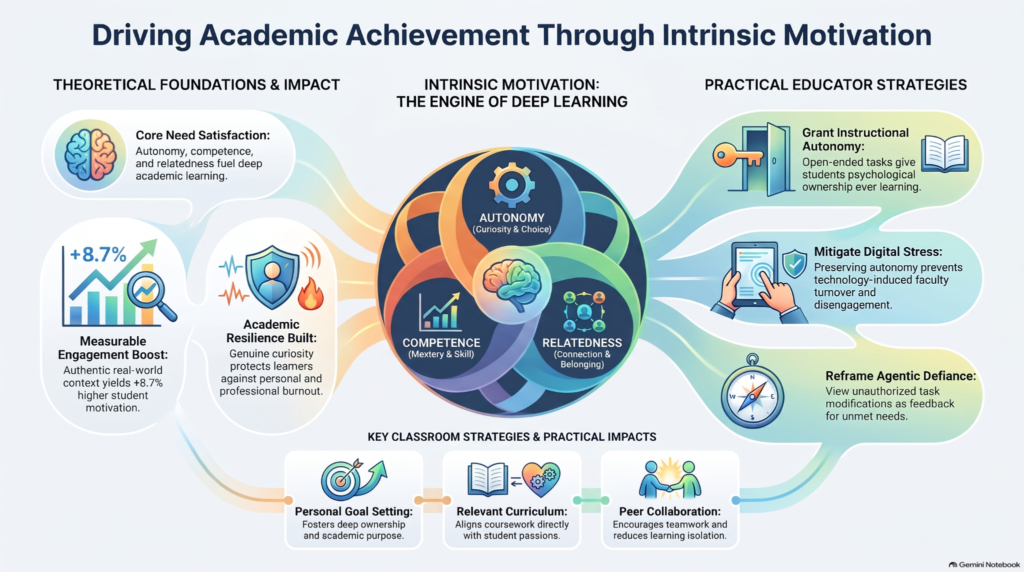
Intrinsic motivation serves as a pivotal force in the domain of higher education, driving students to engage deeply with their learning experiences. Understanding intrinsic motivation involves recognizing its theoretical frameworks, such as Self-Determination Theory, which emphasizes autonomy, competence, and relatedness as key components.
These intrinsic motivation theories suggest that when students feel self-directed and capable, their engagement levels rise, leading to enhanced academic performance.
Furthermore, the intrinsic motivation benefits extend beyond mere academic achievement; they foster a lifelong passion for learning and personal growth. Students who are intrinsically motivated are more likely to pursue knowledge for its own sake, cultivating critical thinking and creativity.
This intrinsic drive not only enhances their educational experience but also equips them to contribute positively to society. Consequently, grasping the importance of intrinsic motivation is essential for educators and institutions aiming to nurture engaged and responsible learners.
What Drives Intrinsic Motivation in Learning?
Intriguing research shows that when students have intrinsic motives for learning — when they engage not for external reward but because they find the activity itself interesting and gratifying — they become more likely to attach meaning to their work, explore new topics, and persist in the face of learning challenges.
What factors contribute to the development of intrinsic motivation in learning? Key drivers include curiosity, which fosters a natural desire to explore and understand.
Personal interests greatly enhance motivation, as learners are more engaged when content aligns with their passions.
Goal setting plays an essential role, as it provides clear objectives that ignite intrinsic rewards upon achievement.
Emotional connections to the material can further deepen this motivation, fostering a sense of relevance to life experiences.
Additionally, self-efficacy—believing in one’s capabilities—enhances motivation by encouraging learners to tackle challenges.
Mastery experiences, where individuals successfully overcome obstacles, reinforce this belief.
Feedback importance cannot be overstated; constructive feedback encourages growth and reinforces motivation.
Finally, social influences, including peers and mentors, can inspire and cultivate a supportive learning environment, ultimately driving intrinsic motivation in students.
These factors collectively create a rich tapestry that nurtures a lifelong love for learning.
How Intrinsic Motivation Affects Student Engagement and Persistence
While various factors influence student engagement and persistence, the role of intrinsic motivation stands out as particularly significant. Intrinsic motivation fosters student curiosity, leading to deeper cognitive engagement in learning activities. When students are emotionally invested in their studies, they are more likely to pursue personal growth and demonstrate academic resilience, even in the face of challenges. The relationship between college education and social mobility also highlights how academic achievement, personal growth, and the development of valuable skills can help students access better opportunities and improve their future prospects.
Goal setting becomes more meaningful when driven by intrinsic rewards rather than external pressures, allowing for a more authentic learning experience. Additionally, learning autonomy nurtured by intrinsic motivation enables students to take ownership of their educational journey, enhancing their commitment to long-term objectives.
Consequently, students who harness intrinsic motivation are better equipped to maintain engagement and persist through difficulties, ultimately enriching their academic experiences and fostering a lifelong love of learning. This intrinsic drive not only supports individual achievement but also cultivates a vibrant, collaborative educational community.
How Intrinsic Motivation Influences Academic Performance
Intrinsic motivation theory is derived from the principle that motivation is fueled from within oneself. Extrinsic motivation theory is derived from the principle that motivation is fueled externally through reward, punishment, or the avoidance of a negative outcome.
The connection between intrinsic motivation and academic performance is well-documented, revealing that students who engage in learning for the sake of personal satisfaction tend to achieve higher levels of success.
Research indicates that intrinsically motivated learners are more likely to set meaningful goals, fostering a sense of purpose and direction in their academic pursuits. This goal-setting behavior not only enhances their focus but also cultivates emotional resilience, enabling them to navigate challenges effectively.
Moreover, students driven by intrinsic motivation exhibit greater persistence and adaptability, qualities essential for overcoming obstacles in higher education. Their intrinsic desire to learn encourages a deeper understanding of the material, facilitating superior academic outcomes.
Consequently, fostering intrinsic motivation within educational environments can lead to enhanced academic performance, ultimately benefiting students, educators, and the broader community. By prioritizing intrinsic motivation, institutions can empower students to achieve their full potential, contributing positively to society.
Practical Ways to Boost Intrinsic Motivation in Students
Numerous strategies exist to enhance intrinsic motivation among students in higher education, each supported by empirical research. Key methods include personal goal setting and peer collaboration, which have been shown to considerably boost engagement and motivation.
| Strategy | Description |
| Personal Goal Setting | Encourages students to define their own academic objectives, fostering a sense of ownership and purpose. |
| Peer Collaboration | Promotes teamwork and mutual support, making learning more meaningful and reducing feelings of isolation. |
| Relevant Curriculum | Aligning coursework with students’ interests can ignite passion and curiosity. |
| Reflective Practices | Encouraging self-reflection helps students connect their learning experiences to personal values. |
Implementing these strategies can create an enriching educational environment, ultimately leading to enhanced academic achievement and personal fulfillment. Educators can also use practical learning materials and educational resources from the engineering teacher shop to support hands-on activities, encourage curiosity, and make learning more engaging for students. By prioritizing intrinsic motivation, educators can cultivate a culture of lifelong learning and personal growth.

HOW EDUCATORS FOSTER INTRINSIC MOTIVATION IN STUDENTS
When I transition from my job site duties to the lecture hall, one of the most frustrating teaching dynamics I encounter is the learned helplessness bred by rigid, lecture-heavy formats. In engineering, as in any higher education discipline, instructors often make the mistake of reducing mastery to robotic compliance. We hand students a predetermined formula, ask them to plug in numbers, and expect them to remain passionate about the discipline.
Whenever I notice my students disengaging, I deliberately redesign our design labs to introduce genuine autonomy. Instead of assigning a sterile, pre-solved textbook bridge layout, I give them actual boundary conditions, a target budget, and the freedom to select their own structural framing system. Suddenly, the entire classroom dynamic transforms. Students argue passionately about load efficiency, experiment with varying truss geometries, and stay late in the computer labs not because I assigned extra homework, but because they have psychological ownership over the outcome.
Allowing students to make mistakes, adapt their strategies, and exercise real volition connects dry theory directly to professional reality. When learners realize that their decisions dictate whether a virtual bridge stands or collapses, academic achievement becomes an organic byproduct of their own curiosity and personal standard of craftsmanship.
Motivated students are much more likely to achieve their potential and find success. Motivation is an essential ingredient in effective teaching and learning. It not only yields more positive behaviour in students, but it also contributes to a greater sense of wellbeing. Understanding how to motivate children and young people in education is crucial, if we are to provide them with the best possible start in life.
Educators play an essential role in fostering intrinsic motivation by creating engaging learning environments that stimulate curiosity and active participation.
By incorporating elements of autonomy and choice into the curriculum, they empower students to take ownership of their learning experiences.
Research indicates that these strategies not only enhance student engagement but also promote a deeper connection to the material, ultimately leading to improved academic outcomes.
Engaging Learning Environments
While intrinsic motivation can markedly enhance student engagement and learning outcomes, creating an engaging learning environment remains an essential responsibility of educators.
To foster this motivation, educators can implement strategies that promote active participation and connection among students.
- Incorporate collaborative projects that encourage teamwork and shared goals.
- Design interactive activities that stimulate curiosity and foster critical thinking. By providing opportunities for exploration, discussion, and hands-on learning, educators can strengthen the cognitive skills developed in college, helping students improve their reasoning, creativity, and ability to solve complex problems.
- Provide opportunities for peer feedback, enhancing social learning dynamics.
- Utilize varied instructional methods to cater to diverse learning styles.
These approaches not only cultivate intrinsic motivation but also create a dynamic classroom atmosphere where students feel valued and empowered.
Ultimately, such environments are pivotal in supporting academic achievement and fostering a lifelong love for learning.
Autonomy and Choice
When students are granted autonomy and choice in their learning experiences, they are more likely to engage intrinsically with the material.
Research indicates that student empowerment through choice-based learning greatly enhances motivation and academic achievement. By allowing students to select topics, methods, or projects that resonate with personal interests, educators create a sense of ownership over the learning process.
This autonomy fosters deeper engagement and encourages students to take responsibility for their education. Additionally, studies suggest that when learners feel their voices are heard, they are more likely to persist in challenging tasks.
Educators who implement strategies promoting autonomy not only support intrinsic motivation but also cultivate a classroom environment that values individual interests and encourages lifelong learning.
Assessing Intrinsic Motivation: Methods and Tools
Evaluating intrinsic motivation in higher education requires a nuanced understanding of various methodologies.
Self-report questionnaires provide direct insights into students’ motivational states, while behavioral observation techniques offer an objective perspective on engagement and participation.
Self-Report Questionnaires
Self-report questionnaires serve as a pivotal tool for measuring intrinsic motivation in higher education contexts, as they enable researchers to gather subjective data directly from participants regarding their motivations and engagement levels.
Effective questionnaire design is essential to guarantee self-report reliability, allowing for accurate assessments of intrinsic motivation.
Key aspects include:
- Question Clarity: Guarantees participants understand what is being asked.
- Response Scales: Utilizes varied scales to capture a range of motivational levels.
- Validity Testing: Establishes that the questionnaire accurately measures intrinsic motivation.
- Pilot Studies: Conducts preliminary tests to refine the questionnaire and enhance reliability.
Through these approaches, self-report questionnaires can greatly contribute to understanding intrinsic motivation and its impact on academic achievement.
Behavioral Observation Techniques
While self-report questionnaires provide valuable insights into students’ intrinsic motivation, behavioral observation techniques offer a complementary approach by capturing actual engagement and motivation in real-time academic settings. These behavioral observation methods can reveal patterns of engagement and disengagement, essential for understanding how observational learning occurs in diverse educational contexts. By systematically observing students’ interactions, educators can identify factors that enhance or hinder intrinsic motivation.
| Behavioral Observation Techniques | Purpose |
| Structured Observations | Assess specific behaviors |
| Unstructured Observations | Capture spontaneous engagement |
| Video Recording | Analyze nonverbal cues |
| Peer Observation | Encourage collaborative learning |
| Feedback Sessions | Enhance reflective practices |
Such techniques contribute to a holistic understanding of intrinsic motivation, fostering environments conducive to academic success.

RELATED STUDIES ABOUT INTRINSIC MOTIVATION IN HIGHER EDUCATION
In the intricate tapestry of higher education, intrinsic motivation emerges as a vibrant thread, weaving together engagement, persistence, and academic success. By understanding the nuanced drivers of this internal fuel, educators can ignite a passion for learning that transcends mere grades. By fostering environments that celebrate curiosity and self-driven exploration, institutions can cultivate a generation of learners who not only excel academically but also develop a lifelong love for knowledge, ultimately enriching both their lives and society.
Physical activity during education outside the classroom and its associations with pupils’ psychological need satisfaction and intrinsic school motivation: A cross-sectional study
Conceptual Framework and Theoretical Rationale
- Age-Related Declines in Adolescent Engagement: During compulsory schooling, pupils’ daily physical activity (PA) levels and intrinsic motivation for academic learning decline substantially, with the sharpest decreases occurring between ages 9 and 15. Concurrently, most European adolescents fail to meet the World Health Organization (WHO) recommendation of 60 minutes of daily moderate-to-vigorous physical activity (MVPA).
- Self-Determination Theory (SDT) Foundation: According to SDT, optimal learning engagement and psychological well-being depend upon the satisfaction of three basic psychological needs:
- Autonomy: A sense of agency, volition, and ownership over tasks.
- Competence: Experiencing mastery, effectiveness, and appropriate cognitive challenges.
- Relatedness: Feelings of social connection, mutual belonging, and positive interpersonal relationships.
- Satisfying these needs fosters intrinsic motivation—learning driven by inherent curiosity and enjoyment rather than external compliance or pressure.
- Education Outside the Classroom (EOtC) as an “Add-In” Model: In Scandinavian educational systems, EOtC (udeskole) embeds curriculum-aligned learning into regular outdoor and community environments (e.g., parks, forests, museums, local enterprises). Rather than acting as an isolated physical education break, EOtC integrates physical movement directly into subject instruction (such as measuring tree volumes for geometry or exploring local historical monuments).
- The Interaction Dilemma: Prior empirical work confirms that EOtC elevates physical activity and increases school motivation. However, it remained unexamined whether elevated physical movement actively drives or moderates the observed psychological need satisfaction and intrinsic motivation during outdoor learning, or whether these gains arise independently from pedagogical affordances.
- Core Research Hypotheses:
- Primary Hypothesis (H1): PA moderates the association between EOtC, psychological need satisfaction, and intrinsic school motivation.
- Supporting Hypotheses: EOtC school days are associated with higher intrinsic motivation and psychological need satisfaction compared to traditional indoor school days (H2); EOtC days elicit higher PA intensities and reduced sedentary behavior (H3); and higher PA intensities independently correlate with improved psychological need satisfaction and intrinsic motivation (H4).
Methodology and Empirical Design
- Study Architecture and Sampling Framework:
- A within-subject observational study with repeated cross-sectional measurements embedded in the broader MOVEOUT cluster-randomized controlled trial.
- Participants: 177 Danish public school pupils aged 10 to 14 years (Mage=11.831.05 years; 52% girls, 48% boys; grades 4–8) across 13 classes from 10 non-special-needs schools in Denmark.
- Socioeconomic distribution was primarily middle to high (69.8% in higher or intermediate managerial/professional households; <1% transfer-income dependent).
- Observation Protocols:
- Conducted between September 2022 and February 2023 across four scheduled school days per class: two EOtC school days (1 curriculum-based outdoor teaching session; averaging 60.6% of the school day) versus two standard non-EOtC school days (conducted entirely indoors).
- Rigorous exclusion criteria removed days involving substitute teachers, special theme days, divided classes, or non-curricular school events. Physical education lessons were deliberately omitted to prevent activity distortions.
- Instrumentation and Measurement:
- Objective Accelerometry: Continuous movement tracking using wrist-worn Axivity AX3 triaxial accelerometers on the non-dominant wrist during school hours (8:00 AM to 2:00 PM), recorded at 50 Hz and processed via MATLAB into 15-second epochs. Non-wear time was detected using integrated temperature-acceleration algorithms. Daily movement was categorized by standard count thresholds into proportions of wear time spent in:
- Sedentary Behavior (SB; 0–99 counts/minute).
- Light-Intensity Physical Activity (LPA; 100–4,621 counts/minute).
- Moderate-to-Vigorous Physical Activity (MVPA; 4,622 counts/minute).
- Psychological Needs and Intrinsic Motivation: Administered via a 12-item end-of-day paper questionnaire utilizing a 4-point smiley scale (scored 0–3 per item, summing to a scale of 0–9 per construct):
- Autonomy: 3 items from the Intrinsic Motivation Inventory (IMI; Cronbach’s =0.65).
- Competence: 3 items from the IMI (=0.53).
- Relatedness: 3 items adapted from the Basic Psychological Need Satisfaction and Frustration Scale (BPNSFS) and the Psychological Need States in Sport Scale (PNSSS; =0.72).
- Intrinsic Motivation: 3 items from the IMI (=0.82).
- Objective Accelerometry: Continuous movement tracking using wrist-worn Axivity AX3 triaxial accelerometers on the non-dominant wrist during school hours (8:00 AM to 2:00 PM), recorded at 50 Hz and processed via MATLAB into 15-second epochs. Non-wear time was detected using integrated temperature-acceleration algorithms. Daily movement was categorized by standard count thresholds into proportions of wear time spent in:
- Statistical Modeling: Linear mixed-effects regression models estimated with restricted maximum likelihood, specifying random intercepts for pupils nested within classes to control for repeated measures and cluster variance. Models controlled a priori for pupil age and gender. Moderation was formally tested by introducing an interaction term between the EOtC day indicator and specific physical activity intensity proportions.
Key Empirical Findings
- Rejection of the Moderation Hypothesis (H1):
- Physical activity did not moderate the relationship between EOtC and psychological need satisfaction or intrinsic motivation.
- All interaction terms between EOtC and movement intensities failed to reach statistical significance (p>0.05 across all paths):
- EOtCSB: Autonomy (p=0.245), Competence (p=0.835), Relatedness (p=0.716), Intrinsic Motivation (p=0.343).
- EOtCLPA: Autonomy (p=0.725), Competence (p=0.586), Relatedness (p=0.687), Intrinsic Motivation (p=0.638).
- EOtCMVPA: Autonomy (p=0.151), Competence (p=0.534), Relatedness (p=0.877), Intrinsic Motivation (p=0.458).
- The motivational and psychological advantages experienced during outdoor teaching days occurred across pupils regardless of the amount or intensity of physical activity they accumulated.
- EOtC Day Main Effects on Need Satisfaction and Motivation (H2):
- Compared to standard classroom days, EOtC days produced statistically significant increases in intrinsic motivation, competence, and relatedness:
- Intrinsic Motivation: Increased by +0.784 points on the 9-point scale (a relative improvement of +8.7%; 95% CI [0.32, 1.25], p<0.001).
- Competence: Increased by +0.473 points (+5.3%; 95% CI [0.15, 0.80], p=0.004).
- Relatedness: Increased by +0.373 points (+4.1%; 95% CI [0.05, 0.69], p=0.023).
- Autonomy: Exhibited a positive trend (+0.421 points; +4.7%), but fell short of formal statistical significance (95% CI [–0.01, 0.85], p=0.055).
- EOtC Day Main Effects on Movement Profiles (H3):
- EOtC days altered pupils’ objective movement compositions, shifting time from sitting to active exploration:
- Sedentary Behavior: Decreased significantly by 9.5 percentage points on EOtC days (95% CI [–0.12, –0.07], p<0.001).
- Light Physical Activity: Increased significantly by 8.4 percentage points (95% CI [0.07, 0.10], p<0.001).
- Moderate-to-Vigorous Activity: Increased by a modest 1.0 percentage point (95% CI [0.001, 0.02], p=0.036).
- Independent Associations Between PA Intensities and Motivation (H4):
- Sedentary Time Detriments: Higher sedentary behavior was negatively associated with autonomy (=-0.31,p=0.003), competence (=-0.25,p=0.002), and intrinsic motivation (=-0.47,p<0.001). Every 10% increase in sedentary time reduced intrinsic motivation by nearly half a scale point.
- Light Physical Activity Benefits: Higher LPA was positively associated with autonomy (=0.42,p=0.002), competence (=0.42,p<0.001), and intrinsic motivation (=0.69,p<0.001).
- Non-Significance of MVPA and Relatedness: MVPA did not significantly correlate with any psychological need or intrinsic motivation (p>0.14). Furthermore, relatedness was not significantly associated with any physical activity intensity level (p>0.05).
Theoretical and Pedagogical Interpretations
- Decoupling Movement Volume from Motivational Gain: The lack of a moderating effect demonstrates that EOtC does not boost motivation merely by exhausting or intensely exercising pupils. Instead, the motivational lift of outdoor teaching stems from pedagogical and environmental affordances: authentic real-world problem solving, tactile sensory engagement, interactive peer collaboration, and reduced physical confinement.
- The Primacy of Light-Intensity Movement: The positive associations observed for LPA alongside the null associations for MVPA indicate that strenuous, high-intensity exercise is not required to foster cognitive and psychological engagement. Ambulatory, low-intensity movement (walking, standing, handling materials) provides an embodied foundation that facilitates focus and competence without inducing physical fatigue or performance anxiety.
- Contextual Explanations for Autonomy and Competence:
- Competence: Real-world tasks offer immediate, observable feedback (e.g., building, measuring, classifying), allowing pupils to experience tangible mastery.
- Autonomy: The lack of a statistically significant increase in autonomy reflects the curricular reality of EOtC in Denmark. Because outdoor lessons remain structured, teacher-facilitated, and bound to national curriculum requirements, pupils’ perceived operational choices do not diverge dramatically from Danish indoor classrooms, which already grant pupils high baseline autonomy.
Practical Implications and Study Limitations
- Implications for Educational Policy and School Leadership:
- Countering Curriculum Narrowing: In jurisdictions where mandatory daily physical activity targets have been reduced or removed, EOtC provides an integrated, curriculum-embedded mechanism to reduce sedentary school hours without competing against academic instructional time.
- Teacher-Led Feasibility: Because EOtC was planned and delivered by regular classroom teachers within standard municipal budgets, it represents a sustainable, scalable pedagogical model. Education ministries should incorporate outdoor pedagogical design into pre-service and in-service teacher training.
- Pedagogical Focus Over Fitness Drills: School leaders implementing outdoor learning should emphasize collaborative inquiry, experiential projects, and exploration rather than attempting to structure outdoor lessons around vigorous exercise drills.
- Methodological Limitations:
- Cross-Sectional Observations: The observational, repeated cross-sectional design cannot establish bidirectional causality (i.e., whether light activity improves motivation or intrinsically motivated pupils move more).
- Scale Reliability: Internal consistency fell below the standard 0.70 threshold for autonomy (=0.65) and competence (=0.53), likely reflecting the short, 3-item smiley-scale survey format adapted for children.
- Sample Composition: Participants were predominantly from higher socioeconomic backgrounds in Denmark, limiting immediate generalizability to under-resourced schools or countries with centralized, teacher-directed school cultures.
- Statistical Power: Attrition and scheduling constraints reduced the number of complete four-day observation sets, which may have limited the statistical power needed to detect subtle interaction effects in moderation models.
| REFERENCE: Sara Rudbæk Larsen, Silje Mikkelsen, Alberte Laura Oest Müllertz, Johanne Aaskilde-Schneider, Glen Nielsen, Lærke Mygind, Peter Bentsen, Mette Aadahl, Peter Elsborg, Mads Bølling, Physical activity during education outside the classroom and its associations with pupils’ psychological need satisfaction and intrinsic school motivation: A cross-sectional study, Social Sciences & Humanities Open, Volume 13, 2026, 103028, ISSN 2590-2911, https://doi.org/10.1016/j.ssaho.2026.103028. (https://www.sciencedirect.com/science/article/pii/S2590291126005930) |
Classroom dynamics in physical education: The interplay of student agentic actions, teacher autonomy support and student intrinsic motivation
Conceptual Framework and Research Rationale
- Transactional Perspective on Classroom Functioning: Classroom dynamics operate through continuous, reciprocal interactions where teachers and students mutually influence and adapt to one another. While traditional instructional research assumes unidirectional teacher-to-student effects, transactional frameworks emphasize that students actively shape their instructional environment through agentic behaviors.
- Conceptualizing Student Agency: Moving beyond compliant behavioral, cognitive, or emotional engagement, student agency refers to intentional, externally oriented actions aimed at shaping learning conditions to better satisfy personal needs and interests.
- Distinguishing Agentic Engagement and Agentic Defiance:
- Agentic Engagement: Proactive, constructive, and teacher-directed actions where learners express preferences, ask questions, and suggest task variations directly to the instructor.
- Agentic Defiance: Reflective, assertive, and task-directed departures where students alter, adapt, or substitute assigned activities on their own without consulting the teacher. Driven by an autonomous appraisal of boredom or task irrelevance, agentic defiance represents self-directed adaptation rather than oppositional defiance, hostility, or destructive off-task misbehavior.
- Physical Education (PE) as a Motivational Context: Primary school PE in the DACH region (Germany, Austria, Switzerland) provides an ideal setting to observe agency. Lessons are organized around thematic units (Thema) where students bring strong personal movement preferences, offering wide scope for both teacher-directed suggestions and self-directed task modifications.
- Core Research Objectives:
- Empirically validate the newly introduced construct of agentic defiance and evaluate its distinctness from agentic engagement.
- Investigate the cross-lagged, reciprocal relationships over time between student-perceived teacher autonomy support, topic-specific intrinsic motivation, agentic engagement, and agentic defiance.
- Examine whether the influence of students’ agentic actions on subsequent autonomy support is moderated by baseline levels of perceived teacher support.
Methodology and Empirical Design
- Sample and Longitudinal Design:
- A two-wave longitudinal survey tracking 732 primary school students across 39 classrooms (grades 1 to 6; mean age 9.41.7 years; 51.6% male, 46.2% female, 1.6% non-binary) in 28 schools in the St. Gallen region, Switzerland.
- Taught by 39 pre-service teachers (92% female; mean age 23.42.8 years) during a six-week, full-time mandatory teaching internship.
- Assessments were administered at Time 1 (T1; weeks 1–2) and Time 2 (T2; weeks 4–6), with an average interval of 21.1 days. To control for curriculum content shifts, pre-service teachers maintained the same movement topic across both surveyed lessons.
- Instrumentation and Measurement:
- Teacher Autonomy Support: Measured with 3 items from the German Students’ Motivation in Physical Education (SMOPE) instrument (4-point scale; Cronbach’s =0.60 at T1, 0.78 at T2).
- Agentic Engagement: Assessed using a translated 5-item version of the Agentic Engagement Scale (AES; 5-point scale; =0.70 at T1, 0.76 at T2).
- Agentic Defiance: Measured via a newly developed 6-item scale capturing autonomous deviations from instructions (e.g., “In physical education I sometimes do something different than the teacher instructed me to do, because the tasks or games were not interesting for me”; 4-point scale; =0.80 at T1, 0.84 at T2).
- Intrinsic Motivation: 4 topic-specific interest/enjoyment items adapted from the Intrinsic Motivation Inventory (IMI) and SPRINT study (4-point scale; =0.88 at T1, 0.91 at T2).
- Covariates: Student gender, student age, and teacher assignment to a minimal 3-hour classroom management training intervention.
- Analytical Modeling Strategy:
- Full Information Maximum Likelihood (FIML) with robust maximum likelihood (MLR) in lavaan.
- Confirmatory factor analysis (CFA) testing longitudinal measurement invariance across waves. Metric and scalar invariance were established ($\Delta\text{CFI} \le 0.009$).
- Two-wave latent Cross-Lagged Panel Model (CLPM) estimating all autoregressive and cross-lagged paths simultaneously while accounting for classroom-level clustering.
- Exploratory latent moderated structural equation modeling (LMS in Mplus) testing latent interaction terms (AE1ASUP1 and AD1ASUP1) predicting T2 autonomy support.
Key Empirical Findings
- Construct Validation of Agentic Defiance vs. Agentic Engagement:
- Confirmatory factor analysis confirmed that a four-factor model separating agentic engagement, agentic defiance, autonomy support, and intrinsic motivation fit the data significantly better than a three-factor model collapsing the two agentic dimensions (2(3)=196.8,p<.001).
- Bivariate Correlations:
- Agentic engagement correlated positively with perceived autonomy support (r=.52 at T1, .58 at T2) and intrinsic motivation (r=.20 at T1, .15 at T2).
- Agentic defiance correlated negatively with perceived autonomy support (r=-.23 at T1, -.24 at T2) and intrinsic motivation (r=-.32 at T1, -.35 at T2).
- Crucially, agentic engagement and agentic defiance were not significantly correlated (r=.003 at T1, .032 at T2). They represent independent, distinct modes of expressing agency rather than opposing poles of a single behavioral continuum.
- Unidirectional Cross-Lagged Effects (Teacher to Student Dominance):
- The latent CLPM demonstrated acceptable overall fit (2(664)=1103,p<.001;CFI=0.936;TLI=0.928;RMSEA=0.030;SRMR=0.051).
- Perceived teacher autonomy support at T1 exerted strong, statistically significant cross-lagged effects on student functioning at T2:
- Positively predicted Agentic Engagement (=0.229,p=.034).
- Positively predicted Intrinsic Motivation (=0.202,p=.011).
- Negatively predicted Agentic Defiance (=-0.152,p=.050).
- Contrary to reciprocal transactional hypotheses, student agentic actions at T1 did not predict subsequent teacher autonomy support at T2:
- Agentic Engagement T2 Autonomy Support: =0.074,p=.218.
- Agentic Defiance T2 Autonomy Support: =-0.064,p=.246.
- Student agentic actions also failed to predict later intrinsic motivation, and baseline intrinsic motivation did not predict subsequent autonomy support or agentic behaviors (p>.05).
- Covariate Effects:
- Student age negatively predicted intrinsic motivation at both waves (=-0.123 at T1; =-0.082 at T2; p<.001).
- Gender Patterns: Boys reported significantly higher agentic defiance across both time points (=-0.505 at T1, -0.195 at T2; p.020) and higher agentic engagement at T2 (=-0.139,p=.040). Girls reported higher initial autonomy support (=0.338,p<.001) and intrinsic motivation at T1 (=0.385,p<.001).
- Pre-service teacher participation in the classroom management workshop had no significant effect on any latent variable.
- Exploratory Interaction Probes:
- Latent product interactions predicting T2 autonomy support yielded marginally significant effects:
- AE1ASUP1ASUP2: =0.165,p=.052. Simple slope analysis showed that high agentic engagement predicted increased T2 autonomy support only when baseline autonomy support was already high (+1 SD).
- AD1ASUP1ASUP2: =-0.160,p=.053. Exhibited a disordinal slope: under low initial autonomy support, higher defiance was associated with slightly higher T2 autonomy support, whereas under high initial support, higher defiance predicted slightly lower T2 support.
Theoretical and Pedagogical Implications
- Asymmetry in Classroom Transactional Dynamics: In classrooms led by pre-service teachers, motivational dynamics are primarily driven top-down. Autonomy-supportive teaching reliably stimulates constructive engagement and mitigates unauthorized task deviation. However, student initiatives do not automatically transform teacher practice, likely due to pre-service teachers’ curriculum constraints, evaluation pressures, or limited capacity to adapt lesson plans in real time.
- Decoupling Compliance from Defiance: The absence of correlation between agentic engagement and agentic defiance confirms that students who adapt tasks on their own are not necessarily disengaged or oppositional. Agentic defiance represents an assertive coping strategy to preserve situational autonomy when instructional tasks fail to align with personal interests.
- Encouraging Sign Regarding Task Defiance: Notably, agentic defiance did not trigger a downward spiral of perceived teacher control or reduced autonomy support.
- Implications for Teacher Education: Professional development programs must train educators to recognize different expressions of student agency. Rather than treating unauthorized task modifications as behavioral disruptions requiring disciplinary correction, teachers should interpret agentic defiance as diagnostic feedback signaling unmet motivational needs.
Study Limitations and Future Directions
- Timeframe and Novice Teacher Context: The study was conducted over a three-week window during a student-teaching practicum. Pre-service teachers under supervision may exhibit less instructional flexibility than experienced in-service educators.
- Single-Informant Self-Reports: All constructs were assessed through student self-reports administered immediately following lessons, which may introduce common-rater tendencies, though factor structures and measurement invariance were empirically supported.
- Model Structure: A two-wave standard CLPM cannot fully separate stable between-person differences from dynamic within-person fluctuations (such as random-intercept CLPM designs).
- Disciplinary Specificity: Findings reflect primary school physical education and require replication in academic classroom subjects (e.g., mathematics or language arts) where task modification may be more constrained by formal curriculum structures.
| REFERENCE: Clemens Berthold, Richard Göllner, Classroom dynamics in physical education: The interplay of student agentic actions, teacher autonomy support and student intrinsic motivation, Learning and Individual Differences, Volume 127, 2026, 102889, ISSN 1041-6080, https://doi.org/10.1016/j.lindif.2026.102889. (https://www.sciencedirect.com/science/article/pii/S1041608026000233) |
Technostress in academia: The mediating role of autonomy satisfaction and frustration in academic staff’s technostress, turnover intention and intrinsic motivation
Conceptual Framework and Research Rationale
- Digital Transformation and Technostress in Higher Education: Academic environments are increasingly reliant on institutional information and communication technologies (ICT), including learning management systems (LMS), digital examination platforms, video conferencing tools, and generative artificial intelligence. While intended to enhance instructional efficiency and quality, digital demands frequently exceed individuals’ coping resources, generating “technostress” (TS)—defined as the stress experienced from using computer technologies.
- Psychological Need for Autonomy: Rooted in Self-Determination Theory (SDT), autonomy represents the most fundamental psychological need for human flourishing, reflecting experiences of volition, self-endorsement, and personal agency in one’s actions. In academic work, autonomy is central to faculty satisfaction, research productivity, and teaching engagement.
- The Dual-Process Model: Satisfaction vs. Frustration: SDT distinguishes between autonomy satisfaction (feeling freedom of choice and authentic alignment with personal values) and autonomy frustration (experiencing pressure, external coercion, and controlled regulation). Autonomy frustration is not merely the absence of satisfaction, but a separate, maladaptive construct linked to emotional exhaustion and distress.
- Motivational Correlates (Adaptive vs. Maladaptive): The study investigates two opposing work outcomes in parallel: intrinsic motivation (an adaptive state of genuine interest and task enjoyment) and turnover intention (a maladaptive indicator of psychological withdrawal and intent to quit).
- Core Research Objectives:
- Examine whether perceived technostress among higher education academic staff is positively associated with turnover intention and negatively associated with intrinsic motivation.
- Test whether technostress diminishes autonomy satisfaction and exacerbates autonomy frustration.
- Evaluate the mediating roles of autonomy satisfaction and autonomy frustration in the relationships between technostress, turnover intention, and intrinsic motivation.
Methodology and Empirical Data Architecture
- Sample Composition and Recruitment:
- Conducted among academic staff at a public higher education institution in Norway (University of Inland Norway).
- Out of 945 faculty members invited via institutional email, 327 completed the survey, yielding a response rate of 34.7%.
- Demographic Profile: 56.6% female, 41.0% male; 57.1% aged 45–64; 39.8% Associate Professors/Senior Lecturers, 28.4% University Lecturers, 16.8% Full Professors/Docents, 10.7% PhD Candidates; represented across education (30.0%), health/social sciences (26.6%), business (24.2%), and STEM/media (19.3%).
- Operationalization of Latent Constructs:
- Technostress (Second-Order Latent Construct): Modeled across four first-order digital stressor dimensions (5 items each, 7-point Likert scale; total 20 items) adapted from Sevic et al.:
- Complexity (=.89): Cognitive difficulty and effort required to master ICT tools.
- Overload (=.89): Work volume intensification and information flooding caused by digital channels.
- Usefulness (=.88): Functional mismatch between institutional software and actual job needs.
- Unreliability (=.94): Workflow interruptions resulting from bugs, slow software, and technical glitches.
- Autonomy Satisfaction and Frustration (Mediators): Measured via the work-adapted Basic Psychological Need Satisfaction and Frustration Scale (BPNSFS; 4 items each; 7-point scale; satisfaction =.91, frustration =.90).
- Turnover Intention: Assessed via Spector et al.’s single-item frequency measure (6-point scale from 1=never to 6=veryoften; M=2.34).
- Intrinsic Motivation: Measured using Kuvaas and Dysvik’s 6-item scale tracking personal task enjoyment and inspiration (=.92; 7-point scale; M=5.37).
- Covariates: Age, gender, faculty affiliation, academic rank, and employment tenure were statistically controlled in all models.
- Technostress (Second-Order Latent Construct): Modeled across four first-order digital stressor dimensions (5 items each, 7-point Likert scale; total 20 items) adapted from Sevic et al.:
- Analytical Modeling Strategy:
- Evaluated via Confirmatory Factor Analysis (CFA) and Structural Equation Modeling (SEM) using maximum likelihood estimation in IBM AMOS 28.
- Both the CFA (2(314)=708.95,CFI=.95,TLI=.94,RMSEA=.062) and full structural mediation model (2(695)=1494.20,CFI=.92,TLI=.91,RMSEA=.059) exhibited acceptable to good fit.
- Indirect mediation pathways were formally tested using 5,000 bias-corrected bootstrap resamples.
- Stepwise hierarchical linear regression analyses with Variance Inflation Factor (VIF) diagnostics were executed to explore stressor-specific nuances.
Key Empirical Findings
- Direct Baseline Effects (Supporting Hypothesis 1):
- In the baseline structural model (without mediators), technostress significantly and positively predicted turnover intention (=.60,p<.001), accounting for 40% of its variance (R2=.40).
- Concurrently, technostress significantly and negatively predicted intrinsic motivation (=-.31,p<.001), accounting for 12% of its variance (R2=.12).
- Dual Impact on Autonomy Needs:
- Technostress was strongly associated with both autonomy constructs, explaining 25% of the variance in autonomy satisfaction (R2=.25) and 37% of the variance in autonomy frustration (R2=.37):
- Strongly and negatively associated with autonomy satisfaction (=-.50,p<.001).
- Strongly and positively associated with autonomy frustration (=.61,p<.001).
- Mediation Mechanisms on Turnover Intention and Intrinsic Motivation:
- Turnover Intention (Full Mediation, Supporting Hypothesis 2):
- Autonomy satisfaction negatively predicted turnover intention (=-.41,p<.001), while autonomy frustration positively predicted it (=.52,p<.001).
- Both indirect paths from technostress through autonomy satisfaction (=.20,p<.001; bootstrapped $B = .186, 95\%\text{ CI } [.093, .304]$) and autonomy frustration (=.31,p<.001; bootstrapped $B = .286, 95\%\text{ CI } [.175, .438]$) were statistically significant.
- Upon adding the mediators, the direct path from technostress to turnover intention was reduced to non-significance (=.12,p=.207), establishing full mediation and expanding the total explained variance in turnover intention to 74% (R2=.74).
- Intrinsic Motivation (Mediation with Suppression, Supporting Hypothesis 3):
- Autonomy satisfaction positively predicted intrinsic motivation (=.62,p<.001), while autonomy frustration negatively predicted it (=-.40,p<.001).
- Both indirect paths through autonomy satisfaction (=-.31,p<.001; bootstrapped $B = -.325, 95\%\text{ CI } [-.479, -.204]$) and autonomy frustration (=-.24,p<.001; bootstrapped $B = -.255, 95\%\text{ CI } [-.397, -.139]$) were negative and statistically significant.
- With mediators included, the residual direct path from technostress to intrinsic motivation reversed to a positive coefficient (=.21,p=.001). Because the total indirect effect (=-.55) and total overall effect (=-.34,p<.001) remained negative, this reversal reflects a statistical suppression effect / inconsistent mediation. The autonomy mediators isolate the motivationally destructive variance of digital stress, leaving residual variance associated with compensatory effort. The full mediation model accounted for 53% of the variance in intrinsic motivation (R2=.53).
- Hierarchical Regressions on Specific Digital Stressors:
- Digital Overload as the Primary Driver: Across individual stressors, digital overload emerged as the most consistent and powerful predictor of turnover intention (=.31,p<.001), rendering complexity non-significant once introduced.
- Perceived Usefulness: Lower perceived software utility independently predicted increased turnover intentions (=.23,p<.05).
- Unreliability: Technical glitches and system crashes did not significantly predict turnover intention or intrinsic motivation in multiple regressions, suggesting that technical disruptions are less damaging than cognitive overload and feelings of mandatory, useless administrative work.
- Mediator Dominance: Entering autonomy satisfaction and frustration into the final steps increased explained variance substantially (R2=.22 for turnover intention; R2=.45 for intrinsic motivation) while extinguishing the direct effects of individual digital stressors.
Theoretical, Organizational, and Policy Interpretations
- The Centrality of Autonomy in the Digital Workplace: The study demonstrates that technostress impairs academic work not merely because digital tools are technically challenging, but because top-down, mandatory software implementation undermines professional autonomy. When digital systems are experienced as controlling, intrusive, and non-negotiable, they trigger autonomy frustration and erode intrinsic motivation.
- The Dual Pathway of Need Frustration and Satisfaction: Confirming SDT’s dual-process architecture, the psychological harm of technostress does not simply represent an absence of volition; it actively inflames autonomy frustration—the subjective experience of institutional coercion, pressure, and micromanagement.
- Reconceptualizing Technostress Interventions: Because technical unreliability was not a significant predictor of turnover, institutional efforts that focus solely on fixing software bugs or offering basic IT troubleshooting will fail to resolve academic disengagement. Interventions must focus on the organizational context of implementation—protecting faculty autonomy, reducing digital communication flooding, and fostering academic co-design of digital workflows.
Practical Recommendations and Study Limitations
- Guidance for University Leadership:
- Protect Faculty Autonomy: Involve academic staff in the selection and design of educational technologies, avoiding top-down software mandates that restrict pedagogical choice.
- Curb Digital Overload: Establish institutional norms to prevent continuous electronic availability (techno-invasion), capping email surges and non-essential administrative notifications.
- Streamline Platforms: Minimize platform fragmentation by retiring redundant, low-utility digital systems that generate administrative drag.
- Methodological Limitations:
- Cross-Sectional Architecture: The single-wave observational design precludes definitive causal claims regarding temporal ordering; longitudinal panel designs are required to verify reciprocal trajectories.
- Single-Institution Scope: Data were collected from one Norwegian public university, reflecting an institutional culture with traditionally strong baseline expectations of academic freedom and democratic governance.
- Self-Report Instrumentation: Dependent variables relied on self-reports, and turnover intention was assessed via a single item rather than a multi-item withdrawal scale.
- Generative AI Horizon: While emerging generative AI was identified as a major impending digital stressor, it was not explicitly disaggregated from general ICT systems.
| REFERENCE: Johannes L. Hatfield, Anne Mette Bjørgen, Yvonne Fritze, Siw Huatorpet, Hans Brox, Technostress in academia: The mediating role of autonomy satisfaction and frustration in academic staff’s technostress, turnover intention and intrinsic motivation, Computers in Human Behavior Reports, Volume 23, 2026, 101233, ISSN 2451-9588, https://doi.org/10.1016/j.chbr.2026.101233. (https://www.sciencedirect.com/science/article/pii/S2451958826003076) |
CONCLUSION
Looking back at my own journey through engineering school, the professional licensure exam, and years on active job sites, the students who merely chased grades were rarely the ones who thrived long term. The board exam, much like the first five years of any technical career, is an endurance challenge. Once the structured routine of classroom lectures, curated syllabi, and letter grades vanishes, you are left alone with your work ethic and your curiosity.
If you spent your college years relying solely on an instructor to hold you accountable, the professional world will feel overwhelmingly disorienting. However, if you built an internal engine—if you learned to enjoy the messy, frustrating process of solving ambiguous problems from scratch—you possess an advantage that no resume bullet point can capture.
As educators, our true responsibility is not just packing syllabi with formulas, but cultivating self-directed, resilient thinkers who take pride in doing difficult work well. When an educational environment successfully nurtures that internal drive, students stop viewing their studies as an arbitrary series of academic hurdles and begin treating their education as the foundation for a lifetime of meaningful, self-directed impact.
