
Over my decade of teaching senior high school and mentoring first-year engineering undergraduates, I have lost count of the number of times a student has walked into my consultation hours completely disheartened by an exam score. Almost invariably, the conversation begins with the same sincere frustration: “Ma’am, I studied for eight straight hours, so why did I fail?” When we unpack what those eight hours actually looked like, the pattern becomes obvious. The textbook was open, but so were five messaging tabs, a video stream playing in the corner, and a group chat chiming every thirty seconds.
What breaks my heart isn’t a lack of effort—it’s that students genuinely believe they are being productive while splitting their focus into a dozen fragile pieces. In psychological terms, they are mistaking mere exposure and physical seat time for actual, deep cognitive processing. You cannot absorb rigorous, complex concepts while treating your attention like a browser with thirty tabs open.
When you take an engineering physics or calculus exam, you are expected to sit quietly, focus deeply, and solve complex, sequential problems under strict time constraints. If your study habits resemble a noisy digital marketplace rather than the quiet demands of the test room, your brain will struggle to retrieve that fragmented knowledge under pressure. Multitasking gives us a comforting illusion of momentum, but in the classroom, it quietly robs students of the genuine mastery they deserve.
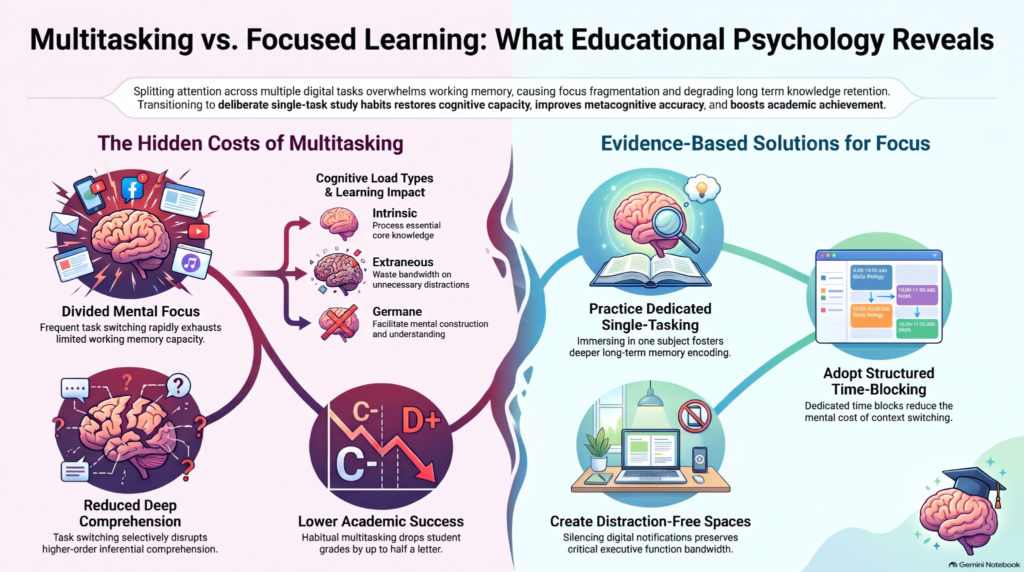
Multitasking negatively impacts student learning by fragmenting attention and increasing cognitive load. Research indicates that frequent task switching leads to diminished focus and impaired memory retention. Students who engage in multitasking experience reduced recall abilities and compromised academic performance due to divided cognitive resources. Effective management of cognitive load, alongside strategies for minimizing distractions, is essential for optimizing learning outcomes. Exploring methods to enhance focus reveals further insights into improving educational success.
KEY TAKEAWAYS
- Multitasking fragments attention, leading to decreased focus and impaired memory retention, ultimately affecting students’ academic performance negatively.
- Cognitive Load Theory highlights that excessive multitasking overwhelms working memory, hindering effective learning and information retention.
- Frequent task switching incurs cognitive costs, resulting in lower sustained attention capacity and diminished cognitive performance for students.
- Prioritizing single-task activities and structured study environments enhances concentration, engagement, and overall academic success.
- Eliminating distractions through tailored study spaces and focused routines is essential for optimizing learning and improving student outcomes.
THE SCIENCE OF MULTITASKING: HOW OUR BRAINS PROCESS INFORMATION
Multitasking can take place when someone tries to perform two tasks simultaneously, switch . from one task to another, or perform two or more tasks in rapid succession. To determine the costs of this kind of mental “juggling,” psychologists conduct task-switching experiments. By comparing how long it takes for people to get everything done, the psychologists can measure the cost in time for switching tasks. They also assess how different aspects of the tasks, such as complexity or familiarity, affect any extra time cost of switching.
Multitasking, often perceived as a hallmark of modern efficiency, triggers complex cognitive processes within the brain. Research indicates that engaging in multiple tasks simultaneously can lead to significant neuroplasticity effects, as the brain adapts to new demands.
However, this adaptation can come at a cost; individuals frequently exposed to information overload may experience diminished cognitive performance. The brain’s executive functions, responsible for decision-making and problem-solving, become strained under the pressure of managing numerous inputs.
Consequently, while some degree of multitasking may enhance neural connections, excessive task-switching can hinder learning and retention. Studies suggest that the brain’s capacity to process information efficiently diminishes when overwhelmed, leading to scattered attention and reduced comprehension.
Therefore, understanding the delicate balance between beneficial multitasking and detrimental information overload is essential for educators and learners alike, ultimately informing strategies aimed at enhancing educational outcomes and better serving student needs.
Impact of Multitasking on Attention Span and Focus
The relationship between multitasking and attention span has garnered significant attention in cognitive research. Studies indicate that engaging in multitasking leads to attention fragmentation, a phenomenon where individuals struggle to maintain focus on a single task due to frequent interruptions from cognitive distractions. Understanding the forgetting curve educational psychology helps explain why information learned during distracted study sessions may fade over time, highlighting the importance of focused review and retrieval practice to strengthen long-term memory.
This fragmentation can result in focus depletion, diminishing the ability to concentrate effectively over time. Additionally, task switching—shifting between activities—has been shown to incur cognitive costs that hinder performance and learning outcomes.
Research highlights that the brain’s capacity for sustained attention is compromised when frequently diverted, leading to lower retention and understanding of information. Consequently, students who multitask may experience diminished academic performance, as their cognitive resources are divided, preventing deep engagement with content.
In light of these findings, educators and policymakers must consider strategies to mitigate the adverse effects of multitasking on students’ attention and focus.
How Cognitive Load Affects Your Learning?
Cognitive Load Theory posits that the brain has a limited capacity for processing information, which greatly impacts learning outcomes.
High cognitive load can overwhelm working memory, leading to decreased memory retention and hindered comprehension.
Understanding these dynamics is essential for optimizing educational practices and enhancing the effectiveness of learning experiences.
Cognitive Load Theory Explained
Learning efficiency is considerably influenced by cognitive load, a concept that describes the total amount of mental effort being used in the working memory. Cognitive Load Theory posits that learners have a limited cognitive capacity, which must be managed effectively to optimize information processing. Understanding autonomous learning psychology can help educators create learning experiences that encourage students to manage their own cognitive resources, take responsibility for their progress, and develop effective independent study habits. When cognitive load exceeds this capacity, learning can become hindered, resulting in diminished performance.
| Cognitive Load Type | Impact on Learning |
| Intrinsic Load | Essential knowledge required |
| Extraneous Load | Unnecessary distractions |
| Germane Load | Facilitates understanding |
| Overload | Impairs learning |
| Balance | Enhances cognitive capacity |
Impact on Memory Retention
Effective information processing directly influences memory retention, particularly in the context of cognitive load. When students engage in multitasking, the cognitive load increases, hindering efficient memory encoding.
Research indicates that high cognitive load can overwhelm working memory, leading to suboptimal learning outcomes. Consequently, recall strategies become vital; techniques such as spaced repetition and retrieval practice are effective in enhancing memory retention.
Evidence suggests that students who limit multitasking are better positioned to utilize these strategies, ultimately improving their ability to encode and recall information.
How Multitasking Impairs Memory Retention: Key Research Findings
Multitasking involves working on two or more tasks simultaneously, switching back and forth from one thing to another, or performing a number of tasks in rapid succession.
Although multitasking is often perceived as a valuable skill in fast-paced environments, research consistently indicates that it markedly impairs memory retention. The act of dividing attention among multiple tasks leads to cognitive interference, which disrupts memory encoding processes essential for effective learning.
Key research findings highlight the following:
- Reduced Focus: Engaging in multitasking diminishes the ability to concentrate, resulting in less effective absorption of information.
- Impaired Recall: Studies show that individuals who multitask frequently exhibit lower levels of recall, struggling to retrieve information accurately when needed.
- Long-term Effects: Chronic multitasking can hinder the formation of long-term memories, affecting overall academic performance and knowledge retention.
These findings emphasize the critical need for educational strategies that prioritize focused engagement, thereby enhancing cognitive processing and memory retention among learners.

EFFECTIVE STRATEGIES FOR REDUCING MULTITASKING
Whenever I explain cognitive load to my students, I often draw an analogy to tending my balcony garden or kneading sourdough bread: you cannot rush biological processes by doing four things at once; depth requires sustained, uninterrupted conditions. In cognitive psychology, we talk extensively about “attention residue”. Every time a student pauses a calculus derivation to fire off a quick reply in a chat app, their working memory does not simply toggle back cleanly. A piece of their mental processing stays stuck on that message, wondering what was said, waiting for a reply, and draining the executive bandwidth needed to solve the mathematical problem in front of them.
When technical coursework gets demanding, students often react to the rising anxiety by checking their notifications or juggling smaller, easier tasks. It feels like multitasking, but it is actually an avoidant coping mechanism. The issue is that technical fields are unforgiving with details; missing a single algebraic sign or misreading an initial boundary condition cascades into an entirely wrong result.
When you juggle tasks, you work at the bare minimum level of attention, which causes minor oversights that force you to redo everything later. In my classes, I explicitly train students to adopt time-blocked, single-task sessions. Silencing devices and giving yourself permission to do only one thing at a time isn’t just good time management—it is an essential act of emotional and cognitive regulation.
Research indicates that prioritizing single-task activities can greatly enhance learning outcomes by allowing individuals to focus deeply on one task at a time.
Additionally, implementing effective time management techniques encourages structured work periods, reducing the likelihood of multitasking.
These strategies are essential for fostering an environment conducive to improved concentration and information retention.
Prioritize Single-task Activities
To enhance learning outcomes, prioritizing single-task activities emerges as an essential strategy for minimizing the detrimental effects of multitasking. Research indicates that engaging in focused learning through single-tasking can notably improve retention and comprehension.
This approach allows learners to fully immerse themselves in the subject matter, leading to a deeper understanding and longer-lasting knowledge acquisition.
Consider these single task benefits:
- Improved Concentration: Focusing on one task enhances cognitive resources, reducing distractions.
- Greater Retention: Single-tasking fosters deeper processing of information, resulting in better memory recall.
- Increased Productivity: Completing one activity at a time leads to more efficient time management and higher quality work.
Implement Time Management Techniques
Implementing effective time management techniques plays an essential role in reducing the tendency to multitask, thereby enhancing learning outcomes.
Research indicates that strategies such as time blocking and task batching greatly improve focus and productivity. Time blocking involves allocating specific periods for individual tasks, allowing learners to immerse themselves fully in one subject or activity. This approach minimizes distractions and fosters deeper cognitive processing.
Similarly, task batching entails grouping similar tasks together, which reduces the cognitive load associated with frequent context switching. Evidence suggests that adopting these techniques not only enhances retention of information but also promotes a structured learning environment.
Long-Term Impacts of Multitasking on Academic Success
Since students aren’t giving their full attention to their schoolwork, they aren’t as effective at absorbing the information they are studying. And without a solid comprehension of what students are learning, grades can start to slip—up to a half a letter grade.
Although multitasking has become a common practice among students, its long-term impacts on academic success raise significant concerns. Research indicates that the multitasking consequences can detrimentally affect students’ academic performance over time.
Key findings include:
- Cognitive Overload: Engaging in multiple tasks simultaneously can lead to cognitive fatigue, impairing a student’s ability to retain information.
- Decreased Retention: Studies show that students who frequently multitask may struggle with long-term retention of material, ultimately affecting their overall comprehension.
- Lower Academic Achievement: Longitudinal studies reveal a correlation between habitual multitasking and reduced grades, suggesting an adverse effect on overall academic success.
These insights underscore the necessity for students and educators to recognize the detrimental effects of multitasking, advocating for focused learning practices that enhance academic performance and promote deeper engagement with educational content.
Tips to Create a Focused Study Environment
Creating a focused study environment is essential for maximizing learning potential and minimizing distractions. Research indicates that the design of a study space greatly influences cognitive performance. A well-organized study area, free from clutter, promotes concentration and enhances information retention.
For effective distraction elimination, it is recommended that students utilize tools such as website blockers and noise-canceling headphones, which have been shown to reduce interruptions from digital devices and ambient noise. Educators and students can explore the engineering teacher shop for practical educational resources and classroom materials that support focused learning, reduce distractions, and create more effective study experiences.
Furthermore, the presence of natural light and comfortable seating can enhance focus, as studies suggest these elements positively affect mood and productivity. Establishing a consistent study routine in this tailored environment can also foster better engagement with academic material.
Ultimately, creating a dedicated study space that prioritizes distraction elimination not only supports individual learning but also encourages a culture of focused academic excellence within educational settings.

RELATED STUDIES ABOUT MULTITASKING EFFECTS ON LEARNING
To summarize, while multitasking may seem like an efficient approach to learning, the evidence reveals a stark contrast between perceived productivity and actual cognitive performance. Research indicates that divided attention hampers memory retention and undermines academic success, highlighting the detrimental effects of cognitive overload. By juxtaposing the allure of multitasking with its adverse impact on focus and learning outcomes, it becomes clear that fostering a dedicated study environment is essential for enhancing student performance and long-term retention.
Effects of data and entity ablation on multitask learning models for biomedical entity recognition
Conceptual Framework and Research Rationale
- The Resource Bottleneck in Biomedical Named Entity Recognition (NER): Named entity recognition (NER) is a foundational task in biomedical text mining, responsible for identifying domain-specific semantic concepts (e.g., genes, chemicals, cell lines, species) from scientific literature prior to downstream clinical pipelines. However, training individual domain-specific sequence taggers requires expert-curated gold-standard corpora, which are costly, labor-intensive, and scarce.
- Inference and Storage Constraints of Single-Task Modeling: Deploying separate dedicated models for dozens of distinct biomedical tasks creates prohibitive memory and storage footprints, as each model independently trains and hosts millions of transformer parameters.
- Multitask Learning (MTL) as an Efficiency Framework: MTL addresses these challenges by sharing a single underlying transformer representation across multiple task-specific classification heads. If shared lexical and contextual features exist across biological entity classes, MTL can reduce parameter redundancy and enable parameter-efficient adaptation to new tasks.
- Core Research Objectives:
- Scale and benchmark a shared-encoder transformer multitask architecture across 22 distinct biomedical NER datasets spanning four entity classes: cell line, chemical, gene, and species.
- Conduct data ablation to examine how much training data is necessary to effectively train single-task versus multitask models.
- Conduct entity ablation to test whether pretraining on a multitask suite enables rapid, data-efficient adaptation when learning a novel, previously unseen entity type.
Methodological Architecture and Experimental Design
- Underlying Deep Learning Architectures:
- Base Encoder: Initialized from BioBERT-Base v1.1 weights and vocabulary (12 transformer layers, 768 hidden dimension, 12 attention heads), processing cased WordPiece subword tokens up to a 512-token sequence window.
- Single-Task Learning (STL) Architecture: Each dataset trains an independent model consisting of its own BioBERT encoder connected to a linear feed-forward classification layer and a softmax output layer over Inside-Outside-Beginning (IOB) tags.
- Multitask Learning (MTL) Architecture: All 22 dataset-specific linear classification heads branch from a single, shared BioBERT encoder. During training, batches pass through the shared encoder into the active task head; backpropagation updates shared encoder weights iteratively across datasets in round-robin fashion.
- Evaluation Protocols and Metrics:
- Evaluations report precision, recall, and F1-score.
- Primary analyses calculate metrics at the word level using the IOB tag corresponding to the final subword token of each word. Exact-boundary entity mention-level evaluations are also reported for cross-study comparisons.
- Model selection uses the checkpoint with the highest validation F1-score across 20 training epochs.
- Dataset Suite (22 Biomedical Corpora):
- Partitioned at the document level into 60% training, 10% development, and 30% testing splits.
- Cell Line (3 datasets): CLL, GELLUS, JNLPBA.
- Chemical (5 datasets): CDR, CEMP, CHEBI, CHEMDNER, SCAI.
- Gene/Protein (10 datasets): BC2GM, BIOINFER, DECA, FSU, GPRO, IEPA, JNLPBA, MIRNA, OSIRIS, VARIOME.
- Species (4 datasets): LINNAEUS, MIRNA, S800, VARIOME.
- Ablation Experimental Protocols:
- Data Ablation: Progressively removes portions of training data across five levels (0%, 25%, 50%, 75%, and 90% removed) to assess resilience to extreme data scarcity in both STL and MTL regimes.
- Entity Ablation (Two-Phase Transfer Protocol):
- Phase 1: An MTL model is trained on 21 tasks with all datasets corresponding to one target entity class entirely withheld.
- Phase 2: The ablated MTL encoder weights are transferred to initialize a single-task model, which is then fine-tuned on the withheld entity across data ablation tiers (10% to 100% data) to simulate introducing a new task.
Key Empirical Findings
- Full-Data Multitask Learning vs. Single-Task Baselines:
- On full datasets, multitasking did not produce broad performance gains over single-task models, but performed on par while consolidating 22 separate encoders into a single shared backbone:
- Overall Average Test F1-Score: STL achieved 0.855, whereas MTL achieved 0.836 (the performance difference was not statistically significant).
- Chemical Entities: Maintained the highest performance across regimes (STL test F1 = 0.925; MTL test F1 = 0.903). CDR and CEMP slightly improved under MTL.
- Gene Entities: Showed high parity (STL test F1 = 0.857; MTL test F1 = 0.847), with three datasets (GPRO, MIRNA, OSIRIS) improving under MTL.
- Species Entities: Averaged 0.764 in STL and 0.759 in MTL; VARIOME species showed the largest single-task gain under MTL (+0.141 F1).
- Cell Line Entities: Showed moderate degradation under MTL (STL test F1 = 0.852; MTL test F1 = 0.787).
- Correlation analysis revealed that single-task performance correlated moderately with annotation density (ratio of mentions to tokens; r=0.52,r2=0.27,p<0.01), whereas document length and total sequence count were not predictive.
- Data Ablation and Resilience Under Scarcity:
- As training data was systematically ablated from 0% to 90%, single-task model performance degraded faster than multitask model performance:
- At 0% ablation (full data), STL held an advantage over MTL (overall F1: 0.859 vs. 0.836).
- At 50% ablation, STL and MTL converged (overall F1: 0.804 vs. 0.814).
- At 75% ablation, MTL held parity or a slight edge over STL (overall F1: 0.793 vs. 0.801).
- At 90% ablation (training on only 10% data), MTL averaged 0.706 F1 compared to 0.697 for STL.
- For chemical and gene classes, MTL maintained stable F1-scores (0.91 for chemicals; 0.80 for genes) even when 90% of training data was removed.
- Entity Ablation and Rapid Unseen Task Adaptation:
- Phase 1 entity ablation revealed that holding out chemical or gene tasks had little negative impact on remaining tasks, whereas cell line and species classes exhibited performance volatility when chemical or gene anchors were removed.
- Phase 2 fine-tuning on unseen tasks demonstrated that pretraining on a multitask suite allows new tasks to reach or exceed baseline performance using a fraction of the training data:
- For GPRO (gene), fine-tuning an ablated MTL encoder on only 10% of training data achieved an F1 of 0.800, matching the performance of a model trained on 100% of the data without ablation.
- Species tasks benefited strongly from prior MTL training across other biomedical classes; for example, S800 (rich in binomial nomenclature) outperformed both baseline STL and MTL models once 50% or more training data was used.
- Exact-Match Entity-Level and State-of-the-Art Benchmarking:
- When benchmarked under exact-match entity mention boundaries against the LSTM-CRF models of Weber et al. (2020), the BioBERT architectures demonstrated competitive performance:
- STL models outperformed the baseline, silver-standard, and gold-standard pretrained LSTM-CRF models on 11 datasets in F1-score and on 10 datasets in precision.
- MTL models achieved the highest precision across 9 datasets.
- On overlapping benchmark evaluations (CDR, CHEMDNER, BC2GM, JNLPBA), the MTL system achieved higher precision, recall, and F1-scores than the prior multitasking frameworks of Zuo & Zhang (2020) and Peng et al. (2020) on 3 out of 4 corpora.
Theoretical, Practical, and Architectural Implications
- Deployment Footprint Consolidation: In multi-stage biomedical text-mining pipelines requiring extraction of dozens of entity classes, hosting individual 110M-parameter BERT models for each task is computationally prohibitive. A unified MTL model requires only a single shared transformer encoder alongside lightweight linear heads (4 logits per subword), providing comparable extraction accuracy while dramatically reducing GPU memory and disk footprint.
- Mitigating Annotation Bottlenecks via Multi-Domain Representation Sharing: When domain experts introduce a new, unannotated entity class, starting from an MTL-pretrained biomedical encoder allows the new task head to converge effectively with 10% to 50% of typical gold-standard annotations, significantly lowering human curation costs.
- Training Dynamics and Task Interference: While MTL confers data efficiency under scarcity, joint training across 22 diverse datasets creates optimization friction and gradient competition across heads, preventing MTL from universally outperforming well-tuned single-task models when unlimited data is available.
Study Limitations and Future Directions
- Unbalanced Dataset Dynamics and Training Latency: Round-robin dataset sampling without upsampling avoided overfitting, but extreme variances in corpus scale (ranging from 14 sequences in CLL to 4,182 sequences in CHEMDNER) contributed to gradient volatility and extended training times.
- Absence of CRF Decoding for Boundary Delineation: Relying purely on independent subword linear-softmax classification occasionally resulted in fragmented multi-token boundary predictions, particularly on formal taxonomic entities (e.g., Linnaeus species exact-match F1 dropped compared to token-level metrics). Incorporating a Conditional Random Field (CRF) layer or machine-reading comprehension spans could enhance boundary precision.
- Scope of Shared Parameters: Parameter sharing was restricted strictly to the transformer encoder stack; task-specific classification heads remained completely isolated.
- Future Research: Subsequent investigations should explore dynamic task weighting, adaptive learning rate schedules, continual learning protocols to update models incrementally without retraining from scratch, and extending evaluation to full-text document inference and relation extraction.
| REFERENCE: Nicholas E. Rodriguez, Mai Nguyen, Bridget T. McInnes, Effects of data and entity ablation on multitask learning models for biomedical entity recognition, Journal of Biomedical Informatics, Volume 130, 2022, 104062, ISSN 1532-0464, https://doi.org/10.1016/j.jbi.2022.104062. (https://www.sciencedirect.com/science/article/pii/S1532046422000788) |
Sailing through media multitasking waters: Does text messaging disrupt video-based learning in lower-secondary school students?
Conceptual Framework and Research Rationale
- Ubiquity of Instructional Videos and Media Multitasking: Educational explainer videos have become core instructional tools in modern classrooms and independent study, integrating spoken narration with dynamic visual representations. Concurrently, adolescent digital environments foster frequent media multitasking (e.g., instant messaging, social media alerts). While students commonly believe they can effectively juggle multiple digital inputs, empirical literature identifies this belief as an educational misconception that divides attention and disrupts learning.
- Cognitive Theoretical Foundations:
- Cognitive Load Theory (CLT) & Cognitive Theory of Multimedia Learning (CTML): Working memory (WM) possesses limited capacity split into partially independent auditory-verbal and visual-pictorial processing channels. Off-task interruptions introduce competing cognitive demands (extraneous load) that exhaust processing capacity, hindering the essential and generative processing required to build coherent mental representations.
- Threaded Cognition Theory (TCT): Multiple concurrent tasks act as independent cognitive “threads” competing for shared resources. While perceptual inputs can be processed in parallel, tasks must queue serially for a single procedural resource responsible for decision-making and action sequencing. Responding to text messages introduces a procedural bottleneck, disrupting continuous comprehension of dynamic video content.
- Metacognitive Vulnerability and the Illusion of Understanding: Explainer videos often induce high perceptual fluency (ease of processing), leading learners to mistake passive, fluent viewing for deep comprehension. This creates an “ease-of-processing” heuristic and an illusion of understanding, producing overconfident judgments of learning (calibration bias) that discourage active mental effort.
- Gaps in Extant Literature: The vast majority of media multitasking research has focused on undergraduate or adult samples during extended lecture videos, assessing outcomes immediately after learning. How brief, chat-like interruptions affect lower-secondary school students’ comprehension (literal vs. inferential), perceived cognitive load, and metacognitive calibration—both immediately and over a delayed retention interval—remains largely unexamined.
- Core Research Questions:
- RQ1: Does media multitasking affect (a) perceived cognitive load, (b) literal and inferential comprehension, and (c) calibration bias, immediately after viewing and across a one-week delay?
- RQ2: Does working memory capacity directly predict these learning and metacognitive outcomes, and does it buffer/moderate the disruptive effects of multitasking?
Methodology and Empirical Design
- Sample Composition and Setting:
- A between-participants experimental design involving 112 lower-secondary school students (seventh and eighth graders; 50% female; mean age 12.800.45 years) from seven classes across three urban schools in Italy.
- Participants were assigned to either the No-Multitasking condition (n=53) or the Multitasking condition (n=59).
- Baseline cognitive measures (reading comprehension skills via the Italian MT-3 standardized test, prior topic knowledge on volcanology, and working memory capacity via the Reading Span Test) confirmed baseline equivalence between groups (p>.39).
- Instructional Video and Multitasking Manipulation:
- Video Material: A 4-minute and 32-second instructional video (The Shape of Volcanoes) adapted from secondary school science textbooks, containing ~550 spoken words, animated diagrams, and real-world volcanic imagery. Participants were allowed up to 10 minutes to watch and interact with the video (pausing, rewinding).
- Multitasking Manipulation: Students in the multitasking condition received four on-screen chat notifications at fixed 140-second intervals. Styled after WhatsApp messages, each prompt presented a realistic peer decision scenario (e.g., choosing a cinema screening time or clothing size) with two forced-choice response options.
- Dependent Measures and Longitudinal Timeline:
- Perceived Cognitive Load: Assessed immediately post-viewing using an adapted 5-item scale measuring intrinsic and extraneous cognitive load (5-point Likert scale; =0.77–0.85).
- Comprehension (Literal vs. Inferential): A 14-item four-option multiple-choice test (7 literal recall items, 7 inferential integration items; scored 0–100%) administered immediately after viewing (Session 2) and repeated one week later without rewatching the video (Session 3; delayed post-test).
- Calibration Bias: Calculated as the difference between students’ predicted score (0–100% slider prediction made prior to taking the test) and their actual comprehension score. Positive values denote overconfidence/overestimation; values near zero reflect accurate calibration.
- Statistical Modeling:
- Analyzed using Linear Mixed Models (LMMs) with restricted maximum likelihood (REML) in R 4.2.1, specifying nested random intercepts for individual students and classes to control for clustering. Continuous predictors were centered; effect coding was applied to condition and time.
Key Empirical Findings
- Effects of Media Multitasking on Cognitive Load and Comprehension (RQ1):
- Perceived Cognitive Load: The multitasking condition did not significantly alter overall perceived cognitive load (b=-0.77,p=.119). However, the number of chat notifications actively attended to was a significant positive predictor of cognitive load ($b = 0.74, 95\%\text{ CI } [0.01, 1.48], p = .047$), indicating that active engagement with distractions increases experienced mental effort.
- Literal Comprehension: Multitasking had no significant main effect on factual recall (b=-0.10,p=.963), nor did it interact with time (b=1.78,p=.128). Literal recall declined uniformly across both groups between the immediate and delayed tests (b=-3.13,p=.008).
- Inferential Comprehension (Selective Disruption): A statistically significant Multitasking Assessment Time interaction emerged ($b = 2.99, 95\%\text{ CI } [0.12, 5.86], p = .042$):
- At the immediate post-test, multitasking significantly impaired inferential comprehension (b=12.18,SE=4.69,p=.010), with the no-multitasking group outperforming the multitasking group (52.06% vs. 41.24%).
- At the delayed post-test, this performance gap disappeared (b=0.24,p=.960; 41.56% vs. 41.11%), primarily driven by a natural memory decay in the uninterrupted group while the multitasking group remained at a stable floor.
- Metacognitive Calibration Accuracy (RQ1):
- A significant Multitasking Assessment Time interaction was observed for calibration bias ($b = -3.74, 95\%\text{ CI } [-6.78, -0.69], p = .016$):
- Students in the no-multitasking condition showed a stable, moderate overestimation of their performance across both immediate ($+7.98\%$) and delayed ($+9.36\%$) tests (b=2.33,p=.583).
- Students in the multitasking condition exhibited substantially inflated overconfidence at the immediate post-test ($+16.45\%$), demonstrating compromised metacomprehension monitoring.
- At the delayed post-test, the calibration bias of multitaskers dropped significantly to $+4.40\%$ (b=-12.63,p=.006), converging toward accurate calibration. Confronting immediate test difficulty likely provided an implicit metacognitive “wake-up call” that prompted mental reflection.
- Direct and Moderating Roles of Working Memory (RQ2):
- Direct Cognitive Advantage: WM capacity significantly predicted superior performance across key outcomes:
- Literal Comprehension: $b = 0.68, 95\%\text{ CI } [0.12, 1.25], p = .018$.
- Inferential Comprehension: $b = 0.78, 95\%\text{ CI } [0.27, 1.30], p = .003$.
- Calibration Bias: $b = -0.67, 95\%\text{ CI } [-1.26, -0.08], p = .026$ (higher WM reduced overconfidence).
- Absence of Buffering / Moderation: All interaction terms between Working Memory and Multitasking were statistically non-significant across cognitive load (p=.824), literal comprehension (p=.514), inferential comprehension (p=.185), and calibration bias (p=.539). Higher WM capacity did not buffer students against multitasking costs, indicating that procedural bottlenecks constrain learning regardless of baseline memory capacity.
Theoretical, Metacognitive, and Educational Interpretations
- Hierarchical Vulnerability of Comprehension: Factual, literal recall is resilient to brief task-switching, as isolated facts can be extracted from transient video feeds without continuous deep processing. In contrast, inferential comprehension requires integrating dynamic visual and auditory representations with prior knowledge, making higher-order synthesis vulnerable to procedural multitasking bottlenecks.
- The Metacognitive Illusion of Multitasking: Multitasking learners failed to perceive their divided attention as cognitively taxing, leading to severe immediate overconfidence. The combination of fluent video presentation and habitual messaging masked their comprehension failures, illustrating that subjective perceptions of ease are poor indicators of actual learning depth.
- Dispelling the “High Working Memory Buffer” Myth: The finding that working memory did not moderate multitasking decrements refutes the assumption that cognitively stronger students can multitask without consequence. Dividing attention across competing communicative threads imposes structural procedural interference that affects learners across all cognitive tiers.
Practical Implications and Study Limitations
- Classroom and Digital Homework Recommendations:
- Enforce Single-Tasking Protocols: Because students underestimate the disruptive effects of notifications on higher-order learning, educators must explicitly teach digital self-regulation and require devices to be placed in “Do Not Disturb” modes during video-based assignments.
- Incorporate Formative Metacognitive Checkpoints: Pairing instructional videos with immediate, low-stakes inferential check questions provides explicit feedback that breaks the illusion of comprehension and recalibrates overconfident self-assessments.
- Methodological Limitations:
- Simulated On-Screen Distractions: Messages appeared on the primary viewing screen rather than an external smartphone, and text content was standardized rather than personally tailored.
- Short Video Duration: The study evaluated a single 4.5-minute video; longer, less structured digital learning tasks may show different cognitive load patterns.
- Potential Testing Carryover: Administering an immediate post-test may have provided an unintended learning event (testing effect) that stabilized delayed recall for the multitasking cohort.
| REFERENCE: Angelica Ronconi, Lucia Mason, Sailing through media multitasking waters: Does text messaging disrupt video-based learning in lower-secondary school students?, Computers & Education, Volume 250, 2026, 105634, ISSN 0360-1315, https://doi.org/10.1016/j.compedu.2026.105634. (https://www.sciencedirect.com/science/article/pii/S0360131526000722) |
Robust dermatological image analysis via multitask learning on heterogeneous datasets
Conceptual Framework and Research Rationale
- Clinical Heterogeneity in Dermatology: Dermatological imaging encompasses a wide range of imaging modalities, including high-magnification dermatoscopy, clinical close-ups, and total-body photography. These images are captured under diverse lighting and camera conditions and annotated for distinct diagnostic tasks such as lesion classification, boundary segmentation, and feature detection.
- Limitations of Single-Dataset and Single-Task Models: Conventional deep learning pipelines are typically developed on isolated, single datasets. Consequently, models often overfit to dataset-specific imaging artifacts, camera profiles, and patient cohorts, leading to poor generalization in real-world clinical environments. Furthermore, single-task classification models focus primarily on global diagnostic patterns, while segmentation models emphasize local border morphology, missing the chance to exploit complementary spatial and diagnostic features.
- The Need for Heterogeneous Cross-Dataset Multitask Learning (MTL): Most existing multitask frameworks require fully overlapping annotations (i.e., every image must have both a diagnostic label and a ground-truth segmentation mask). In real-world medical repositories, however, datasets feature non-overlapping label schemes, differing disease taxonomies, and mismatched annotation types.
- Core Research Contributions:
- Proposes a unified cross-dataset multitask framework that simultaneously optimizes classification and segmentation across heterogeneous, non-overlapping dermatological image datasets.
- Leverages a shared hierarchical Swin Transformer (Swin-Large) backbone paired with task-specific heads to extract unified, domain-agnostic feature representations.
- Introduces a Dynamic Loss Orchestration (DLO) mechanism to adaptively regulate task-specific loss weights based on validation divergence, preventing gradient domination and task-specific overfitting.
- Provides rigorous quantitative validation across 10 major benchmark datasets, supported by explainable AI (Grad-CAM, t-SNE) and clinical alignment analyses.
Architectural Design and Methodological Implementation
- Shared Backbone Architecture:
- Employs the Swin-Large Transformer variant (approximately 197 million parameters, patch size 4, window size 7, input resolution 224224 pixels) initialized with ImageNet pre-trained weights.
- Encodes raw dermoscopic and clinical images into a shared 1,536-dimensional latent representation.
- Task-Specific Output Heads:
- Classification Head: Applied to the 1,536-dimensional feature vector using task-specific linear layers optimized via weighted cross-entropy (for multiclass targets) or binary cross-entropy (for binary benign-vs-malignant targets) to handle class imbalance.
- Segmentation Head: Features a lightweight convolutional decoder that progressively reconstructs spatial resolution. It comprises five consecutive transposed convolution blocks (33 kernel, batch normalization, GELU activation) that reduce channels from 1,536 to 32 while doubling spatial resolution at each step, concluding with a 11 convolution and bilinear interpolation. The decoder deliberately omits U-Net skip connections to remain lightweight and isolate the impact of the shared backbone and loss orchestration.
- Balanced Multitask Dataloading:
- Datasets vary widely in scale (from 200 images in PH2 to over 400,000 in ISIC 2024).
- Implements a balanced multitask data loader (Algorithm 1) that computes the median dataset sample count (Nsamples) across training sets and uses random replacement sampling to draw an equal number of batches per dataset-task pair, preventing large datasets from dominating epoch updates.
- Dynamic Loss Orchestration (DLO) Mechanism:
- In standard multitask learning, joint optimization often stalls when faster-converging tasks overfit while slower tasks remain under-optimized.
- DLO continuously tracks an overfitting score (Ok(t)) for each dataset-task pair k, calculated as the relative generalization gap between validation loss Lkval(t) and training loss Lktrain(t): Ok(t)=0,Lkval(t)-Lktrain(t)Lktrain(t)+
- If the overfitting score exceeds a predefined threshold (Oth=0.5), the task weight k(t+1) decays by a factor (e.g., 0.5 or 0.6) down to a minimum weight floor (min=10-6). Tasks that generalize well maintain their weight (base=1.0).
Dataset Suite and Experimental Setup
- Evaluated Datasets (10 Diverse Repositories):
- HAM10000: 10,015 dermoscopic images (7 diagnostic classes; pixel-level segmentation masks).
- ISIC 2018 (Task 3): 11,720 dermoscopic images; shares training images with HAM10000 but evaluates on disjoint official validation (N=193) and test (N=1,512) splits.
- ISIC 2017: 2,750 dermoscopic images (lesion classification and segmentation).
- BCN20000: 18,946 dermoscopic images capturing challenging anatomic sites (nails, mucosa) and uncropped lesions across 8 classes.
- Derm7pt: 1,011 cases evaluated as two distinct tasks: Derm7pt-derm (dermoscopic) and Derm7pt-clin (clinical close-up) across 5 classes.
- PH2: 200 dermoscopic images annotated with 3 classes and manual segmentation masks.
- DermNet: 19,500 clinical images across 23 disease categories.
- Fitzpatrick17k: 16,577 clinical images covering 114 conditions across diverse Fitzpatrick skin types (I–VI).
- ISIC 2020: 33,123 dermoscopic images (binary benign-vs-malignant).
- ISIC 2024 (SLICE-3D): 401,059 image crops derived from 3D total-body photography.
- Optimization and Statistical Validation:
- Optimized using Adam (learningrate=510-5) with a three-stage step-down LambdaLR scheduler, batch size of 16, and early stopping on a single NVIDIA A100 GPU (80 GB).
- Statistical significance was evaluated using 1,000-resample non-parametric bootstrap confidence intervals (95% CI) and 10,000-resample paired sign-flip permutation tests on held-out test predictions.
Key Empirical Findings
- Generalization Across Heterogeneous Classification Benchmarks:
- In 11 out of 12 evaluated classification benchmarks, the multitask configuration (M) significantly outperformed its corresponding single-task (S) counterpart:
- Derm7pt-derm (5-class): Single-task accuracy improved from 78.73% to 82.03% under joint training (+3.30%, p<0.001), rivaling the multimodal RemixFormer++ (82.50%) despite using only single images without clinical metadata.
- Derm7pt-clin (clinical): Accuracy increased from 72.41% to 74.68% (+2.27%, p=0.004).
- Fitzpatrick17k (diverse skin tones): Accuracy rose from 63.44% to 67.07% (+3.63%, p<0.001).
- ISIC 2018: Multiclass accuracy rose from 85.97% to 88.09% (+2.12%, p=0.002).
- DermNet: Accuracy rose from 73.64% to 75.16% (+1.52%, p=0.019).
- HAM10000 (7-class): Joint training with BCN20000 achieved 96.95% accuracy, surpassing state-of-the-art multimodal transformer baselines (93.81%).
- The only task showing performance reduction was BCN20000 ($\Delta = -0.82\%, p = 0.031$), while near-saturated binary tasks (ISIC 2020 at 98.19% and ISIC 2024 at 99.90%) showed negligible differences.
- Clinical Diagnostic Metrics (Melanoma Sensitivity and False-Negative Reduction):
- Joint training produced significant improvements in identifying life-threatening malignancies:
- On HAM10000, melanoma (MEL) sensitivity increased from 76.68% to 93.27%, with melanoma F1-score rising from 76.85% to 92.65%.
- Absolute melanoma false negatives dropped from 52 to 15 (out of 223 cases), reducing the false-negative rate from 23.32% down to 6.73%.
- Nevus-to-melanoma confusion was drastically reduced: melanomas misclassified as benign nevi fell from 40 to 13.
- In binary benign-vs-malignant classifications, multitask training substantially lowered malignant false negatives across Derm7pt-clin (5743), Derm7pt-derm (4125), and HAM10000 (8771).
- Segmentation Accuracy and Zero-Shot Mask Generalization:
- Supervised Benchmarks: The lightweight decoder paired with the shared Swin backbone achieved an IoU of 92.63% and Dice score of 94.58% on HAM10000, and an IoU of 94.03% and Dice score of 95.79% on PH2, outperforming specialized architectures such as SkinSAM, DeepLabV3+, and MobileUNETR.
- Paired Synergy: Joint training on HAM10000 and PH2 mutually improved segmentation metrics over single-dataset training (HAM10000 IoU: $+0.16\%, p = 0.008$; PH2 IoU: $+1.75\%, p = 0.001$).
- Cross-Domain Generalization: When evaluated on datasets with no segmentation masks in training (e.g., BCN20000, DermNet, Derm7pt, ISIC 2024), the shared backbone generated clean, localized lesion contours across both dermoscopic and clinical images.
- Component Ablation and Effectiveness of DLO:
- Systematic ablation on Derm7pt-derm isolated the specific contribution of each module:
- Adding HAM10000 classification improved accuracy from 78.73% to 80.00%.
- Adding segmentation under static equal loss weighting caused negative task interference, dropping classification accuracy to 76.96% (below baseline).
- Activating DLO fully resolved this interference, driving accuracy up to 81.26% (+4.30% over unweighted multitask learning).
- On ISIC 2018, DLO (=0.6) improved accuracy from 85.97% to 87.50% ($\Delta = +1.53\%, p = 0.002$), outperforming standard uncertainty-based loss weighting (84.72%).
- Model Explainability and Latent Alignment:
- Grad-CAM Localization Alignment: Quantifying spatial overlap against ground-truth masks showed that models trained with DLO focused significantly more attention on lesion tissue than models without DLO (Dice improvements of +0.127 to +0.186,p<0.001). Models without DLO exhibited diffuse attention spread over background skin and artifacts.
- t-SNE Feature Representations: Projecting latent embeddings from HAM10000 and BCN20000 showed that identical diagnostic categories clustered together regardless of source dataset. Furthermore, the unified AKIEC cluster from HAM10000 naturally aligned adjacent to the separated Actinic Keratosis (AK) and Squamous Cell Carcinoma (SCC) clusters from BCN20000, mirroring their shared clinical histopathology.
Theoretical, Clinical, and Practical Implications
- Decoupling Task Design from Dataset Constraints: The study proves that medical AI models do not require uniform, perfectly matched annotations. By modeling each dataset-task pair as an independent objective linked via dynamic loss orchestration, heterogeneous data from clinical photography, dermoscopy, and diverse pathologies can be effectively merged into a single network.
- Mutual Scaffolding Between Tasks: Joint optimization forces the shared transformer backbone to reconcile local spatial boundary cues (from segmentation) with global semantic disease representations (from classification), producing features that are clinically coherent and resilient to background noise.
- Diagnostic Safety in AI Dermatology: The substantial reduction in false-negative melanoma classifications directly addresses the primary clinical barrier to deploying automated diagnostic triage tools in healthcare workflows.
Study Limitations and Future Research Directions
- Retrospective Public Benchmark Scope: All evaluations were conducted on retrospective, publicly available research datasets. The framework has not yet been subjected to prospective clinical trials or multi-reader diagnostic studies alongside board-certified dermatologists.
- Demographic and Phenotypic Bias: Prevalent training sets (such as HAM10000) predominantly represent light skin phenotypes (Fitzpatrick types I–III), posing fairness risks when deployed across darker skin tones (Fitzpatrick types IV–VI).
- Computational Cost: The Swin-Large backbone comprises 197 million parameters, demanding high-memory GPU hardware (e.g., NVIDIA A100) that may be challenging to host in resource-constrained clinic environments.
- Heuristic Loss Hyperparameters: While DLO demonstrated robust performance across decay rates (=0.3 and 0.6), the overfitting thresholds were set a priori rather than learned through end-to-end meta-optimization. Future directions include developing adaptive, gradient-aware weighting mechanisms, integrating multimodal clinical records, and designing compressed vision transformer backbones for mobile point-of-care dermatology.
| REFERENCE: Ignazio Gallo, Mattia Gatti, Leonardo Sgroi, Silvia Corchs, Robust dermatological image analysis via multitask learning on heterogeneous datasets, Intelligence-Based Medicine, Volume 15, 2026, 100474, ISSN 2666-5212, https://doi.org/10.1016/j.ibmed.2026.100474. (https://www.sciencedirect.com/science/article/pii/S2666521226001328) |
CONCLUSION
As we look at the growing demands placed on modern students, the urge to multitask will only continue to grow. Our digital devices are meticulously engineered to pull at our focus, dangling the dopamine of instant notifications while quietly eroding our capacity for deep, reflective thought. Yet, after watching hundreds of young engineering and STEM students navigate these exact hurdles, I remain deeply optimistic. Reclaiming your attention is not an innate talent reserved for a select few; it is a learned psychological skill, a habit of mind that can be cultivated with patience and structure.
I always encourage my students to approach their study habits like an engineering experiment. If your current workflow involves constant switching, chronic mental fatigue, and frustration when test day arrives, the system is telling you that the cognitive load is improperly balanced. Start small: turn off the second monitor, put your phone in another room or on “Do Not Disturb,” and dedicate just twenty-five quiet minutes to a single challenging concept.
When you stop juggling and allow your working memory to breathe, learning shifts from being an exhausting uphill battle into a deeply rewarding process of true discovery. Give yourself the gift of your own undivided mind—it is the single best investment you will ever make in your academic journey.
