Whenever I sit down with incoming students during advising week, I often ask them what they hope to take away from their degree. Almost without fail, they mention technical mastery: learning circuit design, mastering software tools, or memorizing equations that will help them land an entry-level position. It is completely natural to look at a degree through that lens, but having taught electrical engineering and guided hundreds of students through curriculum transitions, I always share an honest secret: the facts and specific technical setups you memorize in lecture will likely evolve or become obsolete within five to ten years.
What never expires, however, is the cognitive infrastructure you build while wrestling with that material. College isn’t simply an information-delivery system; it’s a mental gymnasium. The late nights you spend breaking down an impossible-looking problem set, learning how to separate signal from noise in a dense lab manual, or restructuring your thought process when an experiment fails—those moments are rewiring your executive functions.
As someone who spends time journaling and evaluating how our brains organize information, I see college as the place where you transition from a passive receiver of instructions to an autonomous thinker. You learn how to evaluate ambiguous data, manage cognitive load under pressure, and pivot when circumstances shift. That internal transformation is the real return on investment of your degree.
Cognitive skills acquired in college greatly enhance students’ career success beyond graduation. These skills, such as critical thinking, problem-solving, and effective communication, promote adaptability in a dynamic job market. Graduates are better equipped to manage high-pressure situations and engage in collaborative efforts, leading to innovative solutions. Continuous development of these skills through lifelong learning fosters resilience and prepares individuals for unforeseen challenges. Exploring further can reveal additional insights into the long-term benefits of these competencies.
KEY TAKEAWAYS
- Cognitive skills foster critical thinking and problem-solving, enabling graduates to navigate complex workplace challenges effectively.
- Strong analytical abilities enhance decision-making under pressure, preparing students for high-stress professional environments.
- Adaptability learned in college equips graduates to embrace non-linear career paths and respond to shifting job market demands.
- Effective communication skills developed through college enhance collaboration and networking, which are vital for career advancement and professional relationships.
- Continuous learning habits established in college promote lifelong skill enhancement, ensuring ongoing relevance and success in evolving industries.
WHY COGNITIVE SKILLS MATTER FOR YOUR FUTURE CAREER
As individuals navigate the complexities of the modern job market, the significance of cognitive skills becomes increasingly apparent. These skills, which encompass critical thinking, problem-solving, and analytical abilities, play a pivotal role in fostering career adaptability. In a rapidly changing employment landscape, professionals equipped with strong cognitive skills can pivot more effectively, responding to emerging challenges and opportunities.
Research indicates that employers prioritize adaptability, recognizing that the capacity to learn and evolve is essential for long-term success.
Moreover, the concept of lifelong learning is inherently linked to cognitive skill development. Individuals who cultivate these skills during their college years are better positioned to engage in continuous education and professional growth.
This proactive approach not only enhances employability but also empowers individuals to serve others effectively within their chosen fields. Ultimately, the cultivation of cognitive skills in college lays a strong foundation for enduring career success and meaningful contributions to society.
Critical Thinking Fuels Problem-Solving Abilities
Most students enter college with the notion that there are right and wrong answers and the road to knowledge is straightforward. Students undergo significant cognitive growth during college, shifting their view of knowledge from objective duality to subjective multiplicity (i.e. there are various opinions, which are all valid). By the time of their graduation, few students reach the cognitive stage of relativism (i.e. not all opinions are equally valid, so facts and context matter), which relies heavily on critical thinking skills to make judgments.
Critical thinking is a cornerstone of effective problem-solving, as it enhances analytical skills that allow students to assess complex situations critically.
This cognitive ability also facilitates decision-making under pressure, equipping students with the tools to evaluate options swiftly and effectively.
In addition, the cultivation of critical thinking encourages creative solution generation, enabling students to approach challenges with innovative perspectives.
Enhanced Analytical Skills
College cultivates enhanced analytical skills, enabling students to approach problems with a critical lens. Through rigorous coursework and collaborative projects, students engage in analytical thinking, which sharpens their ability to dissect complex issues. Students can further develop their analytical and problem-solving abilities by exploring practical educational materials and learning resources from the engineering teacher shop, which can support skill development beyond traditional classroom activities.
This skill set is essential for effective data interpretation, allowing individuals to evaluate information critically and derive meaningful insights. For instance, students learn to assess research findings, identify trends, and make informed decisions based on empirical evidence.
As they refine these skills, they become better equipped to contribute to society, addressing challenges with innovative solutions. Ultimately, the analytical skills developed during college empower graduates to serve others effectively, fostering a commitment to informed action and community improvement in their professional endeavors.
Decision-Making Under Pressure
Cognitive skills are the functions your brain uses to think, pay attention, process information, and remember things, constantly aiding your thought processes and memory retention. Some of these functions include sustained attention, auditory processing, and short-term memory. Your brain employs many cognitive skills at the same time to increase its overall performance.
The development of analytical skills in college naturally extends to enhancing decision-making abilities, particularly in high-pressure situations.
Students learn to navigate stress management techniques, allowing them to maintain composure when faced with urgent challenges. This training fosters quick thinking, enabling individuals to assess situations efficiently and make informed choices.
Research indicates that students who engage in rigorous academic environments often find themselves better equipped to handle real-world pressures post-graduation.
Furthermore, these decision-making skills are essential in service-oriented professions, where the ability to think critically under duress can greatly impact outcomes for clients and communities.
Consequently, the cognitive skills honed in college not only benefit students academically but also prepare them to contribute meaningfully in high-stakes environments.
Creative Solution Generation
Engaging in diverse academic challenges cultivates creative solution generation, a vital component of problem-solving abilities. This process enhances students’ capacity for innovative thinking, equipping them to tackle complex issues in various contexts. Through creative brainstorming sessions, students learn to collaborate effectively, drawing on diverse perspectives to develop extensive solutions.
| Key Aspect | Description | Benefit to Students |
| Creative Brainstorming | Collaborative idea generation | Fosters teamwork and diverse insights |
| Innovative Thinking | Applying unique approaches to problems | Encourages adaptability and resilience |
| Problem-Solving Skills | Analyzing situations to find effective solutions | Prepares for real-world challenges |
| Lifelong Learning | Continual development of cognitive skills | Enhances personal and professional growth |
These skills not only empower students academically but also prepare them to serve their communities effectively after graduation.
Why Effective Communication Is Your Secret Weapon
Effective communication emerges as a pivotal skill in the academic and professional arenas that students navigate during their college years. Research indicates that the ability to articulate thoughts clearly and engage in active listening greatly enhances personal interactions and collaborative efforts.
Students who master persuasive speaking can effectively convey their ideas, influencing peers and professionals alike. This skill not only aids in academic presentations but also fosters a sense of community and mutual understanding, essential for serving others.
Moreover, active listening encourages empathy and responsiveness, allowing students to comprehend diverse perspectives and respond thoughtfully. As graduates enter the workforce, these communication abilities become invaluable, facilitating relationship-building and conflict resolution in various contexts.
Ultimately, effective communication serves as a secret weapon, equipping students with the tools necessary to navigate complexities in their careers and to make meaningful contributions to their communities.
MASTERING TEAMWORK: ESSENTIAL COLLABORATION SKILLS FOR SUCCESS
If you ask any working engineer or corporate professional what causes them the most friction in their day-to-day workflow, it is rarely the math—it is navigating communication, teamwork dynamics, and sudden project pivots. Back when I was teaching labs, I frequently watched high-achieving students hit a wall during their first major collaborative capstone. They possessed brilliant individual analytical skills, but when tasked with reconciling competing engineering viewpoints or adapting to an unexpected design constraint, panic would set in. That friction is where true learning happens.
In my advising practice, I often talk about the delicate balance between cognitive reflection and emotional self-regulation. When you are assigned a demanding project with teammates who have completely different communication styles, your brain is forced to practice advanced metacognition: you have to listen actively, manage stress responses, and articulate nuanced ideas without defensive posturing.
It’s remarkably similar to core strength in Pilates—it isn’t always flashy, but it provides the essential stability that keeps everything else upright under pressure. Developing cognitive flexibility during your college years prevents you from becoming rigid when things do not go as planned. In the modern workplace, the professionals who stand out are not those who pretend challenges don’t exist, but those who can calmly analyze an unforeseen roadblock, rally their peers, and formulate a viable solution on the fly.
In college settings, mastering teamwork is vital for student success, as it fosters essential collaboration skills.
Effective communication techniques and conflict resolution strategies serve as foundational elements in facilitating group dynamics and enhancing collaborative efforts.
Research indicates that students who refine these skills during their academic experience are better equipped for professional environments that demand cooperation and problem-solving.
Effective Communication Techniques
How can one truly master the art of communication within collaborative environments? Effective communication techniques are fundamental for fostering teamwork and enhancing collective outcomes.
Central to this mastery are active listening and an awareness of nonverbal cues. Active listening involves fully engaging with team members, ensuring that their perspectives are acknowledged and valued. This practice not only builds trust but also encourages open dialogue, facilitating better decision-making.
Additionally, nonverbal cues, such as eye contact and body language, play an essential role in conveying sincerity and understanding. By honing these skills, students can create an atmosphere of collaboration that benefits all parties involved.
Ultimately, these techniques are crucial for nurturing relationships that extend beyond the academic setting into professional spheres.
Conflict Resolution Strategies
Conflict resolution strategies play a pivotal role in maintaining harmony within collaborative environments, particularly when communication techniques have been applied.
Students equipped with effective dispute mediation skills can navigate conflicts that arise in group projects or team settings. Research emphasizes the importance of negotiation tactics, which can transform disagreements into constructive dialogues.
By employing active listening and empathy, students promote understanding and foster a cooperative atmosphere. In addition, developing these strategies enhances their ability to serve others, as resolving conflicts efficiently contributes to overall group success.
Ultimately, mastering conflict resolution not only prepares students for professional interactions post-graduation but also enriches their capacity to engage in meaningful relationships, thereby fostering a culture of collaboration and support within their communities.
Embracing Change: The Value of Flexibility in Your Career
Cognitive skills are mental abilities used to acquire knowledge, manipulate information, reason, and solve problems. Synonyms are cognitive abilities, cognitive functions, or cognitive capabilities.
While many individuals may view career paths as linear trajectories, the reality is that flexibility and adaptability play crucial roles in professional success. Research indicates that those who undergo adaptability training are better equipped to navigate career shifts, a skill increasingly essential in today’s dynamic job market. As industries evolve, individuals must be prepared to pivot and embrace new roles or challenges.
Flexibility not only enhances resilience but also fosters a mindset conducive to lifelong learning, allowing professionals to respond effectively to unforeseen circumstances.
For students aspiring to serve others, adaptability can be particularly significant, as it enables them to meet diverse community needs with creativity and innovation. By cultivating these skills during college, students can shift into their careers with confidence, ready to tackle challenges and seize opportunities that arise.
Ultimately, embracing change through adaptability is a cornerstone of sustained professional growth and service-oriented impact.
Applying College Skills in the Real World
What skills cultivated during college translate effectively to the complexities of the real world? Research indicates that critical thinking, effective communication, and problem-solving abilities are among the most significant competencies developed in higher education. The connection between college education and social mobility highlights how developing valuable cognitive skills and gaining access to higher education can create better career opportunities and help individuals improve their long-term economic prospects.
These skills exhibit remarkable skill transferability, enabling graduates to navigate diverse professional environments with confidence. For instance, the analytical reasoning honed through coursework allows individuals to assess complex situations and devise innovative solutions in their careers.
Similarly, strong communication skills foster collaboration and understanding in team-oriented settings, enhancing workplace dynamics. Additionally, adaptability nurtured during college prepares graduates to embrace change and tackle unforeseen challenges.
The real world applications of these cognitive skills extend beyond individual success; they empower graduates to contribute positively to society, fostering a culture of service and community engagement.
Ultimately, the skills cultivated in college serve as a foundation for both personal fulfillment and societal impact in a rapidly evolving world.
How to Keep Your Cognitive Skills Sharp After Graduation?
To maintain cognitive skills after graduation, individuals must engage in continuous learning and mental exercises that challenge their intellect.
Lifelong learning can be pursued through online courses that provide both flexibility and diverse subjects, enabling professionals to expand their knowledge base. Understanding the wage gap between college graduates and non graduates can also highlight how higher education and the continued development of cognitive skills may influence long-term earning potential and career opportunities. Incorporating brain exercises into daily routines, such as puzzles or strategy games, further enhances cognitive agility.
Developing strong reading habits is essential; regular engagement with varied literature fosters critical thinking and comprehension skills. Additionally, participating in skill workshops and networking opportunities allows individuals to exchange ideas and learn from peers, enhancing problem-solving abilities.
Mental challenges, such as engaging in debates or contributing to community service projects, stimulate cognitive functions. Maintaining thought journals can also be beneficial, encouraging reflection and the organization of ideas.

RELATED STUDIES ABOUT COGNITIVE SKILLS DEVELOPED IN COLLEGE
In the tapestry of professional life, the cognitive skills woven during college serve as enduring threads that enhance adaptability and resilience. Critical thinking, effective communication, and teamwork act as the loom upon which future challenges are navigated, allowing graduates to construct solutions and foster collaboration. As the landscape of careers evolves, maintaining these skills becomes paramount, akin to tending to a garden; continuous cultivation guarantees that the fruits of one’s education thrive well beyond the confines of academia.
The effect of online parent–child communication on college students’ non-cognitive skills: The mediating role of parent–child closeness and the role of gender
Conceptual Framework and Research Rationale
- Malleability and Significance of Non-Cognitive Skills: Non-cognitive skills—encompassing personality traits, self-regulation, goal orientation, grit, and emotional control—are key predictors of long-term academic attainment, labor market outcomes, and subjective well-being. Unlike fixed cognitive abilities, non-cognitive skills are malleable during late adolescence and early adulthood and are shaped by home and social environments.
- Family Anchoring in the Digital Era: For college students living away from home, digital media (voice calls, video calls, text messaging, and instant messaging) has replaced daily face-to-face contact as the primary vehicle for maintaining family ties. In China, cultural values rooted in filial piety foster high intergenerational interdependence, making continuous communication a primary source of emotional stability during the transition into university life.
- Attachment Theory Foundation: Attachment theory posits that responsive, warm parent-child relationships establish a psychological “secure base”. This security encourages personal autonomy, reduces anxiety, and supports the development of non-cognitive competencies such as emotion regulation, extraversion, and agreeableness.
- Gender-Differentiated Communication Styles: Developmental research suggests that female college students tend to seek expressive, emotional support via digital channels, whereas male students engage more often in short, instrumental, task-oriented communication. This raises the question of whether gender moderates the impact of remote parent-child exchanges on developmental outcomes.
- Core Research Objectives:
- Investigate the direct relationship between online parent-child communication and college students’ non-cognitive skills.
- Evaluate whether parent-child closeness mediates this relationship.
- Test whether student gender moderates the direct, indirect, or overall mediation paths.
Methodology and Data Architecture
- Data Source and Sampling:
- Cross-sectional microdata drawn from the 2022 survey wave of the China Family Panel Studies (CFPS), a nationally representative longitudinal study covering 25 provincial-level administrative divisions across mainland China using multi-stage stratified probability sampling.
- Screened for currently enrolled college students (junior college and four-year undergraduate programs) matched to their parents’ individual and household records using family IDs.
- Final Sample: 479 matched college student-parent dyads.
- Sample Demographics: 50.73% male, 49.27% female; 54.28% urban, 45.72% rural; 85.18% aged 18–22, 14.41% aged 23 and older, and 0.42% under 17.
- Measures and Operationalization:
- Online Parent-Child Communication (OPCC): Measured using two 7-point Likert items tracking contact frequency with father and mother via voice/video calls, phone calls, text messages, letters, or email (reverse-scored so that 1 = never, 7 = almost every day; M=5.167).
- Non-Cognitive Skills (NCS): Constructed using 13 proxy variables mapped to the Big Five framework:
- Openness: Two items measuring growth mindset.
- Conscientiousness: One reverse-scored interviewer-observed item tracking eagerness to end the survey.
- Extraversion: Two positive affect items (“living happily,” “feeling pleasant”).
- Agreeableness: Three items measuring interpersonal relationship quality, trust in parents, and trust in neighbors.
- Emotional Stability (Neuroticism reversed): Five reverse-scored negative affect items (perceiving everything as difficult, loneliness, depression, upset feelings, feeling life is unbearable).
- Factor Extraction: Exploratory Factor Analysis (EFA; KMO=0.749; Bartlett’s test p<0.001) confirmed five factors matching the Big Five dimensions, accounting for 65.64% of cumulative variance. Factor scores were weighted by explained variance to generate a standardized composite non-cognitive index (scale Cronbach’s =0.733, McDonald’s =0.787).
- Parent-Child Closeness (PCC, Mediator): Measured by averaging two 5-point Likert items assessing perceived relationship closeness with father and mother over the preceding six months (1=verydistant, 5=veryclose; M=4.339), serving as an indicator of attachment bond strength.
- Control Variables: Student age, gender, urban/rural residence, paternal educational level, maternal educational level, and per capita family income percentiles.
- Analytical Modeling Strategy:
- Applied survey probability weights and clustered standard errors at the primary sampling unit (PSU / county-district) level across 140 sampling units.
- Tested direct effects via hierarchical ordinary least squares (OLS) regression.
- Tested mediation via Baron and Kenny causal steps combined with 5,000-replication bias-corrected percentile bootstrap estimations.
- Evaluated moderated mediation and simple slope differences across gender.
- Confirmed absence of common method bias using Harman’s single-factor test (first unrotated factor accounted for 21.87% of variance, well below the 40% threshold) and structural questionnaire design separation across survey modules.
Key Empirical Findings
- Direct Positive Effect on Non-Cognitive Skills:
- Bivariate models confirmed that online parent-child communication significantly and positively predicted students’ non-cognitive skills (=0.062,t=2.05,p<0.05).
- The positive relationship remained significant after adding controls for age, gender, urbanicity, and parental education levels (=0.079,t=2.74,p<0.01), explaining 9.7% of total variance (R2=0.097,F=6.73,p<0.001). Hypothesis 1 was fully supported.
- Robustness Testing: The regression coefficient remained statistically significant when controlling for per capita household income percentiles (=0.079,p<0.01), re-weighting non-cognitive skills using the entropy weight method (=0.092,p<0.001) or equal weight method (=0.067,p<0.001), and restricting the sample to traditional college-age students aged 18 to 22 (=0.092,p<0.01).
- Partial Mediation via Parent-Child Closeness:
- Causal Steps Path Estimates:
- Online communication significantly and positively predicted parent-child closeness (=0.146,t=4.71,p<0.001), supporting Hypothesis 2a.
- When entered simultaneously, parent-child closeness significantly predicted non-cognitive skills (=0.190,t=4.63,p<0.001), supporting Hypothesis 2b.
- The direct effect of communication on non-cognitive skills remained statistically significant but decreased from =0.079 to =0.051 (t=2.03,p<0.05), confirming partial mediation and supporting Hypothesis 2c.
- Bootstrap Significance and Effect Share:
- 5,000-sample bias-corrected bootstrap estimation confirmed a significant indirect effect of 0.028 (standardized indirect effect = 0.052, 95% CI [0.010, 0.049]).
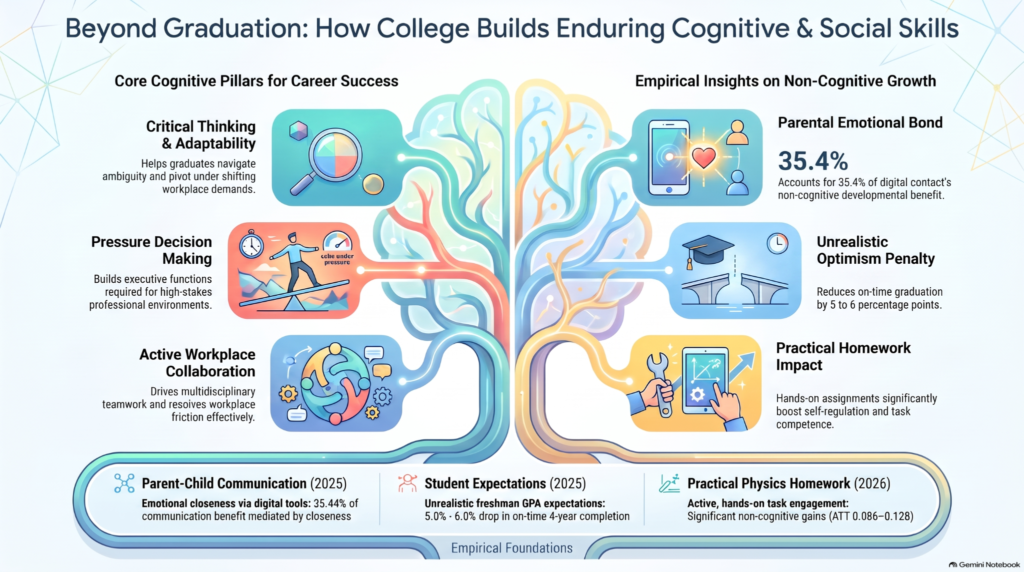
- Parent-child closeness accounted for 35.44% of the total effect of online communication on college students’ non-cognitive skills. Over one-third of the developmental benefit of digital exchanges operates through the emotional bond.
- Moderation Analysis of Student Gender:
- In the moderated mediation model, the interaction term between online communication and gender was not statistically significant (=-0.103,p=0.091). Hypotheses 3a, 3b, 3c, and 3d were not supported at the 5% significance level.
- Exploratory Simple Slope Analysis:
- Female Students: Online parent-child communication had a strong, statistically significant positive association with non-cognitive skills ($b = 0.132, t = 3.52, p = 0.001, 95\%\text{ CI } [0.058, 0.207]$).
- Male Students: The association was weaker and statistically non-significant ($b = 0.029, t = 0.71, p = 0.481, 95\%\text{ CI } [-0.053, 0.112]$).
- While the difference between slopes fell short of formal statistical significance (p=0.091), the directional pattern indicates that female college students may experience greater socio-emotional benefits from digital contact with parents.
Theoretical and Developmental Interpretations
- Digital Tools as Remote Attachment Conduits: The study shows that digital communication media do not alienate emerging adults from family systems, but instead provide a functional remote conduit for attachment maintenance. Regular contact allows parents to provide remote encouragement, supervision, and emotional validation, supporting the student’s sense of security during the transition to university life.
- Closeness as the Primary Psychological Mechanism: The finding that parent-child closeness accounts for more than one-third of the total effect demonstrates that digital interaction influences non-cognitive development primarily when it fosters perceived warmth and mutual trust, rather than through frequency of contact alone.
- Gendered Dynamics of Remote Support: The stronger positive trend observed among female students (b=0.132) aligns with research indicating that young women are more likely to seek out and benefit from expressive, emotional co-regulation with parents. In contrast, young men often utilize digital media for transactional, logistics-oriented check-ins that provide fewer socio-emotional developmental inputs.
Practical Implications and Study Limitations
- Implications for Family Support and University Policy:
- Parents should maintain regular digital contact with college students living away from home, prioritizing open emotional dialogue, empathy, and active listening over purely administrative questions.
- When communicating with sons, parents should consciously introduce emotional check-ins to help develop emotional stability and relational skills.
- University student affairs and counseling centers should include family engagement guidance in orientation programs, helping families use digital tools to support student mental health and resilience.
- Methodological Limitations:
- The study uses cross-sectional observational data from the CFPS, which limits causal inference regarding developmental trajectories.
- Online communication was measured by self-reported interaction frequency, omitting qualitative dimensions such as call duration, communicative depth, or relational conflict.
- Parent-child closeness served as a relationship-quality proxy, which does not capture detailed attachment styles (such as secure, anxious, or avoidant classifications) assessed by instruments like the Inventory of Parent and Peer Attachment (IPPA).
- The sample reflects Chinese cultural contexts characterized by strong filial obligations, which may limit generalizability to societies with earlier expectations of complete residential and emotional independence.
| REFERENCE: Ying Xiong, The effect of online parent–child communication on college students’ non-cognitive skills: The mediating role of parent–child closeness and the role of gender, Acta Psychologica, Volume 260, 2025, 105698, ISSN 0001-6918, https://doi.org/10.1016/j.actpsy.2025.105698. (https://www.sciencedirect.com/science/article/pii/S000169182501011X) |
Unlocking college potential: The role of student expectations and non-cognitive skills in college success
Conceptual Framework and Research Rationale
- The College Completion Challenge: While the wage premium and economic returns associated with higher education remain high in the United States, six-year completion rates at four-year public institutions hover between 55% and 65%, with only about 50% graduating within four years. Over 31 million American adults have accumulated college debt without attaining a credential, making low persistence an urgent public policy issue.
- Limitations of Standard Administrative Predictors: Conventional university interventions (tutoring, remediation, generic advising) often demonstrate limited efficacy, suggesting that traditional academic indicators—such as High School GPA (HSGPA) and standardized test scores (ACT/SAT)—fail to capture the full spectrum of attributes necessary to thrive in university environments.
- Non-Cognitive Skills and the “Thrivers vs. Divers” Framework: Building upon Beattie et al. (2018), who identified students performing significantly above (“thrivers”) or below (“divers”) expectations during their freshman year, this study evaluates whether non-cognitive attributes—including the Big Five personality traits (conscientiousness, agreeableness, neuroticism, openness, extraversion), grit, growth mindset, and locus of control—explain variance in college achievement beyond cognitive baseline ability.
- Subjective Expectations and Metacognitive Misalignment: Although ambitious academic goals are thought to foster student effort, unrealistic optimism may backfire if students fail to calibrate their effort to course demands. The authors examine how freshmen construct subjective Grade Point Average (GPA) expectations, assess the degree to which these expectations diverge from realized performance, and evaluate whether misaligned expectations impede graduation.
- Core Research Objectives:
- Identify how incoming freshmen form subjective expectations of their cumulative GPA at graduation and determine whether non-cognitive traits predict these expectations.
- Track objective overperformance and underperformance relative to high school preparation both at the end of the freshman year and at final degree completion, examining academic differences across business and engineering majors.
- Evaluate the long-term impact of non-cognitive skills and misaligned (unrealistic) grade expectations on eventual (7-year) and on-time (4-year) degree completion.
Methodology and Empirical Dataset
- Sample Composition and Administrative Matching:
- Administered an online survey during the Fall 2016 semester embedded into introductory business and engineering courses at the University of Arkansas (a large public university in the U.S. South).
- Merged survey responses with institutional administrative records tracked across seven years through Spring 2023.
- Analytical Sample: 1,172 first-time, full-time undergraduate freshmen (684 business majors, 488 engineering majors).
- Survey Instrumentation and Metrics:
- Subjective Expected GPA: Freshmen reported the overall cumulative GPA they predicted they would achieve by the completion of their undergraduate degree (0.0 to 4.0 scale). Over 88% of respondents completed the survey prior to receiving early progress grade reports, minimizing exposure to mid-semester grade feedback.
- Non-Cognitive Inventories: 44-item Big Five Inventory (BFI; Cronbach’s =0.73–0.88), 8-item Short Grit Scale (Grit-S; =0.65–0.74), 6-item Growth Mindset Scale (Panorama Student Survey; =0.63–0.69), and 6-item Locus of Control Scale (SPOCQ; =0.64–0.66).
- Direct Cognitive Measures: Numeracy Ability Test (NAT; 0–8 scale) assessing mathematical reasoning and basic probability, and Cognitive Reflection Test (CRT; 0–5 scale) assessing analytical deliberation versus intuitive decision-making.
- Outcome Measures and Econometric Modeling:
- Objective Performance Benchmarks: Regressed freshman cumulative GPA (May 2017) and final cumulative GPA at graduation on HSGPA, composite ACT, student demographics (race, gender, parental education), and 26 high school geographic regional fixed effects. Standardized residuals were categorized into quartiles: Bottom Quartile (<25th percentile) = “Below Objective Academic Expectations” (Divers); Top Quartile (>75th percentile) = “Above Objective Academic Expectations” (Thrivers); Middle Quartiles (25th–75th percentiles) = “At Objective Expectations”.
- Multinomial Logit Models: Estimated relative odds ratios of performing above or below expectations relative to meeting expectations as a function of cognitive and non-cognitive traits.
- Expectation Misalignment Metrics: Unrealistic expectations were calculated as [SubjectiveExpectedGPA-ActualRealizedGPA]. Overconfidence was defined as expecting a GPA >0.25 grade points above actual performance; underconfidence was defined as expecting a GPA >0.25 points below actual performance.
- Linear Probability Models & Selection Corrections: Modeled 7-year degree completion and 4-year on-time graduation. Applied Heckman two-step selection models using in-state residency as an exclusion restriction to address potential attrition among non-graduates.
Key Empirical Findings
- Determinants of Subjective Grade Expectations:
- Freshmen entered college with ambitious grade forecasts: business students reported an average expected graduation GPA of 3.50, and engineering students reported an average of 3.59.
- High school GPA and ACT scores were strong, positive predictors of subjective expectations across both fields (p<0.01).
- Non-cognitive traits independently predicted subjective expectations:
- For business majors, conscientiousness (=0.040,p<0.01), extraversion (=0.019,p<0.10), and grit (=0.029,p<0.01) positively predicted higher subjective GPA targets.
- For engineering majors, conscientiousness (=0.029,p<0.05), grit (=0.025,p<0.05), and openness (=0.023,p<0.10) were positively associated with subjective expectations.
- Direct cognitive assessments (NAT and CRT) showed no statistically significant relationship with subjective expectations.
- Pervasive Expectation Misalignment and Overconfidence:
- Subjective grade expectations systematically exceeded actual performance. Realized cumulative GPAs at graduation averaged 3.27 for business and 3.46 for engineering, falling well short of initial forecasts.
- Overconfidence was widespread: 46% of business students and 38% of engineering students were classified as overconfident (expecting at least 0.25 GPA points higher than they earned). Underconfidence was uncommon (10% in business, 11% in engineering).
- Correlates of Misalignment:
- In business, higher conscientiousness (=-0.041,p<0.10), neuroticism (=-0.053,p<0.05), and numeracy (=-0.064,p<0.01) significantly reduced unrealistic expectations, whereas openness (=0.066,p<0.01) increased unrealistic forecasts.
- In engineering, higher cognitive reflection (=-0.077,p<0.05) and growth mindset (=-0.062,p<0.05) significantly lowered the probability of being overconfident.
- Non-Cognitive Determinants of Objective College GPA (Freshman Year vs. Graduation):
- Freshman Year (May 2017):
- For business majors, a one standard deviation increase in conscientiousness reduced the relative odds of performing below academic expectations (diving) by 23.2% (relative odds ratio [OR]=0.768,p<0.05).
- For engineering majors, conscientiousness increased the relative odds of performing above expectations (thriving) by 27.1% (OR=1.271,p<0.05), and grit increased the odds of thriving by 23.9% (OR=1.239,p<0.05). Cognitive reflection significantly protected against diving (OR=0.703,p<0.05).
- At Graduation:
- Conscientiousness maintained an enduring protective effect: reducing the relative odds of diving by 32.0% for business graduates (OR=0.680,p<0.01) and increasing the relative odds of thriving by 41.9% to 55.0% for engineering graduates (OR=1.419–1.550,p<0.05).
- Discipline-Specific Trait Sorting: Higher neuroticism (OR=1.542,p<0.01) and agreeableness (OR=1.404,p<0.05) predicted higher odds of thriving among business graduates, while growth mindset protected engineering students against diving (OR=0.695,p<0.05).
- Degree Attainment and the Penalty of Misaligned Expectations:
- Eventual 7-Year Graduation:
- Non-cognitive skills and subjective expectations did not predict overall college graduation.
- High school GPA was the primary predictor of 7-year degree completion across both majors (=0.069,p<0.01 in business; =0.170,p<0.01 in engineering). ACT scores were predictive only for business majors (=0.045,p<0.05).
- When freshman GPA was included in the model, freshman GPA became the dominant driver of eventual completion, rendering non-cognitive traits non-significant (except for extraversion, which exerted a small positive effect, 0.04,p<0.05).
- On-Time 4-Year Graduation:
- Controlling for demographics, high school preparation, and actual freshman GPA, unrealistic subjective grade expectations exerted a statistically significant negative effect on on-time graduation.
- A one standard deviation increase in unrealistic expectations reduced the probability of graduating on time by 5.1 to 5.5 percentage points in business (p<0.01) and by 5.0 to 6.0 percentage points in engineering (p<0.10).
- Unrealistic optimism distorts student effort: freshmen who overestimate their performance may fail to seek academic support or make timely course adjustments, accumulating retakes that delay degree completion.
Academic and Policy Implications
- Disentangling Achievement from Attainment: The findings demonstrate a divergence between academic performance (GPA) and academic attainment (degree completion). While non-cognitive skills—particularly conscientiousness—help students earn higher GPAs and avoid academic probation, they do not overcome structural or cognitive barriers to overall graduation beyond what past high school performance captures.
- The Cost of Metacognitive Overconfidence: Inflated student optimism acts as an unrecognized obstacle to on-time college completion. While aspirational goal-setting is motivating, uncalibrated overconfidence prevents timely academic help-seeking, leading to credit accumulation delays.
- Institutional Warning and Calibration Systems:
- University academic advising should move beyond monitoring baseline risk variables to incorporate early expectation-calibration tools.
- Providing early-semester grade diagnostics and objective performance benchmarks can help freshmen reconcile subjective expectations with actual course demands, mitigating downstream on-time completion delays.
Study Limitations and Research Boundaries
- Institutional Scope: The study was conducted at a single public flagship university in the U.S. South focusing on business and engineering cohorts. Patterns may differ in non-STEM/non-business disciplines (e.g., humanities or education) or across open-enrollment and community college contexts.
- Sample Selectivity: Baseline 7-year graduation rates in the sample were relatively high (73% in business, 76% in engineering), which may attenuate the observable impact of non-cognitive skills on degree completion compared to national samples of academically vulnerable students.
- Survey Timing and Measurement: Subjective grade expectations were recorded once during the freshman year. Future work should track longitudinal expectation updates across academic years to evaluate how students adapt their goals in response to semester-by-semester grade shocks.
| REFERENCE: Gema Zamarro, Malachi Nichols, Julie Trivitt, Rian Djita, Unlocking college potential: The role of student expectations and non-cognitive skills in college success, Economics of Education Review, Volume 109, 2025, 102718, ISSN 0272-7757, https://doi.org/10.1016/j.econedurev.2025.102718. (https://www.sciencedirect.com/science/article/pii/S0272775725000986) |
Practical physics assignments and students’ non-cognitive skills: Evidence from propensity score matching analysis
Conceptual Framework and Research Rationale
- Non-Cognitive Skills in Human Capital Formation: Non-cognitive competencies—encompassing social-emotional skills, goal persistence, emotional regulation, and collaboration—are increasingly recognized as crucial components of human capital that predict long-term academic achievement, occupational success, and psychological well-being. Consequently, educational systems are shifting from an exclusive focus on standardized cognitive test scores toward fostering holistic adolescent development.
- Practical Assignments as Active Learning Contexts: In contrast to routine, repetitive paper-and-pencil exercises, practical assignments are defined as outcome-oriented learning tasks requiring students to apply, analyze, and create using subject knowledge within authentic, hands-on, or problem-solving situations. Theoretically, these tasks activate a “task-collaboration-feedback-reflection” developmental cycle that mobilizes constructivist meaning-making and self-regulated learning.
- The Existing Research Gap: While school-based social-emotional learning (SEL) programs have documented benefits, prior evidence largely stems from formalized, standalone psychosocial interventions rather than subject-specific coursework embedded in everyday curriculum routines. Furthermore, because teachers do not randomly assign practical tasks to students, conventional observational evaluations are confounded by selection bias across student ability, socioeconomic background, and school environments.
- Core Research Objectives:
- Investigate the relationship between physics-related practical assignments and five core dimensions of lower-secondary students’ non-cognitive skills: interpersonal skills, collaboration, openness, emotional regulation, and task competence.
- Evaluate the association with scientific critical-reflective disposition as a related developmental outcome.
- Apply propensity score matching (PSM) to adjust for baseline selection bias across individual, familial, and teacher/school-level characteristics.
- Examine whether the developmental benefits of practical assignments vary across urban, township, and rural school environments.
Methodology and Analytical Architecture
- Data Source and Sampling:
- Microdata derived from the 2025 large-scale survey on physics homework implementation conducted by the Jiangsu Provincial Department of Education in eastern China.
- Employed a stratified sampling design covering 13 prefecture-level cities across 298 junior secondary schools in 31 counties.
- Analytical Sample: 7,929 Grade 8 students (53.3% male, 46.7% female) retained after removing invalid and failed attention-check responses.
- Primary Variables and Measurement:
- Treatment Variable (Practical Assignments): Based on a 5-point Likert scale tracking the frequency with which physics teachers assigned practical tasks. Dichotomously recoded to contrast broad exposure (“occasionally,” “frequently,” “very frequently”; coded as 1, representing 69.9% of the sample) against non-exposure (“never,” “rarely”; coded as 0, representing 30.1% of the sample).
- Dependent Variables: Mapped to the OECD Survey on Social and Emotional Skills (SSES) and Big Five frameworks, rated on 5-point Likert scales:
- Interpersonal Skills (mean score = 3.455; Cronbach’s =0.923).
- Collaboration (mean score = 3.806; =0.928).
- Openness (mean score = 3.729; =0.942).
- Emotional Regulation (mean score = 3.368; =0.907).
- Task Competence (mean score = 3.791; =0.878).
- Scientific Critical-Reflective Disposition (mean score = 3.597; =0.823): Capturing the self-reported tendency to evaluate evidence and judge credibility. Confirmatory factor analysis confirmed acceptable to good construct validity across all dimensions.
- Control Covariates: Student gender, physics grade rank within class, subject interest in physics, perceived homework burden, standardized family socioeconomic status (SES), teacher educational attainment, and whether the teacher majored in physics.
- Econometric and Statistical Procedures:
- Ordinary Least Squares (OLS) baseline regressions incorporating school-level fixed effects.
- Propensity Score Matching (PSM): A logit selection model estimated individual propensity scores based on student-, family-, and teacher-level covariates. Balance testing, kernel density distribution comparisons, and common support domain checks confirmed substantial post-matching covariate balance and overlap.
- Robustness Checks: Re-estimated Average Treatment Effects on the Treated (ATT) across alternative matching algorithms: k-nearest-neighbor (k=4), radius/caliper matching (0.01), kernel matching (h=0.06), and local linear regression matching.
- Regional Heterogeneity: Disaggregated matching analyses conducted separately for urban (n=3,655), township (n=3,622), and rural (n=652) subsamples.
Key Empirical Findings
- Baseline OLS Regressions:
- After adjusting for student, family, teacher, and school-level fixed effects, exposure to physics practical assignments demonstrated statistically significant positive associations across all six developmental outcomes (p<0.001):
- Interpersonal Skills (=0.094).
- Collaboration (=0.077).
- Openness (=0.085).
- Emotional Regulation (=0.074).
- Task Competence (=0.094).
- Scientific Critical-Reflective Disposition (=0.083).
- Covariate Relationships: Interest in physics was a strong positive predictor across all non-cognitive dimensions (p<0.001), while perceived homework burden exerted a strong negative effect, most notably undermining emotional regulation (=-0.162,p<0.001). Formal teacher credentials and majoring in physics showed no direct associations with students’ non-cognitive skills.
- Propensity Score Matching (ATT Estimates):
- Balancing checks confirmed that substantial baseline covariate imbalances (e.g., in physics interest, perceived burden, and family SES) were eliminated post-matching, with standardized biases dropping by more than 50% to 90% across indicators.
- Adjusting for observable selection, the Average Treatment Effect on the Treated (ATT) decreased from raw pre-matching differences (0.206 to 0.269) to smaller, robust post-matching estimates ranging from 0.086 to 0.128 scale points (p<0.001):
- Emotional Regulation: ATT=0.128 (t=6.11).
- Interpersonal Skills: ATT=0.127 (t=5.67).
- Openness: ATT=0.106 (t=5.10).
- Task Competence: ATT=0.104 (t=5.50).
- Collaboration: ATT=0.099 (t=4.93).
- Scientific Critical-Reflective Disposition: ATT=0.086 (t=4.15).
- The largest gains were observed in emotional and social domains, indicating that the collaborative problem-solving and setback-recovery inherent in practical tasks directly support emotional self-management and peer communication.
- Robustness Across Matching Algorithms:
- Post-matching ATT estimates remained consistent across nearest-neighbor, radius, kernel, and local linear regression matching methods, with coefficients consistently centering between 0.086 and 0.143 scale points. This stability indicates that the observed positive associations are not artefacts of a specific matching specification.
- Urban-Rural Regional Heterogeneity:
- Disaggregating by geographic context revealed that the developmental associations of practical assignments depend on the school setting:
- Urban Students (n=3,655): ATT estimates were positive and statistically significant across all dimensions (p<0.001), led by interpersonal skills (ATT=0.144) and task competence (ATT=0.133).
- Township Students (n=3,622): ATT estimates remained positive and statistically significant across all dimensions (p<0.01), led by emotional regulation (ATT=0.145) and interpersonal skills (ATT=0.133).
- Rural Students (n=652): Post-matching ATT estimates dropped to near-zero levels and were statistically non-significant across every dimension (e.g., interpersonal skills ATT=-0.001,t=-0.01; collaboration ATT=-0.026,t=-0.30; emotional regulation ATT=-0.070,t=-0.80; task competence ATT=0.042,t=0.51).
Theoretical and Educational Interpretations
- Subject-Specific Homework as a Developmental Vehicle: The findings show that non-cognitive skills can be cultivated through subject-matter homework design rather than relying exclusively on specialized psycho-educational interventions. Routine physics assignments that require hands-on experimentation, data analysis, and peer coordination create authentic settings for developing self-regulation, curiosity, and teamwork.
- Mechanisms of Contextual Failure in Rural Schools: The absence of significant effects in rural schools illustrates that task format alone does not guarantee developmental returns. In rural environments characterized by heavier teacher workloads, laboratory equipment shortages, compressed testing schedules, and limited instructional support, practical tasks may devolve into mechanical, unguided exercises. Without sustained inquiry guidance, peer dialogue, and formative feedback, the developmental cycle fails to activate.
- Digital and Pedagogical Divides: Urban and township schools frequently possess the laboratory infrastructure, teacher professional training, and digital platforms required for collaborative project documentation and process-based feedback, while rural schools face ongoing structural constraints.
Policy Implications and Study Limitations
- Differentiated Implementation Over “One-Size-Fits-All” Mandates: Educational policymakers should avoid uniform mandates requiring practical homework without providing corresponding institutional resources. Priority must be placed on supplying rural schools with basic experimental materials, reducing rural teaching burdens, and facilitating inter-school resource-sharing partnerships.
- Teacher Professional Development: Because formal teacher degree level does not directly predict student non-cognitive growth, training programs should focus on process-oriented instructional skills—specifically scaffolding group inquiry, facilitating formative peer feedback, and managing collaborative student dynamics.
- Curricular Integration: Practical homework should be integrated into thematic, cross-curricular units with process-oriented evaluation, rather than treated as superficial add-ons to traditional written homework.
- Study Limitations:
- The analysis is cross-sectional, which limits definitive causal claims regarding the long-term developmental trajectory of these skills.
- The treatment variable captures broad self-reported exposure rather than objective measures of assignment quality, duration, or implementation rigor.
- Dependent variables rely on student self-reports, which may introduce subjective reporting bias.
- While PSM controls for observed selection factors, potential unobserved confounders (e.g., innate student motivation, unmeasured parenting styles) cannot be completely ruled out.
| REFERENCE: Xia Jing, Yao Jijun, Zhou Shike, Practical physics assignments and students’ non-cognitive skills: Evidence from propensity score matching analysis, Acta Psychologica, Volume 269, 2026, 107456, ISSN 0001-6918, https://doi.org/10.1016/j.actpsy.2026.107456. (https://www.sciencedirect.com/science/article/pii/S0001691826012576) |
CONCLUSION
As you approach graduation or look back on your academic journey, it is easy to measure your success purely by external benchmarks: your final cumulative GPA, the courses you checked off your syllabus, or the job offers waiting in your inbox. While those milestones certainly matter, I always encourage students to reflect on something deeper: their cognitive resilience. When you stepped onto campus as a freshman, you likely expected clean, black-and-white answers to every question. By the time you graduate, you have learned to navigate ambiguity, weigh trade-offs, and construct thoughtful solutions in messy, real-world conditions.
Leaving the structured ecosystem of college can feel daunting, but keeping your mind sharp in the years ahead doesn’t require enrolling in another formal degree. It comes down to cultivating sustainable, curiosity-driven daily habits. Whether you’re exploring new productivity and digital note-taking systems, diving into interdisciplinary reading outside your direct industry, or simply asking deeper questions before jumping to conclusions, cognitive development is an ongoing practice.
Your degree doesn’t signify the finish line of your learning; it simply marks the point where you take full ownership of your mental toolkit. Treat your mind with the same deliberate care and patience that you would any complex, high-value system, and the cognitive agility you built during your college years will continue to open doors throughout your entire career.
