
Over my fifteen years of designing adaptive curricula and working alongside neurodiverse students, I have come to realize that the traditional classroom model rarely accounts for the beautiful, complex ways diverse minds actually process information. When people ask me what personalized learning looks like in special education, my mind rarely jumps first to compliance metrics, legal filings, or district paperwork. Instead, I think of a non-speaking sixth-grader who discovered his voice through an assistive tablet interface during a robotics activity, completely transforming from a withdrawn bystander into an eager, focused designer.
Too often in conventional schooling, we treat curriculum as a rigid mold that children must fit into, penalizing those whose processing speeds, sensory sensitivities, or communication profiles deviate from an artificial “average.” That mindset fundamentally misses the mark. Research-driven personalized learning is not about lowering expectations or running five separate classrooms at the same time; it is about building intentional, flexible scaffolding from the very start.
When we ground our instructional design in empirical strategies, we stop asking students to constantly conform to an inflexible system. We begin creating an educational architecture that meets them exactly where they are, honoring their cognitive differences and empowering them to build genuine academic competence and self-efficacy.
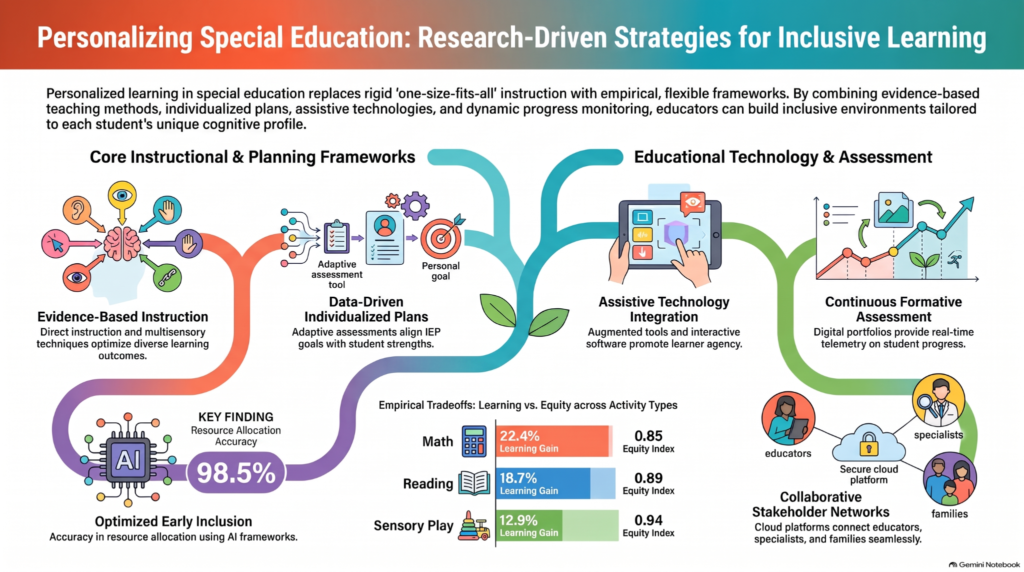
Research-driven approaches to personalized learning in special education curriculum development emphasize tailored strategies that address the unique needs of diverse learners. Utilizing differentiated instruction, educators foster meaningful relationships and enhance student engagement. Evidence-based methods, such as Direct Instruction and Cooperative Learning, improve learning outcomes. Technology plays a vital role, enabling ongoing communication and adaptive assessments. By focusing on individual strengths and challenges, educators can create more effective curriculum pathways. Further insights reveal additional transformative practices.
KEY TAKEAWAYS
- Personalized learning in special education emphasizes individualized strategies to meet unique student needs, moving beyond traditional one-size-fits-all approaches.
- Evidence-based teaching methods, such as Direct Instruction and Cooperative Learning, enhance engagement and improve learning outcomes for students with diverse needs.
- Individualized Learning Plans (ILPs) and innovative IEPs utilize data-driven assessments to tailor educational strategies, ensuring they align with each student’s strengths and challenges.
- Technology, including assistive tools and interactive software, supports personalized learning by adapting to individual learning paces and providing real-time feedback.
- Continuous formative assessments and regular feedback mechanisms foster student ownership of their learning journey, promoting sustained engagement and progress.
WHY PERSONALIZED LEARNING MATTERS IN SPECIAL EDUCATION
Although traditional educational models often adopt a one-size-fits-all approach, personalized learning emerges as an important component in special education, addressing the unique needs of each student. This approach emphasizes inclusive practices that tailor educational experiences to individual strengths, challenges, and interests.
Research indicates that personalized learning not only enhances student engagement but also fosters a sense of belonging and empowerment among learners with diverse needs. By leveraging differentiated instruction, educators can create customized learning pathways that encourage active participation and promote academic success.
In addition, personalized learning facilitates the development of meaningful relationships between educators and students, which are essential for effective support. As a result, implementing personalized learning strategies within special education not only meets legal requirements but also prioritizes the holistic development of each student, ensuring that they are equipped to thrive both academically and socially in inclusive environments.
Research-Backed Strategies for Effective Special Education Curriculum Development
Developmental milestones track a child’s growth across various domains, helping identify typical development and potential delays. These milestones encompass social/emotional, gross motor, fine motor, language, and cognitive skills, serving as crucial indicators of a child’s progress. For learners with special education needs (LSENs), developmental milestones are essential in guiding educators and caregivers to design interventions tailored to their unique requirements. The increasing global prevalence of special education needs highlights the importance of effective strategies to foster development in this population. According to the World Health Organization (2021), approximately 15% of the global population lives with some form of disability, with many facing developmental challenges.
Research indicates that the implementation of evidence-based teaching methods considerably enhances the learning outcomes for students in special education.
Individualized learning plans, tailored to meet the unique needs of each student, serve as a critical component in this process.
These strategies collectively foster a more effective and inclusive educational environment, addressing the diverse challenges faced by learners with disabilities.
Evidence-Based Teaching Methods
When developing a special education curriculum, it is essential to incorporate evidence-based teaching methods that have been systematically validated through rigorous research.
Evidence-based practices enhance instructional strategies, ensuring they are effective and responsive to diverse learning needs.
The following methods exemplify such strategies:
- Direct Instruction: Structured lessons that promote active engagement and immediate feedback.
- Cooperative Learning: Group activities that foster collaboration and peer support, enhancing social skills.
- Multisensory Approaches: Techniques that involve visual, auditory, and kinesthetic modalities to cater to varied learning preferences.
- Positive Behavioral Interventions and Supports (PBIS): Frameworks that promote positive behavior while addressing challenging behaviors systematically.
Educators can also explore the engineering teacher shop for practical teaching materials and classroom resources that support hands-on activities, reinforce instructional strategies, and create more engaging learning experiences for students with diverse needs.
Individualized Learning Plans
A thorough approach to special education curriculum development necessitates the implementation of Individualized Learning Plans (ILPs), which are tailored to meet the unique needs of each student.
Research indicates that effective ILPs incorporate personalized assessments to identify specific learning challenges and strengths. Early intervention through early childhood special education can help identify developmental and learning needs early, allowing educators to provide appropriate support and create individualized strategies that promote student growth. This data-driven foundation allows educators to create adaptive resources that cater to varied learning styles and abilities, enhancing student engagement and outcomes.
By systematically monitoring progress and adjusting strategies accordingly, ILPs guarantee that instruction remains relevant and effective. In addition, collaboration among educators, families, and specialists fosters a holistic understanding of each student’s needs.
Ultimately, ILPs serve as a cornerstone of personalized learning, promoting inclusivity and facilitating meaningful educational experiences for students with diverse needs.
How to Innovate Individualized Education Plans (IEPs) for Diverse Learners
Curriculum is a scope and sequence of instruction. Boy that sounds academic. Curriculum is essentially what tells you what to teach and when to teach it. It’s a set of skills, sometimes based on developmental norms, sometimes linked to state standards or core standards, and sometimes not. Sometimes it includes the materials and strategies to teach the skill (think Edmark or PCI Reading) and sometimes it doesn’t (think the core standards or your state’s general education standards). General educators usually don’t have to think a whole lot about what curriculum they are going to use because they are required to teach the state standards and the school system usually adopts the textbooks and materials to be used. While special educators are expected to teach the general education standards, often those standards are not sufficient for our students. Many of our students have needs outside the regular curriculum. Whether it’s higher functioning students who need social skills instruction or more complex learners who need functional skills, neither of those areas are covered in most state curricula.
Innovating Individualized Education Plans (IEPs) for diverse learners necessitates the establishment of tailored learning objectives that align with each student’s unique needs and strengths.
Research indicates that collaborative goal setting among educators, families, and learners enhances engagement and accountability in the IEP process.
Tailored Learning Objectives
Tailored learning objectives play a pivotal role in the development of effective Individualized Education Plans (IEPs) for diverse learners, ensuring that educational strategies align with each student’s unique needs and abilities.
To create impactful IEPs, educators should consider the following systematic approaches:
- Utilize adaptive assessments** to identify specific learning gaps and strengths.
- Develop personalized feedback mechanisms that facilitate continuous improvement and engagement.
- Set measurable goals** that reflect individual progress and adapt as needed.
- Incorporate diverse instructional strategies** to address various learning styles and preferences.
COLLABORATIVE GOAL SETTING
In my research and field work across inclusive engineering and STEM programs, I constantly encounter educators who feel caught in a tug-of-war between high-level standards and individual IEP accommodations. Many candidly admit that “differentiation” often feels like an impossible balancing act without the right tools and co-planning time. That frustration is completely valid. Effective curriculum personalization cannot rest on individual teacher burnout or improvised, last-minute worksheets; it requires deliberate, research-backed instructional tools and technology that do the heavy lifting of continuous adaptation.
I remember watching an eighth-grader with severe dyscalculia and attention differences struggle through abstract calculations until we introduced adaptive visual simulation software paired with physical, tactile building blocks. The visual feedback loops gave him immediate data without the crushing weight of pencil-and-paper friction, while the tactile models anchored his conceptual reasoning. That breakthrough moment was not accidental. It happened because the curriculum allowed him multiple access points to demonstrate mastery.
Assistive devices, augmentative communication tools, and data-driven learning platforms are not mere technological gimmicks; they are essential cognitive bridges. When we integrate technology thoughtfully rather than treat it as an afterthought, we remove arbitrary barriers and give students direct agency over their own discovery process.
Effective collaboration among educators, parents, and students is key to enhancing the development of Individualized Education Plans (IEPs) that meet the diverse needs of learners.
Collaborative goal setting allows for goal alignment, ensuring that objectives reflect the unique strengths and challenges of each student. By engaging all stakeholders in the IEP process, educators can foster student engagement, which is critical for motivation and achievement.
Research indicates that when students actively participate in setting their own goals, they are more likely to take ownership of their learning. This inclusive approach not only enhances the relevance of educational goals but also cultivates a supportive network that encourages continuous feedback, ultimately leading to improved educational outcomes for diverse learners.
Using Technology to Boost Learning Experiences in Special Education
As technology becomes increasingly integrated into educational environments, its application in special education presents considerable opportunities to enhance learning experiences. The utilization of assistive technology and digital resources can facilitate personalized learning tailored to individual needs.
Key strategies include:
- Augmented Communication Tools: Devices and applications that support non-verbal students in expressing thoughts and needs.
- Interactive Learning Software: Programs that adapt to students’ learning paces, providing customized feedback and engagement.
- Visual Aids and Multimedia: Resources that cater to diverse learning styles, enriching content comprehension through visual representation.
- Data Tracking Systems: Tools that monitor student progress, enabling educators to modify instructional strategies based on real-time analytics.
Implementing these technological innovations not only improves accessibility but also empowers students by fostering independence and engagement in their learning journey.
The systematic integration of these resources can considerably transform educational outcomes in special education settings.
How Technology Enhances Collaboration in Curriculum Development
Special education is instruction and programming specifically designed for students who have special learning needs and require additional support, accommodations, or modifications that they would not receive as part of the general education curriculum. Around 13% of all public school students in the U.S. receive special educational services. Every student who has been identified as eligible to receive special education services receives an Individualized Education Plan (IEP), which is a legally binding document containing the special accommodations and services the school will provide that child to best enhance their individual education. The IEP also contains a statement of measurable annual education and functional goals.
While the landscape of curriculum development in special education is continually evolving, technology plays an essential role in enhancing collaboration among educators, specialists, and families.
Digital platforms facilitate remote collaboration, allowing diverse stakeholders to engage in real-time discussions regardless of geographical barriers. Interactive tools enable participants to brainstorm and create innovative curriculum strategies together, fostering a more inclusive approach to education.
Virtual meetings provide an efficient forum for sharing ideas and resources, while cloud resources offer a centralized location for accessing essential documents. Shared documents enable multiple users to contribute simultaneously, streamlining the development process.
Communication apps enhance ongoing dialogue, ensuring that all voices are heard and valued. Additionally, these technologies create effective feedback loops, allowing for continuous improvement and adaptation of curriculum designs based on collective insights.
Ultimately, technology empowers all involved to develop personalized learning experiences that better meet the unique needs of students in special education.
How to Assess Student Progress in Special Education?
The integration of technology in special education curriculum development not only enhances collaboration but also provides innovative ways to assess student progress. Effective assessment strategies are critical for individualized instruction, particularly through formative assessments and progress monitoring. These methods allow educators to gather ongoing data to inform teaching practices.
Key approaches include:
- Digital Portfolios: Students can showcase their work and progress over time, allowing for reflective feedback.
- Adaptive Learning Software: Programs that adjust to student performance provide tailored assessments and immediate data.
- Observation Checklists: Systematic observations can track specific skills and behaviors in real-time.
- Regular Feedback Sessions: Engaging students in self-assessment fosters ownership of their learning journey.
Creating an Inclusive Classroom for All Learners
Creating an inclusive classroom environment necessitates a systematic approach that recognizes the diverse needs of all learners. Implementing effective inclusive strategies is essential for fostering a sense of belonging and engagement among students with varying abilities.
Research indicates that tailored classroom adaptations, such as differentiated instruction and flexible grouping, markedly enhance learning experiences for all students. Recognizing special education needs also helps teachers select appropriate classroom accommodations, adapt learning activities, and provide targeted support that allows every student to participate meaningfully in classroom activities.
Incorporating assistive technologies can further support individual learning requirements, allowing students to access the curriculum in ways that best suit them.
Additionally, promoting peer collaboration encourages empathy and understanding, thereby reinforcing an inclusive culture.
Training educators in culturally responsive teaching practices is also critical, as it equips them to address diverse backgrounds and learning styles.

RELATED STUDIES ABOUT SPECIAL EDUCATION CURRICULUM DEVELOPMENT STUDIES
While some may argue that personalized learning poses challenges in implementation, the evidence overwhelmingly supports its efficacy in enhancing educational outcomes for students with special needs. By embracing research-driven strategies and leveraging technology, educators can develop tailored curricula that address diverse learning styles and needs. This systematic approach not only fosters an inclusive classroom environment but also empowers students to thrive academically and socially, ultimately transforming the landscape of special education for the better.
Historical development of curriculum research in gifted education (1976–2025): A bibliometric analysis
Research Rationale and Conceptual Framework
- Curriculum Differentiation in Gifted Education: Gifted learners demonstrate advanced cognitive capacity and high-level potential that require differentiated educational programming beyond standard grade-level curricula. Conceptual models evolved from traditional psychometric intelligence scores to multidimensional frameworks: Renzulli’s three-ring conception (above-average ability, creativity, and task commitment), Sternberg’s triarchic theory (analytical, creative, and practical intelligence), and Gardner’s multiple intelligences.
- Core Curriculum Models: Instructional adaptation operationalizes differentiation across four dimensions—content, process, product, and learning environment (Maker). Over the past half-century, foundational curriculum models emerged:
- Renzulli’s Enrichment Triad and Schoolwide Enrichment Model (SEM): Centering exploratory experiences, thinking-skill training, and real-world investigations.
- VanTassel-Baska’s Integrated Curriculum Model (ICM): Combining advanced content knowledge, higher-order process skills, and overarching interdisciplinary concepts.
- Callahan et al.’s CLEAR Model: Integrating challenge, engagement, achievement, and authentic results through continuous formative assessment.
- The Literature Gap: While previous bibliometric reviews evaluated general gifted education or overarching interdisciplinary trends, none systematically mapped the specialized subfield of curriculum research in gifted education across its developmental history.
- Core Research Objectives:
- Map the historical trajectory, annual publication outputs, and key turning points of gifted curriculum research from 1976 through 2025.
- Identify leading academic journals, most influential authors, key institutional contributors, and geographic distributions.
- Examine conceptual structures, keyword co-occurrence clusters, and persistent thematic gaps in the international literature.
Methodology and Bibliometric Design
- Data Source and Search Architecture:
- Microdata were harvested from the Web of Science (WoS) Core Collection, spanning publications between 1976 (marking Renzulli’s seminal publication on curriculum models) and 2025.
- Search Syntax: Topic search query combining “gifted” and “curriculum”, initially returning 574 records.
- Inclusion Criteria: Limited exclusively to peer-reviewed journal articles within the WoS subject category Education & Educational Research, resulting in a final curated sample of 461 research articles.
- Analytical Software and Bibliometric Mapping:
- Utilized VOSviewer to conduct descriptive bibliometric profiling and structural network visualizations.
- Network analyses incorporated:
- Citation and Co-Citation Analysis: Measuring direct citation volume and citation impact.
- Total Link Strength (TLS): Quantifying the centrality, connectivity, and structural weight of articles, authors, journals, institutions, and countries within the scientific interaction network.
- Bibliographic Coupling: Identifying national and institutional collaboration networks.
- Keyword and Abstract Co-Occurrence Analysis: Mapping conceptual term clusters and semantic frequency (using full counting and threshold cutoffs).
Key Empirical Findings
- Historical Trajectory and Annual Publication Growth:
- Early Germinal Phase (1976–1990): Output was minimal, producing only 0 to 3 articles annually.
- Initial Expansion (1991–2003): Publication numbers fluctuated irregularly, averaging fewer than 8 papers per year.
- Acceleration Phase (Mid-2000s): Output reached double digits annually by 2005 (15 articles) and 2010 (16 articles).
- Sustained Productivity Peak (2010–2025): Publication volume expanded substantially after 2010, remaining consistently above 20 articles annually. The highest outputs occurred in 2016 (28 articles) and 2024 (29 articles).
- Highly Cited and Structurally Central Works:
- VanTassel-Baska & Brown (2007): Held the highest direct citation count (81 citations) with a Total Link Strength (TLS) of 65, serving as the foundational reference evaluating 11 curriculum models.
- Hockett (2009): Exhibited the strongest structural network influence (TLS = 82) despite receiving 21 citations, demonstrating extensive cross-study connectivity.
- Additional Influential Nodes: Brown (2014; 2 citations, TLS = 56), VanTassel-Baska (2015; 8 citations, TLS = 52), and VanTassel-Baska (2008; 3 citations, TLS = 35).
- Journal Dissemination Channels:
- Gifted Child Quarterly emerged as the core intellectual flagship of the field, capturing the highest publication volume and citation impact (12 articles, 257 citations, TLS = 135).
- Journal for the Education of the Gifted maintained high scholarly connectivity (3 articles, 43 citations, TLS = 92).
- Other prominent outlets included Gifted Education: Current Perspectives and Issues (1 article, TLS = 55), Revista de Educación (1 article, 8 citations, TLS = 52), and Roeper Review (1 article, 31 citations, TLS = 29).
- Leading Authors and Institutional Networks:
- Author Influence: Joyce VanTassel-Baska was the dominant scholar across the entire 50-year dataset (6 publications, 184 citations, TLS = 654), followed by Elissa F. Brown (2 publications, 83 citations, TLS = 371). Collaborating authors Avery, Little, and Zuo each registered 54 citations and TLS = 285.
- Institutional Diversity: The network featured academic hubs (College of William & Mary, University of Virginia, Indiana University of Pennsylvania) alongside practice-oriented psychological and school organizations (Association of School Psychologists of Pennsylvania, Derry Township School District; each with 5 citations, TLS = 280), demonstrating that curriculum research bridges clinical practice and academic research.
- Geographic Concentration:
- U.S. Hegemony: The United States overwhelmingly led global output and impact (23 articles, 406 citations, TLS = 89).
- International Visibility: Smaller but notable contributions emerged from Canada (2 articles, 57 citations, TLS = 34), Israel (3 articles, 15 citations, TLS = 27), Finland (1 article, 10 citations, TLS = 23), and Türkiye (2 articles, 8 citations, TLS = 16).
- Global Underrepresentation: Low- and lower-middle-income countries and Global South systems were almost entirely absent from the WoS core curriculum network.
- Conceptual Terminology and Thematic Clustering:
- Author Keywords: The conceptual core centered on “Curriculum” (frequency = 7, TLS = 36), “Gifted” (frequency = 5, TLS = 32), “Differentiation” (frequency = 4, TLS = 22), “Gifted students” (frequency = 4, TLS = 19), and “Gifted learners” (frequency = 3, TLS = 16).
- Abstract Terms: Dominant concepts clustered around “Curriculum” (frequency = 29, TLS = 1.63), “Study” (frequency = 22, TLS = 0.86), “Student” (frequency = 20, TLS = 1.39), “Gifted student” (frequency = 20, TLS = 0.58), and “Need” (frequency = 15, TLS = 0.78).
- Semantic linkages confirmed that the field primarily focuses on student-centered needs and academic differentiation.
Theoretical Interpretations and Critical Gaps in the Field
- The Hegemony of Western Acceleration and Enrichment Paradigms: The field has been largely defined by U.S.-developed models (ICM, SEM, CLEAR) that assume well-funded, resource-rich school infrastructures. These models do not account for the structural challenges faced by developing countries, such as high-stakes testing pressures, severe teacher shortages, lack of funding, and absent gifted education policies.
- The “Academic-Only” Blindspot: Despite clinical literature emphasizing the social-emotional vulnerabilities, perfectionism, and overexcitabilities of gifted children, themes such as psychological well-being, resilience, social-emotional learning (SEL), and counseling are largely absent from curriculum keyword clusters.
- Neglect of Underrepresented and Intersectionally Marginalized Subgroups: The bibliometric mapping revealed a near-total absence of curriculum literature addressing:
- Twice-Exceptional (2e) Learners: Gifted students with co-occurring learning disabilities (e.g., ADHD, autism, dyslexia), whose unique needs are hindered by deficit-oriented teacher attitudes.
- Rural and Low-Income Gifted Students: Underrepresented populations where curriculum models face severe implementation fidelity hurdles due to isolation and material constraints.
- Culturally and Linguistically Diverse (CLD) Learners: Gifted learners whose cultural knowledge systems are often overlooked by standardized Western curricula.
Policy, Pedagogical, and Research Recommendations
- Recommendations for Researchers:
- Expand comparative and cross-cultural curriculum studies to examine how differentiation functions outside North American and Western European school systems.
- Conduct longitudinal, multi-year evaluations to assess the postsecondary and adult labor-market impacts of specific elementary and secondary curriculum interventions.
- Recommendations for Educational Policymakers:
- Formulate national gifted education frameworks in middle- and low-income systems that balance global best practices with local resources (e.g., low-cost cluster grouping and schoolwide enrichment rather than segregated academies).
- Mandate specialized identification protocols and targeted funding for twice-exceptional, rural, and economically disadvantaged gifted youth.
- Recommendations for Practitioners and Curriculum Designers:
- Expand beyond pure cognitive acceleration to integrate affective and resilience-building curricula into honors and gifted classrooms.
- Provide continuous in-service professional development to train general education teachers in tiered assignments, flexible grouping, and curriculum compacting.
Methodological Limitations
- Single-Database Restriction: The analysis relied exclusively on the Web of Science Core Collection within the Education & Educational Research subject category, omitting relevant scholarship indexed in Scopus, ERIC, Google Scholar, PsycINFO, or regional databases.
- Exclusion of Non-Journal Formats: By restricting eligibility to journal articles, influential books, book chapters (such as foundational monographs by Renzulli, Tomlinson, and Maker), dissertations, and governmental policy reports were excluded from the citation network.
- Bibliometric vs. Substantive Quality: Network metrics (TLS, citation frequency) capture scientific visibility, citation velocity, and academic interconnectedness rather than providing a direct assessment of classroom efficacy or pedagogical quality.
| REFERENCE: İsmail Satmaz, Historical development of curriculum research in gifted education (1976–2025): A bibliometric analysis, Social Sciences & Humanities Open, Volume 14, 2026, 103171, ISSN 2590-2911, https://doi.org/10.1016/j.ssaho.2026.103171. (https://www.sciencedirect.com/science/article/pii/S2590291126007369) |
Contradictions and coping strategies in the implementation of curriculum-based ideological and political education by Chinese EFL tertiary teachers: From the perspective of activity theory integrated with teacher agency
Conceptual Framework and Research Rationale
- Ideology in Language Education and China’s CIPE Mandate: While mainstream English Language Teaching (ELT) has historically claimed scientific and linguistic neutrality, language learning is inherently value-laden. In China, higher education has instituted a systemic national curriculum reform known as ke cheng si zheng or Curriculum-based Ideological and Political Education (CIPE). Codified under the Ministry of Education’s 2020 Guidelines, CIPE mandates that all academic disciplines integrate moral, civic, and patriotic values—fostering integrity, national cultural confidence, and social responsibility alongside core subject knowledge.
- The Distinct Pressures on Tertiary EFL Instructors: English as a Foreign Language (EFL) teachers occupy a delicate intersection. They must cultivate linguistic proficiency and global cross-cultural communication skills while simultaneously reinforcing students’ identification with domestic Chinese culture and socialist core values. This dual mandate generates complex professional tensions, yet empirical investigations of the holistic, multi-level contradictions educators face remain sparse.
- Theoretical Integration: Activity Theory and Teacher Agency:
- Second-Generation Activity Theory (Engeström): Conceptualizes human activity through a systemic triangle of seven interconnected elements: Subject (EFL teachers), Mediating Tools (textbooks, pedagogical strategies, assessment instruments), Object (fostering virtue and language competence), Outcome, Rules (administrative checklists, Ministry guidelines), Community (colleagues, supervisors, students), and Division of Labor (teaching assignments, CIPE responsibilities). It categorizes structural tensions into four developmental contradiction levels: primary (intra-elemental), secondary (inter-elemental), tertiary (competing objects/motives), and quaternary (central activity vs. adjacent institutional systems).
- Ecological Model of Teacher Agency (Priestley et al.): Evaluates agency as an emergent, situated achievement operating across three temporal dimensions: the iterational (past life and professional history), the practical-evaluative (present on-the-spot judgments in real-world conditions), and the projective (future-oriented short- and long-term aspirations).
- Core Research Objectives:
- Map how structural contradictions manifest across the four levels of the CIPE activity system among tertiary EFL instructors.
- Examine the coping mechanisms teachers deploy and how different temporal dimensions of teacher agency are enacted in response to these contradictions.
Methodology and Qualitative Research Design
- Research Design and Participant Cohort:
- A qualitative exploratory design conducted across four Chinese provinces and municipalities representing diverse developmental tiers: Guangdong, Shandong, Chongqing, and Hunan.
- Sample Composition: Seven in-service tertiary EFL teachers (6 female, 1 male; teaching experience ranging from 3 to 24 years; 2 holding doctoral degrees/candidates, 5 holding master’s degrees) purposively recruited across various institution types (provincial industrial universities, normal universities, municipal universities, comprehensive universities, and vocational colleges).
- Instructors taught both English majors (n=3) and non-English majors (n=4).
- Data Collection Protocols:
- In-depth, semi-structured interviews conducted online via Tencent Meeting (lasting 30 to 80 minutes each in Mandarin Chinese), supplemented by second-round clarifications via WeChat.
- Collected and analyzed approximately 80,000 Chinese words of verbatim transcription.
- Data Triangulation: Corroborated interview accounts with instructional lesson plans, CIPE teaching contest award portfolios, institutional university evaluation directives, and national Ministry of Education policy decrees.
- Data Analysis and Trustworthiness:
- Performed thematic and activity-theoretical coding in NVivo 12 across iterative cycles, establishing 8 main themes and 39 sub-themes.
- Inter-coder reliability was confirmed through independent dual coding, yielding 85.71% agreement and a Cohen’s kappa of 0.82.
Key Empirical Findings: Four Levels of Activity Contradictions
The analysis revealed structural contradictions across all four levels of Engeström’s activity system, with secondary contradictions emerging as the most acute:
- Primary Contradiction (Intra-Subject Knowledge Deficit):
- The Conflict Within the Subject: Resides intrinsically within teachers themselves, manifested as an intra-subject knowledge gap between the extensive sociocultural, historical, and policy literacy demanded by CIPE and teachers’ actual background in traditional English linguistics and Western literature. Teachers reported feeling ill-equipped regarding national policies, Chinese history, and philosophical classics.
- Secondary Contradictions (Inter-Elemental Tensions):
- Subject vs. Mediating Tools (Inadequacy of Learning Materials): Existing college English textbooks were frequently outdated or lacked explicit CIPE elements, forcing teachers to independently generate supplementary resources. Crucially, the study uncovered an unaddressed structural shortage: the absence of CIPE resource repositories tailored to students’ specific academic disciplines (e.g., engineering vs. arts) and generational profiles (post-2000s digital natives).
- Subject vs. Mediating Tools (Absence of Value Evaluation Instruments): A fundamental contradiction between the long-term, internal nature of moral/ideological development and the institutional demand for immediate, quantifiable course assessment. Teachers characterized value acquisition as virtually unmeasurable via standard testing rubrics.
- Subject vs. Mediating Tools (Deficiency of Integrative Pedagogical Strategies): A severe shortage of “cognitive tools”—instructional methodologies for embedding ideological values organically rather than through clumsy, mechanical lecturing.
- Rules vs. Division of Labor (Rigid Administrative Surveillance): Universities’ Academic Affairs Offices (AAOs) enforce mandatory classroom inspections using rigid, one-size-fits-all scoring checklists that demand explicit CIPE coverage in every single lesson. This conflicts with the organic, emergent nature of moral education, creating severe anxiety and driving superficial compliance.
- Tertiary Contradiction (Competing Curriculum Objectives):
- Old Object vs. New Object: The clash between the conventional, instrumental object of EFL teaching (linguistic skills, exam prep, pragmatic communication) and the advanced, culturally transformative object of CIPE (“fostering virtue through education”). Early on, instructors viewed ideological education as the exclusive domain of political science departments and perceived language students as resistant to moralizing content.
- Quaternary Contradiction (Central Activity vs. Neighboring Systems):
- CIPE Teaching Investment vs. Institutional Promotion/Evaluation Metrics: Developing innovative CIPE modules requires immense time and labor. However, neighboring university promotion committees and tenure reviews continue to prioritize traditional academic research outputs (e.g., high-impact journal articles, external grants) and competitive awards, offering minimal institutional recognition for classroom-level CIPE dedication. Furthermore, CIPE-related research grant competitions have become oversaturated, creating professional frustration.
Manifestation of Teacher Agency and Coping Strategies
Teachers mobilized distinct agentic responses across Priestley et al.’s temporal dimensions, with the practical-evaluative dimension proving most prominent:
- Practical-Evaluative Agency (Situated Problem-Solving):
- Remediating Deficits: Engaged in on-the-spot self-directed learning, observing demonstration classes, and reading traditional Chinese classics to address knowledge gaps.
- Formative Assessment Workarounds: Bypassed summative testing barriers by adopting qualitative, formative evaluation—analyzing student essay themes, correcting ideological deviations in classroom debates, and reviewing personal learning journals.
- Informal Peer Exchange: Solved methodological shortages through informal lunchroom exchanges, sharing pedagogical materials, and consulting teaching contest recordings.
- Performative Compliance: Navigated rigid AAO inspections by rescheduling CIPE content specifically for the days when mentors visited, ensuring explicit compliance with observation forms.
- Iterative Agency (Past Experience and Routine):
- Grounded CIPE in personal moral modeling and established instructional habits, arguing that exemplary teacher conduct is itself an organic manifestation of CIPE that does not require exhaustive political mastery.
- Repeatedly analyzed familiar language texts to identify organic, natural thematic openings.
- Projective Agency (Future-Oriented Aspirations and Systemic Advocacy):
- Reoriented professional identities toward long-term virtue cultivation, using culturally responsive pedagogical redesign (e.g., transforming a viral social media trend like the “Falling Stars Challenge” into a classroom dialogue on true social wealth).
- Advanced faculty submitted institutional reform proposals advocating that university promotion boards officially credit CIPE instructional labor.
- Within-Teacher and Cross-Teacher Variations:
- Divergent Strategies Under Identical Pressures: In response to methodological deficits, one teacher attended institutional workshops (practical-evaluative), another collaborated informally with peers (practical-evaluative), a third reread materials iteratively (iterative), and a fourth planned to study video archives (projective).
- Intra-Individual Inconsistency: The same educator could display proactive, innovative agency in classroom lesson planning while simultaneously exhibiting passive, performative compliance during administrative inspections or complete disengagement from promotion pursuits.
Theoretical, Pedagogical, and Systemic Interpretations
- The Predominance of Accommodative vs. Transformative Agency: While instructors displayed high resilience and proactive agency, their strategies remained accommodative rather than transformative. Teachers adjusted their personal workflows to survive within institutional constraints, but the underlying structural contradictions—outdated textbooks, rigid inspection regimes, lack of assessment rubrics, and misaligned promotion systems—remained intact.
- The “Bittersweet” Identity Reconstruction: Moving beyond mechanical compliance requires an emotional and cognitive transformation, where teachers expand their professional self-concept from a narrow “language instructor” to an integrated “educator who cultivates moral character”.
- Limits of Individualized Responsibility: Current CIPE policy implementation places the burden of curricular adaptation almost entirely onto individual frontline teachers. Relying solely on teacher self-study and ad-hoc adaptation is unsustainable over the long term.
Policy Recommendations and Systemic Implementation Roadmap
- Recommendations for Higher Education Administrators and AAOs:
- Abolish Rigid, Checkbox-Driven Surveillance: Replace unannounced, single-lesson inspection checklists with holistic, semester-long curriculum audits that evaluate organic value integration over time rather than demanding explicit moralization in every lecture.
- Realign Academic Promotion and Evaluation Schemes: Incorporate CIPE curriculum redesign, courseware development, and innovative teaching outcomes into formal academic title and tenure evaluation criteria on par with research publications.
- Recommendations for Teacher Educators and Professional Development:
- Targeted Methodological Training: Transition professional development programs from broad ideological lectures to actionable, discipline-specific pedagogical workshops focusing on the how—demonstrating concrete techniques for organic value infusion.
- Address Affective and Emotional Buy-In: Foster positive emotional attitudes toward CIPE goals within teacher preparation, helping educators reconstruct their professional identities constructively.
- Recommendations for Publishing Houses and Disciplinary Committees:
- Develop Disciplinary- and Cohort-Specific Resource Repositories: Create modular, flexible digital resource repositories tailored to varied student majors (e.g., business, engineering, humanities) and the cognitive preferences of younger student generations.
Study Limitations and Future Directions
- Sample Boundaries: The study drew on a qualitative cohort of seven tertiary EFL teachers; while geographically diverse across four regions, the findings cannot be generalized across all higher education contexts in China.
- Single-Stakeholder Perspective: Relied exclusively on teacher self-reports without incorporating observations or the perspectives of students, university administrators, or curriculum inspectors.
- Future Research: Longitudinal, mixed-methods studies with larger, multi-institutional samples are needed to track how teacher agency evolves across multi-year CIPE implementation, evaluate students’ actual reception of integrated value instruction, and measure the impact of reformed institutional evaluation systems.
| REFERENCE: Yinxia Guan, Jianmei Xie, Contradictions and coping strategies in the implementation of curriculum-based ideological and political education by Chinese EFL tertiary teachers: From the perspective of activity theory integrated with teacher agency, Acta Psychologica, Volume 270, 2026, 107781, ISSN 0001-6918, https://doi.org/10.1016/j.actpsy.2026.107781. (https://www.sciencedirect.com/science/article/pii/S0001691826015829) |
Dynamic allocation and curriculum optimization strategies for inclusive preschool education resources driven by reinforcement learning
Conceptual Framework and Research Rationale
- The Challenge of Inclusion in Early Childhood Education: Inclusive preschool education is essential for establishing equitable cognitive, social, and emotional foundations during early developmental stages. However, children enter classrooms with heterogeneous developmental baselines, varying attention spans, differing cultural/socioeconomic backgrounds, and specialized learning needs (e.g., neurodivergence or developmental delays).
- Limitations of Conventional Resource Allocation Models: Traditional early childhood systems rely on static administrative standards, uniform curriculum pacing, and rule-based or fuzzy decision frameworks. These conventional approaches treat learner cohorts as homogeneous entities, failing to dynamically adapt instructional intensity, physical learning materials, and educator attention to real-time classroom interactions.
- The Multi-Objective Optimization Dilemma: Balancing educational equity (narrowing performance variances across diverse groups), curriculum effectiveness (maximizing learning gains), and resource efficiency (minimizing idle time or material waste) creates conflicting objectives that traditional algorithms cannot solve dynamically.
- Core Research Objective: To formulate, implement, and benchmark an intelligent, data-driven optimization framework—termed the Multi-Objective Ant Colony-driven Deep Deterministic Policy Gradient (MOAC-DDPG)—to dynamically manage resource distribution and curriculum differentiation in inclusive preschool environments.
System Architecture and Methodological Design
- The Integrated MOAC-DDPG Framework Architecture: The system establishes a complementary two-tier optimization loop that separates strategic constraint handling from real-time operational policy control:
- Multi-Objective Ant Colony (MOAC) Component: Functions as a macro-level heuristic constraint solver. Virtual “ants” construct resource distribution and curricular strategies by updating local and global pheromone trails () based on multi-objective trade-offs. It pre-allocates resources to balance three explicit objective weights: Educational Equity (0.4), Resource Efficiency (0.3), and Curriculum Effectiveness (0.3).
- Deep Deterministic Policy Gradient (DDPG) Component: Operates as an actor-critic continuous reinforcement learning policy engine that fine-tunes allocations in real time based on incoming student progress telemetry. The Actor network suggests continuous resource actions, while the Critic network minimizes Bellman error loss across an experience replay buffer (100,000 transitions; mini-batch size =64). Target networks undergo soft polyak updates (=0.001) to ensure convergence stability.
- State Space, Reward Formulation, and Data Preprocessing:
- State Inputs (ts): Captures child attributes (age in months [36–72], baseline learning level [low, medium, high], special needs status [0/1], attention span), activity parameters (type [reading, math, art, sensory play, music], difficulty level, allocated duration), and real-time interaction metrics (engagement score [0.0–1.0], resource efficiency [0.0–1.0], teacher ID).
- Multidimensional Reward Function (R): Formulated as a normalized weighted composite (R=w1Re+w2Ra+w3Rs scaled between [-1,1]):
- Equity Reward (Re): Penalizes the variance of student performance distributions across ability groups.
- Efficiency Reward (Ra): Penalizes idle, wasted, or over-allocated classroom materials and time.
- Effectiveness Reward (Rs): Rewards normalized average student learning gain per instructional step.
- Data Cleansing: Sourced from the Preschool Resource and Learning Outcomes Dataset (partitioned into 70% training and 30% testing). Categorical variables underwent one-hot encoding to prevent artificial ordinal bias, while missing engagement/duration values were imputed via feature-specific mean/median substitution.
Key Empirical Findings and Performance Benchmarks
- Algorithmic Optimization and Predictive Superiority:
- In comparative evaluations against established machine learning algorithms and baseline reinforcement learning models, the proposed MOAC-DDPG framework achieved superior performance across all evaluation metrics:
- Classification Accuracy: 98.50% (vs. CNN: 97.96%, XG-Boost-TS-ResNet: 91.22%–96.70%, DDPG baseline: 95.80%, Random Forest: 90.75%–93.40%, Decision Tree: 89.97%–90.20%, SVM: 89.90%–91.50%, and Fuzzy-Q-Learning: 92.10%).
- Area Under the ROC Curve (AUC): 95.31% (vs. XG-Boost-TS-ResNet: 93.47%–94.20%, DDPG: 93.10%, Random Forest: 91.50%–92.31%, SVM: 90.00%–90.29%, Fuzzy-Q-Learning: 90.20%).
- Precision: 93.41% (vs. XG-Boost-TS-ResNet: 91.41%–92.80%, DDPG: 92.00%, SVM: 90.10%).
- Recall / Sensitivity: 94.91% (vs. XG-Boost-TS-ResNet: 92.89%–93.50%, DDPG: 92.80%, SVM: 90.50%–91.67%).
- F1-Score: 94.13% (vs. XG-Boost-TS-ResNet: 92.76%–93.15%, DDPG: 92.40%, SVM: 90.30%–91.31%).
- Convergence Speed and Policy Stability:
- The MOAC-DDPG model converged substantially faster than baseline RL implementations, achieving a sustained maximum cumulative reward of ~400 per episode by episode 150.
- In contrast, unconstrained standard DDPG exhibited oscillating, noisy learning dynamics that peaked around a cumulative reward of ~200, while conventional static allocation remained flat and unresponsive near zero across all 250 training episodes.
- Curricular and Activity-Specific Outcomes:
- Simulated deployment across foundational early learning activities demonstrated that specific subjects optimize distinct educational dimensions:
- Math: Generated the highest Learning Outcome Improvement (LOI = 22.4%), with an Engagement Score of 0.78, Resource Utilization Efficiency (RUE) of 88.2%, and an Equity Index of 0.85.
- Reading: Produced high academic gains (LOI = 18.7%), an Engagement Score of 0.82, RUE of 91.5%, and an Equity Index of 0.89.
- Sensory Play: Achieved the highest inclusion and resource utilization marks (RUE = 95.0%, Equity Index = 0.94, Engagement Score = 0.91), while yielding an LOI of 12.9%.
- Art & Music: Maximized child participation and engagement (Art: Engagement = 0.87, Equity Index = 0.91; Music: Engagement = 0.85, Equity Index = 0.90).
- Across learner demographics, female students displayed slightly higher mean learning gains across all baseline ability tiers, while higher engagement correlated directly with superior resource utilization efficiency.
Theoretical, Technical, and Pedagogical Interpretations
- Resolving the Multi-Objective Trade-Off via Hybrid Architecture: Conventional reinforcement learning policies struggle when reward functions simultaneously attempt to maximize individual learning speed and minimize group variance. By delegating boundary constraint optimization to the ant colony mechanism (MOAC), the policy action space for DDPG is bounded to Pareto-efficient candidates, preventing erratic exploration and eliminating the performance instability seen in standard DDPG.
- Continuous Action Adaptability vs. Static Rule Sets: Unlike discrete classification trees or static fuzzy systems, DDPG’s continuous action space allows the algorithm to recommend subtle, graduated adjustments to instructional duration, sensory material complexity, and teacher intervention time.
- Activity-Specific Instructional Scaffolding: The divergence between academic tasks (math/reading driving cognitive gains) and experiential tasks (sensory play driving equity and participation) demonstrates that inclusion is not achieved through identical instruction. The system dynamically routes children with special needs or lower baseline attention spans toward sensory and play-based scaffolding to build foundational engagement before transitioning them into high-challenge cognitive tasks.
Practical Implications and Implementation Roadmap
- Development of Edge-Computing Class Assistant Tools:
- Implement lightweight, localized versions of the model on classroom tablets or edge devices, allowing preschool teachers to receive real-time, non-intrusive activity and grouping recommendations without requiring high-bandwidth cloud connectivity.
- Equitable Distribution of High-Impact Learning Materials:
- Early childhood administrators can leverage the framework’s resource efficiency metrics to eliminate material hoarding in specific classrooms and route specialized manipulatives (e.g., sensory kits, math blocks) dynamically to children exhibiting immediate readiness.
- Preserving Educator Agency and Pedagogical Oversight:
- Deploy the MOAC-DDPG framework as a decision-support system (recommender) rather than an automated decision-maker. Teachers retain final authority over instructional groupings, using algorithmic insights to identify overlooked or disengaged children who need targeted one-on-one attention.
Study Limitations and Future Directions
- Reliance on Synthetic Simulation Datasets: Model validation was conducted using an open-source Kaggle simulation dataset rather than multi-site observational field trials across physical classrooms, leaving ecological validity untested against unpredictable real-world child behaviors.
- Computational Footprint: Training the dual-network MOAC-DDPG model required ~150 minutes of compute time and 4.7 GB of peak memory on a 16 GB RAM workstation, creating resource barriers for low-income, under-resourced preschool facilities.
- Data Sparsity in Naturalistic Settings: Real-time behavioral tracking assumes reliable recording of child attention spans and facial/behavioral engagement metrics, which may be difficult for frontline teachers to capture manually without sensor-equipped infrastructure.
- Future Research: Subsequent inquiries must focus on offline model compression (knowledge distillation and lightweight edge deployment), longitudinal multi-site classroom field evaluations, and the integration of multimodal computer vision sensors to automate non-invasive engagement tracking.
| REFERENCE: Rongwang Cheng, Dynamic allocation and curriculum optimization strategies for inclusive preschool education resources driven by reinforcement learning, Systems and Soft Computing, Volume 9, 2026, 200534, ISSN 2772-9419, https://doi.org/10.1016/j.sasc.2026.200534. (https://www.sciencedirect.com/science/article/pii/S2772941926000979) |
CONCLUSION
Looking back across my career in academia and classroom advocacy, the most meaningful milestones have never been about standardized test percentiles. They are about seeing a student realize, often for the first time, that their mind is not broken—that the educational environment simply had not been built to accommodate how they learn. Moving away from the conventional “one-size-fits-all” framework can feel daunting for schools and systems accustomed to static textbooks and uniform pacing, but the evidence makes one truth undeniable: true equity in education begins with personalization.
When we commit to research-driven methods—whether through structured direct instruction, dynamic multi-tiered interventions, or collaborative IEP planning—we do far more than ensure regulatory compliance. We create a classroom culture that celebrates neurodiversity as a strength rather than a deficit. Giving a student the tools to independently solve a complex STEM challenge, navigate a sensory overload, or communicate an original idea creates ripples that extend well beyond the school walls.
It builds a foundation of self-worth and lifelong resilience. Special education curriculum development is fundamentally human-centered work, and by continually aligning our classroom practices with rigorous, compassionate research, we build learning environments where every student has the opportunity to thrive.
